WORLD

Illapa
Illapa is a major weather deity in accounts of Inca religion, especially associated with thunder, lightning, rain and hail. He was connected with the atmospheric forces that could nourish crops or destroy them, making him an important figure in the agricultural and political world of the Inca Empire. Spanish colonial writers recorded his name in several forms, including Illapa and Yllapa, and sometimes described him through Christian or classical comparisons. Because the surviving evidence was written after the Spanish invasion, details about Illapa’s character and worship must be treated with care.
Illapa in the Inca religious world
The Inca Empire, or Tawantinsuyu, incorporated many local traditions while promoting a state religion centred on powerful sacred beings and places. The sun, known as Inti or associated with the solar deity, held an especially prominent position in imperial ideology. Yet the sun was not the only force essential to life. Rain, seasonal weather, fertility, mountain waters and the regular movement of the heavens were equally important to farming communities.
Illapa belonged to this wider sacred order of natural and celestial powers. He was not simply a personification of a storm in the modern literary sense. Thunderstorms affected planting, harvests, herding, travel and warfare, and their unpredictable violence could be understood as the action of a powerful divine being. Rain was beneficial when it arrived at the right time, while hail, drought and destructive storms threatened the survival of entire communities.
Inca religion did not always separate “nature” from “religion” in the way modern categories often do. Mountains, springs, caves, fields and other places could possess sacred force, or huaca status. Illapa’s power was encountered in the sky, but it was also relevant to earthly landscapes and agricultural practice. His worship therefore formed part of a network of relationships involving rulers, priests, farmers, local sacred places and other deities.
Name and identity
The name appears in different spellings because early Spanish writers represented Quechua sounds according to Spanish orthographic habits. Illapa, Yllapa and related forms occur in discussions of Inca religion. The name has also been connected with a Quechua term for lightning or thunder, although the precise relationship between the divine name and ordinary vocabulary can vary according to dialect and interpretation.
Colonial writers did not describe Illapa in a completely consistent way. Some presented him as a distinct god of thunder. Others treated thunder, lightning and rain as related manifestations of one celestial power. In some accounts, the word can function almost as a designation for the thunder deity or for the phenomenon itself. This means that references to “Illapa” do not always provide a neatly defined biography comparable to those of a single mythological character.
Some modern summaries call Illapa the Inca god of weather, while others describe him more narrowly as the god of thunder and lightning. The broader description is useful, but it should not imply that the Incas possessed a single, uniform theology across all regions of the empire. Local Andean communities had their own sacred traditions, and imperial religious descriptions sometimes grouped related beings under a common category.
Appearance and heavenly weapons
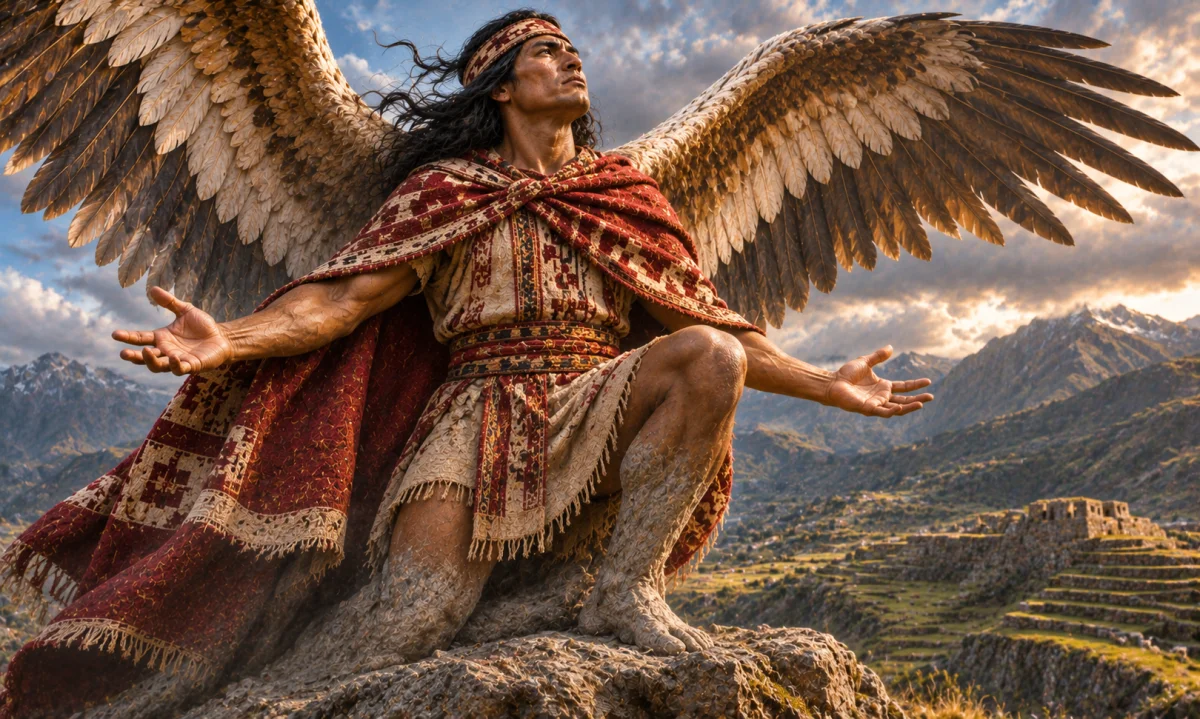
One of the best-known descriptions presents Illapa as a powerful man in the sky. He is said to carry a club or mace in one hand and a sling in the other. When he strikes or uses these weapons, their action produces thunder and lightning. This imagery reflects the importance of weapons in Andean society, where the sling was a practical hunting and military tool rather than a purely symbolic object.
In this interpretation, the flash of lightning could be associated with the movement or brightness of Illapa’s weapon, while the crash of thunder represented its impact. Some retellings also describe Illapa as carrying a vessel or jar containing rain. Accounts differ on how this vessel functions: in some versions, rain is released from it; in others, hail or storm water is connected with the deity’s activity. These details should not be treated as elements of one universally fixed myth, since they come from varying descriptions and later retellings.
Illapa’s imagined weapons also express the double nature of storms. A thunderstorm could bring life-giving rain, but lightning, hail and violent winds could cause serious harm. The club and sling convey force, speed and danger. They present weather not as an abstract process but as the action of an intentional power whose favour was valuable and whose anger was feared.
Rain, agriculture and fertility
Rain was central to agriculture in the Andes, where communities farmed across environments ranging from high plateaus to steep valleys. Water management depended on seasonal rainfall, mountain streams, irrigation channels and careful knowledge of local conditions. A delayed rainy season could threaten crops, while excessive rain or hail could destroy them.
Illapa was consequently linked with the prosperity of fields and herds. His role was not limited to making noise in the heavens. He represented the arrival of water from the upper world and the possibility of renewal in the earthly world. The connection between storm power and fertility is especially significant in an agricultural society, but it should not be reduced to a simple “rain god” label. Illapa could also embody danger, disruption and divine authority.
The Incas maintained ceremonies and offerings for many sacred powers. Colonial descriptions mention rituals directed towards thunder and related celestial forces, including offerings of food, drink, precious materials and animals. The exact form of these observances varied, and surviving accounts often reflect the interests or misunderstandings of their Christian authors. It is therefore safer to speak of a broad ritual concern with thunder, rain and agricultural well-being than to claim a single empire-wide ceremony devoted to Illapa in an identical form everywhere.
Illapa’s importance also had a political dimension. The Inca state presented the emperor as a ruler whose authority was connected with the proper ordering of the world. Agricultural abundance, successful warfare and favourable weather could all reinforce the legitimacy of imperial rule. Conversely, famine, drought or destructive storms might challenge the confidence placed in rulers and priests. A weather deity thus belonged to both religious life and the wider system of Andean power.
Thunder, lightning and sacred people
Lightning was commonly regarded as a manifestation of sacred power rather than an ordinary accident. Early colonial accounts describe people, animals or objects struck by lightning as receiving a special and dangerous distinction. In some traditions, a person hit by lightning could be treated as marked by the deity and might receive ritual attention. Details vary substantially between sources, and it is not possible to reconstruct one uniform institution from these reports.
This idea reflects an important feature of Andean religion: sacred force could be encountered directly in unusual events and places. A lightning strike made a location or person exceptional. The event could inspire fear, reverence or both. Such responses were part of a broader Andean understanding in which certain people, natural features and occurrences became charged with huaca, or sacred significance.
Illapa should not be imagined only as a distant ruler of the sky. His power was believed to break into the human world through storms, flashes, rain and the marking of particular places. The boundary between heavenly and earthly realms was therefore permeable. Mountains, clouds and atmospheric events were part of a living religious landscape rather than merely scenery surrounding human life.
Relationship with other Inca deities
Illapa existed within a hierarchy and family of sacred beings that colonial writers described in different ways. The relationship between thunder and the sun was especially important. Some accounts rank the thunder deity among the great powers honoured by the Incas, while others place him below or alongside the sun. This does not necessarily mean that one writer was simply correct and another incorrect; imperial theology could assign different importance to the same power in different contexts.
Water also connected Illapa with other sacred forces. Springs, rivers, lakes and mountain peaks were frequently associated with local sacred traditions. The storm deity’s rain might be understood as the source or renewal of earthly waters, but the evidence does not support turning every water deity or mountain spirit into an aspect of Illapa. Andean religion was diverse, and similar functions did not always imply identical identities.
The name of the Inca ruler Inca Roca is sometimes brought into discussions of thunder because colonial traditions link royal ancestry, sky powers and divine authority in complex ways. However, Illapa should not automatically be treated as a royal ancestor or as another name for every celestial figure in Inca mythology. The sources use divine titles and names inconsistently, and confident claims about a single divine family tree can go beyond the evidence.
Regional variation and related thunder beings
Thunder deities were not exclusive to the Inca imperial tradition. Across the Andes, different peoples worshipped beings connected with storms, mountain power, rain and fertility. Some figures had names and myths that resemble descriptions of Illapa, but resemblance does not prove identity.
Catequil, for example, was a prominent thunder deity associated particularly with the Huamachuco region in what is now northern Peru. Spanish reports describe Catequil as a powerful local god, but he belongs to a distinct regional tradition. It is possible that imperial or colonial observers compared different thunder beings, or that later writers grouped them together because they performed similar functions. Catequil should therefore not simply be presented as another name for Illapa.
Likewise, the thunder powers of other Andean communities may have been absorbed into broad descriptions of “Inca mythology” even when they originated in local religious systems. The Inca Empire governed a vast territory containing many languages and traditions. Imperial religion could adopt, reinterpret or place local sacred beings within a larger order, but the result was not necessarily complete religious uniformity.
Colonial sources and the problem of interpretation
Most detailed written descriptions of Illapa come from the colonial period, after Spanish conquest and the suppression or transformation of many Indigenous institutions. The writers included Spanish clergy, officials and Indigenous or mixed-heritage authors working within colonial conditions. Their accounts are valuable, but they were not neutral transcripts of pre-conquest belief.
Christian observers often interpreted Andean gods through familiar categories. A storm deity might be compared with a classical thunder god, a demon or a pagan idol. Such comparisons can obscure the original cultural setting. Other writers attempted to preserve Indigenous accounts but translated them into Spanish religious vocabulary, which could alter the meaning of names and practices.
The famous identification of the Inca thunder deity with Saint James arose in the colonial and post-conquest context. Spanish traditions associated Saint James with warfare, horses and thunderous intervention, and some Andean communities connected him with the older power of lightning and storms. This association is historically important, but it does not mean that Saint James and Illapa were originally the same figure. It represents a process of religious reinterpretation, accommodation and sometimes deliberate replacement.
For the same reason, descriptions of Illapa as an “Inca Zeus” or “Andean Jupiter” can be useful as rough comparisons for readers, but they are not Indigenous names or exact equivalents. They reflect the interpretive habits of classical and Christian observers. Illapa’s meaning must be understood through Andean agriculture, sacred geography, imperial politics and local ritual life rather than through a direct equation with a Mediterranean god.
Illapa in later cultural memory
Illapa continues to appear in writing about Andean mythology, Indigenous heritage and the history of religion in Peru and neighbouring regions. His image is often reconstructed from the familiar elements of lightning, thunder, a sling, a club and rain. These features make him visually memorable, but modern illustrations and simplified mythological summaries may combine details from several colonial accounts or from different Andean traditions.
Contemporary cultural references may also use Illapa as a symbol of Andean identity, natural power or resistance to colonial interpretations. Such uses can be meaningful expressions of modern heritage, but they should be distinguished from evidence about pre-conquest worship. A fantasy novel, game or illustration may give Illapa a fixed personality, weapon or narrative role that is not found in the historical sources.
Traditional and colonial evidence presents Illapa less as a character with one complete adventure cycle than as a powerful presence governing the dangerous and necessary processes of the sky. His significance lies in the relationship between thunder, rain, crops, sacred authority and the precarious balance on which Andean communities depended.
Symbolism of storm power
Illapa’s symbolism brings together opposing qualities. He is a provider because rain sustains crops, fills streams and supports animal life. He is also a destroyer because lightning, hail and violent storms can damage fields, kill people and disrupt settlements. This combination is not a contradiction but a central feature of weather religion: the same power that gives life can also withhold or destroy it.
The sling and club express the active force of the storm, while rain represents renewal and abundance. His heavenly position links the upper world with human fields and mountains. Through these associations, Illapa embodies dependence on forces beyond human control and the religious responsibility to maintain a proper relationship with them.
Understanding Illapa therefore requires more than identifying him as a deity of thunder. He belongs to a complex Andean world in which atmospheric events, agriculture, sacred landscapes and political authority were closely connected. The surviving accounts are incomplete and sometimes contradictory, but they consistently preserve the importance of storm power in the religious imagination of the Andes.