WORLD

Viracocha
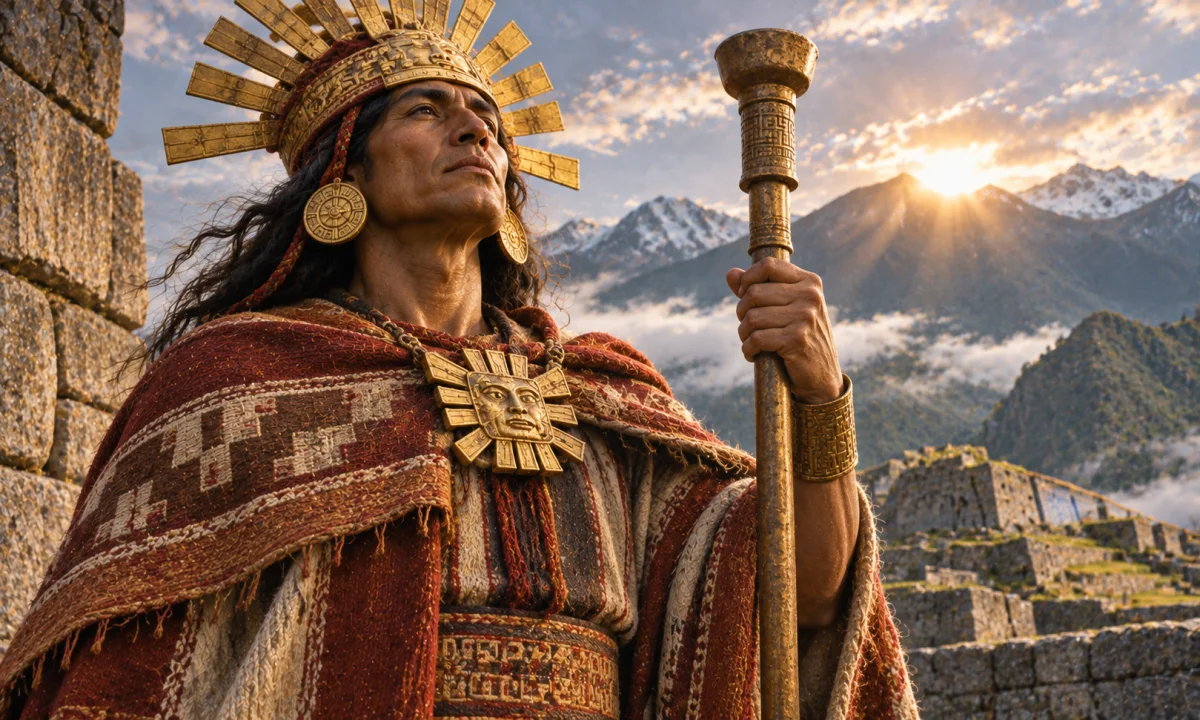
Viracocha is one of the most important creator figures associated with Inca religion and the wider religious traditions of the Andes. Usually written as Viracocha in English, his name also appears in forms such as Wiraqocha, Huiracocha and Uiracocha. In Quechua, the modern standardized spelling is often Wiraqucha, although the historical spelling used by Spanish writers varied considerably.
Viracocha is commonly described as a creator of the world, the sun, the moon, the stars and humankind. Some traditions present him as an ancient being who existed before the present cosmic order; others focus on his role as a culture-bringer who travelled through the Andes, shaping the landscape and teaching people. The surviving accounts do not form one single, consistent mythology. They preserve different oral traditions recorded by Spanish observers, Indigenous informants and later writers, often many decades after the Inca state was conquered.
Origins and cultural setting
The Inca Empire, or Tawantinsuyu, dominated much of the central Andes during the fifteenth and early sixteenth centuries. Its territory included parts of modern Peru, Bolivia, Ecuador, Chile and Argentina. Inca religion developed within a much older Andean religious environment, and many deities, sacred places and ritual practices existed before the rise of the Inca ruling dynasty.
Viracocha may have been one of these older religious figures. Some scholars interpret him as a pan-Andean creator or high deity whose worship was adopted and reorganized by the Incas. Others emphasize that the evidence is too fragmentary to reconstruct a single pre-Inca cult with certainty. The name and figure appear in traditions from different regions, but regional similarities do not necessarily prove that every community understood Viracocha in exactly the same way.
Inca religion was not a simple system with one universally defined supreme god. It included solar worship centred on Inti, reverence for ancestors, sacred mountains known as apus, veneration of springs, rocks and other powerful places, and rituals connected with fertility, weather and political authority. Viracocha could occupy a very exalted position within this religious world without replacing these other beings or forms of sacred power.
Names and identity
The form Viracocha comes largely from Spanish transcriptions of an Andean name. Modern Quechua writing commonly uses Wiraqucha, but pronunciation and spelling varied across Quechua-speaking regions and historical periods. The meaning of the name is debated. It has sometimes been explained through words associated with fat, sacred substance, sea or lake, but the exact historical etymology remains uncertain.
Spanish chroniclers occasionally translated or described Viracocha in ways that made him resemble the Christian God. They called him a creator, an eternal being or a lord above other gods, and some writers used Christian theological language to make Andean beliefs intelligible to European readers. Such descriptions are valuable evidence, but they cannot be treated as neutral records. The chroniclers were working through interpreters, relying on Indigenous informants with different local traditions, and often fitting unfamiliar ideas into European religious categories.
For that reason, calling Viracocha an “Andean supreme god” can be useful as a broad description, but it may also be misleading if it suggests a fully systematized monotheism. In different accounts he appears as a creator, an ancestor-like wanderer, a cosmic power, a teacher of humanity or a remote deity whose direct worship was less prominent than that of Inti and local sacred powers.
Viracocha as creator
Several colonial-era accounts describe Viracocha as creating the first world and its inhabitants. In one widespread pattern of the story, he fashioned people from stone or another substance and placed them in different regions. He then destroyed an earlier generation, often through a flood, before creating the present human order.
Flood traditions are especially prominent in accounts connected with the region around Lake Titicaca and the highlands. In some versions, the world was covered by darkness or water, and Viracocha emerged from or appeared near the lake. He created the sun, moon and stars, sometimes sending them upward from the island or region of Titicaca. The exact sequence differs from one account to another.
Some traditions say that Viracocha made human groups from stones, clay or other materials and assigned them their languages, customs and places of origin. These places of emergence were not merely mythic locations. They could be connected with caves, springs, mountains, rocks and other pacarinas, sacred points from which particular communities believed their ancestors had first emerged. Creation mythology therefore helped explain both the origin of humanity and the sacred geography of Andean societies.
The stories are not always concerned with creation in the abstract. They also explain why communities occupy particular territories, why different peoples have distinctive customs and how human beings became part of an ordered landscape. In this sense, Viracocha’s creative activity can include the organization of society, language and ritual as well as the making of the physical universe.
The wandering creator and culture-bringer
A second major group of stories presents Viracocha as a traveller. After creating or restoring the world, he journeys through the Andes with companions, teaching people useful practices and establishing social or religious order. He may be described as giving communities laws, ceremonies and knowledge, or as showing them how to live in the newly formed world.
These narratives often have a strong geographical dimension. Viracocha passes through places that later became important in local memory, and features of the landscape may be explained through his actions. In some accounts he causes springs to appear, names places, transforms people into stone or creates pathways across difficult terrain.
One well-known tradition describes Viracocha reaching the shore of the Pacific at the end of his journey and walking across the water. The image has sometimes encouraged comparisons with a returning prophet or a bearded European visitor, but the older accounts do not provide a single uniform version of this episode. The story belongs to a complex set of Andean traditions about creator beings, sacred travellers and the transformation of the landscape.
Some narratives name companions who travelled with Viracocha. The names and roles vary among chroniclers and regional traditions. They should not automatically be treated as a fixed pantheon or as universally recognized members of his household. The available accounts often combine several local stories, and their genealogies are not consistent.
Appearance and symbolic attributes
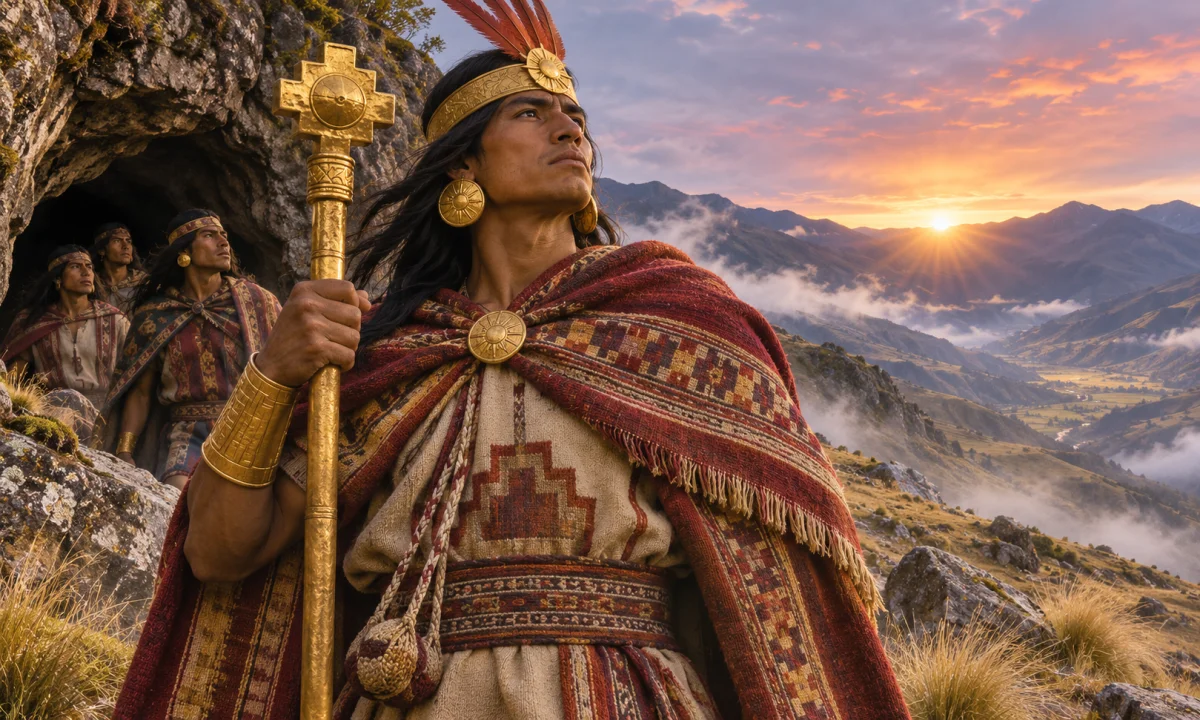
Viracocha is frequently portrayed in colonial descriptions as a humanlike male figure wearing a long robe and carrying a staff or other object. He is sometimes said to have had a beard. Later retellings commonly add a pale complexion or present him as a tall, white, bearded stranger.
The bearded and pale appearance requires caution. A beard may have been included in some early descriptions, but the complete image of a white European-looking man is not securely established as a universal pre-conquest representation. Spanish observers had strong reasons to interpret an unfamiliar deity through the appearance of European holy men, prophets or travellers. There is also no reliable basis for claiming that the Incas universally mistook the first Spaniards for Viracocha.
The staff or rod associated with Viracocha in some accounts is also interpreted in different ways. It may symbolize authority, travel, teaching or the power to shape the world. It should not automatically be confused with the distinctive staff-bearing figure represented in much earlier Andean art. Archaeological images from different periods may resemble one another without proving that they depict the same deity.
Viracocha’s most consistent symbolic feature is not a particular costume but his connection with creation and ordering. He belongs to the beginning of the present world, the arrangement of the heavens and the establishment of human communities. His movement across the landscape links cosmic creation with the practical organization of Andean life.
Relationship with other Andean deities
Viracocha’s relationship with other deities is difficult to define because the sources present different religious systems. In some accounts he creates Inti, the sun, along with the moon and stars. In others, the sun occupies a central position in Inca state religion and receives more visible ritual attention than Viracocha.
Inti was closely associated with the Inca ruler, who was described in political and ritual terms as the sun’s descendant. The major temple of the sun in Cusco, known as Coricancha, represented the importance of solar religion to the imperial state. This prominence does not necessarily conflict with Viracocha’s role as creator. A creator may stand at the beginning of the cosmic order while another deity serves as the principal focus of royal worship.
Viracocha is also sometimes compared with Pachamama, but they are not the same figure. Pachamama is associated with the earth, fertility and the productive powers of the land, especially in later and continuing Andean traditions. Viracocha is primarily associated with creation, cosmic order and the origins of humanity. The two may both be described broadly as powerful sacred beings, but their identities and ritual contexts differ.
Confusion also arises with figures such as Tunupa or Thunupa, a travelling religious figure known particularly in traditions from the southern and central Andes. Some colonial writers merged, compared or confused Viracocha with Tunupa, while later interpretations have treated them as versions of a single culture hero. The relationship is debated. They should not be assumed to be identical in every tradition.
Viracocha and the Inca ruling tradition
Viracocha was not only a cosmic creator. The Inca state used religious history to explain the legitimacy of its rulers and the special status of Cusco. Myths of emergence, migration and divine ancestry connected the ruling dynasty with sacred origins, although the details differ between accounts.
Inca rulers could be associated with Viracocha through names, titles or claims of descent without being identical to the deity. One Inca ruler, Wiraqucha Inka, is known by a name referring to Viracocha. This historical ruler and the creator deity are distinct figures. The shared name reflects the prestige of the divine figure but does not mean that the king was the god or that every story about one belongs to the other.
Royal religion also involved the management of sacred places and ritual specialists. The state could incorporate local shrines, ancestral traditions and regional deities into an imperial framework. Viracocha’s broad creative role may have helped connect different communities, but local religious practice remained diverse. The empire did not erase every local tradition or impose a single uniform mythology across the Andes.
Surviving sources and their limitations
No complete pre-conquest Inca religious scripture describing Viracocha survives. Knowledge of him comes from colonial chronicles, Indigenous traditions recorded after the Spanish invasion, dictionaries and linguistic evidence, archaeological interpretation, and continuing Andean oral and ritual traditions.
Important accounts were written by figures such as Pedro Cieza de León, Juan de Betanzos, Pedro Sarmiento de Gamboa, José de Acosta and Garcilaso de la Vega. Their works differ in date, purpose and relationship to Indigenous informants. Some sought to record Inca history; others aimed to explain non-Christian religions, defend particular historical interpretations or support colonial administration.
Garcilaso de la Vega, who had Inca and Spanish parentage, offered influential accounts of Andean religion and history, but his work also reflects the intellectual and political circumstances of colonial Peru. No single chronicler should be treated as the final authority on Viracocha. Variations between sources are evidence of a complex tradition, not simply errors that can be resolved by selecting the most familiar version.
Archaeology adds important context but rarely allows a secure identification of Viracocha. Stone figures, staff-bearing images and creator-like beings appear in Andean art from periods long before the Inca Empire. Similar visual motifs may reflect shared religious ideas, artistic conventions or historical influence rather than an unbroken representation of one named deity.
Interpretation and cultural significance
Viracocha can be understood as a figure of cosmic renewal. His myths often involve darkness, flood, destruction and the establishment of a new human world. This pattern reflects the importance of transformation in Andean ideas about time, society and the landscape, although it should not be reduced to a simple universal “flood myth.” Each tradition places the events within its own sacred geography and social history.
His stories also express the relationship between people and place. Mountains, lakes, caves, springs and stones are not passive scenery in these narratives. They are active participants in the formation of communities and the structure of the sacred world. Viracocha’s journey makes the land legible as a network of origins, transformations and obligations.
Some interpretations describe Viracocha as a distant or transcendent creator, while others emphasize his bodily movement through the Andes and his practical instruction of humans. These aspects are not necessarily contradictory. A creator can remain remote in ritual life while appearing in stories as a travelling teacher whose actions shaped ordinary existence.
Viracocha and the “white god” theory
Modern popular writing has sometimes claimed that Viracocha was a white, bearded god whom Indigenous people expected to return, and that this belief explains the Spanish conquest. This theory is not an adequate account of the historical evidence.
Colonial descriptions do contain references to a bearded or humanlike Viracocha, but they do not establish a universal belief in a European-looking deity. The supposed expectation that Viracocha would return is also not a consistent pre-conquest doctrine. Some Indigenous accounts recorded after the conquest were shaped by the catastrophic arrival of the Spanish, by Christian interpretation and by political efforts to explain an unprecedented event.
The connection between Viracocha and the Spaniards therefore belongs largely to later interpretation rather than to a securely documented ancient prophecy. Viracocha’s traditional importance lies in his creative and culture-bringing roles within Andean religious thought, not in a prediction of European invasion.
Viracocha in modern culture
Viracocha continues to appear in books, documentaries, games, fantasy fiction and popular accounts of ancient civilizations. Modern adaptations may portray him as a bearded prophet, an extraterrestrial visitor, a universal creator or a direct equivalent of a god from another culture. These portrayals are creative reinterpretations, not interchangeable with Inca or broader Andean traditions.
Contemporary Indigenous communities and Andean cultural movements may also invoke Viracocha as part of discussions about heritage, language, spirituality and the survival of pre-colonial identities. Such uses belong to living cultural and political contexts. They should be distinguished both from colonial descriptions and from entertainment imagery that treats Viracocha as a generic “mystery god.”