WORLD

Ai Apaec
Ai Apaec is the modern name commonly given to a powerful supernatural figure in the art of the Moche, or Mochica, culture of northern Peru. Although often listed under “Inca mythology,” Ai Apaec is not an Inca deity. The Moche flourished many centuries before the expansion of the Inca Empire, and the name “Ai Apaec” is a later scholarly and museum convention rather than a securely attested ancient name.
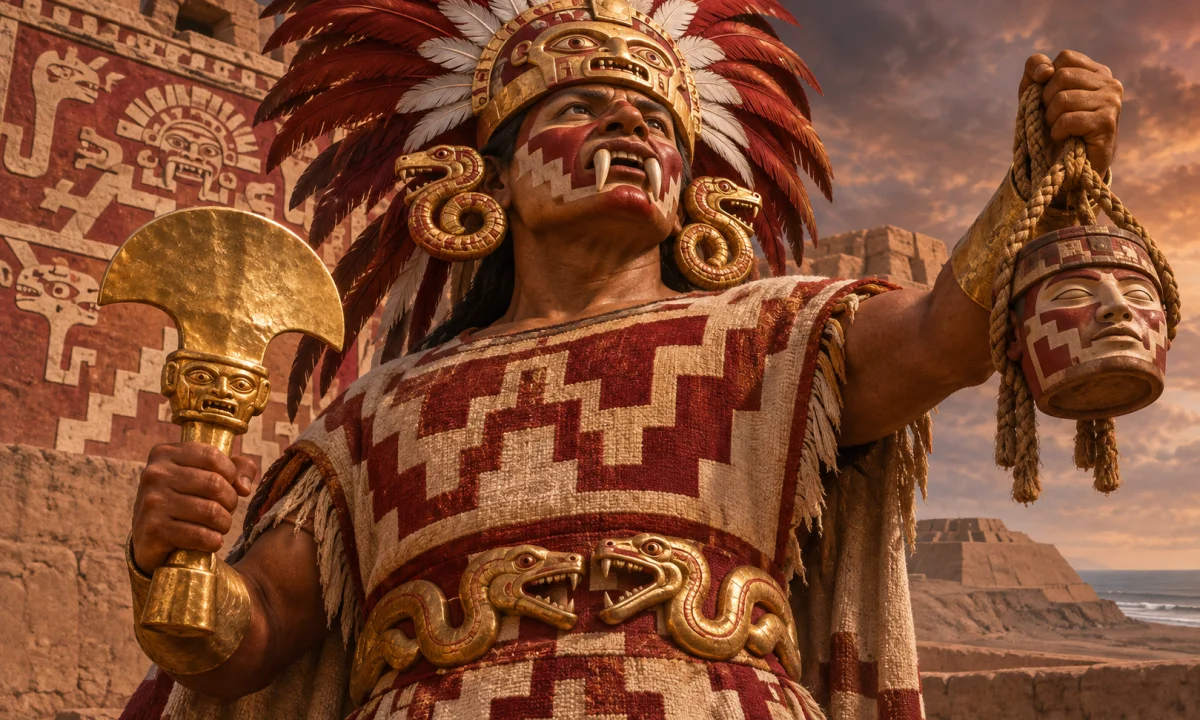
Moche artists represented this figure in ceramics, murals, metalwork and sculpture. The images often show a human-like being with prominent fangs, an intense expression and elaborate headdresses or ornaments. Some representations associate him with decapitation, warfare, ritual performance and supernatural power. Yet the precise identity of the figure remains uncertain. Archaeologists can study the repeated visual patterns, ceremonial settings and associated objects, but no surviving Moche text provides a definitive explanation of the figure’s name, personality or myths.
The Moche cultural setting
The Moche society developed along the arid northern coast of Peru, especially in river valleys supported by irrigation. Its major centres included the valleys around modern-day Trujillo, Chicama, Moche, Lambayeque and Jequetepeque. Moche culture is generally dated from approximately the first to the eighth centuries CE, although dates and regional divisions vary among archaeologists.
The Moche were not a single unified empire in the later Inca sense. They appear to have consisted of related but sometimes competing political communities, each controlling agricultural valleys, ceremonial centres and surrounding territories. Their religious imagery was remarkably widespread, but local traditions could differ. A figure identified in one region or period may not have had exactly the same meaning elsewhere.
Much of what is known about Moche religion comes from visual and archaeological evidence. Important sources include painted pottery, mould-made vessels, metal objects, textiles, monumental architecture, tombs and wall paintings. Ceremonial compounds such as the Huaca de la Luna and Huaca Cao Viejo preserve images of supernatural beings, processions, combat scenes, sacrifice and ritual activity.
Unlike the Inca, the Moche left no surviving written history in a script that can be read today. Their images are highly detailed, but they do not function like labelled religious texts. As a result, scholars must interpret them through recurring forms, archaeological context and comparison with other Moche objects. Interpretations are therefore provisional rather than certain.
The name “Ai Apaec”
The name Ai Apaec is widely translated as “creator” or “maker.” Its use is associated especially with the archaeologist and collector Rafael Larco Hoyle, who applied the term to a major Moche supernatural figure. The expression may have been connected with a Mochica-language phrase, but the evidence is not sufficient to establish that “Ai Apaec” was the figure’s original ancient name.
The Mochica language is no longer spoken and is imperfectly documented. Colonial-era records preserve some vocabulary from languages of northern Peru, but they do not provide a complete Moche religious lexicon. There is also no known Moche inscription identifying a god with this name. For that reason, “Ai Apaec” should be treated as a conventional modern designation, not as an unquestionably preserved indigenous divine name.
Older museum descriptions sometimes presented Ai Apaec as the supreme Moche god. Some modern interpretations continue to describe the figure as a creator deity or principal god, while others use more cautious terms such as “major supernatural figure” or “recurrent religious persona.” The disagreement reflects the difficulty of reconstructing a religion from images without written explanations.
Appearance and visual characteristics
Images identified as Ai Apaec often combine human and animal qualities. The figure may have a broadly human face with large eyes, pronounced eyebrows, fangs or sharply displayed teeth, and an elaborate headdress. Some examples show ear ornaments, necklaces, nose ornaments or other signs of high status. The exact combination of features varies according to period, region and artistic medium.
Fangs are especially important in Moche supernatural imagery. They may indicate a being’s non-human power, but they do not necessarily identify one individual deity. Several Moche figures possess fangs, animal features or other signs of transformation. A fanged face can therefore be a category of supernatural representation rather than a unique personal emblem.
Some forms show the being with a radiating headdress, horn-like projections or a large crescent-shaped ornament. Other representations are more naturalistic, with the figure seated, standing or participating in a ritual scene. Moche artists frequently repeated and recombined motifs, so a single visual feature should not be used as the sole basis for identifying Ai Apaec.
One famous type is the so-called Decapitator, a supernatural figure holding a severed human head, a knife or another weapon. The Decapitator may overlap with images conventionally labelled Ai Apaec, but the relationship is debated. Some scholars regard the Decapitator as an aspect or manifestation of a major deity; others distinguish it as a separate supernatural figure or as a broader ritual role represented by several beings.
Power, ritual and symbolism
Moche art connects powerful supernatural figures with fertility, agricultural abundance, warfare, death and the renewal of life. In a desert environment dependent on seasonal rivers and irrigation, water and agricultural productivity were matters of religious and political importance. The presence of supernatural beings in temple murals and elite tombs suggests that religious authority was closely linked to the management of ritual and the natural world.
Ai Apaec is sometimes described as a creator because of the traditional meaning assigned to the modern name. However, the surviving evidence does not allow a simple account of a Moche creation myth comparable to a written cosmogony. The figure’s association with creation may reflect the broad importance of the being in Moche religious interpretation rather than a clearly recorded story about the formation of the world.
Decapitation imagery is one of the most striking features of Moche religion. Archaeological discoveries show that human sacrifice took place in at least some Moche ceremonial contexts. At the Huaca de la Luna, excavators found evidence of sacrificed individuals, and murals depict violent ritual scenes involving captives, blood and supernatural participants. These findings support a connection between Moche religious art and sacrificial practice, although the precise meaning of each scene remains debated.
The Decapitator’s severed heads may have symbolised victory, control over enemies, sacrificial offering or the transfer of vital power. A knife or ceremonial blade could refer to an actual ritual instrument, but artistic scenes are not necessarily literal records of a single event. They may combine mythology, political ideology and ceremonial symbolism.
Important representations
The Huaca de la Luna, a major Moche ceremonial complex in the Moche Valley, contains murals and painted surfaces with supernatural beings, processions and scenes of violence. These images are often used when discussing Moche religion and the figure called Ai Apaec. The temple’s decoration shows that supernatural imagery was integrated into architecture, ceremony and elite display rather than confined to portable objects.
Moche ceramic vessels provide another important body of evidence. Many are sculptural or carry finely painted scenes. A vessel may portray a supernatural figure in isolation, but other vessels show encounters, processions, combat and ritual acts. The repeated appearance of particular characters and actions suggests that Moche artists drew on a shared visual mythology, even though the sequence and meaning of its stories are not fully understood.
Some vessels show a powerful figure seated on a throne or engaged with other supernatural beings. Others depict a fanged personage carrying weapons, severed heads or ceremonial objects. Scholars compare these images with murals, metal ornaments and burial contexts to determine whether they represent the same being. Because Moche art frequently uses conventional poses and attributes, identification is often a matter of probability rather than certainty.
Several elite burials have also produced masks, ornaments and objects bearing supernatural faces. These finds indicate that religious imagery was connected with status, ancestry and rulership. It is possible that Moche leaders presented themselves as participants in a sacred order or as temporary embodiments of supernatural roles. The evidence does not prove that every image of a fanged being represented one single god.
Relationships with other Moche beings
Moche iconography includes a large cast of supernatural and semi-supernatural figures. These include anthropomorphic beings with animal traits, animals acting in human ways, warriors, priests, ancestors and figures associated with the sea, mountains or the underworld. Modern labels have been applied to several of them, but the boundaries between named beings are not always secure.
A commonly discussed figure is the Wrinkle-Faced or old supernatural being, often shown with an aged or lined face. Some interpretations identify this figure with Ai Apaec, while others treat the old figure as distinct. Facial wrinkles, fangs, headdresses and ritual objects can appear in overlapping combinations, making it difficult to establish a fixed divine identity.
The Decapitator should likewise not automatically be treated as identical to Ai Apaec. The two labels are sometimes used together because certain images combine the attributes associated with both. In other cases, the Decapitator seems to function as a particular ritual or mythological figure. The safest description is that Ai Apaec and the Decapitator are closely related in modern interpretations but are not demonstrably the same in every Moche representation.
Nor should Ai Apaec be equated automatically with every Moche fanged deity. The Moche visual system used recurring symbols across different supernatural characters. A fanged mouth can communicate dangerous or sacred power without identifying a single named personality.
Religious and political significance
Whether or not Ai Apaec was a single supreme god, the figure represents the way Moche religion joined supernatural authority to social power. Temples, tombs and costly objects placed religious imagery in settings controlled by elites. Ritual specialists and rulers may have used these images to present warfare, sacrifice and agricultural prosperity as parts of a divinely sanctioned order.
The figure’s possible connection with decapitation also reflects the importance of warfare and captive sacrifice in Moche political symbolism. Moche artists repeatedly portrayed defeated enemies, ceremonial combat and the handling of human remains. These images may have asserted the dominance of rulers and communities while expressing beliefs about communication with supernatural powers.
At the same time, Moche religion should not be reduced to violence. Their art also contains images of cultivation, animals, plants, sexual reproduction, birth, burial and the movement of water. Supernatural beings appear within a larger system concerned with bodily transformation, fertility, death and continuity. A figure associated with dangerous ritual power could therefore also participate in ideas about renewal and the maintenance of the world.
Ai Apaec and the Inca
Ai Apaec is sometimes placed in lists of Inca gods because many general references group all pre-Columbian Peruvian traditions together. This classification is historically inaccurate. The Moche culture was centred on Peru’s northern coast and reached its height long before the Inca Empire became dominant in the Andes.
The Inca state expanded into northern coastal Peru only during the late fifteenth century, by which time Moche political society had disappeared for many centuries. The Inca had their own religious traditions, including major deities such as Inti, Viracocha, Illapa and Pachamama, although local beliefs were often incorporated into the imperial system. There is no reliable evidence that the Inca worshipped a god named Ai Apaec.
“Inca mythology” is therefore sometimes used as a broad and imprecise category rather than a precise cultural identification. Ai Apaec belongs more accurately to the mythology and religious iconography of the Moche, a pre-Inca society of ancient northern Peru.
Modern reception
Ai Apaec has become one of the best-known names associated with ancient Peruvian art. Museums, educational materials and popular histories often present the figure as a creator god with a distinctive fanged face. This presentation can be useful as an introduction, but it may give the impression that the ancient evidence is clearer than it really is.
Modern depictions sometimes turn Ai Apaec into a single, fully defined character with a fixed biography, a complete set of powers and a stable relationship to other gods. Such portrayals belong to modern reconstruction, fantasy or popular culture unless they are explicitly grounded in archaeological interpretation. The ancient Moche evidence instead reveals a changing group of supernatural images whose names, stories and identities cannot be recovered with complete certainty.
The most responsible description of Ai Apaec is therefore a qualified one: a modern name for a major and recurring Moche supernatural figure, often represented with fangs and sometimes associated with decapitation, ritual violence, rulership and sacred power. The label remains valuable for discussing Moche art, but it should not be mistaken for a securely preserved ancient biography or for an Inca deity.