WORLD
WORLD
Mama Ocllo
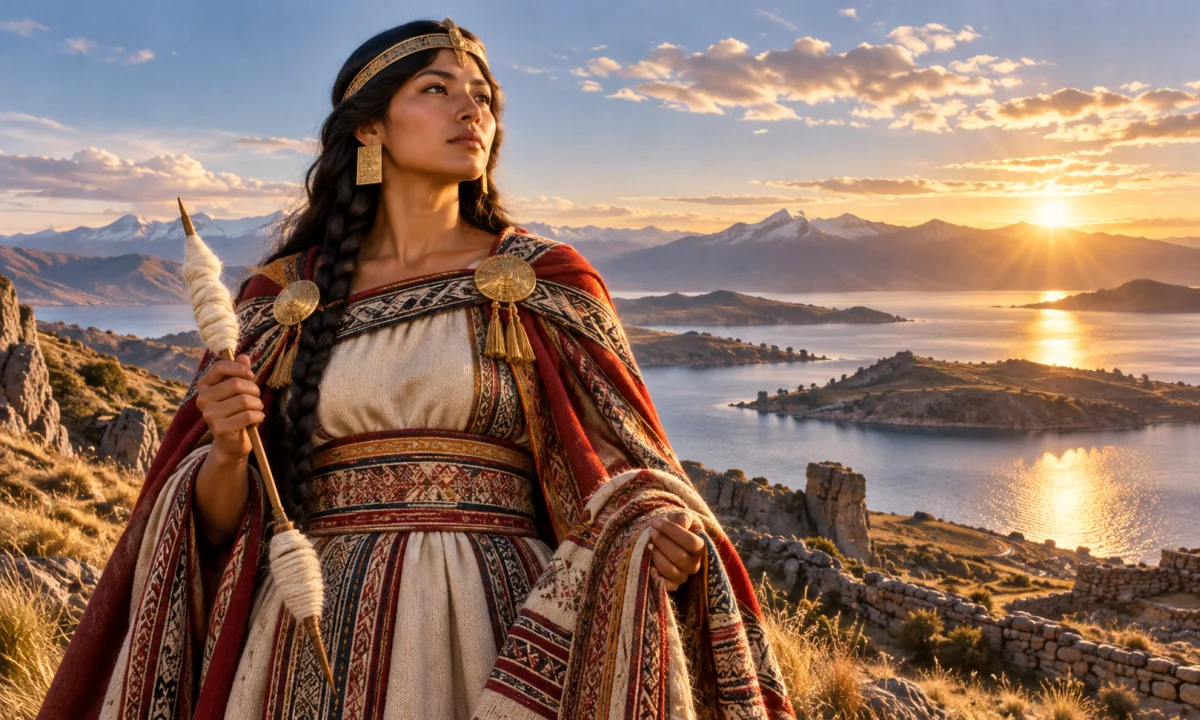
Mama Ocllo is a founding woman of Inca tradition, best known as the companion, sister and wife of Manco Cápac, the legendary first ruler of Cusco. In the most familiar version of the story, she and Manco Cápac were sent by the Sun to establish a civilized kingdom in the Andes. Mama Ocllo is therefore associated with the origins of Inca royalty, the ordering of society and the transmission of practical knowledge, especially textile work and household arts.
She is often described in modern writing as an Inca goddess, but that classification requires care. Surviving colonial accounts generally present her as an ancestral founder, culture heroine and royal foremother rather than as a goddess with a clearly defined independent cult. The traditions about her were recorded after the Spanish conquest, and they differ in their details, origins and emphasis.
Origins in Inca tradition
The Inca Empire, or Tawantinsuyu, developed around Cusco and eventually ruled a vast region of western South America. Its official history connected the ruling dynasty to sacred ancestors who had established Cusco and introduced the institutions of civilized life. Stories about Manco Cápac and Mama Ocllo helped explain why the Inca rulers possessed authority and why Cusco held a uniquely sacred position.
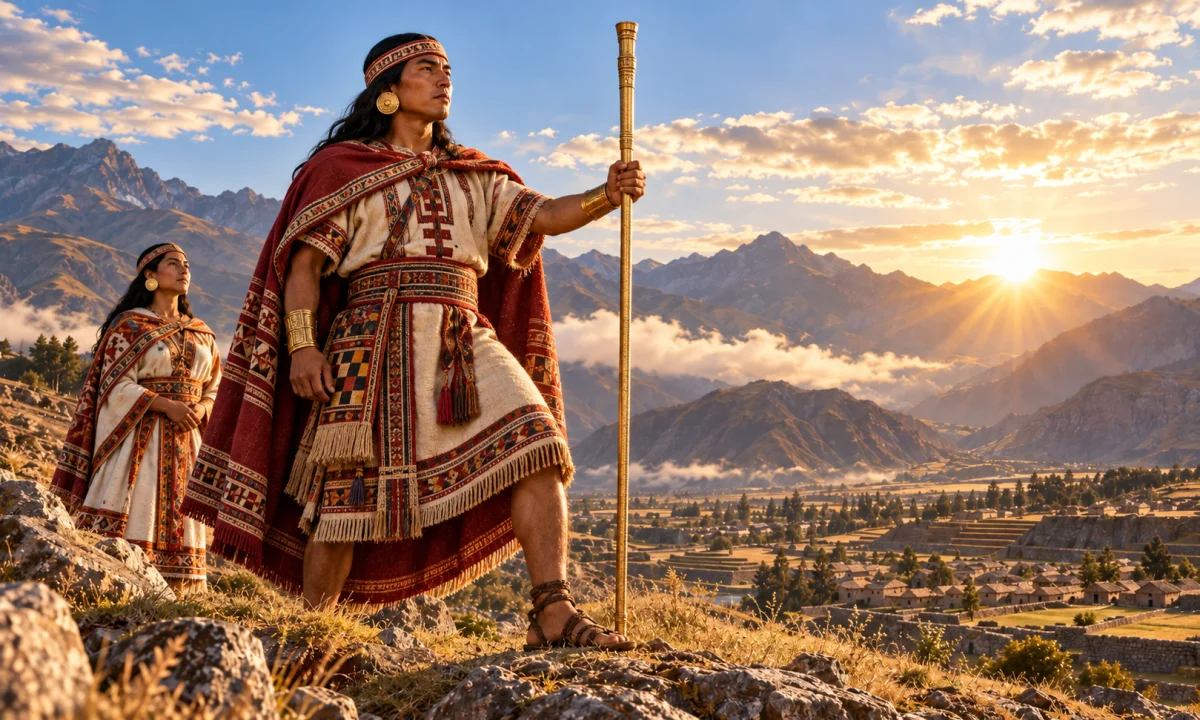
One of the best-known accounts comes from the early seventeenth-century writer Garcilaso de la Vega, whose work preserves traditions associated with his Inca maternal heritage. In his version, the Sun sent Manco Cápac and Mama Ocllo from Lake Titicaca. They emerged carrying a golden staff and were instructed to travel until the staff sank into the ground. The place where it disappeared would be the proper site for their settlement. After journeying northward, they found the sign near the valley of Cusco and established the centre of the future Inca state.
This account should not be treated as the single official form of the myth. Other colonial chroniclers recorded different origin narratives. Some traditions locate the emergence of the Inca ancestors at Paqariq Tampu, or Pacaritambo, south of Cusco, rather than directly at Lake Titicaca. These accounts may include Manco Cápac among groups of ancestral brothers and sisters, including the famous Ayar figures. The stories may represent different regional memories, dynastic explanations or versions collected from different informants.
The surviving written sources are not pre-conquest Inca manuscripts. They were produced by Spanish or mixed-heritage authors who relied on oral testimony, interpreters, Indigenous informants and their own assumptions about history and religion. Some writers were interested in recording Indigenous traditions; others wished to explain the Inca past through Christian, classical or Spanish political categories. As a result, Mama Ocllo’s identity must be understood through several overlapping traditions rather than through a single canonical scripture.
The name and identity of Mama Ocllo
The name appears in several spellings, including Mama Ocllo, Mama Ocllo Huaco and, in modern Quechua-oriented writing, forms such as Mama Uqllu. Spelling varies because colonial Spanish writers represented Quechua sounds according to Spanish orthographic habits, while modern scholars and Indigenous language specialists use different systems.
The word mama can function as a respectful title as well as a reference to motherhood. It does not, by itself, prove that Mama Ocllo was a mother goddess. The meaning and origin of Ocllo are not securely established in a way that would justify a simple translation. Proposed explanations found in popular sources should therefore be treated cautiously.
In the traditions most closely associated with Garcilaso, Mama Ocllo is the sister and wife of Manco Cápac. Their relationship reflects the concern of Inca royal ideology with descent, dynastic continuity and sacred ancestry. Royal marriages among close relatives were associated with the Inca ruling house, although the social rules of marriage varied across the empire and should not be generalized to all Andean communities.
Mama Ocllo is also called a coya in some contexts. Coya was the title of the principal wife and queen of an Inca ruler, although the exact use of the title and its application to legendary figures can vary among sources. As a founding queen, Mama Ocllo represents the female side of the royal lineage and the origin of the institutions that supported Cusco.
The journey to Cusco
The journey of Manco Cápac and Mama Ocllo is a migration story and a foundation myth. They do not simply find a city that already exists; they are guided toward the place where a new political and sacred order should begin. The golden staff acts as a sign of divine approval. When it sinks into the earth, the landscape itself identifies the place chosen for the centre of the Inca realm.
In the Lake Titicaca version, the lake is a powerful place of beginnings. It was an important sacred landscape in the Andes and remained central to later Inca ideas about ancestral origins. Emerging from the lake places Manco Cápac and Mama Ocllo outside ordinary human history. Their arrival marks the movement from sacred ancestry into organized settlement, agriculture, law and kingship.
The destination is generally identified with the Cusco valley, whose geography became central to Inca political and religious life. Inca traditions connected the city with sacred places, shrines, caves, springs, hills and ancestral beings. The foundation story therefore does more than explain a migration: it gives a sacred explanation for the political centre of Tawantinsuyu.
Some popular retellings describe the pair as carrying a golden plough or as using a golden object to test the fertility of the soil. The most widely repeated version, however, concerns a golden rod or staff that sinks into the earth. Details such as the route, the exact location of the sign and the number of companions vary between accounts.
Mama Ocllo as a culture heroine
Mama Ocllo’s principal traditional role is not that of a warrior or a ruler acting independently of Manco Cápac. She is a culture heroine: a figure who helps establish the practices that make settled life possible. In Garcilaso’s account, Manco Cápac teaches men the work of agriculture, while Mama Ocllo teaches women domestic skills, spinning, weaving and the management of the household.
This division reflects the way one colonial account presents Inca ideas about social order, but it should not be read as a complete description of women’s lives in the Andes. Inca women worked in agriculture, produced textiles of great economic and ritual value, participated in religious institutions and could hold important positions within royal and provincial administration. Textile production was not merely a private household activity: cloth was a major form of wealth, tribute and political exchange.
By teaching weaving and related skills, Mama Ocllo represents the knowledge needed to clothe the population, mark rank and maintain social obligations. Inca textiles could communicate status, ethnicity and allegiance. Fine cloth was also used in ceremonies and diplomatic relations. Her role therefore connects domestic knowledge with the broader organization of the state.
Her partnership with Manco Cápac presents social order as complementary. The male founder and the female founder together establish a community, a dynasty and a system of labor. This paired structure has sometimes been compared with broader Andean ideas of duality and complementary opposites. Such comparisons can be useful, but they should not be treated as proof that every detail of the Mama Ocllo story originated from one universal Andean religious principle.
Relationship with Manco Cápac
Manco Cápac and Mama Ocllo are usually presented as a matched pair. Manco Cápac supplies the royal and political centre of the foundation story, while Mama Ocllo provides the female ancestry and the knowledge associated with social reproduction, clothing and household organization. Neither figure is fully understandable within the most familiar version without the other.
Their sibling relationship also makes them more than an ordinary married couple. As children of the Sun or as sacred ancestors emerging from a place of origin, they stand at the beginning of the ruling line. Their marriage joins the founding branches of the dynasty and gives later Inca rulers a prestigious genealogy.
The story does not provide a detailed biography of Mama Ocllo. It does not describe a long series of individual adventures, battles or transformations. Her importance lies in what she establishes and transmits. She is remembered as a foundational presence whose authority comes from origin, kinship and instruction.
Religious and cultural significance
Mama Ocllo’s significance is closely connected to the religious status of Inca kingship. Inca rulers claimed descent from the Sun, particularly through the solar deity Inti. A tradition in which Mama Ocllo and Manco Cápac are children of the Sun gives the royal dynasty a sacred genealogy and portrays its expansion as part of a divinely sanctioned order.
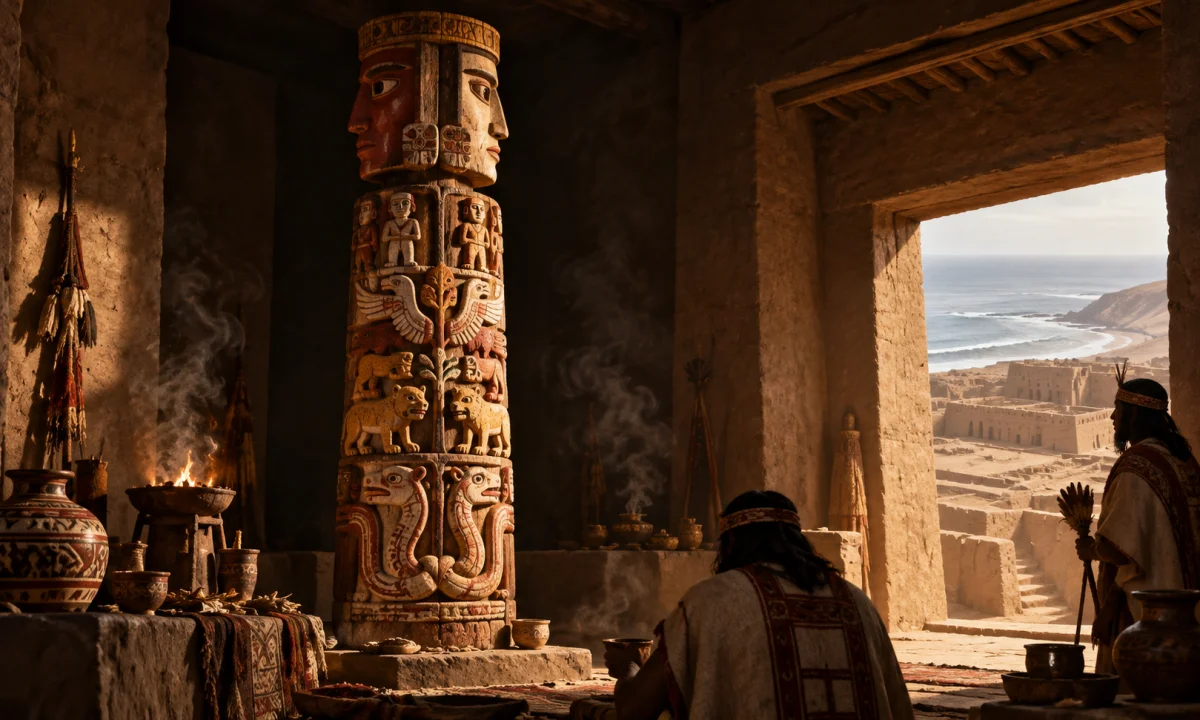
At the same time, the story reflects the importance of ancestral beings in Andean religious life. Ancestors were not merely remembered individuals. They could remain active sources of identity, protection and political legitimacy for their descendants. Royal ancestors were associated with particular places and social groups, and their memory could be maintained through ritual, offerings and public tradition.
The story also gives cultural meaning to women’s labor. Weaving, spinning and the preparation of clothing were essential to Inca society, and the myth presents these skills as gifts taught by a sacred ancestress. Mama Ocllo thus represents the transmission of knowledge from the divine or ancestral past into everyday communal life.
Calling her a fertility goddess can be misleading if it suggests a clearly attested cult equivalent to that of a major agricultural or lunar deity. Her association with motherhood, women and social continuity is reasonable as an interpretation, but the surviving accounts do not establish a uniform doctrine in which she governs fertility in the same way that later popular summaries sometimes claim.
Variants and related figures
Mama Ocllo should not automatically be identified with every female ancestor in Inca origin traditions. The Ayar narratives include figures such as Mama Huaco, who has a distinct role in many accounts. Mama Huaco is often portrayed as a powerful, aggressive or even warrior-like ancestral woman connected with the early settlement of Cusco. Some modern retellings combine her with Mama Ocllo, but the two are not consistently the same person in the colonial sources.
She is also different from Mama Quilla, the Inca moon deity. The shared use of the title mama can create confusion, but Mama Quilla belongs to the celestial pantheon, whereas Mama Ocllo is primarily a dynastic ancestress and founder. Likewise, she should not be merged with Pachamama, the earth mother or earth-power revered in many Andean traditions. Pachamama has a much broader and more enduring religious presence across the Andes.
Nor should Mama Ocllo be treated as simply another name for the Inca queen in general. Coya was a royal title, while Mama Ocllo is a particular legendary figure. Later queens could be described through her example, but they were not automatically manifestations of her.
Historical interpretation
Historians and anthropologists generally approach the story as a combination of sacred genealogy, political foundation narrative and cultural explanation. It expresses how the Inca ruling house wished to explain its origins, why Cusco was central and how the authority of the dynasty was connected to the Sun and to ancestral places.
The differences among the accounts are especially important. A Lake Titicaca origin emphasizes a sacred birthplace and a connection with a broader Andean landscape. The Pacaritambo and Ayar traditions emphasize caves, emergence and the movement of ancestral groups toward Cusco. These versions may preserve older local traditions, later dynastic revisions or attempts to integrate several origin stories into one imperial history.
Because the accounts were written after the conquest, it is difficult to determine which elements belong to pre-conquest oral traditions and which were shaped by the chroniclers’ interpretations. It is also possible that Inca authorities promoted particular versions for political reasons, especially when incorporating diverse peoples and territories into an imperial history.
Mama Ocllo’s story should therefore be read as meaningful evidence about Inca ideas of ancestry, gendered labor, kingship and place, rather than as a straightforward historical record of a woman whose life can be reconstructed independently.
Later reception
Mama Ocllo remains one of the most recognizable female figures associated with Inca mythology. School materials, illustrated retellings, museum displays, tourism writing and cultural performances often present her alongside Manco Cápac at the beginning of Cusco. These versions commonly emphasize the golden staff, the journey from Lake Titicaca and her role as the teacher of weaving and domestic arts.
Modern adaptations sometimes expand her into a fully developed goddess of fertility, motherhood or the earth. Such portrayals can express contemporary interest in Indigenous symbolism, women’s cultural knowledge and Andean identity, but they are not identical to the roles preserved in the principal colonial narratives. The traditional figure is more securely understood as a sacred ancestress and founder whose teachings help create the ordered society of the Inca world.
Her continuing presence in Peruvian cultural memory also reflects the importance of female founders in accounts of national and regional origins. Mama Ocllo is not merely the companion of a male hero: she is the source of a royal female lineage and the bearer of knowledge without which the new society could not function.