WORLD
WORLD
Centzon Totochtin
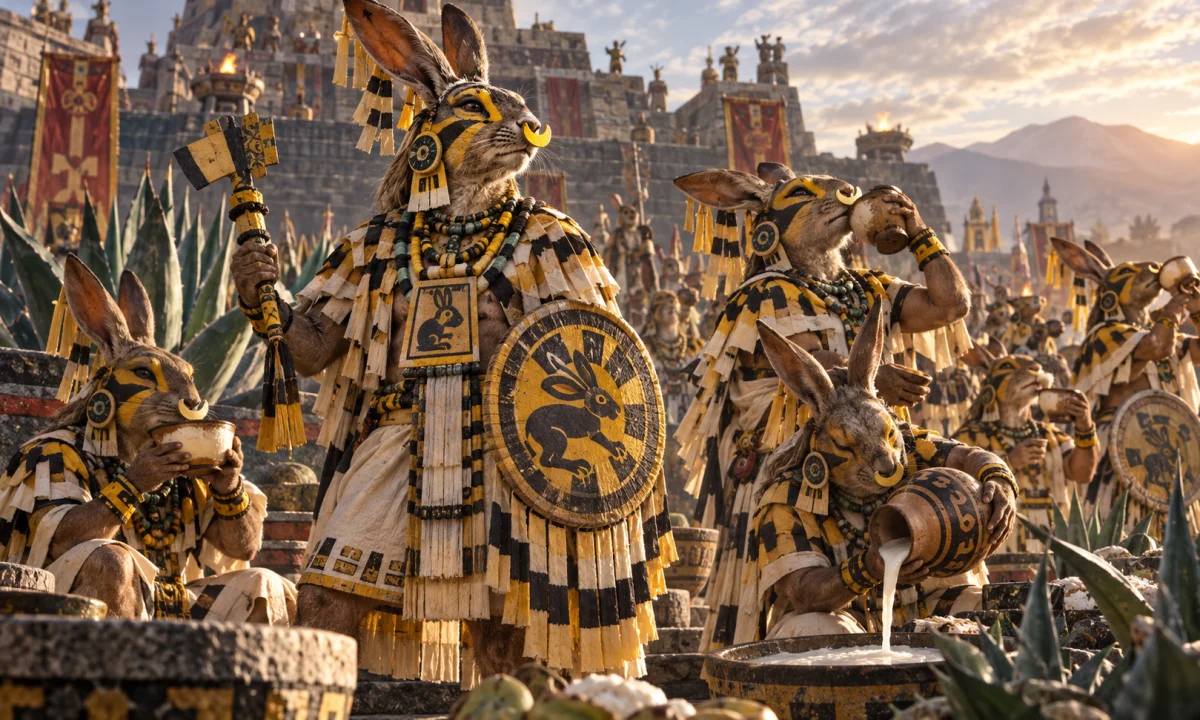
Centzon Totochtin is the Nahuatl name commonly translated as the “Four Hundred Rabbits,” a collective group of deities associated with pulque, intoxication and the many forms that drunkenness could take. They belong to the religious traditions of central Mexico, especially those recorded among Nahua-speaking peoples in the centuries before and after the Spanish conquest. The number four hundred probably expresses abundance or an uncountable multitude rather than a literal census of exactly four hundred rabbit gods.
Name and identity
In Nahuatl, centzon means “four hundred,” while tochtin is the plural of tochtli, “rabbit.” Spellings vary because Nahuatl was written in several different orthographic systems. Forms such as Centzon Totochtin, Centzontotochtin and “Four Hundred Rabbits” may therefore refer to the same collective group.
The Centzon Totochtin were not simply animal spirits or ordinary rabbits enlarged into supernatural beings. They were divine personifications of pulque and its effects. Pulque, called octli in many Nahuatl sources, is an alcoholic drink made by fermenting the sap of the maguey, or agave, plant. It had important ritual, economic and social roles in central Mexican societies.
The group was understood as a multitude of related powers. Different members could represent different kinds of drunken behavior, moods or consequences. One person might become cheerful, another quarrelsome, another boastful or melancholy. The rabbit image provided a way to express the unpredictable and varied effects of intoxication. The Centzon Totochtin were therefore connected not only with the drink itself, but also with the transformations brought about by consuming it.
Pulque in Aztec religious culture
For the Mexica and other Nahua peoples, pulque was more than a recreational beverage. Maguey was a valuable plant that provided food, fiber, thorns, fuel and drink. Its sap could be collected and allowed to ferment into pulque. Because the plant sustained human life in several ways, it had strong religious associations.
Pulque could be offered to deities and consumed in ceremonial settings. It was connected with fertility, agricultural abundance, bodily vitality and the earth. The drink was also associated with age and special status. Some traditions describe its use by priests, warriors, rulers, the elderly or people taking part in particular ceremonies. These contexts did not mean that unrestricted drunkenness was accepted throughout society.
Mexica laws and moral teachings treated public drunkenness as a serious offense, especially for people who had no ritual or socially recognized reason to drink. Punishments could be severe. At the same time, ritual intoxication and the sacred use of pulque occupied a different position from uncontrolled drinking. The Centzon Totochtin belong to this complex religious setting, where intoxication could be dangerous, holy, socially regulated or all three at once.
Origins and family relationships
The surviving traditions do not present one completely uniform genealogy for the Centzon Totochtin. Some accounts associate them with Mayahuel, the goddess or divine personification of the maguey, and Patecatl, a deity connected with pulque, fermentation and medicines. In these versions, the rabbits are described as their children or descendants.
Other accounts focus on separate aspects of the pulque tradition rather than giving the entire group a single, consistent family history. The sources were recorded at different times, by different writers and with the help of different Indigenous informants. As a result, relationships among Mayahuel, Patecatl, the Centzon Totochtin and individual pulque deities can vary.
Mayahuel is particularly important in stories explaining the origin of maguey and its products. One well-known version tells how she was taken from the sky or from the realm of the tzitzimime, terrifying star beings, and brought to earth by Quetzalcoatl. She and Quetzalcoatl were transformed into a maguey plant, but a hostile relative found and destroyed her. Quetzalcoatl recovered what remained and transformed it into the maguey, whose sap could later be used to make pulque.
This story is often retold as a simple “origin myth of tequila,” but that is historically inaccurate. Tequila is a distilled spirit developed in the colonial period, whereas the pre-Hispanic drink associated with Mayahuel and the Centzon Totochtin was fermented pulque. The myth concerns the sacred value of maguey and pulque, not the later production of tequila.
Individual rabbits and named deities
Although the Centzon Totochtin were a collective, some members had individual names and identities. Ometochtli, meaning “Two Rabbit,” is one of the best-known. The number two may distinguish this deity from other rabbit powers, but its precise religious meaning is not certain. Ometochtli is frequently described as a pulque deity and is sometimes treated as a leading figure among the rabbit gods.
Macuiltochtli, “Five Rabbit,” is another named figure associated with drunkenness and the Centzon Totochtin. The prefix macuil-, meaning five, appears in the names of several Aztec deities and supernatural beings. Macuiltochtli should not automatically be treated as identical to Ometochtli or to the entire group; these names refer to distinct figures even when their functions overlap.
Tepoztecatl was a prominent pulque-related deity associated with Tepoztlan in the modern state of Morelos. He was connected with the local sacred landscape and with the wider network of pulque gods. Some traditions include him among the Centzon Totochtin, while others emphasize his identity as a separate named deity with his own cult and stories.
Other names connected with the pulque group include Papaztac and several figures whose names may refer to particular places, qualities or types of intoxication. The surviving sources do not provide a universally agreed catalogue in which every rabbit has a fixed personality or clearly defined sphere. Lists of individual members should therefore be treated as source-dependent rather than as a settled pantheon.
Why rabbits?
The rabbit was a familiar and symbolically important animal in central Mexico. Rabbits were associated with fertility and rapid reproduction, which made them suitable symbols for abundance. Their behavior could also appear erratic or difficult to control, qualities that suited the unpredictable effects of alcohol.
Aztec religious thought often linked animals with particular gods, places and natural forces without reducing them to a single meaning. The rabbit could suggest fertility, abundance, speed or unruliness depending on context. Its association with the moon is also well known in Mesoamerican traditions, especially in stories explaining the rabbit-shaped marking visible on the lunar surface. However, the Centzon Totochtin should not be defined solely through the lunar rabbit. Lunar symbolism and pulque symbolism overlap in broader Mesoamerican thought, but they are not the same religious subject.
The rabbit image may also reflect the way intoxication was understood as a change in ordinary behavior. A person under the influence of pulque could seem to become a different version of themselves, just as the many rabbits represented different emotional or social manifestations of drunkenness.
Stories and ceremonial associations
Stories about pulque deities often combine divine genealogy, the discovery of fermentation and warnings about excess. Patecatl is associated in several traditions with discovering or preparing substances used in the making of pulque. Mayahuel provides the sacred maguey, while the rabbit gods embody the drink’s numerous effects. These elements do not always appear in one single narrative, and the order of events varies among sources.
Some colonial descriptions explain drunkenness by saying that different rabbits entered a drinker and caused different forms of conduct. This is not necessarily a literal doctrine shared in exactly the same way by every Nahua community. It is better understood as a recurring religious image: intoxication was produced through the presence or influence of one of many supernatural powers.
Ritual observances for pulque deities could involve offerings, songs, dance and the presentation of the drink. Certain festivals honored mountains, fertility and rain, all of which could intersect with the religious significance of maguey and pulque. The precise ceremonies differed between communities, and the surviving descriptions often combine local practice with the categories used by Spanish observers.
The Centzon Totochtin were also linked with the moral danger of drinking. Their presence in religious tradition did not encourage constant intoxication. Instead, they helped explain why alcohol could produce radically different states of mind and why drinking required social and ritual control. A person who ignored those boundaries risked shame, punishment or loss of self-command.
Surviving sources and their limitations
Most written information about the Centzon Totochtin comes from sources produced after the Spanish invasion. The most important materials include the Nahuatl-language records gathered under the direction of Bernardino de Sahagún, as well as illustrated manuscripts and other colonial-era accounts. These works preserve valuable Indigenous testimony, vocabulary and religious information, but they were created in a period of cultural upheaval.
Christian missionaries frequently described Nahua deities as “gods,” “idols” or demons. Such terms do not always correspond neatly to Nahua categories of sacred power. The manuscripts also reflect translation, editorial choices and the interests of their collectors. Some descriptions may preserve pre-conquest traditions, while others may show how those traditions were explained or reorganized under colonial conditions.
For this reason, the Centzon Totochtin should not be treated as a completely standardized group with a fixed hierarchy comparable to a modern religious list. The central association with rabbits, pulque and drunkenness is well established, but details about their genealogy, membership and individual functions vary by source.
Distinctions from related figures
- Mayahuel is primarily associated with the maguey plant and its nourishing or life-giving properties. She is not simply another name for the Centzon Totochtin, although some traditions describe her as their mother.
- Patecatl is a named deity linked with fermentation, pulque and medicinal knowledge. He may be presented as the father or consort in traditions concerning the rabbit gods, but he is not identical to the collective group.
- Ometochtli and Macuiltochtli are individual rabbit-named deities associated with the wider pulque complex. Their names should not be used as interchangeable translations of Centzon Totochtin.
- Tepoztecatl is a distinct local and regional deity associated with Tepoztlan as well as with pulque. His inclusion among the rabbit gods depends on the tradition or classification being used.
- The rabbit in the moon belongs to lunar stories and imagery. It is not automatically one of the Centzon Totochtin merely because both subjects involve rabbits.
Cultural significance
The Centzon Totochtin express a distinctly complex view of intoxication. Pulque could nourish, heal, strengthen ritual bonds and connect humans with divine powers, yet it could also provoke disorder and social harm. The “four hundred rabbits” gave religious form to this range of possibilities.
Their tradition also shows how a cultivated plant, a fermented drink, an animal symbol and a set of moral rules could belong to one interconnected religious system. Maguey was not merely a raw material, and pulque was not merely an intoxicant. Both were part of a sacred landscape involving fertility, ancestors, local communities, ceremonies and the limits of human behavior.
In modern writing, the name Centzon Totochtin is sometimes simplified into “the Aztec gods of drunkenness.” That description captures one important element but leaves out their relationship with maguey, fertility, ritual drinking and the diversity of individual rabbit deities. It is also important to remember that “Aztec mythology” is a broad modern label. The traditions were rooted in the cultures of Nahua-speaking peoples, including the Mexica, and were not necessarily identical across every community in central Mexico.
Contemporary references to the Centzon Totochtin appear mainly in works about Mesoamerican religion, mythology and the history of pulque. Modern games, fantasy fiction and popular media may portray them as a single army, a set of animal-headed characters or a conventional pantheon of alcohol gods. Such portrayals are creative adaptations rather than direct representations of the surviving religious traditions.