WORLD
WORLD
Yansan
Yansan is a name used chiefly in the African diaspora for Ọya, one of the powerful òrìṣà of Yoruba religious tradition. She is especially associated with wind, storms, sudden change, warfare, transformation and the boundary between the living and the dead. In Brazil, the form Iansã is particularly common in Candomblé and Umbanda, while spellings such as Yansan, Yansã and Iansan appear in English-language writing and other diaspora contexts. In most cases, these names refer to the same religious figure rather than to separate beings.
Yoruba religious setting
Ọya belongs to the religious world of the Yoruba peoples of West Africa, especially communities in present-day Nigeria and neighbouring parts of Benin. Yoruba religion recognises a supreme creator, often called Olódùmarè or Ọlọ́run, together with numerous òrìṣà. The òrìṣà are not simply “gods” in the narrow European sense. They are divine powers, sacred personalities and intermediaries who express particular forces of existence and maintain relationships with human communities.
Traditional Yoruba religion has been preserved through oral transmission, ritual practice, praise poetry, divination verses, songs, personal initiation and hereditary religious knowledge. Written accounts produced by outsiders are useful but incomplete, and they do not always agree. The character of Ọya therefore cannot be reduced to one canonical story or a single fixed list of attributes. Her identity may differ between Yoruba regions, religious lineages and the African diaspora.
In Yoruba thought, natural forces are not merely physical processes. Wind, rain, rivers, thunder and the movement of the atmosphere can have spiritual significance. Ọya’s storms express energy that is both dangerous and renewing. Wind clears, carries, disrupts and reveals. It can destroy established arrangements, but it can also open the way for new growth. This makes Ọya an important figure of transition rather than only a goddess of bad weather.
Name, identity and classification
The Yoruba name most commonly associated with Yansan is Ọya, sometimes written Oya when tone and underdots are omitted. Her name is connected in Yoruba tradition with the River Niger, which is known in Yoruba as the River Ọya. Rivers themselves may be understood as sacred manifestations or domains of òrìṣà, and the river association is central to Ọya’s identity.
Iansã is a major Brazilian form of her name. A widespread explanation connects it with the Yoruba expression Ìyá mésàn, often translated as “mother of nine.” This interpretation reflects stories and titles associated with Ọya, but its linguistic history is not entirely certain, and it should not be treated as an unquestioned explanation in every context. The spelling Yansan is best understood as a variant used in English or diaspora writing, not automatically as the name of an independent Yoruba deity.
Ọya is usually described as an òrìṣà of wind, storms and transformation. In different traditions she may also be connected with the marketplace, the threshold of the cemetery, ancestral forces, fire carried by the wind, and the courage required to enter dangerous or uncertain situations. These associations overlap, but they are not identical everywhere. A role prominent in Brazilian Candomblé may not have exactly the same importance in a Yoruba community in Nigeria.
Wind, storms and transformation
Ọya’s most widely recognised power is the wind. She may be imagined as the force that drives a storm, changes the direction of events or carries a person from one condition into another. Her movement is swift and difficult to contain. For this reason she is often connected with personal transformation, political upheaval and the breaking of stagnant conditions.
Her storms are not simply destructive. Rain and wind can clear the air, prepare the land and make renewal possible. This dual quality is reflected in her religious character: Ọya is protective and dangerous, compassionate and fierce, associated with life’s transitions as well as with death. She is a power to approach with respect, not a harmless personification of a pleasant breeze.
Lightning is more directly associated with Ṣàngó, the Yoruba òrìṣà of thunder and lightning, but Ọya is frequently linked with him through storms and through their marriage in many traditions. Some accounts describe her as fighting beside Ṣàngó or helping to unleash the force of his thunder. This does not mean that all Yoruba traditions assign thunder and lightning to her in the same way. The boundaries between related natural powers can be fluid, especially in praise poetry and ritual.
Relationship with Ṣàngó
One of Ọya’s most important relationships is with Ṣàngó, also written Shango or Xangô in diaspora traditions. Ṣàngó is associated with thunder, lightning, royal authority, justice, virility and the historical memory of a powerful ruler of Ọ̀yọ́. In many stories Ọya is one of his wives, alongside Ọ̀ṣun and Ọ̀bà, although the details and emphasis vary.
The relationship between Ọya and Ṣàngó symbolises the meeting of storm winds and thunder. She is not merely a secondary companion, however. Ọya is often portrayed as a formidable power in her own right: a warrior, a strategist and a figure whose force can equal or complement Ṣàngó’s. Some stories describe her as learning or acquiring knowledge connected with Ṣàngó’s thunderous power. Such narratives may explain her place within a network of storm-related forces, but they should not be read as a single universally accepted biography.
Stories involving Ṣàngó’s other wives sometimes portray rivalry, jealousy or competition, particularly in Brazilian retellings. These accounts can be religiously meaningful, but they also reflect the narrative style of particular oral and ritual traditions. They do not establish a single historical family structure for the òrìṣà. Yoruba sacred stories commonly exist in multiple versions, with different episodes highlighted according to the community telling them.
The buffalo woman
A well-known story presents Ọya as a buffalo who can take human form. In one version, a hunter discovers a female buffalo entering the forest, removing her animal hide and becoming a woman. He conceals the hide and eventually marries her. They have children, but she remains anxious about the secret of her identity.
When the hidden skin is found or revealed, Ọya resumes her buffalo form and leaves the household. Before departing, she may give her children objects, instructions or a means of calling her. In some versions she promises to protect them when they honour her, while in others she becomes a powerful ancestral presence. The precise sequence differs between tellings.
The story connects several of Ọya’s central qualities. The buffalo is strong, swift and dangerous when provoked, while the removal of its hide represents a passage between animal and human identities. Ọya’s transformation suggests that no visible form completely contains her nature. The tale also warns against concealment and disrespect: attempting to control a powerful being without understanding her can end in separation or danger.
Buffalo symbolism is important in several West African traditions, but the story should not be treated as proof that every Yoruba community describes Ọya in exactly this way. Some versions place greater emphasis on her marriage, children or departure; others focus on her power as a spirit of the wilderness and transformation.
“Mother of nine” and the number nine
In Brazilian religious contexts, Iansã is often associated with the title mãe de nove, “mother of nine,” and the number nine may appear in explanations of her name and mythology. Some accounts say that she is the mother of nine children. Others connect the number with the nine branches or tributaries associated with the Niger River, or with a symbolic relationship to death and the ancestral realm.
These explanations are not interchangeable, and there is no single interpretation accepted across all Yoruba and Afro-Brazilian traditions. The number may function as a sacred epithet rather than as a literal census of offspring. It is therefore more accurate to say that “mother of nine” is an important title or association in some traditions than to claim that it defines Ọya everywhere.
Warrior and guardian of thresholds
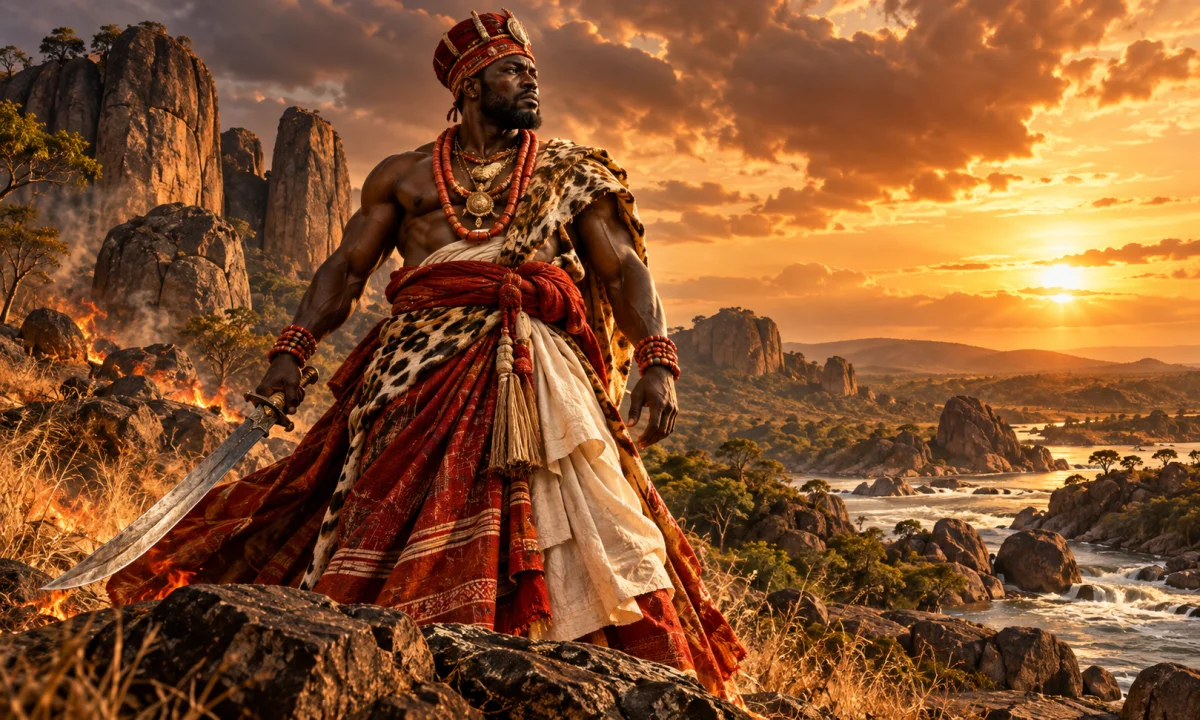
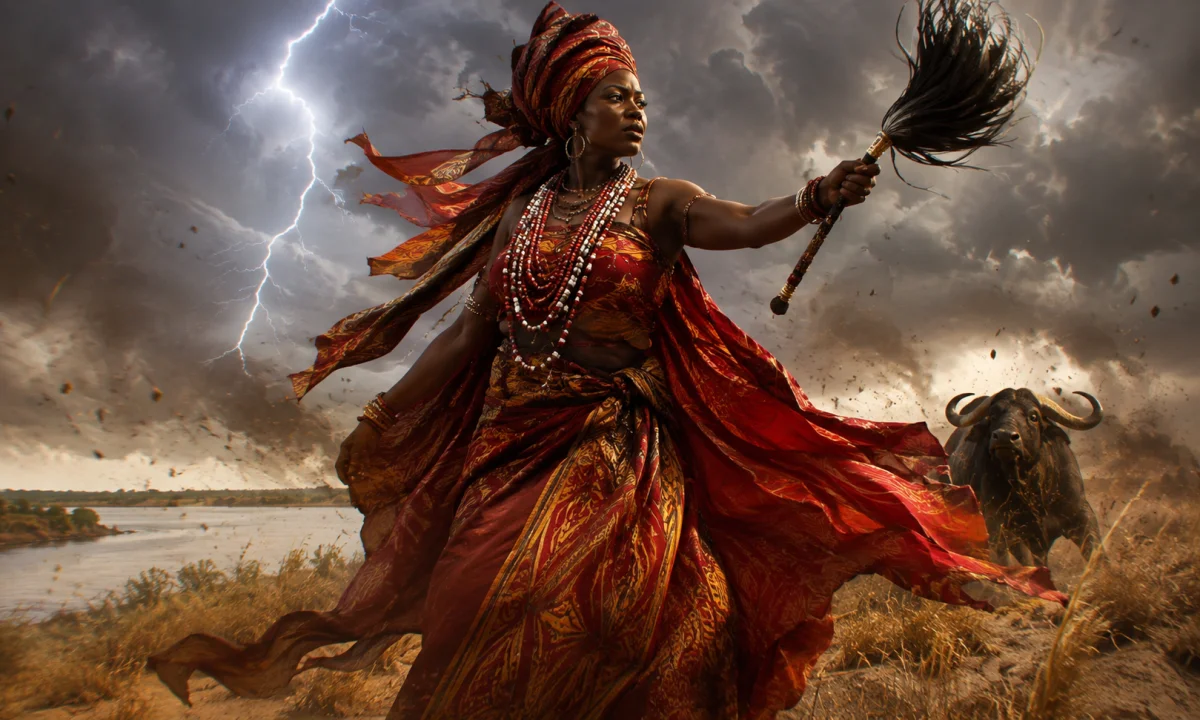
Ọya is frequently portrayed as a warrior. Her speed, courage and command of the wind make her a powerful defender. Artistic representations may show her carrying a sword, machete or other weapon, although the exact object and its ritual significance vary by community. She is also associated with a fly-whisk or horsetail switch in some representations, an object that can signify authority as well as movement.
Her warrior character does not mean that she is exclusively a war goddess in the manner of a simple combat deity. Warfare, political power, personal courage and spiritual protection overlap in her symbolism. She represents the ability to confront a crisis, cut through confusion and move decisively when ordinary stability has failed.
In several diaspora traditions, particularly Brazilian ones, Iansã is associated with cemeteries and with the gates or boundaries of the world of the dead. This role is sometimes expressed through the title Iansã do Balé or Igbalé, in which the relationship with the dead and with ancestral spirits is especially prominent. In Yoruba religious thought, Ọya also has important connections with ancestors and the movement between states of existence, but the exact cemetery imagery is not universal to every Yoruba tradition.
The threshold is an appropriate symbol for Ọya. A doorway, market entrance, riverbank or cemetery boundary marks a change from one condition to another. As a power of wind, she moves across such boundaries rather than remaining confined to one side. Her presence can therefore be invoked in contexts involving transition, protection, mourning, initiation or major change.
Appearance and ritual representation
There is no single canonical appearance for Ọya. In religious art and public festival settings, she may be represented as a beautiful, commanding woman dressed in flowing garments that suggest wind. Red, burgundy, purple, brown and other strong colours are associated with her in different communities, but colour conventions vary by lineage and country.
She may be shown with weapons, a horsetail whisk, or garments that move dramatically as dancers turn and spin. Dance is especially important in the representation of òrìṣà. The rapid movement of cloth and the vigorous rotation of the body can evoke wind and the force of a storm. These performances are not merely theatrical portrayals for an audience; within religious settings they form part of ritual relationships between devotees and the sacred powers.
Offerings, songs, foods, colours and ritual objects connected with Ọya also vary. Details that are correct for one Candomblé house, Yoruba lineage or other religious community may not apply elsewhere. General descriptions should therefore not be mistaken for instructions or universal rules of worship.
Ọya, ancestors and the living
Ọya’s association with death does not make her a goddess of death alone. In Yoruba and diaspora religious thought, death is part of a continuing relationship among the living, the dead and the unborn. Ancestors may remain active within family and community life, while ritual practices help maintain proper relations across these boundaries.
Ọya’s wind can be understood as the movement that carries messages, spirits or change. Her connection with ancestral forces gives her a role in protection and transition, especially when a person or community faces grief, danger or a major alteration in circumstances. Yet her relationship with the dead must be distinguished from the identities of other òrìṣà and spirit categories. She is not simply another name for the ancestors, nor is she identical with every cemetery-related figure in Afro-diasporic religion.
Distinguishing Yansan from similar figures
Yansan or Iansã should not be confused with Ọ̀ṣun, the òrìṣà of rivers, freshwater, beauty, fertility, diplomacy and sensuality, even though both may appear as wives or companions of Ṣàngó. Ọ̀ṣun’s principal water symbolism differs from Ọya’s association with wind and storms. Nor should Ọya be merged with Yemọja, whose traditions centre on motherhood, water and the sea or large bodies of water in many diaspora forms.
She is also distinct from Ṣàngó. Their powers can meet in thunder and storms, and their relationship is central to many stories, but Ṣàngó remains primarily associated with thunder, lightning, royal authority and justice, while Ọya is more strongly associated with wind, transformation and boundary-crossing. The two figures may be portrayed as a powerful pair without being treated as the same deity.
Comparisons with European goddesses of storms, war or death can help readers identify broad themes, but they should not erase Ọya’s Yoruba setting. She is not simply an African equivalent of a Greek, Roman or Norse goddess. Her meaning comes from Yoruba religious language, ritual practice, social history and the many communities that continue to honour her.
Yansan in the African diaspora
The figure known as Iansã became especially prominent in Brazil through the development of Afro-Brazilian religions, including Candomblé. Enslaved Africans and their descendants preserved, transformed and recombined religious traditions under conditions of colonial violence, forced conversion and cultural suppression. Different Yoruba-derived, Fon-derived and other traditions sometimes placed related sacred figures into new relationships, while Portuguese spelling and Catholic comparison influenced the names by which òrìṣà were publicly known.
In Umbanda and other Brazilian religious settings, Iansã may be understood through ritual systems that differ from those of Candomblé. Her association with storms, movement, courage and the dead remains important, but the meaning of particular titles, colours and ritual roles depends on the community. Similar processes of preservation and transformation occurred in Cuba, Haiti, the Caribbean and parts of the Americas, although Ọya does not have exactly the same prominence or form in every diaspora tradition.
Contemporary artists, writers, musicians and visual creators sometimes use Yansan or Iansã as a symbol of female independence, resistance, erotic power, political change or survival. Such interpretations may draw sincerely on religious tradition while also adapting it for modern audiences. They should be distinguished from ritual understandings held by devotees. A fictional character inspired by the image of a storm warrior is not automatically a representation of Ọya, and a modern retelling may select only one aspect of a much broader sacred identity.
For worshippers, Ọya is not merely a mythological personification. She can be a living sacred presence approached through prayer, initiation, song, dance, offerings and community practice. Her enduring significance lies in the way she joins apparently opposite qualities: destruction and renewal, danger and protection, the wilderness and the city, the living and the dead, and the force that tears down with the force that makes change possible.