WORLD
WORLD
Oxomoco
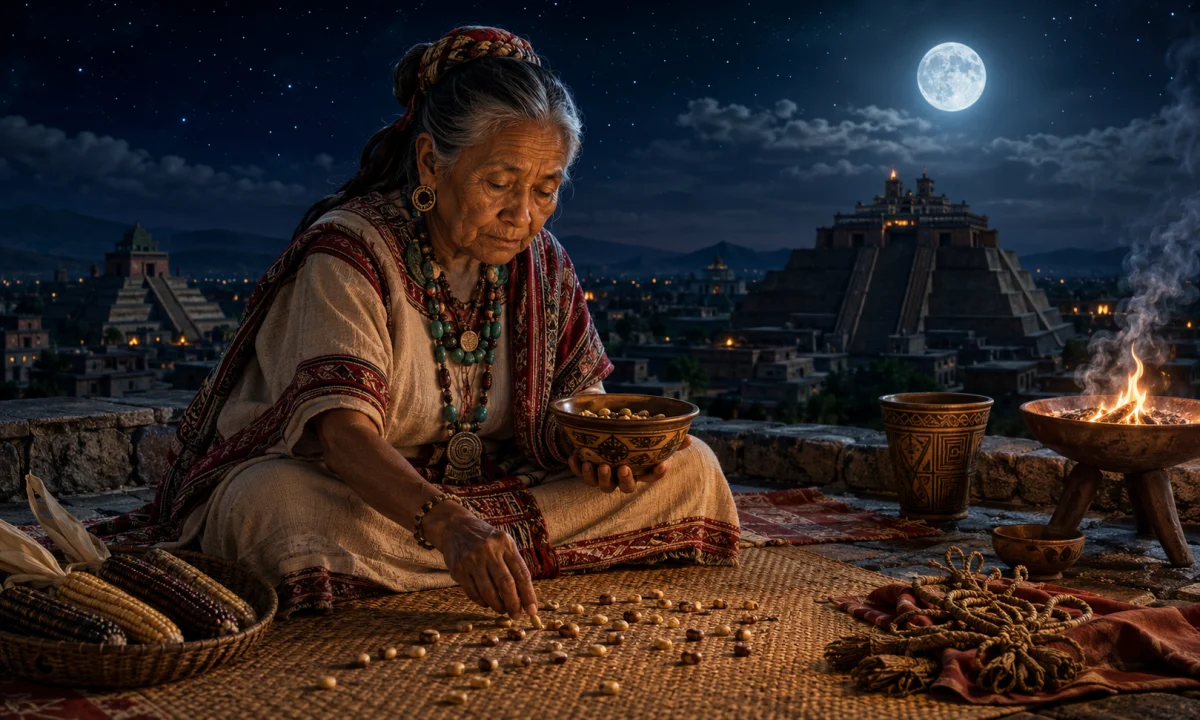
Oxomoco is an ancient Nahua figure associated with creation, divination and the keeping of ritual time. In Aztec and broader central Mexican traditions, she appears most often alongside Cipactonal, her male counterpart. Some colonial-era accounts describe the pair as the first human beings or as primordial elders who helped establish knowledge essential to human society, especially the calendar and systems of fortune-telling.
Oxomoco is not represented by one completely uniform tradition. The surviving accounts were recorded in the sixteenth century, after the Spanish conquest, by Indigenous informants, missionaries and colonial writers working in different contexts. As a result, her identity and role vary. She may be described as a first woman, an ancestral human, a divine elder or one of the original specialists in calendrical divination. These differences are important: there is no single ancient text that provides a universally accepted biography of Oxomoco.
Origins in Nahua tradition
Oxomoco belongs to the religious world of the Nahua peoples of central Mexico, including the Mexica, commonly called the Aztecs. Nahua religion did not consist of one fixed mythology shared in precisely the same form everywhere. Local traditions, priestly schools, dynastic histories and oral accounts could present the same sacred figures differently.
The best-known accounts of Oxomoco come from early colonial sources written in or translated from Nahuatl. These include traditions associated with the Florentine Codex, the Codex Chimalpopoca and other histories of Indigenous religion and creation. Such records preserve valuable information, but they must be read with care. They were produced after Christian missionaries and Spanish administrators had transformed the political and religious environment in which Nahua knowledge was transmitted.
In these traditions, Oxomoco and Cipactonal belong to an early stage of existence, before the fully ordered human world of cities, temples and established dynasties. Their antiquity is often expressed through their appearance as an elderly couple. Rather than being youthful heroes or rulers, they represent the remote ancestors of human knowledge.
Name and identity
The name is usually written Oxomoco, although colonial spelling varied because Nahuatl was being represented through the Spanish alphabet. The precise meaning of the name is not entirely secure. Proposed translations and etymologies differ, and a confident literal interpretation should not be treated as established fact.
Oxomoco is generally paired with Cipactonal. The two names occur together in discussions of the origin of divination and the calendar, and some sources present them as the first man and woman. Other accounts give them a more explicitly supernatural or ancestral status. The relationship between them is commonly understood as that of a couple, but the sources do not always define their relationship in the same way or emphasize marriage in the later, familiar sense.
Her classification is therefore flexible. Calling Oxomoco simply a “goddess” can be misleading if it suggests a sharply defined temple deity with one fixed domain. She is better understood as a primordial female ancestor and culture-bringer whose sacred importance lies in the knowledge she represents. In some accounts, that knowledge is granted or transmitted by higher gods; in others, Oxomoco and Cipactonal themselves perform the foundational act.
Oxomoco and the origin of divination
Oxomoco is especially associated with the beginning of divinatory practice. Divination was a central part of Mesoamerican religious life. It was used to interpret the qualities of days, determine auspicious or dangerous times, guide important decisions and understand the influence of sacred forces on human affairs.
The most important calendrical system connected with this tradition is the tonalpohualli, a cycle of 260 days. Each day combined a number from one to thirteen with one of twenty day signs. The resulting sequence was used by ritual specialists to assess the character of a day and its likely effects on people, ceremonies and events.
Colonial narratives credit Oxomoco and Cipactonal with discovering or establishing practices connected with this sacred count. In some versions, the pair cast lots using kernels of maize or another simple divinatory method. The act is not merely a game of chance. Maize was the foundation of settled life in Mesoamerica and carried deep associations with nourishment, fertility and the continuity of human communities. Using maize in a sacred procedure links the prediction of fate with the material basis of life.
Descriptions of the pair sometimes present them as the first astrologers or diviners. These terms reflect the language of colonial observers and should not be assumed to mean exactly what “astrologer” means in a modern European context. Their expertise concerned the sacred ordering of time, the character of days and the interpretation of signs. They stand at the beginning of a professional and religious tradition later represented by the tonalpouhque, the specialists who interpreted the 260-day calendar.
Oxomoco’s role is significant because it places a female figure at the origin of specialized intellectual and ritual knowledge. She is not merely a passive mother of humanity. In the traditions that name her as an inventor or practitioner of divination, she participates directly in the creation of systems used to understand the world.
The first woman and ancestral elder
Several Nahua creation traditions describe Oxomoco and Cipactonal as the first human pair or as the first ancestors. Their old age is meaningful. They are not necessarily elderly because they have lived through an ordinary human lifespan; rather, their age marks them as people from the beginning of the world, already possessing the authority of experience.
As an ancestral woman, Oxomoco can be connected with the transmission of practical and ritual knowledge. The stories do not consistently provide a long list of inventions attributed to her, and later summaries sometimes exaggerate her role by presenting her as the universal inventor of all human arts. The strongest and most recurring association is with divination, calendrical knowledge and the establishment of sacred methods for interpreting time.
Her partnership with Cipactonal also reflects a recurring Mesoamerican pattern in which complementary forces cooperate in the formation of the cosmos and society. This should not be reduced to a simple modern idea of “male and female balance,” because Nahua religious symbolism was more complex. Nevertheless, the pair’s joint activity shows that the origin of important knowledge could be represented through cooperation between a woman and a man rather than through a male figure alone.
Appearance and visual representation
There is no single universally agreed image of Oxomoco. Written descriptions identify her as an old woman, but the surviving manuscripts do not always label every figure clearly, and the interpretation of individual scenes can be uncertain. Some images thought to show Oxomoco and Cipactonal present aged figures engaged in acts of ritual calculation or divination. Their identification often depends on the surrounding scene, accompanying names or comparison with parallel traditions.
Oxomoco may be represented with signs of age and with objects associated by interpreters with spinning, household production or ritual practice. However, not every spindle, basket or seated female figure in an Aztec manuscript should automatically be identified as Oxomoco. Mesoamerican codices use complex visual conventions, and a figure’s identity cannot always be established from one attribute.
Nor should Oxomoco be imagined according to the standardized appearance of a later fictional goddess. Ancient Nahua beings could be represented through actions, calendrical signs, costumes and symbolic contexts rather than through a single fixed portrait. Her importance lies more in what she does than in a consistently repeated physical form.
Important narrative variations
The stories about Oxomoco differ in the way they explain her position at the beginning of time. In some accounts, a creator deity or a group of higher gods brings the first human pair into existence. Oxomoco and Cipactonal then become the recipients or founders of knowledge required by later humanity.
In other versions, the pair themselves carry out a foundational act, such as casting lots or establishing the calendar. This makes them active culture-bringers rather than merely the first people created by someone else. The distinction is not always clear in translated accounts, partly because colonial authors combined material from different oral and written traditions.
Their names also occur in narratives about the creation and ordering of the world, but they should not be treated as protagonists in every Nahua creation story. Accounts of the Five Suns, the birth of the gods, the creation of humans from ancestral bones and the founding of the Mexica people involve different groups of beings and different narrative purposes. Oxomoco’s most securely recognizable sphere is the origin of divinatory and calendrical knowledge, not every stage of cosmic creation.
Relationship with Cipactonal
Cipactonal is Oxomoco’s usual companion and counterpart. He is likewise associated with the first human generation, divination and the interpretation of sacred time. Some accounts assign particular actions to one figure, while other accounts describe the pair collectively.
The name Cipactonal is sometimes connected by modern writers with cipactli, the crocodilian or earth-monster being that gives its name to the first day sign of the tonalpohualli. The exact relationship between the name of Cipactonal and the day sign is not simple enough to justify treating him as the same being as Cipactli. Cipactonal and Cipactli should be kept distinct. One is the male partner of Oxomoco in traditions about primordial diviners; the other is a major cosmic creature and calendrical sign with its own mythology.
Oxomoco and Cipactonal are also distinct from the many creator pairs and divine couples found elsewhere in Mesoamerican religion. Their association with the calendar does not make them identical with Ometecuhtli and Omecihuatl, the male and female aspects of the dual creator principle in some Nahua accounts. Nor are they simply alternate names for Coatlicue, Cihuacoatl or other powerful female figures.
The religious significance of sacred time
Oxomoco’s importance becomes clearer when the calendar is understood as more than a method of counting days. In Nahua thought, time had qualities and agencies. A day sign was not neutral: it could carry favorable, dangerous or mixed influences. Birth under a particular combination of number and sign could affect a person’s character and prospects, while ceremonies and undertakings were planned with attention to the sacred count.
To establish a calendar was therefore to make the world interpretable. The calendar connected human decisions with the movements and powers believed to shape existence. The figure who first discovers or teaches divination is not simply an inventor of a technical system. She is an intermediary between people and the hidden pattern of the cosmos.
Oxomoco can consequently be read as a personification of inherited wisdom. Her old age conveys memory, while her role in divination conveys the ability to recognize relationships between visible events and unseen forces. Her gender is also meaningful within the stories: a woman stands among the earliest authorities on the interpretation of time, fate and ritual order.
Historical interpretation
Scholars have interpreted Oxomoco in several ways. Some emphasize her status as a primordial ancestor, while others focus on her as a divine inventor or patron-like figure of diviners. Another approach treats the pair as mythic representations of the ritual specialists who maintained the calendar in historical Nahua communities.
These interpretations are not mutually exclusive, but none should be presented as the only certain meaning. Mythic figures often combine human, ancestral and divine qualities. A person can be the first human woman in one narrative context and a sacred embodiment of knowledge in another.
It is also important to distinguish Indigenous tradition from later scholarly reconstruction. The surviving accounts do not provide a systematic theology of Oxomoco, nor do they describe a large independent cult devoted exclusively to her. Her significance is inferred from her narrative roles, her pairing with Cipactonal and her connection with divination. Claims that she was universally worshipped as the supreme Aztec goddess of the calendar go beyond the evidence.
Oxomoco in modern culture
Oxomoco appears occasionally in modern discussions of Aztec mythology, Mesoamerican women and the history of divination. She has particular relevance in interpretations that highlight female intellectual authority and the role of women in the preservation of ritual knowledge. Such readings can draw attention to an important feature of her tradition, but they are modern interpretations rather than direct statements made by the surviving colonial sources.
She is less prominent in mainstream popular culture than figures such as Quetzalcoatl, Huitzilopochtli or Coatlicue. Modern artworks, games and fantasy settings may expand her into a fully developed goddess with specific powers, clothing and mythological relationships. Those creative versions should be distinguished from the more limited but historically significant evidence: Oxomoco was a primordial female figure, commonly paired with Cipactonal, and associated above all with the beginnings of divination and sacred calendrical knowledge.