WORLD
WORLD
Cipactli
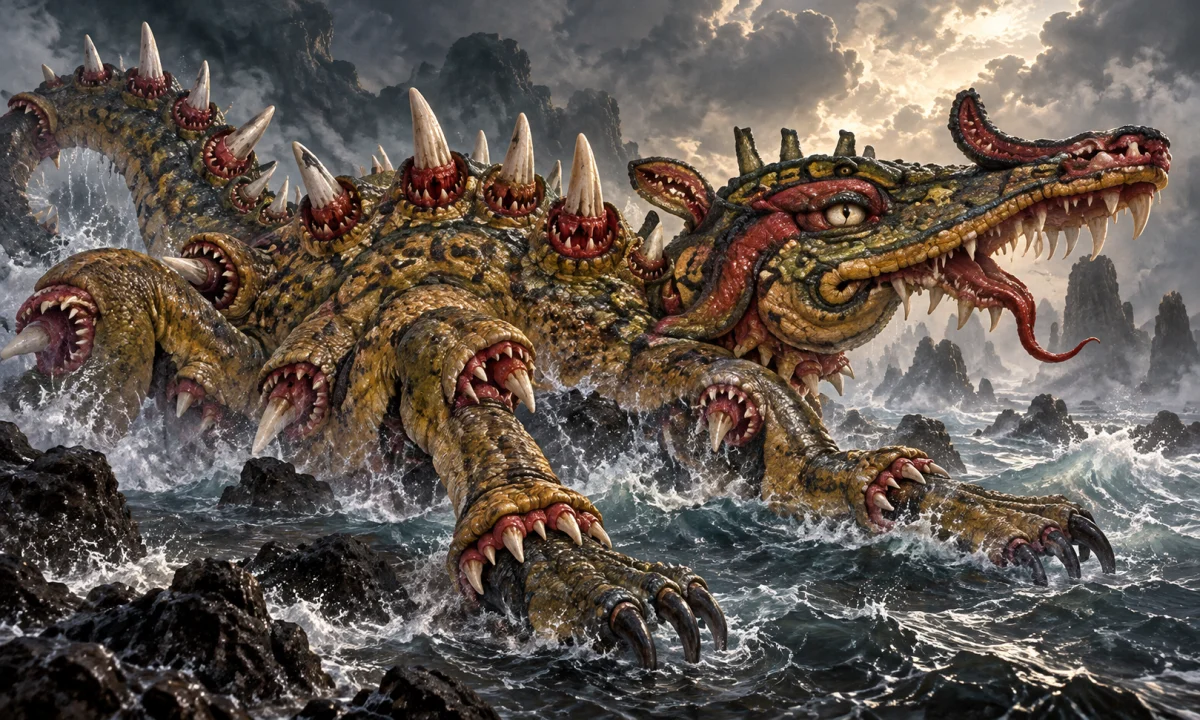
Cipactli is a primordial aquatic monster in Aztec and broader Nahua creation traditions. Described as a crocodile-like, fish-like, or otherwise monstrous creature that lived in the waters before the ordered world existed, Cipactli became the substance from which the earth was made. The name also belongs to the first day sign of the 260-day ritual calendar, so Cipactli is connected both with the creation of the world and with the organization of sacred time.
Origins in Nahua tradition
Accounts of Cipactli survive through early colonial records written in or translated from Nahuatl traditions. These sources include the Leyenda de los Soles, the Historia de los mexicanos por sus pinturas, and other compilations that preserve stories associated with central Mexican peoples. They were recorded after the Spanish conquest, and their wording, emphasis, and details are not identical. As a result, there is no single version of the Cipactli story that represents every Aztec or Nahua tradition.
In the creation narratives, the earliest world is often presented as a watery and unstable realm. Before the familiar earth had been formed, the gods encountered Cipactli in the primeval waters. The creature was enormous, dangerous, and difficult to control. In one widely known account, the gods Quetzalcoatl and Tezcatlipoca joined together to overcome it. They used the monster’s body to create the earth, transforming a living being into the landscape inhabited by gods and humans.
The broad pattern is consistent across related accounts, but the details vary. Some versions emphasize Cipactli as a great fish or crocodile-like beast. Others describe it as having unusual combinations of animal features, including a mouth filled with teeth and numerous joints or limbs. The surviving texts do not provide a single standardized portrait. Modern illustrations that show Cipactli as a conventional crocodile are therefore useful approximations, not definitive depictions.
The meaning of the name
Cipactli is commonly translated as “crocodile,” although the creature in myth is more than an ordinary animal. Nahuatl animal names and descriptions do not always correspond neatly to modern zoological categories. Depending on the source and translation, Cipactli may be rendered as a crocodile, caiman, alligator-like monster, or aquatic beast. Some descriptions also give it fish-like qualities, reflecting its existence in the primordial waters.
The word should not automatically be understood as the personal name of a fully individualized god in the same way that Quetzalcoatl or Tezcatlipoca is. Cipactli is a named mythic creature and a calendar sign, and some interpretations treat the figure as a cosmic monster or personified force rather than as a deity with a consistent cult and biography. The surviving evidence does not establish a separate, universally recognized temple cult devoted exclusively to Cipactli.
Cipactli and the creation of the earth
The central story begins with the world not yet arranged into its familiar form. In versions involving Quetzalcoatl and Tezcatlipoca, the two gods encounter Cipactli floating or moving through the waters. Its strength and appetite make it a threat, but its body also contains the material needed to produce a stable world.
The gods attack or seize the creature and divide its body. From different parts of Cipactli they create the earth’s features: mountains, valleys, plains, and other elements of the landscape. The exact allocation of body parts differs in retellings, and not every source describes the process in the same way. The important idea is that the earth is formed from a living, dangerous primordial being rather than created from inert matter alone.
This act is not presented as a simple peaceful act of construction. The new earth retains something of Cipactli’s animate and hazardous nature. In some accounts, the gods or other divine powers must compensate the earth for the violence done to the monster. Offerings, sacrifices, or the nourishment of the earth become part of the relationship between humans, gods, and the land. These motifs help explain why the earth in Mesoamerican religious thought could be both generous and demanding.
The story also expresses a recurring Mesoamerican concept: the world is alive and requires reciprocal care. Agricultural abundance does not come from a passive landscape. Crops, rain, fertility, and human survival depend on maintaining relationships with powerful forces embodied in the earth. Cipactli’s transformation therefore serves as a creation story, but it also provides a mythic background for obligations toward the land.
Appearance and attributes
Cipactli is generally imagined as a monstrous creature with reptilian and aquatic characteristics. The most common modern description is crocodile-like, but early sources can be less precise. The creature may have a large toothed mouth, a broad body, and multiple limbs or appendages. Some accounts give it features that do not belong to any ordinary animal, reinforcing its status as a being from the time before the present cosmos.
Its dangerous mouth is especially significant. Cipactli is sometimes described as capable of devouring whatever came near it, making the creature a fitting embodiment of untamed primordial appetite. The monster is not evil in the later Christian sense. Rather, it represents a force that exists before the ordered human world and must be transformed, divided, or ritually managed before creation can become habitable.
Because Cipactli’s body becomes the earth, its attributes are often interpreted in relation to the land’s fertility and instability. The earth can feed living beings, but it also receives the dead and may demand offerings. Mountains and fields can sustain communities, while earthquakes, droughts, floods, and crop failure reveal the land’s destructive power. Cipactli provides a mythic image for this double character: the earth is productive and necessary, yet never entirely safe or passive.
The first day sign of the ritual calendar
Cipactli is also the first day sign in the tonalpohualli, the 260-day ritual calendar used by Nahua peoples and related Mesoamerican cultures. The calendar combined twenty day signs with the numbers one through thirteen, producing a repeating cycle. The sequence begins with 1 Cipactli in many presentations of the system.
As a calendar sign, Cipactli is not simply a repetition of the creation monster. Its position at the beginning of the cycle associates it with beginnings, emergence, and the ordering of time. The first sign can be understood as marking the opening of a complete sacred sequence, although interpretations of the sign’s personal and ritual implications vary among sources and scholars.
Day signs could be used in divination and in assessing the qualities of a day. A person’s birth date within the 260-day cycle could be considered meaningful, and ritual specialists interpreted combinations of day signs and numbers. The surviving sources do not support a single universal list of personality traits for those born under Cipactli. Modern descriptions sometimes assign fixed qualities such as ambition, leadership, or aggression, but these should be treated cautiously because they often combine scholarly reconstruction with modern esoteric interpretation.
The connection between the first day sign and the earth-making monster is substantial, but it does not mean that every use of the word Cipactli refers to the entire creation narrative. In one context, it names a cosmic creature; in another, it identifies a day in the calendar. These meanings overlap symbolically without being identical.
Cipactli, the earth, and divine nourishment
The transformation of Cipactli into the earth reflects a larger religious understanding of creation as a process involving sacrifice and reciprocity. The gods’ work produces a habitable world, but the world itself remains a source of divine power. Humans depend on earth, rain, plants, and seasonal cycles, while the gods and the earth require offerings, ritual attention, and proper conduct.
This pattern is visible in the importance of earth-related powers in Aztec religion. The earth could be represented through goddesses and other figures associated with fertility, agriculture, death, and childbirth. However, Cipactli should not simply be equated with any one of these deities. The primordial monster’s body is the raw cosmic substance of the earth, whereas figures such as Tlaltecuhtli have more developed identities and iconographic traditions connected with the earth.
Some scholars describe Cipactli as feminine or connect the creature with an earth mother, especially when interpreting the earth as a generative body. Yet the surviving traditions do not present a uniform gender for Cipactli. Nahua mythic beings can have shifting or context-dependent identities, and early Spanish-language records do not always preserve grammatical and cultural distinctions consistently. It is safer to say that Cipactli is an earth-forming primordial being whose gender varies or remains uncertain in the sources.
Relationship to Quetzalcoatl and Tezcatlipoca
The most familiar creation episode places Cipactli in conflict with Quetzalcoatl and Tezcatlipoca. These two gods frequently appear as complementary and competing cosmic powers in Nahua accounts of creation and destruction. Quetzalcoatl is associated with wind, knowledge, priesthood, and the restoration of humanity in several traditions, while Tezcatlipoca is linked with night, rulership, conflict, fate, and transformation. Their roles are complex and cannot be reduced to a simple opposition between good and evil.
In the Cipactli story, their cooperation is more important than any straightforward moral contrast. Together they overcome the monster and turn its body into the earth. The episode presents creation as the result of divine struggle and collaboration. It also contributes to the broader image of the two gods as agents who repeatedly reshape the cosmos.
Some accounts say that Tezcatlipoca loses a foot or limb during the struggle with Cipactli. This detail is often connected with his well-known iconography, in which one foot may be replaced by an obsidian mirror, a snake, or another symbolic element. The exact relationship between the creation story and every form of Tezcatlipoca’s imagery is not identical in all sources, so the missing-foot motif should not be treated as a universally fixed explanation for his appearance.
Distinction from Tlaltecuhtli
Cipactli is sometimes confused with Tlaltecuhtli, an earth deity represented in striking sculptural and pictorial forms. The names are related in modern discussions because both figures are associated with the earth and with a frightening, open-mouthed body. They are not simply the same being under different names.
Tlaltecuhtli appears in Aztec religious art as a powerful earth entity, often shown crouching, with clawed limbs, a prominent mouth, and bodily features associated with birth, death, and the consumption of offerings. Cipactli, by contrast, is primarily known from creation narratives and from the first day sign of the ritual calendar. The two figures may share themes of earth, appetite, and cosmic danger, but the evidence does not justify collapsing them into one figure.
They should also be distinguished from Cipactonal, a separate figure whose name resembles Cipactli. Cipactonal is associated in some traditions with divination and with the origins of calendrical knowledge, often alongside Oxomoco. The similar names likely contribute to confusion, but Cipactonal is not simply another name for the crocodile-like earth monster.
Variants and limits of the evidence
Knowledge of Cipactli comes through sources produced in a period of major cultural change. Indigenous traditions were recorded by Indigenous informants, Nahuatl-speaking scribes, and Spanish missionaries or historians, sometimes through translation and adaptation. Some texts preserve material from different communities or periods. Differences between accounts may reflect local variation, changes in transmission, the purposes of the recorders, or the difficulty of translating religious concepts across languages.
For that reason, statements about Cipactli’s exact sex, size, anatomy, and relationship to particular deities should not be presented as universally settled. One source may call the creature a fish, another may emphasize crocodilian traits, and another may provide a more elaborate monster-like description. Modern illustrations often synthesize these details into a single recognizable design, but the historical evidence is more varied.
Nor is it certain that Cipactli was worshipped as an independent deity in every community that knew the name. The calendar sign had an important place in ritual time, while the monster appeared in cosmological narratives. Those functions establish religious significance, but they do not by themselves prove a standardized cult centered on a personified Cipactli.
Cultural significance
Cipactli’s importance lies in the way the figure joins several fundamental ideas: the earth’s creation, the danger of uncontrolled nature, the beginning of sacred time, and the obligations created by divine sacrifice. The earth is not merely a setting for human history. It is made from a powerful being and continues to possess agency, appetite, and the capacity to sustain or destroy life.
The story also challenges the assumption that creation myths must describe a peaceful act of divine design. In Cipactli’s case, a world suitable for gods and humans emerges through confrontation with a primordial creature. Order is carved out of chaos, but the original force is not entirely erased. It remains present in the earth and in the recurring calendar sign that begins the ritual cycle.
Reception in modern culture
Cipactli appears today in books, games, artworks, educational media, and online discussions of Aztec mythology. Modern adaptations often portray the figure as a giant crocodile, a sea monster, or a dragon-like earth beast. Such designs can communicate the creature’s threatening and primordial character, but they are artistic interpretations rather than standardized images preserved from antiquity.
Some contemporary treatments also turn Cipactli into a conventional villain or assign it a fixed gender, personality, or set of supernatural powers. Traditional sources support its role as a dangerous cosmic being, but they do not provide a complete character profile of the kind common in modern fiction. The most historically grounded understanding remains that Cipactli is a primordial aquatic monster, the substance of the earth in creation traditions, and the first sign of the sacred 260-day calendar.