WORLD
WORLD
Tzitzimime
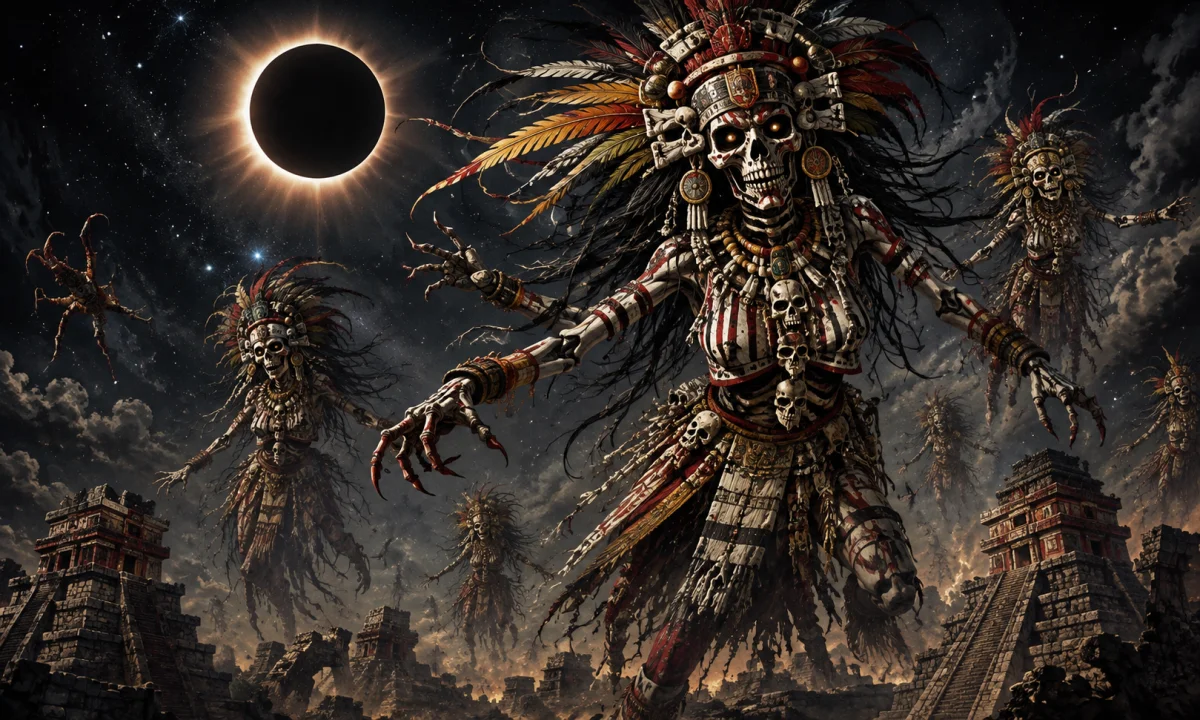
Tzitzimime are terrifying celestial beings in the religious traditions of central Mexico, especially those recorded among Nahua-speaking peoples of the Aztec Empire. They are often described in English as “star demons,” “star monsters,” or “female demons,” although each translation captures only part of their meaning. In Nahua accounts, the Tzitzimime were associated with the night sky, eclipses, cosmic danger and the possibility that the ordered world could collapse. Their name and nature vary between sources, and they should not be reduced to generic demons in the Christian sense.
Name and spelling
The singular form is usually written tzitzimitl, while the plural is commonly given as tzitzimime or tzitzimimeh. English-language works also use tzitzimime as a general name for the beings. Colonial transcriptions of Classical Nahuatl were not completely standardized, so spelling differences are expected.
The exact etymology of tzitzimitl is uncertain. Dictionaries and modern interpretations do not agree on a single literal meaning, and translating the word simply as “demon” can be misleading. Spanish missionaries often used Christian vocabulary to describe unfamiliar Indigenous beings. Such translations communicate that the Tzitzimime were dangerous supernatural powers, but they can also suggest a strict opposition between good and evil that was not necessarily present in Nahua religious thought.
Cultural setting and surviving traditions
The Tzitzimime belong to the cosmological and ritual world of central Mexico during the Late Postclassic period, particularly the centuries before the Spanish conquest. Much of what is known about them comes from accounts written after the conquest by Spanish friars working with Nahua informants. The most important written record is the Florentine Codex, compiled in the sixteenth century under the direction of Bernardino de Sahagún. Other colonial manuscripts and painted screenfolds preserve related names, images and beliefs.
These records are invaluable but do not provide a single, uniform account. They combine Indigenous testimony, missionary questions, European categories and the interpretations of colonial scribes. A description in one source may emphasize the Tzitzimime as stars, while another presents them as monstrous women who descend from the heavens. Painted manuscripts also use visual conventions that do not always identify a figure by name. For this reason, claims that every skeletal female deity in an Aztec manuscript is a Tzitzimitl are unreliable.
The Tzitzimime were understood within a universe governed by cycles. The sun, the seasons, the calendar and the continuation of human life depended on the maintenance of a fragile cosmic order. Darkness was not merely an absence of light; it could signal the return of dangerous powers held at the edge of the ordered world. The Tzitzimime occupied that threatening boundary between the heavens and the earth.
Celestial beings and cosmic danger
One of the most persistent descriptions of the Tzitzimime presents them as beings connected with the stars. They were sometimes characterized as star monsters or destructive celestial women. Their danger became especially vivid during an eclipse, when the normal relationship between the sun, moon and sky was disrupted.
In accounts of an eclipse, people feared that the sun might disappear permanently or that hostile beings might descend from the heavens. Some descriptions say that the Tzitzimime would come down and attack or devour human beings if darkness prevailed. These statements should be understood as part of a wider ritual and cosmological explanation of eclipses, not as evidence of a single standardized myth in which the Tzitzimime always behaved in exactly the same way.
Their role was also associated with the end of a cosmic age. Nahua traditions described successive world eras, often called “Suns” in modern scholarship. The present world was believed to be vulnerable to catastrophe, including earthquakes and the failure of the sun. In some accounts, the Tzitzimime would descend at the final destruction of the current age. They therefore represented not only nighttime threats but also the possibility that the entire human order could be overturned.
The New Fire ceremony
The fear of cosmic interruption was particularly important during the New Fire ceremony, held at the completion of a fifty-two-year calendrical cycle. This cycle resulted from the alignment of the 260-day ritual calendar and the 365-day solar calendar. When the two cycles coincided, people faced the possibility that the sun might not rise again and that the current world might come to an end.
During the ceremony, priests extinguished fires throughout the region and carried out rites intended to renew the cosmic order. A new flame was kindled on the chest of a sacrificial victim at a sacred hill, traditionally identified as Huixachtlan. Once the fire had been successfully created, it was distributed and used to relight hearths across the community.
The Tzitzimime formed part of the danger imagined if this renewal failed. Without the new fire, darkness would prevail and the star beings could descend to consume humanity. The ceremony was therefore more than a calendar celebration. It expressed collective anxiety about the continuation of time, the survival of the sun and the responsibilities required to sustain the universe.
Colonial sources associate the last known pre-conquest New Fire ceremony with the year 1507, during the reign of Motecuhzoma Xocoyotzin. The ceremony itself belonged to a living religious system, but the surviving descriptions were written after the Spanish invasion and must be read in that historical context.
Appearance and attributes
Descriptions of the Tzitzimime commonly emphasize their frightening female form. They may be represented or described with skeletal bodies, exposed bones, claws, fangs, long hair or other features associated with death and predation. Some are shown as star-like or sky-dwelling beings, while others appear as monstrous women descending toward the earth.
These features should not be treated as a fixed portrait shared by every Tzitzimitl. The surviving material presents a category of dangerous beings rather than a single individual with one official appearance. Some representations that modern viewers identify as Tzitzimime may instead depict a named goddess, a dead woman, an underworld power or another supernatural figure.
Their skeletal imagery has several possible meanings. Bones could evoke death, the remains from which life was renewed, the destructive power of sacrifice or the vulnerability of the human body. In Mesoamerican religious art, a skeletal appearance did not always mean that a figure was simply evil. It could also indicate transformation, fertility through decay, ancestral power or a connection with the earth and the underworld.
Their most important “power” was therefore not a list of magical abilities in the modern fantasy sense. The Tzitzimime embodied the power of celestial darkness and cosmic disorder. They could descend when the normal structure of the universe failed, and their threat reinforced the need for ritual action, vigilance and renewal.
Itzpapalotl and the Tzitzimime
Itzpapalotl, whose name is usually translated as “Obsidian Butterfly,” is closely connected with the Tzitzimime in several traditions. She is sometimes described as a Tzitzimitl herself and, in some accounts, as a leader or queen of the group. Her character is complex. She is associated with obsidian, fire, warfare, sacrifice, the earth and celestial powers, and she can appear as both a dangerous skeletal figure and a powerful goddess.
Itzpapalotl should not automatically be treated as identical with all Tzitzimime. The Tzitzimime are a broader class or group of supernatural beings, while Itzpapalotl is a particular named figure with her own myths and cultic associations. The relationship between her and the group varies according to the source and the interpretive tradition.
Her famous imagery includes a butterfly form, sharp obsidian-like claws and a body marked by bones or skeletal features. Modern summaries sometimes present these characteristics as a standard description of every Tzitzimitl, but they belong most securely to Itzpapalotl and to particular artistic traditions. The overlap demonstrates how fluid categories of deity, monster, star power and death could be in Nahua religious thought.
Relationships with other dangerous female beings
The Tzitzimime are often confused with the cihuateteo, the spirits of women who died during childbirth. Both groups can be described as dangerous female supernatural beings, and both may be linked in modern discussions with the night, crossroads or threatening forms of death. They are nevertheless distinct categories in the surviving traditions.
The cihuateteo were dead women who had achieved a special, frightening status because death in childbirth was understood as comparable to death in battle. They were believed to accompany the sun for part of its daily journey and could haunt crossroads on certain calendrical days. Their danger was connected with their condition as the dead and with the ritual significance of childbirth.
The Tzitzimime, by contrast, were primarily celestial or cosmic beings. Their defining associations involve stars, eclipses, darkness and the possible destruction of the world. Some imagery overlaps, particularly skeletal or female imagery, but resemblance does not prove that the two groups were the same.
Other figures are also sometimes folded into the category without sufficient evidence. Coyolxauhqui, the lunar or celestial warrior figure who is defeated by Huitzilopochtli in the story of Coatepec, is linked with stars and nighttime powers, but the surviving accounts do not make her simply interchangeable with the Tzitzimime. Likewise, Coatlicue and Cihuacoatl possess associations with death, fertility and frightening female power, yet each has a distinct identity and religious history.
Symbolism and religious significance
The Tzitzimime reveal how strongly Nahua religion connected celestial events with human vulnerability. An eclipse could be observed as an astronomical event while also being interpreted as a moment of ritual danger. The stars were not distant objects separated from human life; they were active powers within a living cosmos.
Their female identity is also significant, although it should not be interpreted through a simple opposition between “female” and “evil.” Nahua traditions included many powerful female deities and spirits associated with birth, agriculture, sexuality, warfare, earth, death and renewal. The Tzitzimime represented one threatening aspect of female and celestial power: the capacity to descend, consume and undo the structures that support ordinary life.
Their association with the end of the world does not mean that they were worshipped only as enemies. Dangerous powers could be acknowledged, feared and ritually addressed without fitting the modern category of a purely evil monster. Religious systems often include beings who must be respected precisely because they possess destructive force. The rites surrounding the calendar and the New Fire expressed the human attempt to maintain a relationship with such powers.
Traditional Tzitzimime and modern interpretations
In modern popular culture, Tzitzimime are often presented as female skeletons, star demons or apocalyptic monsters. These adaptations draw on genuine elements of the traditional material, especially their skeletal imagery, celestial origin and association with the destruction of the world. They frequently simplify the beings into a single villain or use the name for any frightening female figure from Aztec mythology.
That simplification can obscure their religious context. Traditionally, the Tzitzimime were not merely monsters invented for entertainment. They belonged to a calendrical and cosmological system in which eclipses, stars, ritual fire, sacrifice and the continuation of the sun were connected. Their meaning depended on the vulnerability of a cyclical universe, not only on their appearance.
Contemporary writers, artists and game designers may adapt the Tzitzimime creatively, but such versions should be distinguished from the evidence of Nahua traditions. The most historically responsible descriptions acknowledge that the sources vary, that colonial records mediate much of the surviving information and that the Tzitzimime were a group of complex celestial powers rather than one universally fixed character.