WORLD
WORLD
Mama Pacha
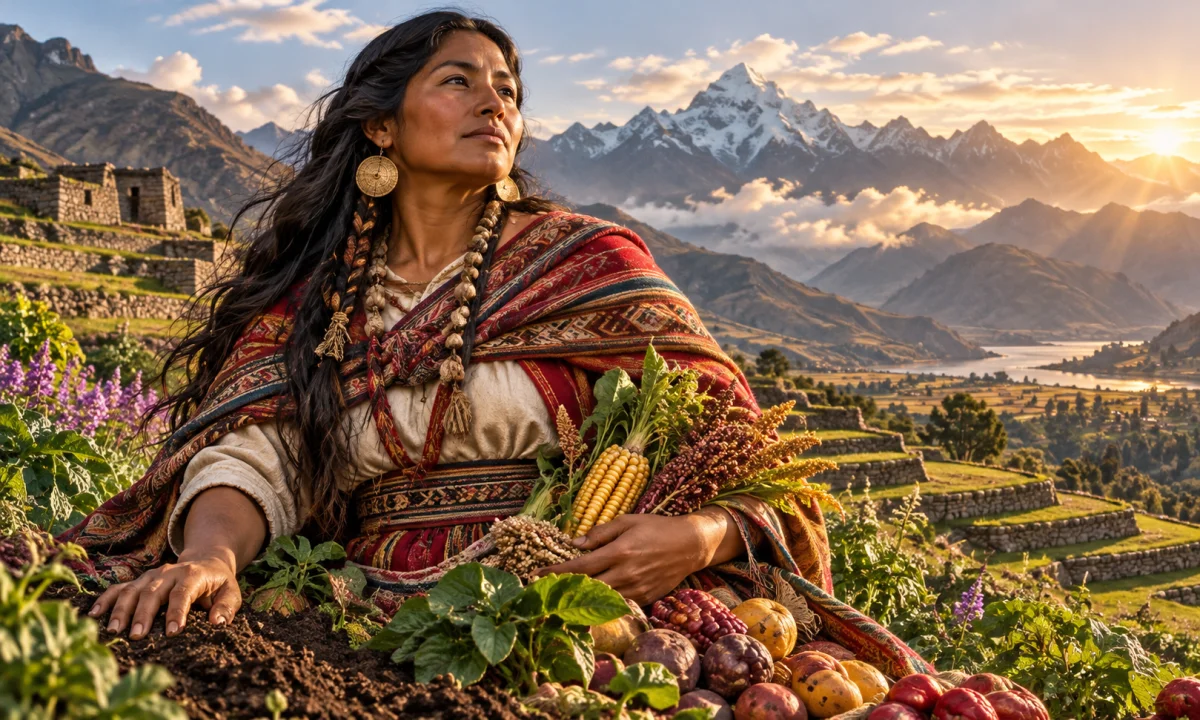
Mama Pacha is a name associated with the earth, the living landscape and the sustaining powers of the Andean world. It belongs to the religious and cultural sphere of Quechua-speaking peoples, including communities within the former Inca realm. The name is sometimes treated as another form of Pachamama, usually translated as “Mother Earth,” but the two forms are not always used in exactly the same way. In many contexts, “Mama Pacha” is a rearrangement or explanatory form of the better-attested name Pachamama; in others, it reflects local usage or modern retellings.
The figure connected with these names should not be imagined only as a goddess in the narrow classical sense. In Andean religious thought, the earth is a powerful, responsive presence that gives food, receives offerings, governs fertility and forms part of a larger sacred environment. Mountains, springs, fields, ancestors and cultivated places may all possess spiritual importance. Mama Pacha is therefore best understood through the relationships between people, land, animals, crops and sacred places rather than through a single fixed mythology.
Name and identity
The Quechua word pacha has a broad range of meanings. Depending on context, it can refer to the earth, the world, a place, a period of time or the ordered totality of existence. It does not correspond perfectly to the English word “planet” or to “nature.” The word mama means “mother,” and is also used respectfully for a female being or a nurturing power. Pachamama can consequently be rendered in several ways, including “Mother Earth,” “Earth Mother” or “Mother of the World.”
Mama Pacha uses the same two elements in the reverse order. This form appears in some descriptions of Andean belief, particularly in modern English-language and Spanish-language discussions, but it is not necessarily a separate ancient deity with a distinct biography. Spellings and forms vary because Quechua has several regional varieties and because early European writers represented Indigenous words according to Spanish orthographic conventions. The absence of a single standard spelling in older records does not by itself indicate different beings.
It is therefore important to distinguish three possibilities:
- Pachamama: the widely recognised Andean name for the earth-associated maternal power, especially in Quechua-speaking communities.
- Mama Pacha: a reversed form that may be used as a synonym, a regional expression or a modern explanatory name.
- A separate local figure: in some traditions, a local community may use a name in a way that differs from broader descriptions of Pachamama.
There is no reliable basis for assigning one universal appearance, genealogy or set of adventures to every being called Mama Pacha. Descriptions that give her a single standard family tree or a fixed list of powers often combine different Andean traditions or draw heavily on modern mythological summaries.
Andean religious setting
The Inca Empire, or Tawantinsuyu, incorporated a vast and culturally diverse region of the Andes before the Spanish conquest. Its territory included much of present-day Peru and parts of Bolivia, Ecuador, Chile and Argentina. The empire did not replace every local religious practice with one uniform system. Instead, Inca authorities incorporated important local shrines and deities into an imperial order while maintaining distinctive traditions in different communities.
Inca religion centred on relationships of exchange and obligation. Offerings were made to sacred powers, and people expected protection, fertility, good weather or prosperity in return. This principle is often described with the Quechua term ayni, meaning reciprocal assistance or mutual exchange, although its meaning extends beyond a simple transaction. A person did not merely worship an abstract earth goddess. They participated in a continuing relationship with fields, herds, ancestors, mountains and the powers believed to sustain life.
The earth was especially important in agricultural societies dependent on rainfall, irrigation, seasonal cycles and the careful cultivation of high-altitude land. The Andean environment includes severe ecological contrasts: high puna grasslands, fertile valleys, steep mountain slopes and dry coastal regions. Communities developed different agricultural practices for these settings, but all remained vulnerable to drought, frost, hail, flooding and crop disease. A maternal earth power represented both generosity and the consequences of failing to maintain proper relationships with the land.
In the Inca period, the earth was not necessarily understood as a passive material resource. Sacred places, known as huacas, could include springs, caves, stones, mountains, fields and constructed shrines. A huaca might be associated with an ancestral event, a local origin story or a particular protective power. Mama Pacha belongs to this wider sacred landscape, although she should not automatically be equated with every huaca or with every earth-related being.
Sources and historical evidence
Knowledge of Inca religion comes from a difficult and incomplete body of evidence. The Incas did not leave a surviving alphabetic religious scripture comparable to the Bible or the Qur’an. Information was transmitted through oral traditions, ritual practice, material remains, administrative systems and forms of record-keeping such as khipu. Most written descriptions were produced after the Spanish invasion by Europeans or by Indigenous authors writing within colonial conditions.
Colonial chroniclers often tried to fit Andean religious beings into categories familiar from European religion and classical mythology. They might describe a power as a “god,” “goddess,” “idol” or “demon,” even when the original concept did not match those categories. Some accounts also focused on the imperial religion of Cuzco and gave less attention to local practices. Other writers preserved valuable Indigenous information, but their works still reflect translation, Christian criticism, political agendas and changing social conditions.
For this reason, statements about Mama Pacha should be expressed with care. The evidence supports a longstanding Andean reverence for the earth and for maternal or generative powers, but it does not establish a universally standardised myth of Mama Pacha with one origin story and one canonical set of deeds. The name Pachamama is more prominent in descriptions of later Andean religious life, while “Mama Pacha” is often used as a variant in modern presentations.
Role and attributes
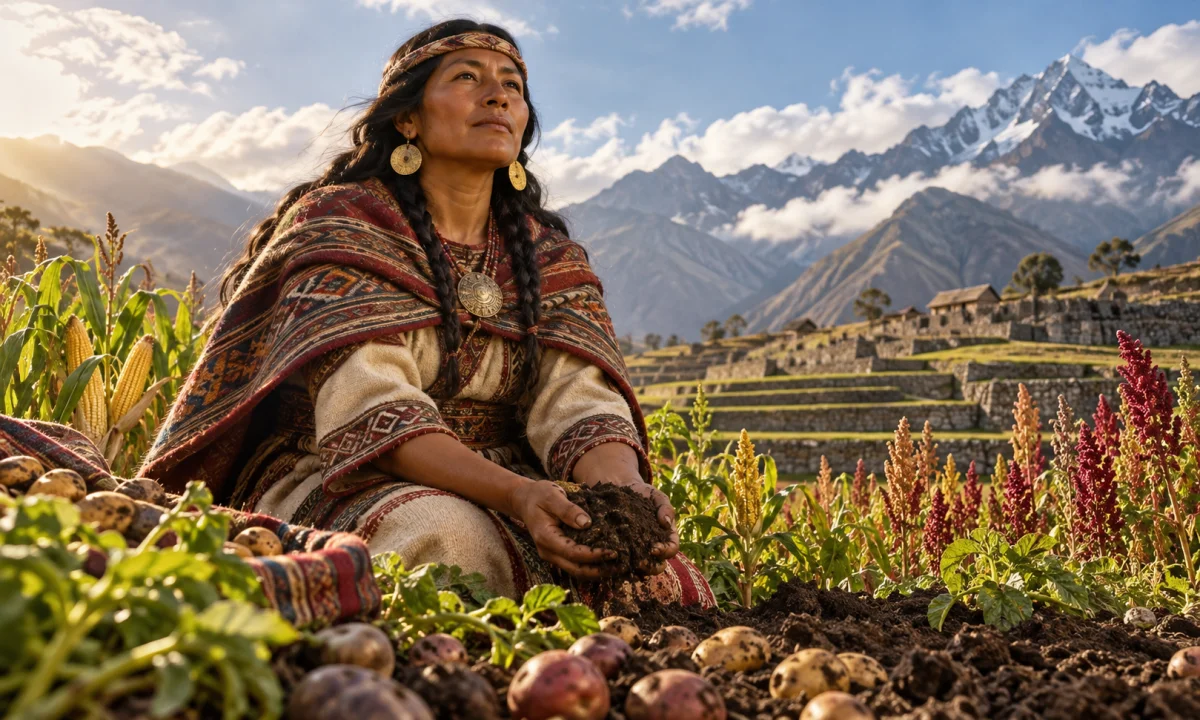
Mama Pacha is associated above all with fertility and sustenance. She is connected with the soil, planting, germination, harvests and the continuing ability of the land to feed human communities. Her maternal quality expresses nourishment, but it does not imply that the earth is endlessly generous. The earth must be treated with respect, and agricultural success depends on appropriate ritual, labour and environmental conditions.
Offerings to the earth may include food, drink, coca leaves, chicha, seeds, animal products or other valued substances. Practices differ greatly by region, community and historical period. In parts of the Andes, offerings are placed in the ground or near a household, field or sacred location. The well-known ritual sometimes called pago a la tierra, or “payment to the earth,” reflects the idea that people should give back to the power that sustains them. It is not accurate to reduce all such rites to one ancient ceremony, since forms and meanings vary.
Earth-related powers are also connected with domestic prosperity. A household’s food, animals and dwelling depend on a stable relationship with the land. In some communities, a new house, a field or a period of agricultural work may be marked by offerings. The ritual setting can include prayers to several sacred powers, including mountain beings and ancestral forces, rather than to an isolated Mother Earth figure.
Mama Pacha may also be described as a power of balance and reciprocity. Human beings receive from the land but must work, share and offer in return. This relationship includes moral dimensions: greed, disrespect or neglect may be understood as damaging the harmony on which communal life depends. Such ideas should not be presented as a simple ecological slogan, however. Andean ritual traditions are religious systems involving obligation, kinship, memory and place, not merely symbolic versions of modern environmentalism.
Appearance and personality
Traditional Andean representations of the earth power do not provide one agreed physical appearance for Mama Pacha. Modern illustrations may show an old woman, a fertile mother, a woman clothed in Andean textiles or a figure whose body merges with mountains, plants and soil. These images can communicate her maternal and agricultural associations, but they are artistic interpretations rather than a universally inherited portrait.
Some later folklore portrays Pachamama as a generous mother who rewards respectful people and becomes dangerous when neglected. Other traditions emphasise her appetite, her demands or her ability to withhold fertility. These contrasting qualities are not necessarily contradictory. The earth gives life, yet it can also produce famine, landslides, storms and disease. A sacred power that governs food and fertility may therefore be benevolent, formidable or both, depending on the situation.
Descriptions that present Mama Pacha as a beautiful young woman, a serpent-bodied goddess or the wife of a particular male deity should be treated cautiously unless tied to a clearly identified local tradition. Such details are common in modern mythological artwork and popular summaries, but they are not uniform features of Andean belief.
Relationships with other Andean powers
Mama Pacha is often discussed alongside Inti, the sun deity honoured by the Inca state, and Illapa, a name associated in colonial sources with thunder, lightning and rain. Agriculture depended on the interaction of earth, sunlight and water, so these powers could be understood as participating in a shared cosmic and agricultural order. This does not mean that every community arranged them into the same family or hierarchy.
Rain and mountain powers are especially significant. The high mountains, often called apus in Quechua-speaking contexts, may be regarded as powerful beings or sacred presences that protect communities and influence weather and water. In some traditions, the apus and Pachamama are addressed together or occupy complementary roles. The mountain is not simply a husband to the earth in a universal Andean myth; that relationship belongs to particular interpretations and should not be imposed everywhere.
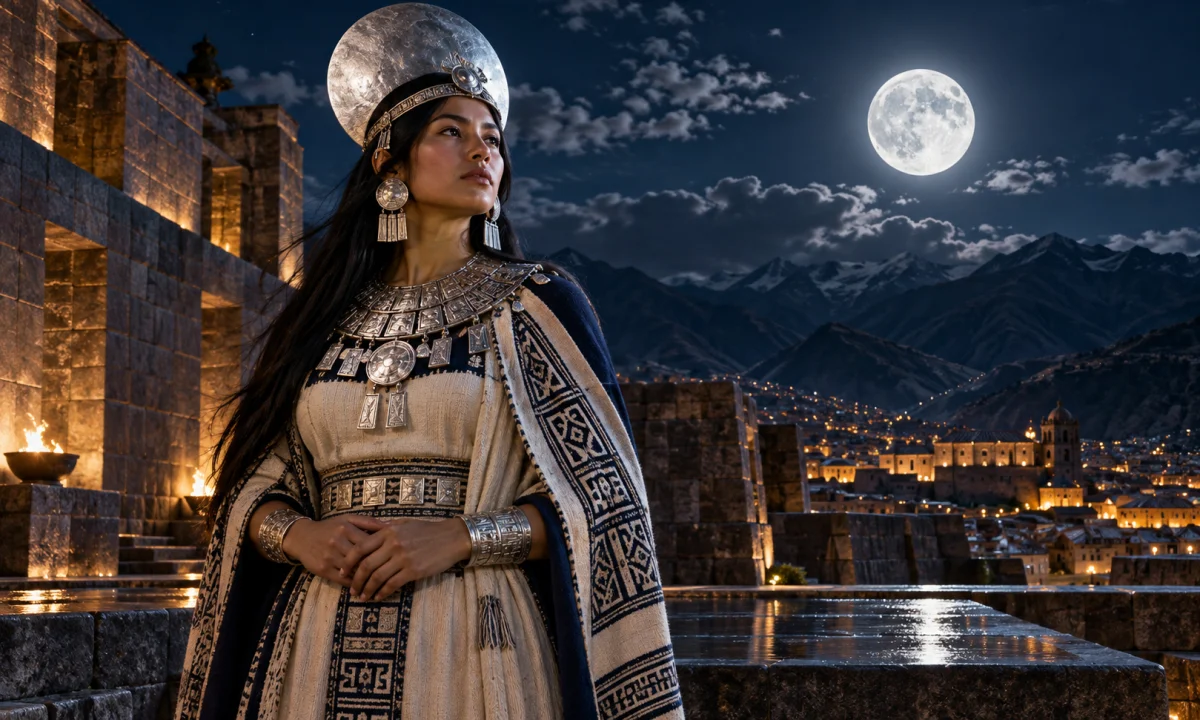
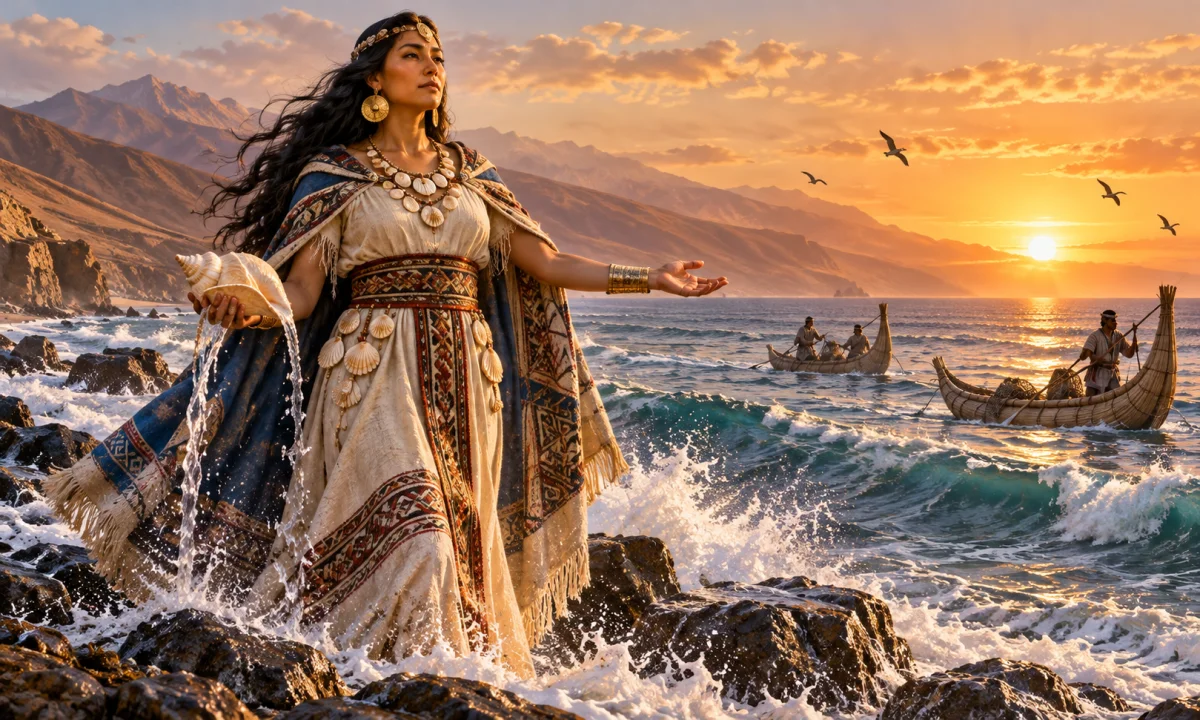
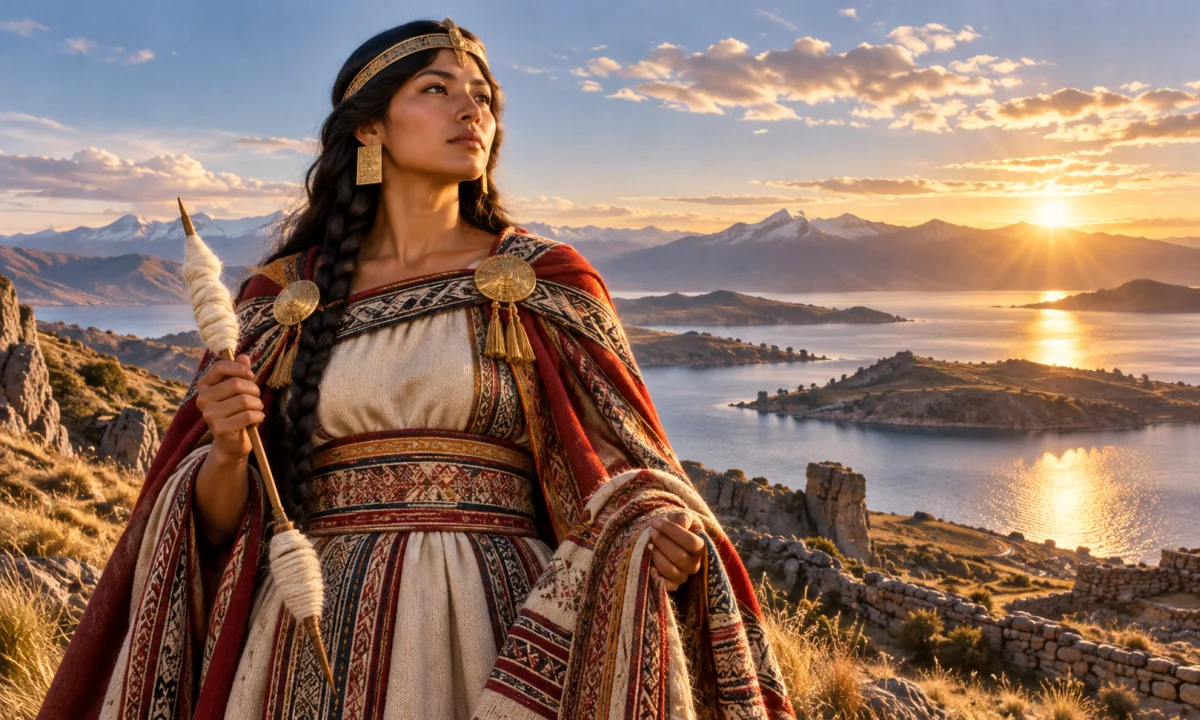
Other figures frequently mentioned in discussions of Inca religion include Mama Quilla, associated with the moon, and Mama Sara, associated with maize. Mama Cocha is connected with waters, especially the sea or large bodies of water, while Mama Ocllo is a culture heroine and ancestral mother in Inca origin traditions. These names contain the respectful element mama, but they are not automatically forms of Mama Pacha. Their roles should remain distinct.
Stories and local traditions
Unlike the Greek gods or the Norse gods, Mama Pacha does not have a single widely preserved cycle of narratives known throughout the Andes. The most important traditions are often embedded in ritual practice, local origin stories and relationships with particular places. A community may explain the origin of its fields, springs, ancestors or crops through a story that cannot be separated from the landscape in which it is told.
Some modern accounts describe Pachamama as a partner of Pachacamac, a powerful coastal deity whose name is also related to pacha. This pairing should not be treated as an established universal marriage. Pachacamac was a distinct and important religious power associated with a major sanctuary on the central Peruvian coast. The coastal religious setting, language and traditions connected with Pachacamac differed in important ways from those of the highland Quechua-speaking world. Later writers may place the two figures together because both are linked with the earth or world, but similar names do not prove a shared mythological relationship.
Likewise, stories in which Mama Pacha gives birth to all gods, creates humanity or rules a complete pantheon may be modern syntheses. Andean traditions include many creation and origin accounts, but they do not all assign these functions to one earth mother. Viracocha, the sun, ancestral founders, sacred mountains and local beings appear in different narratives and contexts.
Meaning in Andean life
The importance of Mama Pacha lies less in a fixed character biography than in a way of understanding life. People, animals, crops, water, mountains and ancestors are linked through reciprocal relations. Food is not merely produced by human labour; it depends on rain, soil, seasonal knowledge, communal cooperation and sacred powers. Ritual acknowledges that dependence and places agricultural work within a moral and religious framework.
This perspective also helps explain why the earth can be approached as a relative rather than as an object. Calling the earth “mother” expresses origin, nourishment and dependence, but it does not erase the need for discipline or reciprocity. Fields must be prepared, water managed and communal obligations fulfilled. Religious respect and practical labour are not separate activities.
At the same time, “Mother Earth” is an English approximation. It can make Andean religion sound more familiar than it really is and may encourage comparisons with Gaia, Demeter or other figures from unrelated traditions. The comparison may be useful at a broad symbolic level, but Mama Pacha belongs to specific Andean histories, languages and ritual relationships.
Continuity and modern representation
Reverence for Pachamama and related earth powers remains important in many Andean communities today, including communities shaped by both Indigenous traditions and Christianity. Religious life has often involved adaptation rather than a simple choice between “pre-Christian” and “Christian” belief. Catholic festivals, Indigenous offerings, prayers to saints, respect for mountains and agricultural rites may coexist, although the balance differs from place to place.
Public ceremonies connected with the earth are especially visible in contemporary discussions of Andean culture. In parts of the Andes, August is associated with offerings to Pachamama, though dates, procedures and interpretations vary. Such living practices should not be treated as museum survivals unchanged since the Inca period. Communities continue to reinterpret them in response to migration, farming changes, political movements, tourism, environmental pressures and religious diversity.
Modern popular culture often turns Mama Pacha or Pachamama into a universal ecological goddess. Films, games, fantasy novels, wellness writing and illustrated mythology books may give her a standard appearance, a romantic relationship or supernatural powers borrowed from several traditions. These portrayals can draw attention to Andean concepts, but they should not be mistaken for evidence of a single ancient canon.
The most accurate description of Mama Pacha is therefore a cautious one: she is a name associated with the sacred earth and its life-giving, demanding and reciprocal relationship with human communities in the Andes. In many cases the name refers to, or is a variant of, Pachamama rather than to a wholly separate Inca goddess. Its meaning depends on language, locality, historical source and the continuing traditions of the people who use it.