WORLD
WORLD
Mama Cocha
Mama Cocha, also written Mama Qocha, is a water mother or female personification of the sea and other great waters in Andean religious tradition, especially in accounts associated with the Inca world. Her name comes from Quechua: mama means “mother,” while qucha or cocha refers to a lake, lagoon, or body of water. Depending on the spelling system and regional usage, the name may therefore be translated as “Mother Sea,” “Mother Lake,” or more broadly “Mother of the Waters.”
Mama Cocha is not known from a single surviving Inca scripture or from one complete, standardized mythology. Knowledge of her comes from a combination of early colonial descriptions, Quechua religious vocabulary, later Andean traditions, and modern interpretations of Indigenous cosmology. These sources do not always describe her in the same way. In some contexts she is specifically associated with the ocean; in others, the name can refer to a sacred female power present in lakes, springs, rivers, and the waters that sustain human life.
Origins and cultural setting
The Inca Empire incorporated many peoples and religious traditions across the Andes, from the highlands around Cusco to the Pacific coast and the southern regions surrounding Lake Titicaca. Religious life was therefore not based on a single uniform system. Communities venerated local sacred places, mountains, springs, lakes, ancestors, and celestial powers, while the imperial state promoted certain major cults and connected them with the authority of the Inca ruler.
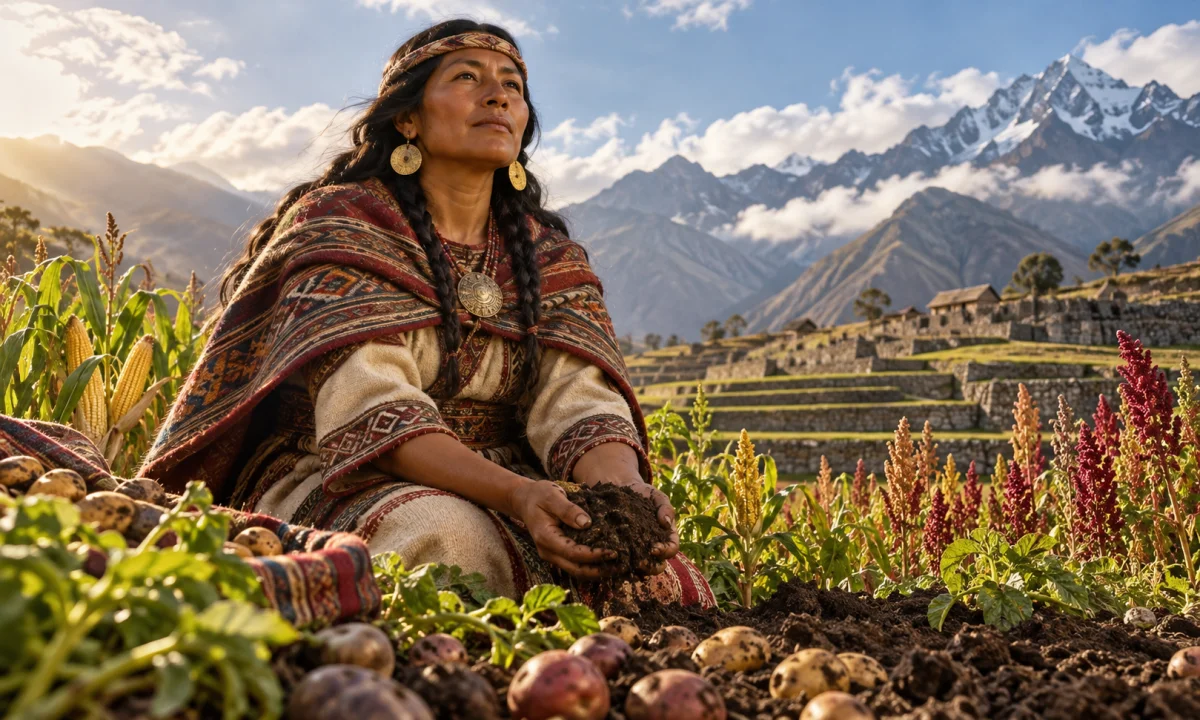
Water was central to this world. Andean agriculture depended on seasonal rain, mountain snowmelt, springs, irrigation canals, wetlands, and carefully managed rivers. The sea also supplied fish, shell ornaments, salt, and routes of travel along the Pacific coast. A large lake could be a source of food, a landmark, a sacred place, and a point of origin in local traditions. Water was consequently not merely a natural resource. It could be approached as a living and powerful presence that required respect, offerings, and ritual attention.
The name Mama Cocha reflects this attitude. Calling a great body of water “mother” expresses dependence, nourishment, and generative power. It does not necessarily indicate a goddess with a fixed human biography comparable to a figure in a literary pantheon. In many Andean traditions, sacred beings are closely connected with places and forces. A mountain, spring, lake, or ancestral site may possess agency and receive offerings. Mama Cocha belongs to this broad religious environment.
The name and its meaning
The spelling Mama Cocha is common in Spanish-language writing, while Mama Qocha follows a Quechua-oriented spelling. Other forms may appear because Quechua has several regional varieties and because early Spanish writers represented Indigenous sounds with Spanish orthography. The word cocha is widely used in Andean Spanish for a lake, pond, or body of water and derives from Quechua terminology.
The translation “Mother Sea” is useful when the figure is discussed as a maritime power, but it can be too narrow in other contexts. Qocha does not exclusively mean the ocean. It may refer to inland waters as well, and local interpretations can place Mama Cocha within a wider sacred geography. For that reason, “Mother of the Waters” is sometimes a more flexible translation.
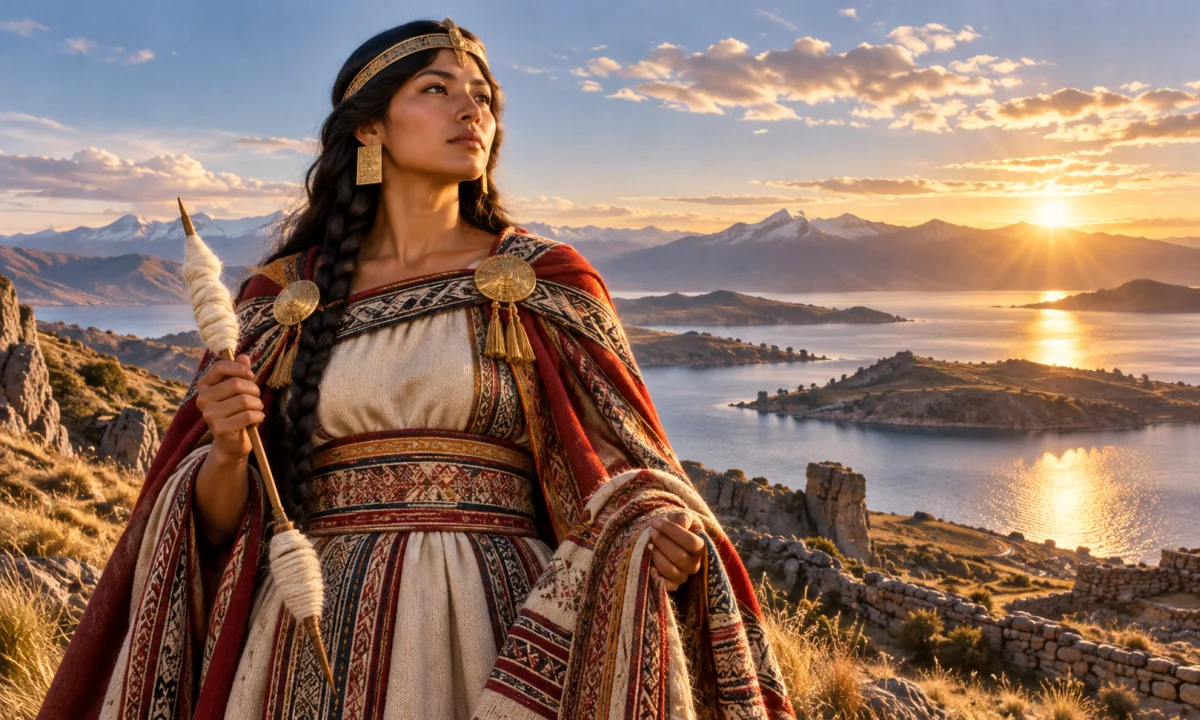
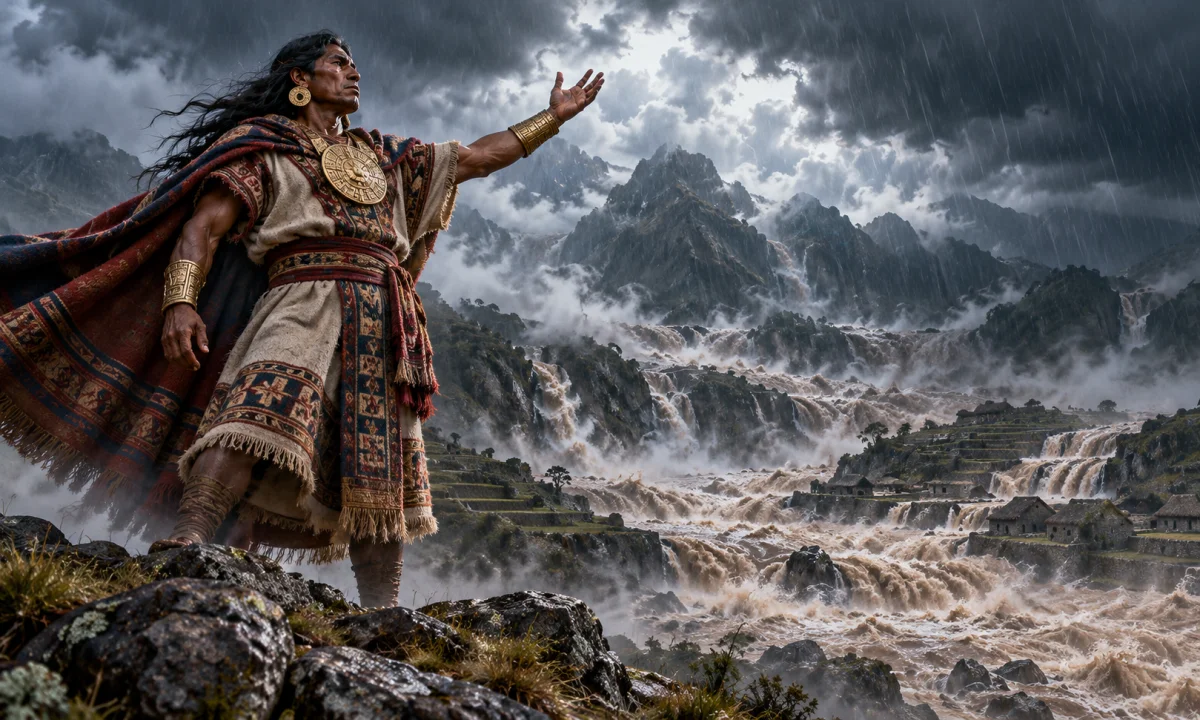
There is no universally agreed ancient image or physical description of Mama Cocha. Modern illustrations may portray her as a woman rising from waves, wearing shells, or accompanied by fish and sea birds. Such imagery communicates her association with water, but it should not automatically be treated as an authenticated representation from the Inca period.
Identity and classification
Mama Cocha is often called an Inca goddess, but that label requires some care. “Goddess” is a convenient English term for a female sacred power, yet Andean religious categories did not necessarily divide beings according to the same boundaries as classical Greek or Roman mythology. Mama Cocha may be understood as a personified water power, a sacred maternal presence, or a name for the spiritual force of a body of water.
Her status also varied according to location. An imperial religious framework might recognize major cosmic beings, while a particular community maintained its own relationship with a local lake, spring, river, or coastal site. These levels of tradition could overlap without producing a single official doctrine. As a result, descriptions of Mama Cocha should not imply that every Inca community worshipped an identical figure with the same rituals and stories.
Colonial observers often recorded Andean beliefs through Christian and European categories. They might describe a sacred being as a “god,” “goddess,” idol, or demon, even when the original concept had a different meaning. In addition, missionaries and chroniclers selected what they considered important, misunderstood Indigenous languages, or interpreted local practices through their own religious assumptions. The surviving evidence is therefore valuable but incomplete.
Water, fertility, and nourishment
Mama Cocha’s most consistent associations are with water, nourishment, fertility, and the continuation of life. Water feeds crops, animals, and people; it also links highland and coastal environments through rain, rivers, and the movement of water from mountains toward the sea. A maternal water figure naturally expresses the idea that human communities receive life and sustenance from a power greater than themselves.
Her role should not be reduced to fertility in a purely human or sexual sense. In Andean contexts, fertility includes the productivity of fields, the health of herds, the abundance of fish, the renewal of vegetation, and the regular return of rain. The sea can be both generous and dangerous, providing food while threatening boats and settlements. A maternal sacred power may therefore represent protection and abundance, but also the need to maintain a respectful relationship with forces that cannot be controlled completely.
Water’s movement also gives Mama Cocha a symbolic connection with change and circulation. Rivers carry water from the mountains toward the ocean, rain returns moisture to the land, and lakes hold water that supports surrounding communities. These relationships do not prove that the Inca possessed a single abstract theory of a water cycle personified as Mama Cocha. They do, however, help explain why water could be imagined as a living, relational power rather than as an inert substance.
Relationship to Andean sacred geography
Andean religion frequently treated particular places as sacred. Mountains known as apus could be approached as powerful protectors, while springs, caves, fields, and ancient settlements could also have religious importance. Lakes were especially significant because they could be sources of food, irrigation, travel, and origin traditions.
Lake Titicaca held an important place in southern Andean religious history. In traditions recorded after the Spanish conquest, it is associated with the origins of the sun, the Inca people, or ancestral founders. These traditions belong to a complex body of mythology involving figures such as Viracocha, Manco Capac, and Mama Ocllo, depending on the version. Mama Cocha should not simply be substituted for any of these figures. Her name may evoke the sacred power of the lake or of water generally, but the surviving origin stories do not establish a universal identification between Mama Cocha and Lake Titicaca itself.
Likewise, coastal peoples maintained religious traditions that were not merely copies of highland Inca beliefs. When the Inca expanded toward the Pacific, they encountered established societies with their own gods, sacred places, temples, and ritual specialists. A broad water-mother concept could be adapted to local circumstances, but evidence does not justify assuming that all coastal traditions used the name Mama Cocha in exactly the same way.
Attributes and representations
Traditional descriptions of Mama Cocha are less detailed than modern depictions of many mythological figures. The available material supports several broad attributes:
- Maternal power: Her name presents water as a sustaining and generative mother.
- The sea and lakes: She is associated with major bodies of water, although the precise emphasis varies by source and region.
- Abundance: Her sphere includes the food and fertility made possible by water, including agriculture and aquatic resources.
- Protection and danger: Water can support communities but also bring storms, floods, drowning, or failed harvests.
- Ritual respect: Her significance belongs to a wider pattern of honoring sacred places and natural powers through offerings and observance.
Fish, shells, waves, boats, rain, reeds, and aquatic birds are common modern symbols used to represent her. Some may also be culturally appropriate expressions of her domain, particularly in coastal or lakeside settings, but they should not be presented as a fixed ancient set of attributes. There is no securely established canonical portrait of Mama Cocha comparable to the standardized statues of certain deities in other religious traditions.
Offerings and ritual relationships
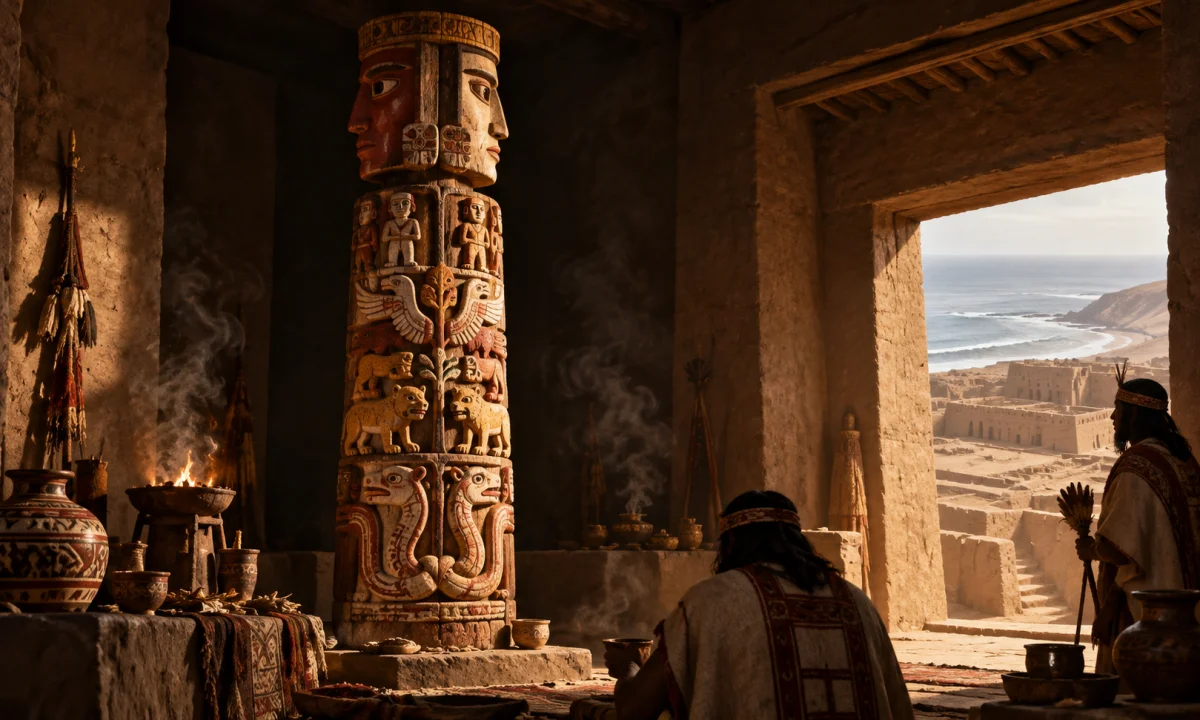
Andean communities historically made offerings to sacred powers. Offerings could include food, drink, coca leaves, chicha, textiles, precious materials, or other items whose significance depended on the place and ritual context. The famous Inca practice of capacocha involved elaborate state ceremonies and, in some documented cases, human sacrifice, but it would be misleading to connect every offering to Mama Cocha or to assume that all water rituals followed this pattern.
Specific rites directed to a being called Mama Cocha are difficult to reconstruct with confidence. Early accounts often describe Indigenous worship in general terms, omit local distinctions, or record Spanish interpretations rather than Indigenous explanations. Contemporary Andean communities may continue to honor water sources, lakes, rivers, and the sea, but present-day practice reflects both local continuity and historical change. Catholic festivals, Indigenous ritual knowledge, environmental concerns, and regional identities can all shape how sacred water is understood today.
The important point is that reverence for water was embedded in practical and spiritual life. Irrigation, agriculture, fishing, travel, and community survival all required cooperation with water. A ritual relationship could express gratitude, seek favorable conditions, acknowledge danger, or reaffirm bonds between a community and its landscape.
Relationships with other figures
Mama Cocha and Pachamama
Mama Cocha is often mentioned alongside Pachamama, the earth mother or earth-and-world power widely honored in Andean traditions. The two can be presented as complementary: Pachamama is associated with the earth, soil, crops, and the living environment, while Mama Cocha represents water. This pairing is useful as a symbolic interpretation, especially in discussions of agriculture and ecological interdependence.
They are not, however, simply two universally fixed members of an Inca divine family. Both names have regional histories and can carry different meanings in different communities. Modern popular accounts sometimes arrange them into a neat pantheon with strictly defined duties, but the evidence for such a standardized system is limited.
Mama Cocha and Mama Quilla
Mama Quilla, or Mother Moon, is a distinct figure. She is associated with the moon and, in Inca state religion, with calendrical and royal concerns. Because both names begin with Mama, they are sometimes confused, but Mama Quilla is not a water goddess. The shared word means “mother” and does not indicate that the two figures are identical or necessarily related as members of one family.
Mama Cocha and Mama Ocllo
Mama Ocllo is a culture hero and ancestral mother in important Inca origin traditions, especially those connected with Manco Capac. She is a different figure from Mama Cocha. The similarity of their names can lead to mistaken identifications, but Ocllo and Qocha refer to different names and traditions.
Mama Cocha and Viracocha
Viracocha is a major creator or culture-bringing figure in several Andean traditions recorded by colonial chroniclers. Some modern writers connect his name with the sea or interpret it through water imagery, but this does not make him another name for Mama Cocha. The relationship between Viracocha, the sea, and particular Andean languages is linguistically and historically complex. Similarities in association should not be treated as proof that the two figures were one being.
Evidence and interpretation
Information about Mama Cocha must be read against the fragmentary nature of the record. The Inca did not leave behind a surviving alphabetic sacred text that sets out a complete theology. Much of what is known about Inca religion comes from Spanish colonial chronicles, Indigenous testimony recorded in colonial settings, archaeology, language, and comparison with later Andean traditions. These materials can preserve genuine information while also reflecting translation, censorship, selective observation, and cultural change.
For this reason, statements that Mama Cocha was “the wife” of a particular god, ruled a fixed undersea kingdom, or possessed a specific animal companion should be treated cautiously unless they are clearly tied to a regional tradition. Such details frequently appear in modern retellings, educational summaries, and artistic reconstructions rather than in securely documented Inca sources.
Scholars may also use Mama Cocha as an interpretive term for the sacred feminine dimension of water in the Andes. That interpretation can illuminate patterns of environmental dependence and Indigenous relationships with landscape, but it should not erase regional differences. A symbolic reading is not the same as evidence for a centralized Inca cult with one uniform doctrine.
Cultural significance today
Mama Cocha remains relevant in discussions of Andean identity, Indigenous ecological knowledge, water protection, and the persistence of pre-Columbian religious concepts. The figure can symbolize the dependence of human communities on oceans, lakes, rivers, and rain, as well as the ethical idea that water should be approached with respect rather than treated only as a commodity.
Contemporary books, paintings, online mythology collections, and fantasy works may portray Mama Cocha as a fully individualized sea goddess with a dramatic biography and a standardized appearance. These creative versions can introduce the name to new audiences, but they are modern adaptations. They should be distinguished from the more limited and varied evidence for Mama Cocha in Andean religious traditions.
The most careful understanding of Mama Cocha keeps both aspects in view: she is a meaningful expression of water’s maternal and life-giving power, and the historical record does not support every detail assigned to her by later retellings. Her significance lies less in a single canonical story than in the Andean recognition that water is sacred, powerful, nourishing, and inseparable from the survival of human communities.