WORLD

Ayar Cachi
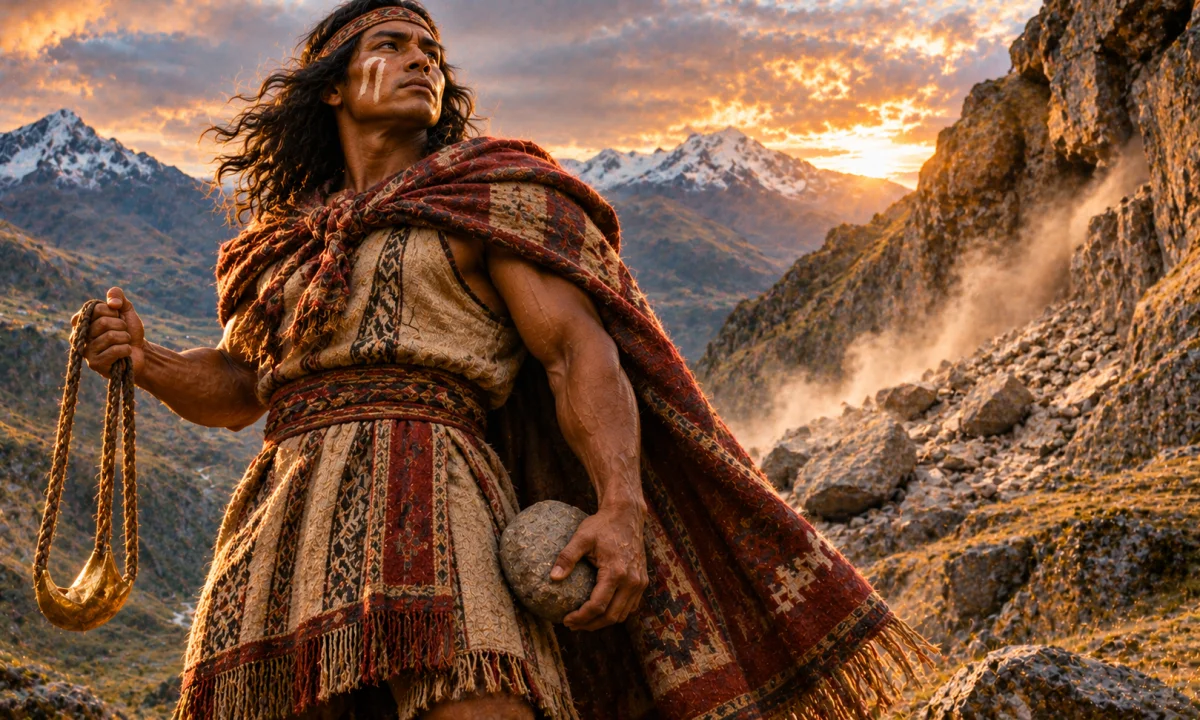
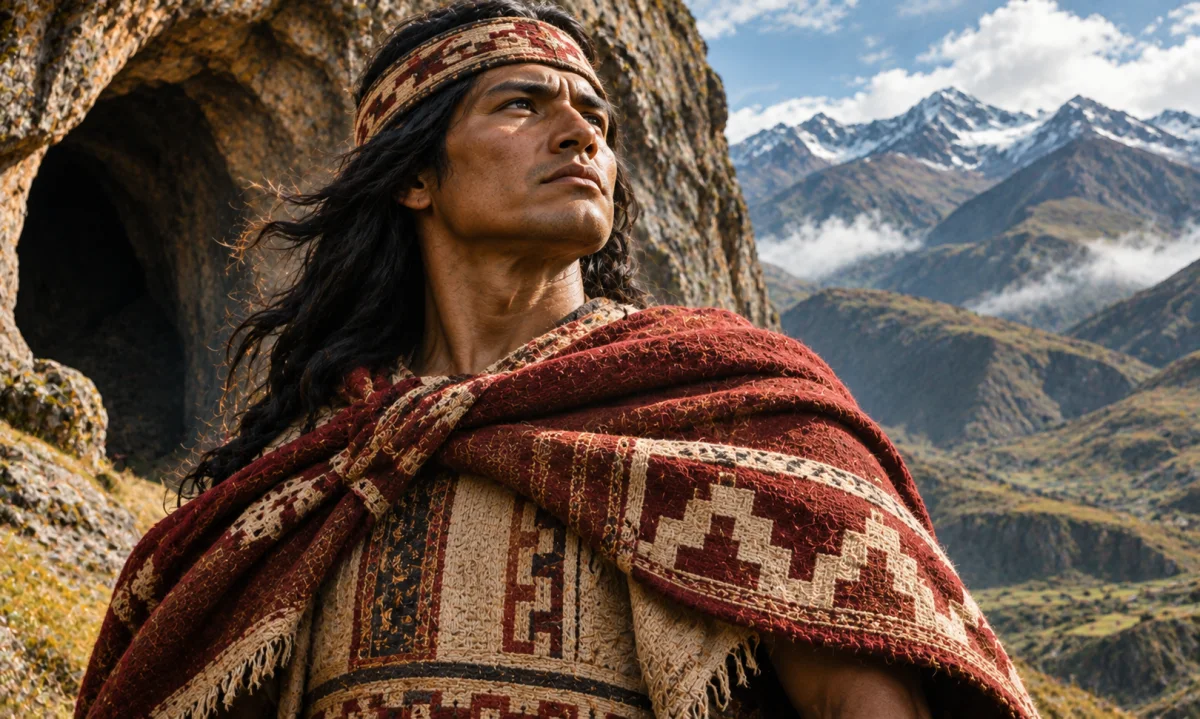
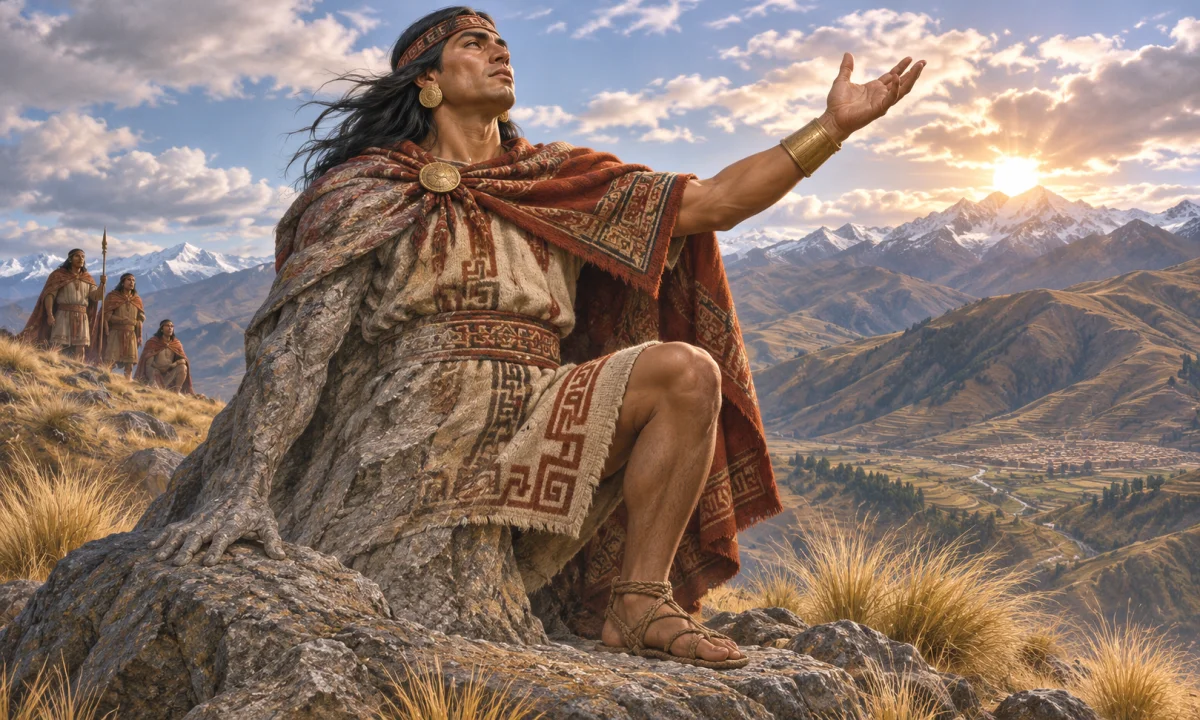
Ayar Cachi is a powerful ancestral figure in Inca origin traditions, especially in narratives about the emergence of the Inca people and the founding of Cusco. He is usually described as one of four Ayar brothers who came from a sacred place of origin with four female companions. His extraordinary strength, use of a sling and destructive powers make him one of the most striking figures in these accounts. Unlike a god with a large independent cult, Ayar Cachi is primarily a culture hero, ancestor and participant in a dynastic foundation myth.
Origins in Inca tradition
The story of Ayar Cachi survives mainly through accounts recorded by Spanish chroniclers during and after the sixteenth-century conquest of the Inca state. These writers gathered information from Indigenous informants, nobles and interpreters, but their accounts do not form a single, uniform scripture. Names, details and the order of events vary between narratives.
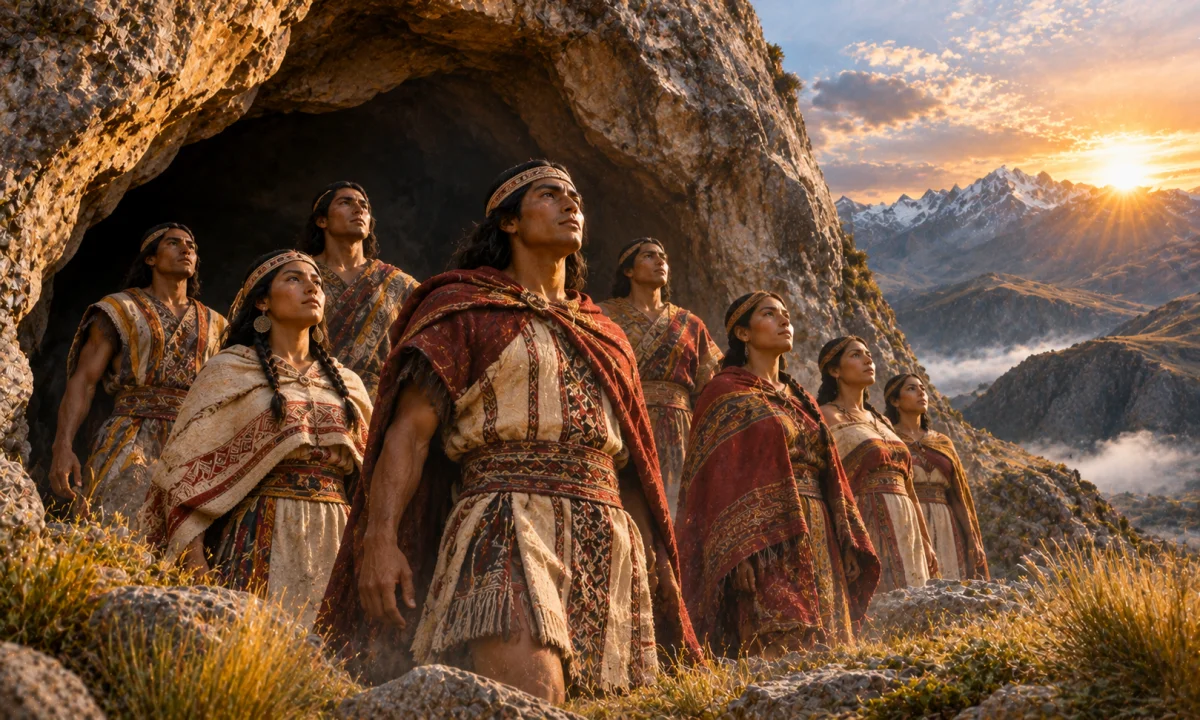
In the best-known version, the Ayar brothers emerged from Pacaritambo, often identified with a place south of Cusco. The name is also written Pacariqtambo or Pacaritampu, and the location has been associated with the cave or opening called Tampu T'oqo. The name Pacaritambo is commonly connected with ideas of dawn, emergence or origin, although its precise interpretation and the historical identification of the site remain subjects of discussion.
The four brothers are generally named:
- Ayar Manco, who later becomes Manco Cápac, the founding ancestor of the Inca dynasty;
- Ayar Cachi, the exceptionally powerful brother whose actions reshape the landscape;
- Ayar Uchu, who is transformed into or associated with a sacred stone in many versions; and
- Ayar Auca, another brother whose fate is connected with territorial possession and transformation.
They travel with four female figures, commonly named Mama Ocllo, Mama Huaco, Mama Raua and Mama Ipacura. Their relationships are not described identically in every account. They may be presented as sisters, wives, companions or female counterparts of the brothers. The famous pairing of Manco Cápac and Mama Ocllo belongs to one important strand of Inca origin tradition, but it should not be treated as the only version of the founding story.
The meaning of Ayar Cachi’s name
The spelling Ayar Cachi reflects colonial Spanish recording of Quechua names. Other spellings can be found, and the pronunciation and orthography of the original forms are not always recoverable with certainty. The second element is often compared with the Quechua word kachi, commonly translated as “salt.” This has encouraged interpretations connecting the figure with salt or a place associated with salt.
That interpretation is not secure enough to define the character. Colonial chroniclers did not provide a consistent linguistic explanation of the name, and Indigenous names recorded in Spanish orthography can preserve several possible meanings. “Ayar” has likewise been interpreted in different ways, sometimes as an element shared by the brothers’ names rather than as a simple personal name. It is safest to regard Ayar Cachi as a traditional name whose exact original meaning is uncertain.
A figure of overwhelming power
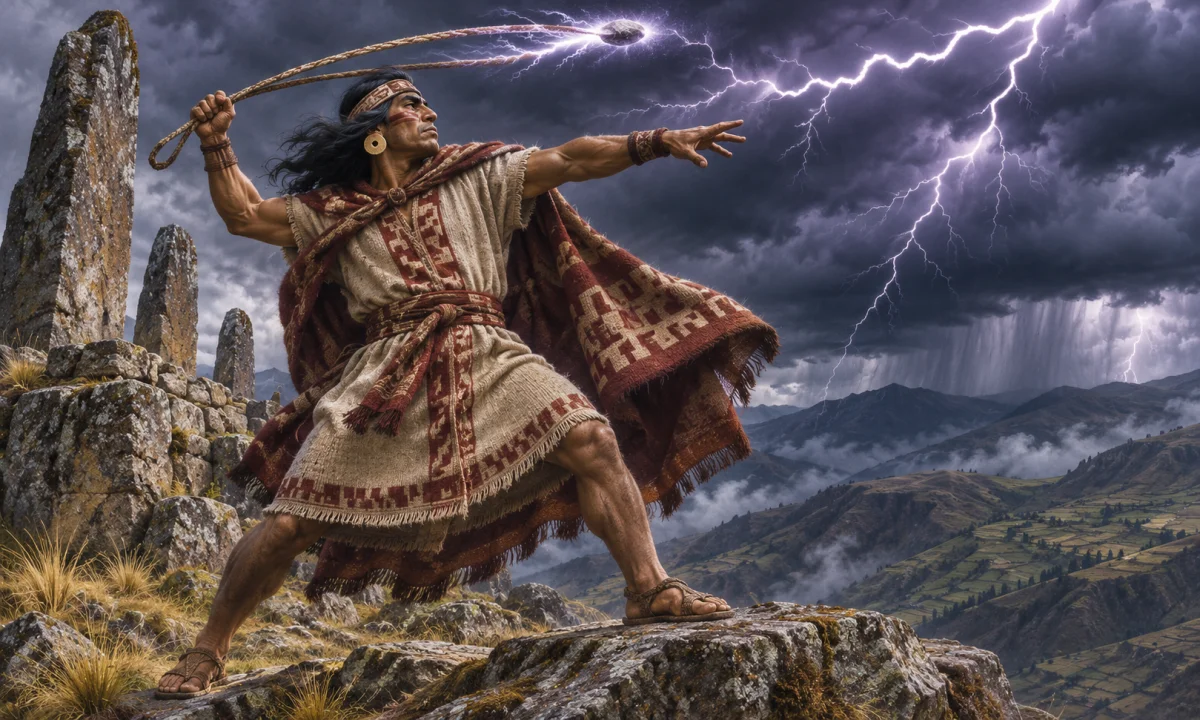
Ayar Cachi is distinguished from his brothers by the scale of his physical and supernatural power. He carries a sling and is said to be able to hurl stones with such force that hills are broken apart and valleys or ravines are formed. In these stories, landscape is not merely a setting: it preserves the actions of ancestral beings.
His powers suggest more than ordinary strength. The ability to alter mountains places Ayar Cachi within a world in which founding ancestors, sacred places and geological features are closely connected. The Andes were understood through relationships between communities, mountains, springs, stones and other beings or powers. A founder could therefore be both a human-like ancestor and a sacred presence whose actions explained the shape and spiritual character of the land.
The stories do not usually portray Ayar Cachi as an evil demon. His violence and destructive capacity are dangerous, but danger is not the same as moral wickedness in these traditions. His power is excessive, difficult for the other founders to control and potentially disruptive to the group’s progress. The narrative tension comes from the need to manage an extraordinarily potent ancestor while establishing a community and a political order.
The story of his confinement
In a widely known version of the origin narrative, the brothers and their companions leave their place of emergence and begin travelling toward the region that will become the centre of Inca power. Ayar Cachi’s strength soon becomes a problem. His sling can strike distant places and break apart the landscape, and the other brothers fear what he might do or fear that his power will make him dominant among them.
The precise deception differs in surviving accounts. In one form of the story, the brothers persuade Ayar Cachi to return to the cave from which they emerged in order to retrieve or fetch something that has been left there. Once he enters, they block the opening with a large stone or otherwise seal him inside. His confinement removes him from the journey and allows the remaining brothers to continue.
Some accounts describe the imprisonment as an act of treachery, while others place greater emphasis on the necessity of controlling a dangerous force. The episode may be read as a mythic explanation for why one of the founding ancestors does not reach Cusco with the others. It also establishes a recurring theme in Andean origin narratives: a powerful being may remain present through a place, stone or landscape even after disappearing from ordinary human society.
Details of Ayar Cachi’s fate after confinement are not completely consistent. Some retellings focus on his being trapped within the mountain or cave. Others preserve additional episodes in which the brothers encounter sacred manifestations and transformations. Because the accounts were recorded at different times and under different circumstances, it is not always possible to combine every detail into one original sequence.
The wider journey of the Ayar ancestors
After Ayar Cachi is removed from the group, the remaining founders continue their journey. Their route includes Huanacauri, a mountain or sacred place of great importance in Inca tradition. Ayar Uchu is associated in many versions with a transformation into stone at Huanacauri. This is not simply a death in the ordinary sense. Becoming stone can mean entering the category of a huaca, a sacred being or place with continuing ritual significance.
Ayar Auca also undergoes a transformation in some narratives, becoming connected with a stone or with the possession of the land where Cusco will be established. Manco, meanwhile, survives to become the ancestor of the Inca rulers. These episodes distribute different forms of sacred authority among the brothers: one is associated with overwhelming force, another with a mountain sanctuary, another with territorial possession and Manco with dynastic continuity.
The female figures are not passive additions to the story. Mama Huaco, in particular, is described in some traditions as a formidable founder with unusual strength and authority. Her portrayal varies considerably, and later writers sometimes treated her differently from the more familiar Mama Ocllo. The variation demonstrates that Inca foundation traditions included multiple ancestral lines and political memories rather than a single universally fixed genealogy.
Relation to Inca religion and sacred geography
Inca religion did not separate mythology from place in the same way that modern readers may separate a story from a map. Mountains, springs, caves, stones and settlements could all be part of an active sacred landscape. The origin of a people was therefore also the origin of a network of relationships with particular locations.
The cave or opening at Pacaritambo functioned as an ancestral point of emergence, while Huanacauri became a major sacred location in the journey toward Cusco. The transformations of Ayar Uchu and Ayar Auca show how an ancestor could become attached to the land as a sacred stone or place. Ayar Cachi’s confinement similarly links his power to the mountain environment, even though the surviving stories do not present a single, fully documented cult devoted exclusively to him.
The term huaca can refer to a sacred being, object, site or source of power. It should not be translated too narrowly as “idol” or “spirit.” A huaca might be a natural feature, a stone associated with an ancestor, a shrine or a powerful presence embedded in a landscape. The Ayar narratives make sense within this broader religious world, where ancestral founders could remain consequential after their removal from the human journey.
Ayar Cachi and the founding of Cusco
Ayar Cachi is connected with the founding of Cusco indirectly rather than as its final ruler or principal founder. His disappearance clears the way for the surviving members of the group, especially Ayar Manco, to continue toward the place that becomes the centre of Inca political authority.
Inca foundation narratives were not merely stories about the distant past. They helped explain why the Inca dynasty possessed authority, why particular places were sacred and how the ruling community related to other Andean peoples. The story’s supernatural events gave depth to claims about ancestry and territory. At the same time, the different versions preserved by chroniclers suggest that the Inca state incorporated more than one regional tradition about origins.
Ayar Cachi’s role may therefore be understood as that of a foundational but excluded ancestor. He belongs to the group that initiates the migration and establishes the sacred ancestry of the Inca, yet he does not become the continuing dynastic ancestor. His removal is necessary within the narrative structure, but it does not make him insignificant. His strength explains the extraordinary nature of the founding generation, and his confinement leaves an enduring connection between ancestral power and the landscape.
Interpretations of his character
Scholars and interpreters have approached Ayar Cachi in several ways. One interpretation treats him as a mythic personification of the untamed power of the mountains. His sling, the breaking of hills and his removal from the travelling group can symbolize the transformation of a wild or unstable landscape into an ordered human territory.
Another interpretation emphasizes political succession. The brothers may represent competing ancestral lines or groups whose relationships were later organized into a story that gives Manco Cápac the privileged position of dynastic founder. From this perspective, Ayar Cachi’s confinement dramatizes the suppression or incorporation of a rival source of authority.
A further interpretation focuses on the structure of Andean ancestor myths. The brothers do not simply die one after another; several become stones, mountains or sacred presences. Their transformations express a continuing relationship between social groups and the places from which they claim descent. These interpretations are not mutually exclusive, but none should be presented as a proven original meaning. The sources are colonial records of traditions that had circulated orally and may already have contained regional and political variations.
Distinguishing Ayar Cachi from similar figures
Ayar Cachi should not be confused with Ayar Manco, the ancestor later known as Manco Cápac. Both are members of the same founding generation, but Manco is the figure who continues to the dynastic foundation of Cusco, while Ayar Cachi is associated with extraordinary destructive power and confinement.
He is also distinct from Ayar Uchu and Ayar Auca. Their names are similar because all four belong to the Ayar group, not because they are alternate names for one being. Ayar Uchu is especially associated with transformation into stone at Huanacauri in many versions, whereas Ayar Cachi is the brother connected with the sling and the breaking of hills.
Modern retellings sometimes reduce all four brothers to interchangeable “Inca gods” or describe Ayar Cachi as a god of war, earthquakes or salt. Such labels can be convenient summaries, but they are not securely established categories in the surviving traditions. Ayar Cachi is better described as a powerful ancestral figure within an Inca origin cycle.
Survival and modern representation
The story of the Ayar brothers remains important in discussions of Inca mythology, Andean sacred geography and the historical reconstruction of Indigenous traditions. It appears in educational materials, retellings, museum contexts and popular presentations of Inca culture. These modern versions often simplify the variations in the colonial records and may give Ayar Cachi a fixed personality or a clearly defined divine domain that the older accounts do not consistently provide.
Responsible retellings preserve the distinction between the traditional material and later interpretation. Ayar Cachi is not known primarily through a large surviving body of prayers, festivals or independent temple records. His importance comes from his place in the ancestral narrative: he is the immensely powerful brother whose actions affect the land, whose companions fear his strength and whose confinement helps shape the route toward Cusco.