WORLD
WORLD
Macuilcozcacuahtli
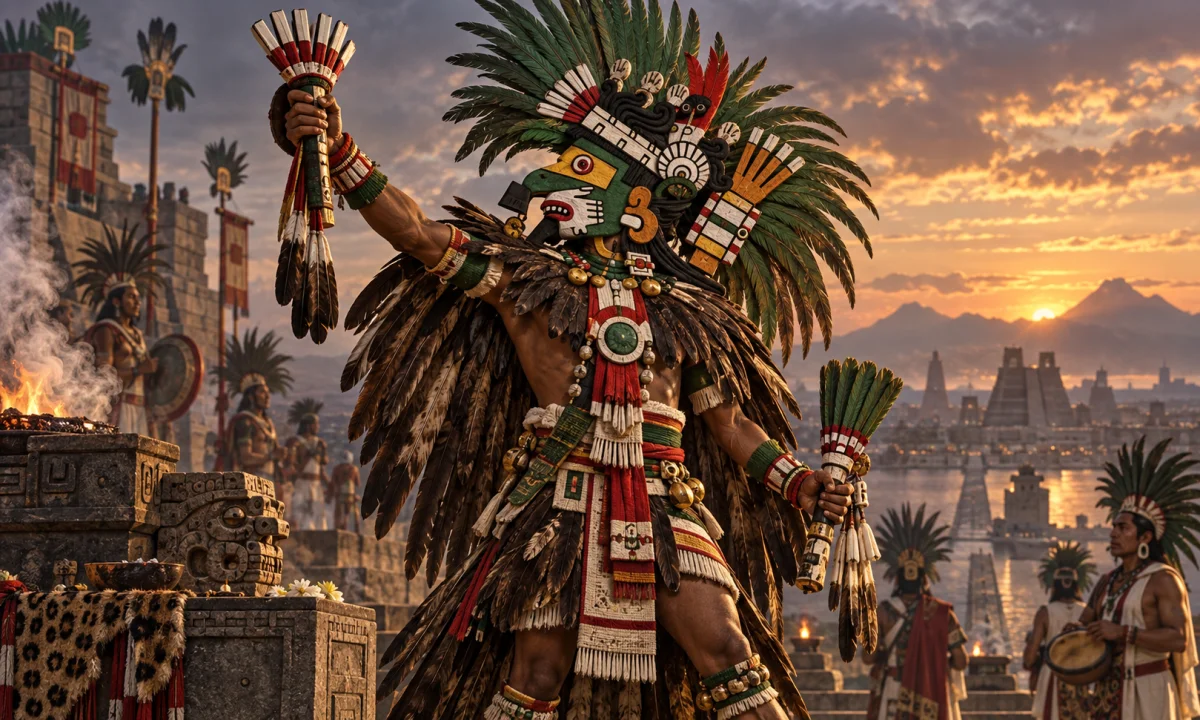
Macuilcozcacuahtli is a little-known figure associated with Aztec and wider Nahua religious tradition. His name is usually translated as “Five Vulture” or “Five [the] Vulture,” from macuil, “five,” and cozcacuahtli, a Nahuatl term conventionally translated as “vulture.” The spelling varies considerably in modern works and in the transcription of colonial Nahuatl. Forms include Macuilcozcacuauhtli, Macuilcozcacuahtli, and versions that simplify or alter the vowels.
Macuilcozcacuahtli is generally identified as one of the Macuiltonaleque, a group of five male supernatural beings connected with the number five, dangerous excess, bodily desire, and the consequences of uncontrolled behaviour. The surviving evidence does not present him as a major god with a large independent mythology. Instead, he belongs to a religious and calendrical complex whose meanings are preserved unevenly in colonial descriptions and painted manuscripts.
The cultural setting
Aztec religion was not organized around a single fixed list of gods with identical identities in every community. Deities could have several names, forms, titles, and local manifestations. Calendar signs, ritual offices, natural forces, sacred directions, and social activities all contributed to the way a supernatural figure was understood.
The most important context for Macuilcozcacuahtli is the tonalpohualli, the 260-day ritual calendar used in central Mexican religious practice. This calendar combined twenty day signs with the numbers one through thirteen. Individual days therefore had both a sign and a numerical designation, and priests used the resulting combinations for divination, ritual timing, and the assessment of a person's destiny.
The number five had an ambivalent character in Nahua thought. It could be associated with excess, instability, danger, and behaviour that had gone beyond proper limits. This does not mean that every occurrence of five was simply evil. Rather, the number could mark a condition that required caution and ritual management. The Macuiltonaleque are best understood within this framework of perilous abundance and uncontrolled force.
Name and spelling
The name Macuilcozcacuahtli combines macuil, “five,” with cozcacuahtli, commonly rendered “vulture.” The second element is also the name of one of the twenty day signs of the tonalpohualli. English translations sometimes use “Five Vulture,” while other renderings preserve the Nahuatl name without translating it.
Orthographic variation is normal when Nahuatl names are written in Latin letters. Colonial scribes used spelling conventions influenced by Spanish, and modern scholars may represent long vowels, glottal stops, and consonants differently. The forms cuauhtli and cuahtli, for example, reflect different approaches to writing a Nahuatl word associated with an eagle or bird of prey. Variations in the name should not automatically be treated as evidence for separate beings.
The translation “vulture” is conventional, but the exact zoological identification of Nahuatl bird terms can be difficult. Pre-Hispanic names did not necessarily correspond to the precise species distinctions used by modern ornithology. The name should therefore be understood primarily as a traditional calendrical and symbolic designation rather than as a secure biological classification.
The Macuiltonaleque
Macuilcozcacuahtli is usually placed among five related beings known collectively as the Macuiltonaleque, a name often translated as “the Five Fates,” “the Five Destinies,” or “the Five Solar Forces.” Interpretations of the collective name differ because tonalli has a broad semantic range. It may refer to a day-sign force, destiny, animating heat, or a person's calendrical influence.
The five figures are commonly listed as:
- Macuilcuetzpalin, “Five Lizard”;
- Macuilcozcacuahtli, “Five Vulture”;
- Macuilmalinalli, “Five Grass” or “Five Grass-like Plant”;
- Macuiltochtli, “Five Rabbit”; and
- Macuilxochitl, “Five Flower.”
This list is widely repeated, but the way the group is classified is not completely uniform. Some sources treat the five as related calendrical gods; others emphasize their connection with the ahuiani, erotic entertainers or pleasure-associated figures, the Cihuateteo, or other beings linked with dangerous desire and transgression. These associations overlap, but they should not be treated as proof that all such figures were identical.
Macuilxochitl, in particular, had a more substantial and recognizable identity of his own. He was associated with music, dance, games, flowers, pleasure, and abundance, and was also connected in some traditions with the deity Xochipilli. Macuilcozcacuahtli should not simply be equated with Macuilxochitl because both belong to the same numerical group.
Attributes and representation
There is no securely established portrait of Macuilcozcacuahtli that can be separated from the wider visual language of the Macuiltonaleque. Painted manuscripts and colonial accounts may depict or describe these beings using signs of the number five, calendrical emblems, bodily injury, ritual danger, or associations with pleasure and excess. Identifying a particular image as Macuilcozcacuahtli requires caution, especially when the accompanying name or day sign is absent.
The vulture element of his name gives him an association with a scavenging bird, but the surviving evidence does not support a detailed personal mythology about a vulture deity. Vultures occupy an important ecological and symbolic place in Mesoamerica. They consume the remains of the dead and are linked by their habits with corpses, battlefields, exposure, and the transformation of dead matter. These associations may help explain why a vulture day sign could carry ominous or liminal meanings, but they do not by themselves prove a specific set of myths about Macuilcozcacuahtli.
Nor should the bird in his name be confused with the eagle imagery associated with Huitzilopochtli or with the eagle day sign Cuauhtli. Nahua bird terminology included several distinct names, and the presence of the element cuauhtli does not make every bird-related figure an aspect of an eagle god.
Excess, punishment, and ritual danger
The Macuiltonaleque are often interpreted as figures of dangerous excess. In this setting, “excess” could include uncontrolled sexuality, drunkenness, gambling, gluttony, violence, or other behaviour that disrupted social and ritual order. Nahua moral thought did not always condemn pleasure itself. Music, feasting, sexuality, flowers, dance, and altered states could have legitimate religious or social contexts. The danger arose when a person crossed accepted limits or failed to observe the proper discipline.
Colonial descriptions of related figures connect transgressive behaviour with illness, misfortune, or bodily punishment. A person who offended the powers represented by the Macuiltonaleque might be thought vulnerable to a characteristic form of affliction, sometimes described in terms of a damaged or mutilated body. Interpretations of these passages vary, and the records were written through the framework of Christian-era colonial observation. They are valuable evidence, but they do not provide a transparent transcript of pre-conquest belief.
Macuilcozcacuahtli therefore seems to have functioned less as a character in a narrative cycle and more as a named force within a system of ritual danger. His name could identify a calendrical influence, a member of a group of five related beings, or a supernatural manifestation encountered in divinatory interpretation.
Relation to the vulture day sign
Cozcacuauhtli was one of the twenty day signs of the tonalpohualli. A day sign was not merely a picture used to mark a date. It had a network of associations, including omens, ritual predictions, patron beings, and qualities attributed to people born under it. The same sign could be interpreted differently depending on its numerical coefficient and the purpose of the ritual consultation.
Macuilcozcacuahtli should not automatically be identified with the day sign itself. A day sign was a calendrical category, whereas a named being could act as its patron, embodiment, or associated supernatural force. Nahua religious language often allowed such relationships to overlap, but they were not necessarily equivalent.
The prefix macuil- also does not simply mean that Macuilcozcacuahtli was a “fifth version” of an ordinary vulture deity. It places the figure within the special group of five Macuiltonaleque and gives the bird sign a particular numerical and ritual character.
Sources and limits of the evidence
Knowledge of Macuilcozcacuahtli comes mainly from sources recorded after the Spanish conquest. These include alphabetic descriptions in colonial Nahuatl and Spanish, as well as painted manuscripts that preserve calendrical signs, ritual scenes, and divine figures. Such materials are indispensable, but they are fragmentary and shaped by the circumstances in which they were collected.
Some records were produced by Christian missionaries who wished to document or refute Indigenous religion. Others were compiled with the help of Nahua informants, artists, scribes, and ritual specialists. Their terminology and explanations do not always agree. A name may appear in a list without a story, while an image may preserve an attribute that an alphabetic account does not mention.
For this reason, claims about Macuilcozcacuahtli should remain modest. It is reasonable to identify him as a member of the Macuiltonaleque and to connect him with the vulture day sign, the number five, and the religious management of excess. It is not reasonable to construct an elaborate biography, family tree, or set of adventures unsupported by the surviving evidence.
Distinctions from related figures
Macuilxochitl
Macuilxochitl is another member of the fivefold group and is much more prominent in discussions of Aztec religion. His name means “Five Flower,” and he is associated with music, dance, games, pleasure, and abundance. Because both names begin with Macuil-, they are sometimes confused. Macuilcozcacuahtli is the vulture-associated member, not another name for Macuilxochitl.
Cozcacuauhtli as a calendar sign
The word cozcacuauhtli also denotes a day sign. The calendrical sign and the named figure Macuilcozcacuahtli are closely related in symbolism, but they are not interchangeable in every context. A date marked by Cozcacuauhtli is not necessarily a reference to the specific “Five Vulture” being.
Itzpapalotl
Itzpapalotl, the “Obsidian Butterfly,” was a powerful female deity associated in different traditions with warfare, sacrifice, fire, the earth, and the stars. She could have a terrifying skeletal or butterfly-like appearance. Her connection with death and predatory imagery does not make her identical to Macuilcozcacuahtli. Both belong to a religious world in which death, transformation, and danger were important, but their names and traditional identities are distinct.
The Cihuateteo
The Cihuateteo were female dead, especially women who died in childbirth, and were believed to return at particular times with potentially dangerous powers. They are sometimes discussed alongside the Macuiltonaleque because both groups could be associated with sexuality, danger, misfortune, and liminal states. They were not, however, simply female and male versions of one uniformly defined pantheon in every source.
Cultural significance
Macuilcozcacuahtli illustrates the importance of examining Aztec religious figures as parts of systems rather than expecting each one to resemble a fully developed mythological character. His significance lies in the interaction of number, calendar, bird symbolism, moral discipline, and divine danger.
The vulture image evokes the boundary between life and death, while the number five marks an unstable or excessive condition. Together, these elements suggest a force that belongs to the margins of ordinary order. Such a force could be feared, ritually addressed, or interpreted through divination rather than worshipped in the same manner as a major temple deity.
There is no strong evidence that Macuilcozcacuahtli has played a major role in modern popular culture. Contemporary works about Aztec mythology sometimes use his name in lists of deities or adapt him into a fantasy character, but those portrayals are modern inventions unless they are explicitly grounded in the limited calendrical evidence. Modern depictions should therefore be distinguished from the historical record, which presents Macuilcozcacuahtli chiefly as a scarce but meaningful name within the religious complex of the Macuiltonaleque.