WORLD
WORLD
Xochipilli
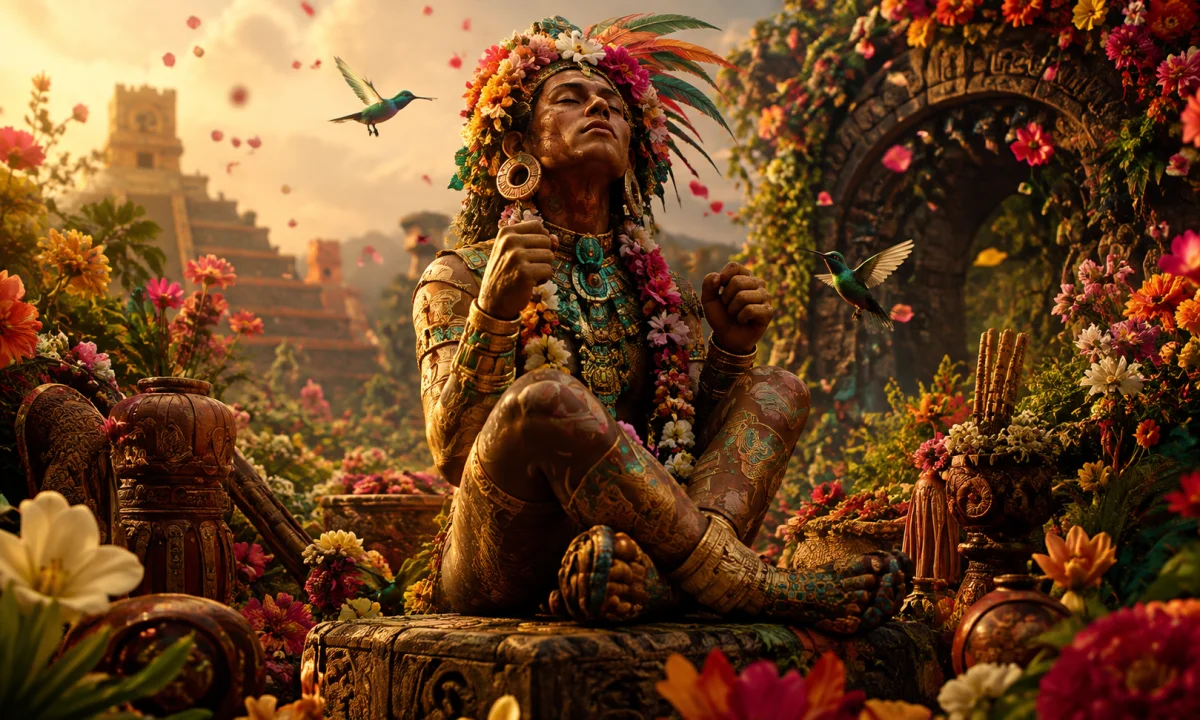
Xochipilli is a deity from Aztec religion, most often understood as a god of flowers, song, dance, beauty, love, pleasure, and the flowering richness of life. His name is usually translated from Nahuatl as “Flower Prince” or “Noble Flower,” though translation can vary with scholarly interpretation. In Mexica and wider central Mexican tradition, he belongs to a complex sacred world in which art, sexuality, ritual celebration, and divine power were closely connected rather than separated into modern categories.
Origins and cultural setting
Xochipilli comes from the religious tradition of the Mexica, commonly called the Aztecs, within the broader cultural world of central Mexico before the Spanish conquest. He is known from colonial-era descriptions, indigenous pictorial traditions, and later scholarly reconstructions based on surviving Nahuatl-language sources, Nahua iconography, and archaeological evidence. As with many Mesoamerican deities, the historical record does not preserve a single fixed mythology for him. Different sources emphasize different aspects of his character, and some details are uncertain or debated.
In Mexica religion, divinity was not divided into rigidly separate “domains” in the modern sense. Gods could embody forces of nature, human activities, social roles, and sacred states at once. Xochipilli’s association with flowers, music, dance, fertility, and pleasure fits this pattern. He appears as a divine figure linked to the vitality of growth and the heightened experience produced by ceremonial art and sacred intoxication.
Scholars often note that Xochipilli is related to a broad set of Mesoamerican ideas about blossoms, scent, song, and embodied joy. Flowers in Nahua thought were not only decorative; they were symbols of preciousness, beauty, poetry, and ephemeral life. That symbolic world helps explain why a flowering deity could also be connected to song, artistic inspiration, and ritual ecstasy.
Name and identity
The name Xochipilli combines xōchitl, “flower,” and pilli, a term that can mean “noble one,” “prince,” or “child” depending on context. Because Nahuatl words often carry layered meanings, the name can suggest both noble status and youthful vitality. The “prince” translation is common, but it should not be taken too literally as a dynastic title in the European sense.
Some traditions and interpretations connect Xochipilli with Xochiquetzal, the flower-goddess associated with beauty, fertility, weaving, and sensuality. The relationship between the two is not fully clear and may vary by source or by region. They are sometimes treated as complementary figures, and in some modern discussions Xochipilli is presented as a male counterpart to Xochiquetzal. That comparison is useful as a broad summary, but the ancient evidence does not always support a simple one-to-one pairing.
He is also sometimes called by titles or descriptions that emphasize his floral and joyful character. In surviving material, however, Xochipilli is not as extensively documented as major gods such as Huitzilopochtli, Tlaloc, or Tezcatlipoca. His profile is therefore partly reconstructed from iconography and from the symbolic logic of Nahua religion.
Appearance and iconography
One of the most important sources for understanding Xochipilli is a famous stone statue now known for its elaborate imagery. In this sculpture, he is seated in an upright, formal pose and covered with dense carved motifs of plants, flowers, and sacred substances. The image has been widely studied because it seems to visualize divine ecstasy, artistic potency, and altered states of consciousness. Some scholars interpret the engraved patterns on the body as references to psychoactive plants, though the exact meaning of every motif remains disputed.
The statue presents Xochipilli as an intensely embodied deity rather than an abstract symbol. His posture, adornment, and the vegetal imagery on his body reinforce the sense that he is a god of living force, sensory fullness, and cultivated beauty. The seated pose can suggest authority, while the floral decorations emphasize abundance and transformation.
In manuscript imagery and later descriptions, deities linked with flowers and pleasure are sometimes shown with rich ornaments, bright colors, and offerings associated with music, dance, or perfume. Because colonial sources often filtered indigenous religion through European categories, surviving descriptions may not always preserve the original nuances of his appearance. Even so, the recurring floral emphasis is consistent across interpretations.
Attributes, powers, and symbolism
Xochipilli is primarily associated with flowers, song, dance, pleasure, creativity, and youthful vitality. These associations should not be reduced to “fun” in a modern sense. In Nahua religious thought, song and dance were serious sacred acts, capable of honoring the gods, shaping social harmony, and opening a path to divine presence. Xochipilli therefore belongs to a sphere where aesthetics and ritual power overlap.
Flowers themselves carried multiple meanings. They could represent beauty and fragrance, but also fleeting life, precious speech, and sacred truth. Nahuatl poetry often uses floral imagery to speak of art, truth, and the idealized richness of existence. A flower deity therefore symbolizes not only growth but the refined, ephemeral, and performative dimensions of life.
Xochipilli is also associated with pleasure and, in some interpretations, erotic or sensual energy. This should be handled carefully. The available evidence supports a connection with delight, fertility, and bodily abundance, but not a simple projection of modern ideas of romance or sexuality onto the ancient deity. In Mexica religion, vitality and desire were integrated into a broader sacred order that also included restraint, ritual obligation, and cosmic balance.
Some modern writers connect him with altered states, especially because of the decorated statue and the presence of plant imagery. It is reasonable to say that many scholars see the statue as evoking ecstatic or visionary experience, but specific identifications of plants or psychoactive substances should be treated cautiously when the evidence is uncertain. Interpretation differs, and the archaeological object does not speak in a single clear voice.
Roles in religion and ritual life
Xochipilli’s role in religion likely extended beyond a narrow sphere of “arts” as that term is understood today. Among the Mexica, music, dance, flower offerings, feasting, and ritual performance were deeply woven into public ceremonial life. A deity of flowers and song would therefore have been relevant to festival settings, offerings of beauty, and perhaps the cultivation of inspired performance.
In Nahua ritual practice, dance and music were not entertainment alone. They were disciplined and sacred forms of action that expressed cosmic order and social duty. A figure like Xochipilli could embody the power that makes such acts vibrant, pleasurable, and spiritually effective. His presence would fit a world in which the beauty of the earthly realm could be a means of approaching divine realities.
He is also commonly linked to fertility in a broad sense: the fertility of plants, the flowering of crops, the flourishing of human creativity, and the generative force that renews life. This connection reflects a Mesoamerican pattern in which agricultural abundance, sensual beauty, and sacred performance are interrelated.
Stories and relationships
Unlike some better-known gods, Xochipilli is not the center of many surviving narrative myths. That absence does not mean he was unimportant; rather, it reflects the uneven preservation of pre-Columbian religion. Much of what can be said about him comes from iconography, naming patterns, and later ethnographic or colonial testimony rather than from extensive mythic cycles.
His possible relationship with Xochiquetzal is one of the most discussed questions. In some modern accounts he is called her male counterpart or partner, but ancient sources do not always present the relationship in a consistent form. Because indigenous categories of gender and divine function do not map neatly onto European models, it is safest to say that the two deities belong to a related floral and aesthetic complex, with overlaps in fertility, beauty, and pleasure.
Some scholarly discussions place Xochipilli in a wider family of gods associated with regeneration, agriculture, and the life force expressed through flowers. He should not be confused with deities whose floral names do not mean the same thing or whose functions differ significantly. Similar naming patterns in Nahuatl can easily create confusion, so careful distinction matters.
Interpretation by scholars
Xochipilli has attracted sustained scholarly interest because he raises questions about how the Mexica understood beauty, art, and ecstatic experience. Modern interpretations often emphasize that the deity challenges simplistic stereotypes of Aztec religion as only warlike or severe. Xochipilli shows that pleasure, music, and flowers had sacred value within the religious system.
Some scholars read the famous statue as evidence for ritual use of visionary or psychoactive plants. Others urge caution, arguing that floral and plant imagery may symbolize abundance, divinity, or transformation without requiring a specific drug-based reading. Both positions appear in the scholarship, and the evidence does not allow absolute certainty. It is accurate to say that the statue invites multiple interpretations and that no single explanation has been universally accepted.
Another important theme is the relationship between Xochipilli and Nahua poetry. In pre-Hispanic and early colonial Nahuatl literary culture, flowers and songs are often paired as emblems of truth, beauty, and artistic expression. This makes Xochipilli highly significant for understanding the religious imagination behind Nahuatl verse. He stands at the intersection of language, performance, and sacred aesthetics.
He also illustrates a broader Mesoamerican principle: divinity can be experienced through sensory richness. Perfume, color, rhythm, blossom, and bodily movement are not trivial details but ways in which sacred power becomes visible and felt. Xochipilli’s importance lies partly in this integration of the artistic and the divine.
Distinction from similar figures
Xochipilli is sometimes confused with Xochiquetzal because both are associated with flowers, beauty, and fertility. They are related conceptually, but they are not the same deity. Xochiquetzal is generally portrayed as a goddess with strong associations to weaving, female beauty, fertility, and youthful sensuality. Xochipilli, by contrast, is usually treated as a male deity centered on flowers, song, dance, pleasure, and artistic ecstasy. Any overlap should be understood as part of a shared symbolic field rather than as evidence of identity.
He should also not be conflated with deities of agriculture more broadly, such as those who govern maize, rain, or earth. Although flowers and fertility overlap with those domains, Xochipilli’s emphasis is more specifically on the blooming, aesthetic, and celebratory dimensions of life.
Because some modern writings loosely describe him as a “god of art” or “god of homosexuality,” care is needed. Such labels may reflect contemporary efforts to find modern categories for an ancient figure, but they can oversimplify the original tradition. The historical evidence supports a much broader profile: flowers, music, dance, sensuality, and vital abundance. Claims about specific modern identity categories should not be treated as established ancient facts unless supported by clear evidence, which is limited and context-dependent.
Later reception and modern interest
Today Xochipilli appears in museum displays, academic writing, and modern popular discussions of Aztec mythology, often because of the striking sculptural image associated with his name. The statue has become one of the most recognizable visual representations of Mexica sacred art, and it has encouraged renewed interest in the aesthetic and ecstatic dimensions of Nahua religion.
In modern spiritual or artistic circles, Xochipilli is sometimes invoked as a symbol of creativity, natural beauty, and altered consciousness. These are contemporary receptions rather than historical continuations in a simple sense. They may draw inspiration from indigenous tradition, but they are shaped by modern values and should be distinguished from pre-Columbian religious practice.
In popular culture, Xochipilli is less widely known than some other Mesoamerican gods, but he occasionally appears in fiction, games, and visual art when creators seek a deity linked to flowers, music, or ritual ecstasy. Such portrayals can be imaginative, but they often simplify or remix the original tradition. The ancient context remains rooted in Mexica religion, where the blooming world, the spoken song, and the moving body were all part of sacred life.
Why Xochipilli matters in Aztec mythology
Xochipilli matters because he reveals a side of Aztec religion that is sometimes overlooked: the sacred value of beauty, pleasure, and artistic creation. He belongs to a world where flowers were not mere decoration, where song carried religious force, and where dance could be an act of devotion. His imagery suggests that divine power was felt not only in war, sacrifice, or rulership, but also in the flourishing of life and the intensity of sensory experience.
For understanding Mesoamerican religion, Xochipilli is especially important because he shows how ritual, poetry, and embodiment were intertwined. His figure stands at the meeting point of nature and culture, discipline and delight, passing beauty and sacred permanence. That combination is central to the symbolic language of Nahua thought and to the continuing fascination he holds in scholarship and art.