WORLD
WORLD
Macuilxochitl
Macuilxochitl, whose name means “Five Flower” in Classical Nahuatl, is a deity associated with music, dance, flowers, games, pleasure and forms of cultivated enjoyment in central Mexican religious tradition. He belongs to the religious world of Nahua-speaking peoples, including the Mexica or Aztecs, rather than to a single system with one universally fixed mythology. Surviving descriptions and images present Macuilxochitl as a figure connected with artistic performance and festivity, while other traditions place him among the dangerous powers of excess and bodily disorder.
Name and religious setting
The name Macuilxochitl combines macuilli, “five,” with xochitl, “flower.” It may also be written Macuilxóchitl or Macuil Xochitl, depending on the spelling system used. Nahuatl spelling was standardized by European writers in different ways, so variations in accents, spacing and capitalization do not necessarily indicate different beings.
Macuilxochitl was worshipped within the complex religious traditions of central Mexico before the Spanish conquest. The word “Aztec” is often used for this setting, although the people most directly associated with the surviving evidence were the Mexica and other Nahua communities. Their religion included major temple gods, local and occupational patrons, calendrical powers, ancestral forces and supernatural beings connected with particular human activities. A deity could therefore have several overlapping roles without fitting neatly into a modern category such as “god of one subject only.”
Knowledge of Macuilxochitl comes mainly from early colonial records produced after the conquest. Indigenous informants and artists contributed much of the underlying knowledge, but the accounts were recorded through Christian European observers and translation. Important evidence appears in the Florentine Codex, compiled under the direction of Bernardino de Sahagún, as well as in central Mexican painted manuscripts and related colonial descriptions. These sources do not always agree in their emphasis, and they preserve only part of the pre-conquest religious tradition.
Macuilxochitl and the arts of pleasure
Macuilxochitl is most often associated with activities that brought people together in celebration: song, dance, music, flowers, feasting and games. Some descriptions specifically identify him as a patron of games, including forms of competitive play and gambling. These activities were not necessarily viewed as trivial entertainment. In Nahua society, music and dance could be part of public ceremonies, royal display, military celebration, religious festivals and communication with the gods.
Flowers also carried meanings beyond their physical beauty. In Nahua poetic and ceremonial language, flowers could represent song, preciousness, refined speech and the fragile beauty of life. A flower name for a deity therefore suggests an association with cultivated pleasure and artistic expression, not simply with gardening or vegetation. The number five may likewise have calendrical and symbolic importance, although the surviving sources do not provide one complete explanation of every element in the name.
The figure’s sphere could also include sexual pleasure and other forms of indulgence. This does not mean that Macuilxochitl was simply a personification of pleasure in a modern psychological sense. Nahua religion often treated pleasure as powerful and ambivalent: it could be socially valuable when placed within ritual and communal order, but dangerous when it became excessive. The same religious world that honoured music, dance and feasting also warned about drunkenness, gambling, uncontrolled sexuality and the loss of discipline.
The Five Gods of Excess
Macuilxochitl is sometimes listed among a group known as the Ahuiateteo, often translated as the gods or beings of excess. The group is connected with the number five and includes figures whose names begin with Macuil-, “five.” The other commonly named members are Macuilcuetzpalin, “Five Lizard”; Macuilcozcacuauhtli, “Five Vulture”; Macuilmalinalli, “Five Grass”; and Macuiltochtli, “Five Rabbit.”
These beings were associated with excessive behaviour and with the punishments or afflictions that could follow it. Colonial accounts connect them with illnesses, accidents, misfortune or bodily consequences, especially consequences understood as resulting from intemperance. Macuilxochitl’s place among them shows that his identity was not limited to innocent artistic pleasure. The beauty of flowers, music and celebration existed alongside the possibility of overindulgence.
The Ahuiateteo should not be treated as a simple equivalent of a group of “sin gods.” That wording imposes a Christian moral framework on a different religious system. Their significance involved balance, danger, fate, bodily suffering and the consequences of behaviour. They belonged to a world in which ritual action, calendrical signs and personal conduct could intersect. The sources also differ in how clearly they distinguish the group’s individual members.
Relationship with Xochipilli
Macuilxochitl is closely related to Xochipilli, whose name is usually translated as “Flower Prince” or “Prince of Flowers.” Xochipilli is associated with flowers, music, song, dance, games, pleasure and other forms of artistic or sensual experience. Because their domains overlap so strongly, scholars and reference works sometimes describe Macuilxochitl as an aspect, manifestation or closely related form of Xochipilli.
That relationship should be stated cautiously. The surviving sources do not establish a single universally accepted rule that Macuilxochitl and Xochipilli were always exactly the same deity. In some contexts they appear as distinct names with overlapping responsibilities; in others, the distinction may have been less important than their shared connection with pleasure, performance and flowers. Indigenous religious traditions could recognize different manifestations of a divine power without requiring the rigid separation expected in modern lists of mythology.
Macuilxochitl should therefore not automatically be replaced by Xochipilli in every description. Nor should every reference to flowers, music or pleasure be assigned to Macuilxochitl. The names reflect a network of related ideas and divine identities rather than a perfectly closed catalogue.
Connection with the calendar
“Five Flower” also has a calendrical dimension. The tonalpohualli, or 260-day ritual calendar, combined numbers from one to thirteen with twenty day signs. Flower, Xochitl, was one of those day signs, making “Five Flower” a legitimate calendar date as well as a divine name.
Calendar names could connect people, ceremonies and supernatural powers to particular combinations of number and day sign. A day name was not merely a label: it could carry implications for character, fortune, ritual suitability and divination. The fact that Macuilxochitl shares his name with a calendrical combination does not by itself prove that every person or date called “Five Flower” referred directly to the deity. It does, however, show why number and day signs were important parts of divine naming in central Mexican religion.
The number five appears repeatedly in the group of Ahuiateteo and in related ideas of excess and misfortune. Modern explanations sometimes assign a single universal meaning to the number, but the evidence is more complicated. Its importance may arise from calendrical structure, grouping conventions and religious symbolism rather than from one simple definition.
Appearance and iconography
There is no single uncontested portrait of Macuilxochitl comparable to a modern character design. Images in pre-conquest and early colonial manuscripts use conventional signs, colours, costumes and gestures to communicate divine identity. Their meaning depends on the manuscript, the surrounding scene and the artistic tradition in which the image appears.
Because Macuilxochitl and Xochipilli share several attributes, identifying an image as one or the other can be difficult. Flowers, instruments, dance and other signs of festivity may point toward either figure or toward a broader artistic and ceremonial complex. A figure’s name in an accompanying gloss may be more decisive than an isolated visual feature, although colonial glosses themselves must be interpreted carefully.
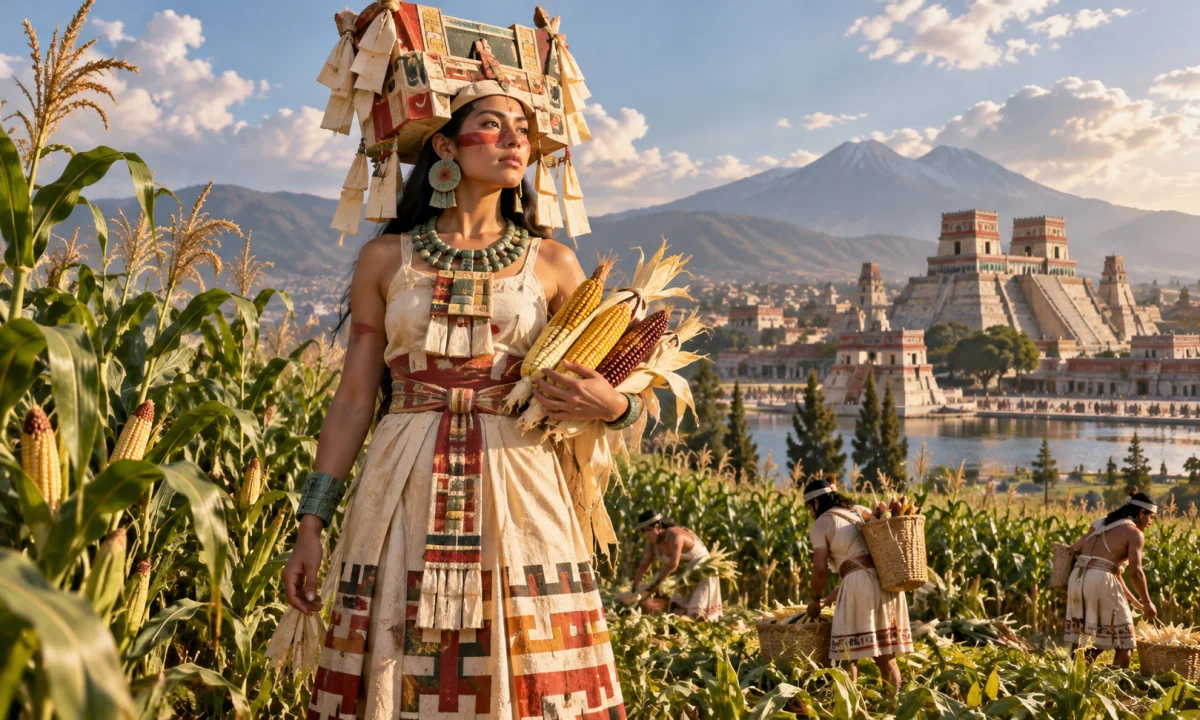
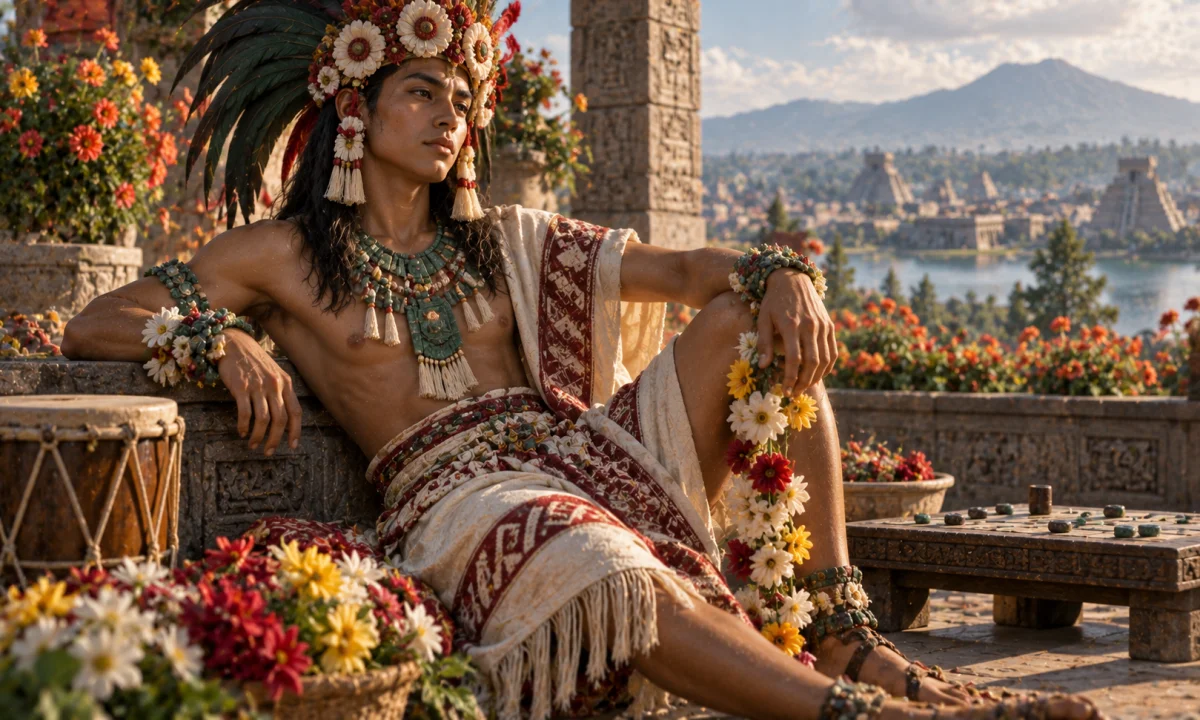
Some modern illustrations present Macuilxochitl as a richly dressed young man covered in flowers, carrying musical instruments or surrounded by dancers. Such images can communicate the deity’s general associations, but they should not be treated as exact reconstructions of a single historical standard. The surviving evidence does not justify confidently assigning every colourful, floral or musical attribute used in modern art to Macuilxochitl alone.
Games, gambling and social order
The association with games is particularly important because it shows how religious meaning extended into recreation and competition. Games could involve skill, chance, status and public reputation. A divine patron of games would not merely bless amusement; he could also represent the uncertainty and danger built into competition. Victory brought honour and celebration, while loss could carry financial, social or spiritual consequences.
Gambling was often viewed with ambivalence. It could be a recognized social practice, yet excessive attachment to it threatened household resources and personal discipline. Macuilxochitl’s connection with games therefore fits his broader position between enjoyment and excess. He could represent the attraction of pleasure as well as the risks that arise when pleasure governs conduct.
This balance is also visible in the treatment of song and dance. Music was central to public ritual and education, and trained performers could hold respected positions. At the same time, feasting, intoxication and sexual behaviour were subject to social rules. Macuilxochitl’s religious significance lies partly in this tension: pleasure was not outside religion, but neither was it automatically harmless.
Stories and the absence of a single major myth
Macuilxochitl does not possess a large, stable cycle of surviving myths equivalent to the better-known stories of Quetzalcoatl, Huitzilopochtli or Tezcatlipoca. The available evidence presents him more often through lists of deities, ritual descriptions, calendar associations and explanations of divine functions. This does not mean that no stories about him ever existed. Oral traditions, local ceremonies and songs could preserve material that was never recorded or did not survive the conquest.
The lack of an extensive narrative cycle is significant. It is better to describe Macuilxochitl through his documented associations than to invent a biography, family tree or heroic adventure for him. Claims that identify him as the child, spouse or reincarnation of another deity require evidence from a particular source and should not be generalized across all Nahua traditions.
Colonial writers sometimes organized Nahua gods according to categories that resemble European ideas about pantheons and divine offices. Their accounts are valuable, but they are not neutral transcripts of an unchanged pre-conquest religion. Names may have been translated inconsistently, related figures may have been grouped together, and indigenous concepts may have been explained using Christian vocabulary. For this reason, interpretation of Macuilxochitl depends on comparing textual, calendrical and visual evidence rather than relying on a single short definition.
Cultural significance
Macuilxochitl illustrates the importance of pleasure and artistic expression in Nahua religious life. Music, dance, flowers and games were not marginal subjects separated from worship. They belonged to public ceremony, social identity and the presentation of order. A deity connected with these activities could therefore have relevance for performers, nobles, participants in festivals and people concerned with luck or excess.
His association with the Ahuiateteo adds a moral and bodily dimension. The figure does not represent pleasure as purely good or purely evil. Instead, he belongs to a religious environment that recognized pleasure’s power and its dangers. Celebration could create community and honour the gods; uncontrolled appetite could lead to illness, poverty, disgrace or other forms of suffering. This dual perspective is more faithful to the evidence than describing Macuilxochitl simply as a “god of happiness.”
Distinguishing Macuilxochitl from similar figures
- Xochipilli: A closely related deity of flowers, music, dance, games and pleasure. The two figures overlap considerably, and some interpretations treat Macuilxochitl as an aspect or manifestation of Xochipilli, but they are not automatically identical in every source.
- Macuiltochtli and the other Ahuiateteo: These are separate five-named beings associated with excess and its consequences. A reference to the Ahuiateteo as a group should not be taken as a list of alternate names for Macuilxochitl.
- Centzon Totochtin: The “Four Hundred Rabbits” are associated with pulque and drunkenness. Macuilxochitl may share the broader theme of pleasure and excess, but he is not simply another name for the rabbit deities.
- Flower day signs: “Five Flower” can refer to a calendrical combination as well as to the deity. The calendar date and the divine figure are related but should not be treated as interchangeable in every context.
Later reception
After the Spanish conquest, devotion to pre-Christian deities was suppressed, transformed or incorporated into new local religious practices. Much of what is known about Macuilxochitl comes from this period of cultural disruption. Later retellings often simplify him into a generic god of flowers, music or pleasure, while modern fantasy, games and popular illustrations may turn him into a warrior, nature spirit or fully individualized character.
Such adaptations can draw inspiration from the name and traditional associations, but they are not evidence for ancient belief. A historically careful portrayal keeps the uncertainty around his relationship with Xochipilli, recognizes his place among the Ahuiateteo, and treats music, games and pleasure as culturally significant activities rather than as decorative themes alone.