WORLD
WORLD
Kami-kaze
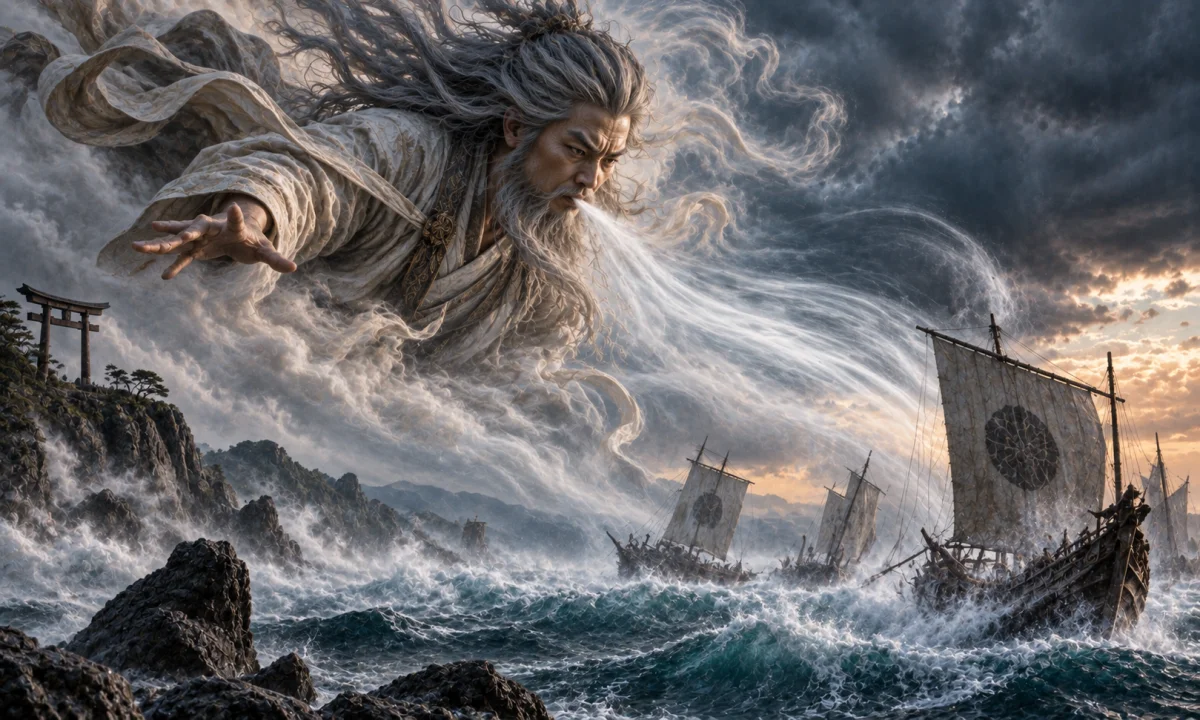
Kami-kaze, more commonly written kamikaze in English, means “divine wind” or “wind of the kami.” In Japanese religious and historical tradition, it is not normally the name of a single god, monster or supernatural creature. The expression became famous because Japanese accounts associated powerful storms with the defeat of Mongol-led invasions in the thirteenth century. It reflects a religious understanding in which kami could protect a land, its rulers and its communities through forces of nature.
Meaning of the name
The Japanese expression is written 神風. The first element, kami, can refer to a deity, sacred power, revered natural presence or other supernatural being in Shinto contexts. The second element, kaze, means “wind.” In ordinary modern Japanese, the compound is pronounced kamikaze. The spelling kami-kaze reflects an older style of romanisation and helps show the two elements of the expression.
The phrase should not automatically be understood as the personal name of a wind deity. Japanese mythology includes deities associated with wind, storms and weather, but kamikaze generally describes a divinely interpreted wind rather than identifying one particular divine personality. Depending on the period and context, the kami believed to be responsible could be understood collectively or connected with important protective deities and shrines.
The expression also has an older literary use unrelated to the Mongol invasions. In classical Japanese poetry, “the divine wind of Ise” could function as a poetic epithet associated with Ise. Ise was the home of the Grand Shrine of Ise and the worship of Amaterasu, the sun kami traditionally regarded as the imperial ancestor. In such poetry, the phrase need not describe a historical storm. Its meaning may be symbolic, poetic or connected with the sacred status of Ise.
Religious and cultural setting
Traditional Japanese understandings of the natural world did not always separate physical events from religious significance in the modern manner. Mountains, rivers, forests, rocks, storms and unusual occurrences could all be associated with kami. A typhoon might therefore be treated both as a destructive natural event and as an expression of supernatural will.
Shinto was not historically an entirely separate system from Buddhism. For many centuries, kami worship and Buddhist institutions existed in close relationship. Buddhist temples and Shinto shrines could share sacred sites, rituals and protective functions. Religious specialists might interpret a military crisis through several overlapping traditions, including prayers to kami, Buddhist invocations, divination and rituals for the protection of the realm.
Ideas of divine protection were especially important in relation to the Japanese sovereign and the imperial state. Court traditions associated the imperial line with Amaterasu and presented the realm as possessing sacred guardianship. This did not mean that every Japanese person interpreted a storm in exactly the same way, nor that all surviving accounts agree about which deity acted. It does show why a natural disaster that harmed an invading army could be remembered as a sign of sacred protection.
The Mongol invasions and the “divine wind”
The historical event most strongly associated with kamikaze was the attempted conquest of Japan by forces connected with the Mongol Empire and the Yuan dynasty. The first invasion took place in 1274. The invading force included Mongol, Chinese and Korean troops and crossed to northern Kyushu, where Japanese defenders fought near the area of modern Fukuoka. The invaders withdrew after a short campaign.
The reasons for the withdrawal are not entirely certain. A storm may have damaged ships and contributed to the decision, but the surviving evidence does not permit every detail to be reconstructed with confidence. Japanese religious and historical traditions later presented the retreat as evidence that the kami had defended the country.
A larger invasion was launched in 1281. The Yuan forces again used fleets and troops drawn from several parts of East Asia. Japanese resistance, coastal fortifications and difficult logistical conditions all played important roles. A major storm struck the invading fleets, causing severe destruction. The disaster became the most powerful historical foundation for the idea of the divine wind.
Japanese accounts from and after the invasions describe the victory in religious terms, although their emphasis varies. Some refer to the protection of particular kami or shrines; others frame the event as evidence of sacred favour toward Japan. The famous picture of one miraculous wind instantly saving the nation is a later simplification of a much more complicated military and environmental episode. The storms were important, but so were Japanese defensive preparations, naval conditions, the organisation of the invading forces and the prolonged resistance of the defenders.
It is also important not to treat every traditional account as a neutral military report. Chronicles and religious documents had purposes beyond recording events. They could praise a shrine, strengthen the authority of a ruler, support claims about a deity’s power or explain why Japan had survived a dangerous foreign threat. The belief in divine protection was historically influential even where the precise meteorological and military details remain debated.
Which kami caused the wind?
There is no single universally accepted answer. The expression kamikaze does not function like the name of a god with one fixed mythology. Different accounts and religious institutions could attribute protection to different sacred powers.
Hachiman was one of the most important protective deities associated with warfare and the defence of Japan. Originally connected with the worship of the Hata? No—Hachiman’s early history is complex and includes associations with the ancient court, Usa in Kyushu and later Buddhist interpretation. By the medieval period, Hachiman was widely revered as a guardian of the imperial institution and a martial protector. Shrines dedicated to Hachiman played an important role in prayers for victory and national defence.
Amaterasu, worshipped especially at Ise, could also be understood as a supreme protector of the imperial realm. Since Ise traditions were closely connected with the sacred legitimacy of the court, references to the divine wind of Ise could carry political and religious meaning beyond the physical movement of air.
Other kami and sacred institutions could be included in local or institutional interpretations. The precise attribution depended on the source, the shrine involved and the religious language being used. It is therefore misleading to describe kami-kaze as the weapon of one clearly defined wind god.
Wind deities and related figures
Japanese mythology does include figures associated with wind, but they should not be merged with kamikaze. Fūjin, also called Fūten in some contexts, is the well-known wind deity represented in Buddhist and Japanese religious art. He is often shown as a wild, supernatural figure carrying a large wind bag over his shoulders. Images of Fūjin became especially recognisable through medieval and early modern art.
Fūjin’s role is to control or release wind, but the storms associated with the Mongol invasions were not simply identified in all traditions as the actions of Fūjin. Buddhist iconography and Shinto accounts used different religious frameworks, and later popular explanations may combine them more freely than historical sources did.
Raijin, the thunder deity, is another related but distinct figure. He is commonly depicted with drums and is associated with thunder and lightning. Raijin and Fūjin are often shown together in art, yet neither figure is identical with the historical and religious concept of the kamikaze. Likewise, the dragon deities and water spirits associated with seas, rain and storms belong to a broader group of weather-related beings rather than constituting the “divine wind” itself.
Appearance and supernatural qualities
Because kami-kaze is an event or sacred force rather than a single being, it has no fixed traditional appearance. It is not ordinarily represented with a human body, animal form, costume or distinctive weapon. In visual art, the wind might be suggested through curling clouds, waves, banners, flying debris or the movement of ships. The divine presence is conveyed by the effect of the storm rather than by a standard portrait.
Its principal power is the ability to alter the course of history through nature. A divine wind can disperse fleets, destroy ships, conceal defenders, delay an enemy or make an invasion impossible. Such power is not merely meteorological in traditional interpretation. It demonstrates that the sacred forces connected with Japan could intervene directly when the country or its legitimate rulers were threatened.
The symbolism is therefore double-edged. Wind can protect, but it can also destroy without regard for human plans. A storm that saves one community may kill sailors, devastate fields and damage settlements elsewhere. Calling it “divine” gives the event religious meaning, but it does not make the force gentle or morally simple.
Stories, prayers and historical memory
The Mongol invasions produced a substantial body of religious and political memory. Rituals were performed at shrines and temples for the protection of the country. Religious communities that claimed to have prayed successfully for victory could gain prestige, donations or stronger political relationships. Stories of sacred intervention thus became part of institutional history as well as popular belief.
The invasions also encouraged a broader image of Japan as a land under divine protection. This image could be expressed through the idea that foreign armies would fail when they challenged the sacred order of the islands. In medieval Japan, however, the meaning was not necessarily a simple statement of ethnic or national superiority. It was closely tied to the authority of the court, the power of particular shrines and the religious interpretation of political legitimacy.
Later generations often remembered the storms more vividly than the many other factors involved in the invasions. The phrase became a compact explanation for survival: the enemy was defeated because the kami sent a wind. That memory remained powerful even as Japanese political institutions, religious practices and ideas of national identity changed.
Interpretation and cultural significance
Kami-kaze illustrates how myth, religion and history can overlap without becoming identical. The storms were physical events, and the invasions were historical military campaigns. At the same time, their meaning was shaped by religious traditions that understood nature as capable of expressing sacred intention.
For historians, the question is not simply whether a wind was “really” divine. A more useful question is how the interpretation developed, who promoted it and what work it performed in society. Shrines and temples used accounts of protection to establish religious authority. Rulers and court traditions could present victory as confirmation of the sacred status of the realm. Communities could remember survival through stories that connected local worship with national history.
The term also shows why translations can be misleading. “Divine wind” is accurate at a basic level, but it may suggest a single god, a permanent supernatural weapon or a fully unified national belief. The Japanese expression has had different meanings in poetry, religious narratives, historical writing and modern political language. Its significance depends heavily on context.
Use during the Second World War
In the twentieth century, kamikaze acquired a new and very different meaning. During the final period of the Second World War, the Japanese military used the term for deliberate attacks in which pilots guided aircraft into enemy ships. The expression drew on the earlier memory of the Mongol invasions and the image of Japan being saved by a divine wind.
These wartime attacks were not the same thing as the traditional kami-kaze. The medieval expression referred to sacredly interpreted storms, not human pilots. Military propaganda deliberately connected the modern attacks with older stories of divine protection, sacrifice and loyalty to the emperor. That connection was a modern political use of historical and religious symbolism rather than a continuation of an ancient supernatural practice.
The pilots were real people operating under military command, and their experiences varied. Some volunteered under intense social and institutional pressure; others were conscripted or assigned to missions. The popular image of the fearless, purely willing “kamikaze pilot” can hide fear, coercion, grief and the human cost of the policy. In contemporary English, kamikaze is often used more broadly for a reckless person or action, but that casual usage can obscure its specific wartime history.
Kami-kaze in modern popular culture
Modern films, novels, games and comics sometimes portray kami-kaze as a literal magical wind, a named supernatural weapon or the power of a particular Japanese deity. Such treatments can be imaginative, but they are adaptations rather than a single inherited myth. They may also blend the divine wind with Fūjin, dragon spirits, storm magic or the wartime meaning of kamikaze.
A historically careful portrayal presents kami-kaze as a religious interpretation of storms associated especially with the Mongol invasions. It distinguishes the phrase from Fūjin and other wind or storm figures, recognises variation among medieval accounts and avoids treating the expression as the personal name of a universally defined being. Its importance lies not in a fixed appearance or biography, but in the way natural power, sacred protection, political authority and historical memory became joined in Japanese culture.