WORLD
WORLD
Tonatiuh
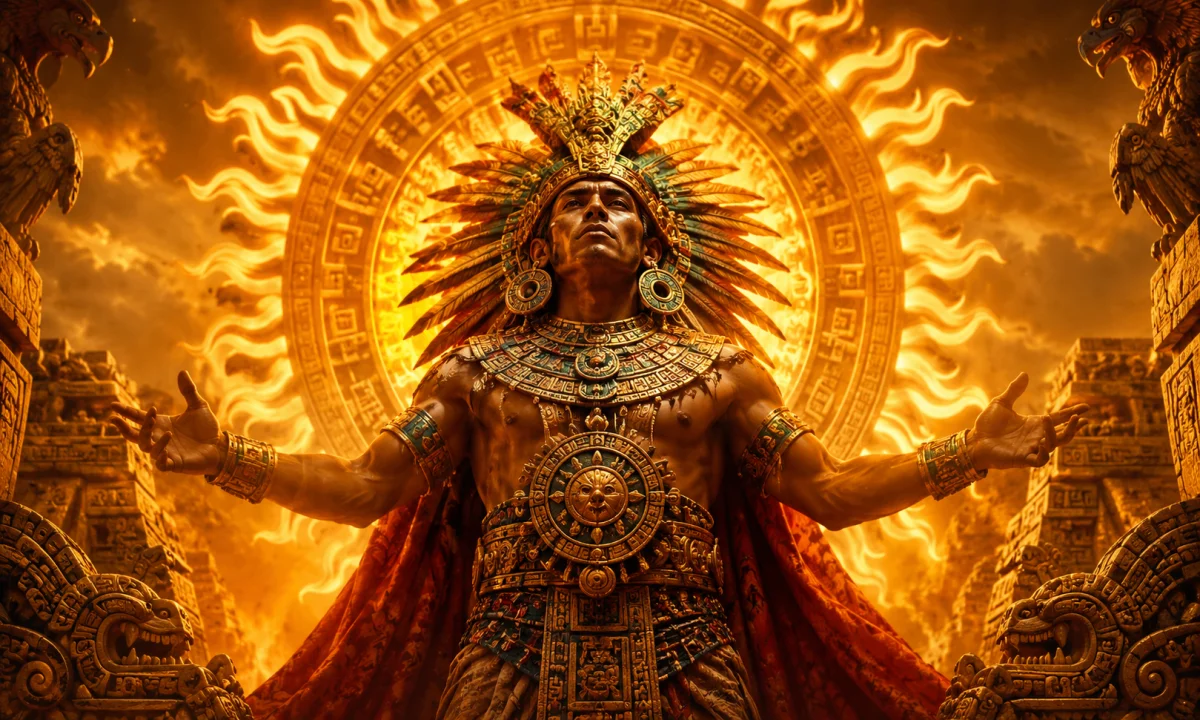
Tonatiuh is the Nahuatl sun deity associated with the Fifth Sun, the present age of the world in Mexica and other Nahua traditions of central Mexico. He represents the sun’s light, heat, movement and life-giving power, but also its dangerous demands. The sun had to travel across the sky each day, and Nahua religious thought connected that movement with warfare, offerings and the nourishment of the cosmic order. Tonatiuh is therefore not simply a benevolent sun god: he is a powerful and potentially destructive force whose continued movement helped keep the world alive.
Tonatiuh in Nahua religious tradition
The name Tonatiuh comes from Classical Nahuatl. It is related to the sun and to ideas of shining, warmth and heat, although the precise grammatical and etymological explanation is not entirely uniform in modern discussions. In Nahuatl-speaking societies, the word could function as a term for the sun as well as a divine name or title. Spellings vary because colonial writers recorded Nahuatl using different orthographic conventions; Tonatiuh is the most familiar modern spelling.
Calling Tonatiuh an “Aztec god” is useful but somewhat simplified. “Aztec” is a broad modern label for several related Nahua-speaking peoples, while the Mexica of Tenochtitlan were one particular Nahua polity. The religious traditions known from central Mexico were not perfectly uniform. Accounts produced after the Spanish conquest preserve Mexica beliefs, but they also reflect the perspectives of informants, scribes and missionaries working in a changed colonial environment. As a result, Tonatiuh does not appear as a single, fully standardized character in every source.
Tonatiuh is most clearly understood as the divine sun of the current cosmic era. In Nahua accounts, the world had passed through earlier ages, or “suns,” each of which ended in a catastrophe. The present age was often called Ollin Tonatiuh, “Sun of Movement” or “Moving Sun,” emphasizing that motion was essential to its survival. The exact names, sequence and details of the earlier suns vary between sources, but the broader concept of successive worlds destroyed and renewed is widespread in surviving Nahua material.
Sources and surviving traditions
Knowledge of Tonatiuh comes from a combination of Indigenous manuscripts, colonial-era records, painted screenfolds, archaeological objects and later interpretations. Important evidence includes the Codex Borgia group of ritual manuscripts, the Codex Borbonicus, the Codex Vaticanus A, and other pictorial works. These manuscripts were created in different circumstances, and not all belonged to the Mexica tradition specifically. They should not be treated as illustrations of one single, universally accepted mythology.
Colonial Nahuatl texts also preserve important traditions. The collection known as the Florentine Codex, compiled in the sixteenth century under the direction of Bernardino de Sahagún with Indigenous collaborators, describes religious practices, gods, festivals and cosmic ideas. The Leyenda de los Soles, preserved in the Codex Chimalpopoca, contains a major version of the creation story involving the Fifth Sun. These sources were written after the conquest, so they are not untouched records of pre-Hispanic belief. Nevertheless, they preserve Indigenous-language accounts and concepts that are central to understanding Tonatiuh.
Archaeological evidence adds another dimension. Solar imagery appears in temple sculpture, ritual objects and monumental stonework. The famous object now called the Aztec Sun Stone or Calendar Stone is especially important, although both popular names can be misleading. It is not simply a calendar, and its original ritual function remains debated. The central face is often identified as Tonatiuh, but scholars have proposed other interpretations, including a more general representation of the sun or a composite cosmic image. The identification is powerful and widely used, but it should not be presented as completely certain.
The Fifth Sun and the creation of the present world
The best-known story of Tonatiuh concerns the creation of the Fifth Sun at Teotihuacan. According to one major version, the gods gathered to create a new sun after the previous world had ended. Two deities volunteered to sacrifice themselves in a fire: the wealthy and proud Tecuciztecatl, associated with the moon in the story, and the poor, diseased or humble Nanahuatzin.
Tecuciztecatl possessed valuable ornaments and made impressive offerings, but he hesitated when the moment came to enter the flames. Nanahuatzin, despite having fewer possessions and a lower social status, threw himself into the fire. Tecuciztecatl then followed. Nanahuatzin rose as the sun, while Tecuciztecatl became the moon. In this narrative, Nanahuatzin’s transformed solar identity is associated with Tonatiuh, although the story’s wording and the relationship between the personal name and the divine title vary between versions.
The newly created sun did not move across the sky. The gods realized that further sacrifice was required to set the sun in motion. In some accounts, the wind deity Ehecatl played a decisive role by moving the sun or by killing the remaining gods so that their vital force could sustain the new cosmic order. The story links divine sacrifice with solar movement: the sun’s daily journey was not automatic but depended on the transfer of sacred energy.
This myth should not be reduced to a simple explanation for human sacrifice. It expresses several related ideas: the value of self-sacrifice, the contrast between humility and pride, the transformation of death into cosmic power, and the continuing obligations between humans, gods and the natural world. Later Mexica ritual practices were interpreted through this wider religious framework, but particular ceremonies had their own histories, deities and political meanings.
Appearance and visual symbolism
Tonatiuh is commonly shown as a face within a solar disk or surrounded by rays. His imagery can include red, yellow or orange coloration, although colors differ according to the manuscript, artistic convention and condition of the surviving object. The face may appear severe, aged or otherworldly rather than youthful. This emphasizes the sun’s authority and its role as a cosmic power rather than portraying it as a human-like personality in a single fixed form.
One of the most recognizable features associated with Tonatiuh is a protruding tongue shaped like a blade or knife. The detail is often interpreted as a symbol of sacrifice, hunger or the need for offerings. Some representations show the sun’s face emerging from a surrounding sign of movement, while others place solar rays, precious ornaments or calendrical signs around it. Interpretations are not always unanimous, particularly when an image combines solar, calendrical, sacrificial and earth-related symbols.
The central image on the Sun Stone is frequently described as Tonatiuh. It shows a powerful face with a tongue-like form extending outward and clawed hands holding human hearts or other sacred elements, depending on how the design is read. Around the center are the four signs associated with earlier world ages and other calendrical components. The monument’s imagery strongly evokes the moving sun and the succession of cosmic eras, but identifying every feature with one named deity risks making the design more straightforward than it actually is.
Eagle symbolism is also closely connected with the sun. The eagle was associated with height, daylight, warfare and the eastern direction. The Mexica military order known as the Eagle Warriors drew on this symbolism, though the warriors were not simply priests or incarnations of Tonatiuh. The eagle’s relationship to the sun belongs to a wider network of associations involving courage, sacrifice, nobility and the movement of celestial forces.
The sun’s journey and the dead
Nahua ideas about the sun included a daily journey through different regions of the cosmos. The sun rose in the east and traveled across the sky before descending in the west. Warriors who died in battle or in sacrificial rites were believed, in important Mexica accounts, to accompany the sun during part of its journey. Women who died in childbirth could also receive a special posthumous status, because childbirth was compared to warfare and the woman was regarded as struggling to bring a new life into the world.
These ideas are sometimes described as a simple “solar heaven,” but the surviving evidence is more complex. The fate of the dead depended on the manner of death in some traditions rather than on moral judgment in the later Christian sense. The sun’s companions were not necessarily eternal residents of a paradise. Their relationship to Tonatiuh was connected with time, ritual identity and the maintenance of cosmic movement.
The concept also helped link warfare to religion and state power. Mexica rulers and military elites presented warfare as part of a cosmic responsibility: captives and sacrificial victims could provide the vital force required by the gods and the sun. This was a religious interpretation of political violence, not a neutral description of all warfare in Mesoamerica. Other Mesoamerican societies had different institutions and traditions, and the Mexica system should not be generalized to the entire region.
Tonatiuh, sacrifice and cosmic dependence
The Fifth Sun’s need for nourishment is a recurring theme in interpretations of Mexica religion. Hearts, blood, incense, food, flowers and other offerings could all participate in systems of exchange between humans and deities. Human sacrifice was one part of this larger ritual economy, although its scale and meaning varied according to ceremony, location, historical period and political circumstance.
Tonatiuh’s association with sacrifice does not mean that every offering in Mexica religion was made to him, or that he was the only deity connected with blood and warfare. Huitzilopochtli, Tlaloc, Tezcatlipoca, Xipe Totec, the earth powers and many other deities received offerings within distinct ritual contexts. Solar imagery could overlap with royal, military and calendrical symbolism without making all these gods identical.
The idea of movement is especially important. Ollin, often translated as “movement,” also suggests earthquake, change and dynamic force. The Fifth Sun was not a stable object suspended in the heavens; it was a living cosmic process. Its movement promised continuity but also contained the possibility of catastrophe. Some traditions predicted that the present sun would eventually end through earthquakes, though the details vary.
Tonatiuh and related deities
Huitzilopochtli is the figure most likely to be confused with Tonatiuh. Huitzilopochtli was the Mexica patron deity of migration, warfare and the foundation of Tenochtitlan. He was strongly associated with the sun in Mexica state ideology, especially with the rising sun and the victorious warrior. Some modern descriptions therefore call Huitzilopochtli “the sun god” without qualification. Tonatiuh, however, is the named solar deity of the Fifth Sun in the creation traditions, while Huitzilopochtli has his own myths, symbols and ritual identity. The two could be connected without being interchangeable.
Nanahuatzin is also distinct from Tonatiuh, even though he becomes the sun in the creation story. Nanahuatzin is the humble deity who enters the fire first. The story explains the origin of the sun, and the transformed Nanahuatzin may then be identified with Tonatiuh. It is more accurate to describe this as a transformation or identification within a mythic narrative than to assume that the two names always referred to exactly the same figure in every tradition.
Tecuciztecatl, who becomes the moon after following Nanahuatzin into the fire, is not a second form of Tonatiuh. The sun and moon are paired in the story, but they have different roles. Nor should Tonatiuh be confused with Tlaloc, the rain deity, whose storms and agricultural power were essential to life but whose identity and mythology are separate.
Cultural significance
Tonatiuh expresses a central principle of Nahua cosmology: the world survives through relationships of exchange and obligation. Humans depend on sunlight, rain, crops and the ordered movement of the heavens, while the gods are represented as requiring offerings, devotion and sacred energy. This was not merely an abstract theology. It shaped ceremonies, calendars, rulership, warfare, architecture and ideas about honorable death.
The sun also served as a political symbol. Mexica rulers could present their capital, armies and ceremonies as participating in the preservation of the Fifth Sun. Monumental art connected the Mexica state with ancient sacred centers such as Teotihuacan, which was already an important place of origin in Nahua memory long after its earlier inhabitants had disappeared. Tonatiuh therefore belonged both to a broad Mesoamerican sacred landscape and to the specific political claims of the Mexica empire.
Modern popular culture often portrays Tonatiuh as a generic “Aztec sun god,” sometimes giving him invented weapons, personality traits or relationships drawn from unrelated deities. Such portrayals may be inspired by the Sun Stone or by the Fifth Sun myth, but they should not be treated as direct representations of a single ancient canon. The historical Tonatiuh is better understood through the varied Nahua traditions in which the sun was a moving, sacrificial and indispensable power at the center of a changing cosmos.