WORLD
WORLD
Xiuhcoatl
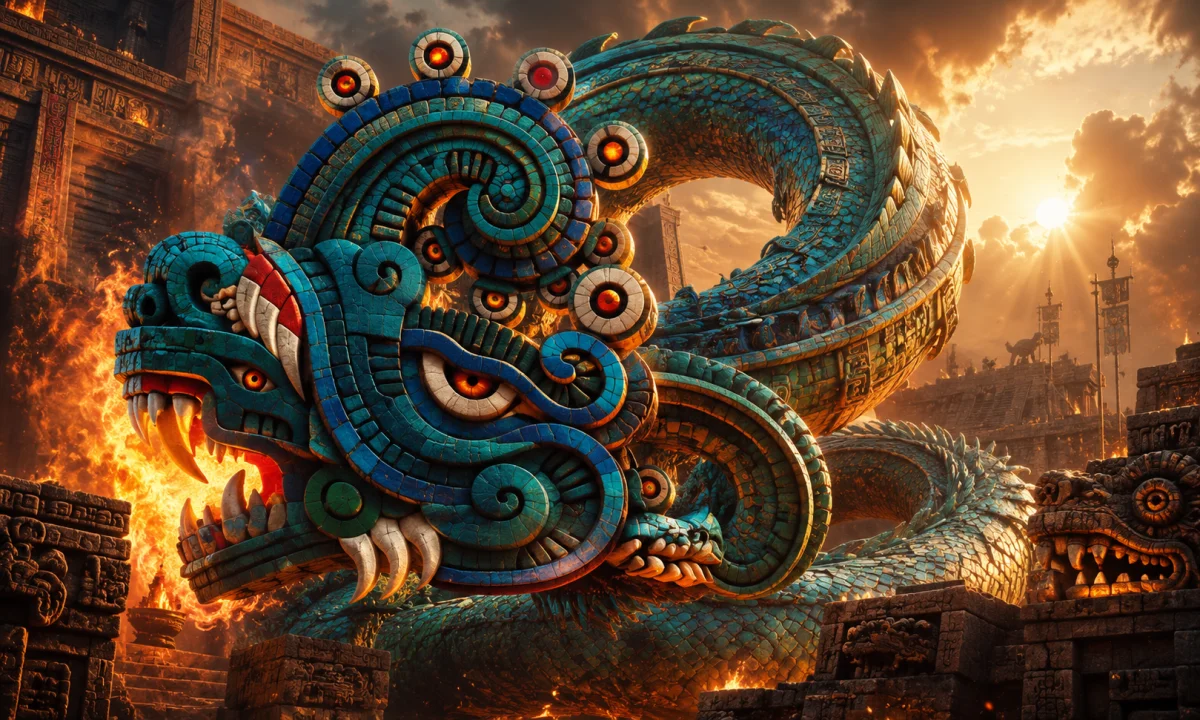
Xiuhcoatl is a powerful serpent figure in Aztec mythology, most often understood as the “turquoise serpent” or “fire serpent.” In Nahua tradition, the name refers not to a single simple creature but to a complex sacred image associated with heat, fire, warfare, kingship, and divine force. Xiuhcoatl appears in ancient Mexican cosmology, ritual symbolism, and mythic narratives, especially in connection with the sun and the god Huitzilopochtli. The figure is one of the best-known serpent beings from central Mexico, yet its exact character varies by source and context.
Origins and cultural setting
Xiuhcoatl belongs to the religious and mythological world of the Nahua peoples of central Mexico, including the Mexica, commonly called the Aztecs. The Mexica inherited and reshaped older Mesoamerican traditions, and serpent imagery was already deeply important in the region long before the rise of Tenochtitlan. In Aztec thought, serpents could embody water, fertility, the earth, precious power, vision, and danger. Xiuhcoatl stands within this broad symbolic field, but with a strong association with fire and solar violence.
The clearest surviving information about Xiuhcoatl comes from post-conquest sources written in the 16th century and later, especially colonial-era Nahua texts, Spanish accounts, and pictorial manuscripts. These sources are not uniform. Some present Xiuhcoatl as a divine weapon, some as a mythic serpent, and some as a named object or force rather than a fully independent being. Because of this, the figure is best understood as a tradition of related meanings rather than a single fixed character.
In the Mexica worldview, sacred powers were often expressed through named beings that could also function as symbols, ritual objects, or divine manifestations. Xiuhcoatl is one of the clearest examples of this kind of overlap. The serpent can be read as mythology, but also as cosmology and political ideology, since it helps explain how divine power legitimized the Mexica state and its war god.
Name and meaning
The name Xiuhcoatl is usually translated as “turquoise serpent,” though “fire serpent” is also common in modern discussion. The Nahuatl word xiuhitl can mean several related things, including turquoise, precious green-blue stone, fire, year, and sometimes grass, depending on context. This makes the name intentionally rich and somewhat ambiguous. As a result, scholars and translators do not always agree on the best rendering.
That ambiguity matters. In Nahua symbolism, turquoise and fire are not unrelated ideas. Turquoise was a precious material associated with rulership, sacred value, and brilliance, while fire could represent divine energy, transformation, and the burning power of the sun. Xiuhcoatl therefore suggests not just an ordinary serpent, but a luminous, precious, and destructive serpent force.
Because xiuh- can carry more than one meaning, the name may evoke time as well as fire or turquoise. Some interpretations connect Xiuhcoatl with the calendrical or cyclical dimension of sacred time, though that reading should be treated cautiously and not overstated. The important point is that the name is deliberately layered and culturally resonant.
Appearance and symbolic character
Xiuhcoatl is usually imagined as a serpent or serpent-like creature, but its appearance is not fixed in a single ancient description. In some artistic representations it appears as a blazing or ornamented snake with fire-like features. In others it is less a zoological creature than a symbolic weapon or animated sacred force. The imagery often emphasizes movement, heat, and divine aggression rather than naturalistic anatomy.
In Aztec visual culture, serpents commonly served as carriers of sacred potency. Xiuhcoatl adds the force of flame or turquoise brilliance to this older serpent symbolism. The creature is therefore associated with destruction, but not only destruction in a negative sense. Fire also purifies, transforms, and enables renewal. In a society where warfare, sacrifice, and cosmic maintenance were closely linked, this made Xiuhcoatl a fitting image of necessary violence in service of the gods and the world order.
Xiuhcoatl is also linked to rulership and sacred power. Turquoise was a prestigious material used in elite and ritual contexts, and serpent imagery often appears on ceremonial objects. A serpent of turquoise or fire could symbolize the precious authority of the state, the brilliance of the sun, and the dangerous legitimacy of war.
Role in myth and religion
Xiuhcoatl is most famous as the weapon or manifestation associated with Huitzilopochtli, the Mexica patron deity of war and the sun. In this role, the serpent functions as a divine missile, fiery blade, or sacred weapon used against the enemies of the sun. The most prominent narrative connection is with Huitzilopochtli’s victory over his sister Coyolxauhqui and her brothers at Coatepec, “Serpent Mountain.”
In that mythic cycle, Huitzilopochtli is born fully armed and immediately destroys the forces that threaten his mother Coatlicue. Xiuhcoatl is often described as the weapon he uses to defeat Coyolxauhqui, whose dismemberment becomes a foundational image in Mexica ritual and political symbolism. The serpent weapon helps explain the cosmic triumph of the sun over the moon and stars, as well as the violent establishment of order over chaos.
Different colonial sources do not always describe the event in exactly the same way. Sometimes Xiuhcoatl is clearly the weapon in Huitzilopochtli’s hand. In other cases it may seem more like an extension of the god’s own force. This variation is typical of Mesoamerican mythic traditions, where divine attributes can shift between body, weapon, and living being.
Xiuhcoatl also appears in broader solar symbolism. Because fire is closely associated with the sun, the serpent can represent the sun’s dangerous, active power, especially in warfare and sacrifice. It is therefore not simply a monster defeated by a god; it is also a vehicle of divine action.
Xiuhcoatl in the Coatepec cycle
The Coatepec narrative is the most important traditional story involving Xiuhcoatl. Coatepec is the serpent hill where Huitzilopochtli’s birth and victory take place in mythic time. There, the god emerges to defend his mother and establish his position as a solar warrior. Xiuhcoatl is the instrument through which the defeat of Coyolxauhqui is accomplished.
This story has strong ritual and political significance. The Mexica modeled parts of their ceremonial landscape on sacred mythic places, and the Templo Mayor in Tenochtitlan was closely linked to the Coatepec myth. The dismemberment of Coyolxauhqui, in particular, was echoed in temple sculpture and ritual action. Xiuhcoatl belongs to this same symbolic world, though its role is less iconic in modern popular imagination than the famous Coyolxauhqui stone.
The Coatepec cycle is not a random tale of divine family conflict. It presents a mythic explanation for the daily and cosmic struggle between the sun and the forces of night. Xiuhcoatl, as the fiery serpent weapon, marks the moment when divine force becomes decisive and ordered sovereignty is secured.
Relationship to fire, the sun, and sacred time
Xiuhcoatl is closely tied to fire in both literal and symbolic senses. Fire in Mesoamerican religion was not merely a domestic necessity; it was a sacred element with ritual importance. It could mark renewal, the transition of eras, and the maintenance of cosmic balance. A serpent of fire is therefore a fitting expression of divine transformation.
The creature’s association with turquoise also connects it to elite ritual culture and sacred brilliance. In Nahua thought, precious materials were not decorative only; they carried meaning, prestige, and divine quality. The combination of serpent, fire, and turquoise suggests an entity that is at once earthly and celestial, destructive and precious.
Some modern interpretations link Xiuhcoatl to broader Mesoamerican concepts of time and calendrical cycles because of the range of meanings carried by xiuhitl. That connection is plausible, but the exact extent of the link depends on the source and should not be stated too rigidly. What can be said confidently is that Xiuhcoatl belongs to a symbolic system in which sacred time, solar movement, and ritual fire were deeply interconnected.
Images and archaeological context
Xiuhcoatl is known not only from texts but also from Aztec art and archaeology. Serpent imagery appears widely on sculpture, temple decoration, ritual implements, and codices. In some works, serpentine forms are combined with flame-like elements or turquoise ornamentation, reflecting the sacred associations of the figure.
The Mexica world used images as active carriers of meaning rather than as simple illustrations. A serpent form could invoke presence, power, and cosmological truth. In that sense, Xiuhcoatl was not merely “represented” in art; art could help enact its symbolic force.
The most famous archaeological context connected to Xiuhcoatl is the Templo Mayor complex in Mexico-Tenochtitlan, where solar, war, and sacrificial symbolism were densely layered. While not every serpent carving at the site should be identified as Xiuhcoatl, the temple’s iconography belongs to the same religious environment and helps explain why the serpent was so powerful in Mexica thought.
Interpretation and scholarly discussion
Scholars generally treat Xiuhcoatl as a polymorphic symbol rather than a single “mythological creature” in the narrow European sense. It can be a serpent, a weapon, a divine fire, or a ritual emblem depending on context. This fluidity is characteristic of Nahua religious expression, where gods and sacred forces often appear through multiple forms.
There is also debate about how much of the surviving image of Xiuhcoatl reflects pre-conquest belief and how much was shaped by colonial-period interpretation. Since most detailed descriptions were recorded after the Spanish conquest, they are filtered through Christian, alphabetic, and political frameworks. Even so, the recurrence of Xiuhcoatl across different kinds of evidence suggests that it was a significant and authentic part of Mexica sacred symbolism.
It is also important not to reduce Xiuhcoatl to a simple “dragon” or fantasy serpent. Such comparisons can be helpful at a very general level, but they may obscure the specific Mesoamerican meanings of the figure. Xiuhcoatl is embedded in Nahua religion, solar warfare, and elite ideology, and those contexts shape its significance.
Distinction from similar serpent beings
Xiuhcoatl is often confused with other Mesoamerican serpent figures, especially because serpent imagery is widespread and varied. It should not be merged with Quetzalcoatl, the plumed serpent deity. Quetzalcoatl and Xiuhcoatl are distinct in origin, symbolism, and role. Quetzalcoatl is primarily associated with wind, priestly knowledge, and sacred duality, while Xiuhcoatl is associated more strongly with fire, warfare, and solar aggression.
Xiuhcoatl should also not be confused with ordinary snakes appearing in Mesoamerican art or ritual. Many serpents in Aztec culture have specific meanings, but not all are Xiuhcoatl. Likewise, the name should not be used as if it referred universally to any fiery serpent in all Mesoamerican traditions. The figure is specifically Nahua and especially Mexica in the form most commonly discussed today.
Another possible source of confusion is whether Xiuhcoatl is a deity, a monster, or a weapon. The answer is that it may function as any of these depending on the source. In some contexts it is best described as a divine weapon or manifestation. In others, it is treated as a sacred serpent being. The uncertainty is part of the tradition rather than a problem to be eliminated.
Modern reception and popular culture
Xiuhcoatl appears occasionally in modern literature, games, fantasy art, and online discussions of mythological weapons or dragons. These uses often emphasize the name’s dramatic sound and fiery associations. Some modern works present Xiuhcoatl as a dragon-like monster or as a magical artifact inspired by Aztec culture.
Such adaptations are modern inventions and should not be mistaken for ancient tradition. Popular culture often simplifies Xiuhcoatl into a single combat creature, while the historical figure is more complex: a sacred serpent of fire, turquoise, and divine power tied to Nahua cosmology. Modern uses can raise awareness of the name, but they usually flatten its religious and cultural depth.
In contemporary discussions of Aztec mythology, Xiuhcoatl is sometimes highlighted because it illustrates how power, violence, and sacred legitimacy were understood together. Its continued appeal lies partly in that richness. The figure is memorable not just because it is serpentine, but because it combines beauty and destruction, preciousness and flame, divine authority and martial force.