WORLD
WORLD
Heracles
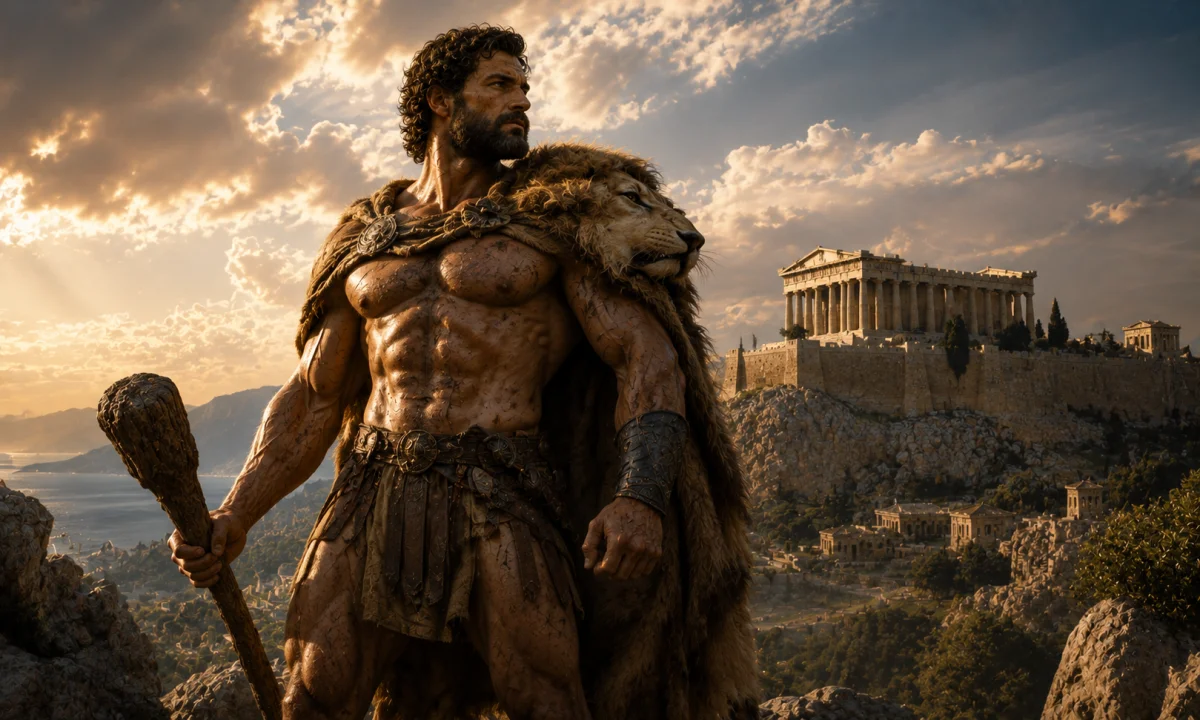
Heracles (Greek Hēraklēs; Latin Hercules) is one of the greatest heroes of Greek mythology. Son of Zeus and the mortal woman Alcmene, he is celebrated for extraordinary strength, endurance and courage, but his stories also concern violence, guilt, suffering and the difficult pursuit of purification. In Greek tradition, Heracles is both a mortal hero who undergoes severe trials and a divine figure who receives immortality after death. His most famous exploits are the Twelve Labours, performed in the service of King Eurystheus.
Origins and cultural setting
Heracles belongs to the heroic mythology of ancient Greece, a tradition populated by figures who stand between ordinary human beings and the gods. Heroes could possess exceptional abilities or divine ancestry while remaining vulnerable to death, grief and moral failure. Unlike the Olympian gods, they were often associated with particular tombs, sanctuaries and local communities where they received cult.
Heracles was especially important because his legends circulated widely across the Greek world. Different cities and regions associated him with their own landscapes, monuments and local traditions. His stories link him with Thebes, Tiryns, Argos, the Peloponnese, Crete, the far western reaches of the known world and, in later traditions, many places beyond Greece.
The surviving mythology was not preserved in one single canonical book. Episodes appear in archaic epic, lyric poetry, tragedy, vase painting and later mythographic works. The Odyssey and Iliad already refer to Heracles, while later writers such as Euripides, Sophocles, Diodorus Siculus, Apollodorus and Ovid provide fuller or differently arranged versions. These accounts do not always agree about the order of events, the names of minor characters or the precise details of his adventures.
Name, identity and classification
The Greek name Hēraklēs is commonly understood as meaning “glory of Hera,” formed from the name of the goddess Hera and a word associated with fame or glory. The meaning is striking because Hera is usually his hostile divine opponent. The name may reflect a mythic idea that the hero’s fame arises through the trials imposed upon him by Hera, although the exact historical development of the name and its religious associations is not entirely certain.
Heracles is not simply a god, demigod or giant in the modern sense. In Greek religious terms, he begins as a mortal hero with one divine parent. His later apotheosis—the transformation or reception of a mortal into divine status—makes him an unusual figure who can be honoured both as a hero and as a god. Some ancient communities emphasised his heroic aspect, while others worshipped him as a full deity.
His Roman counterpart is Hercules, whose mythology draws heavily on Greek Heracles but develops distinctive Roman associations. The two figures are often treated as equivalent in classical literature and modern reference works, but Roman religious practice and political symbolism gave Hercules meanings that were not identical to those of the Greek hero.
Birth and early life
Heracles was born to Zeus and Alcmene, a mortal princess descended from Perseus. Alcmene was married to Amphitryon, who was away fighting when Zeus approached her in the form of her husband. Zeus prolonged the night, and Heracles was conceived during that union. Amphitryon later returned and fathered Iphicles, Heracles’ mortal half-brother. As a result, the two boys were raised together, with Heracles possessing divine ancestry and Iphicles remaining fully mortal.
Hera’s anger toward Heracles began before his birth. In many versions, Zeus had boasted that a descendant of Perseus would become a great ruler, but Hera manipulated the succession so that Eurystheus was born first and received authority over Heracles. Hera also sent snakes to kill the infant Heracles. The child strangled them, revealing his extraordinary strength. This episode is one of the most frequently represented scenes from his childhood, although details vary between literary and artistic traditions.
Heracles received instruction in music, warfare, archery and other skills. His education was not always successful. In one well-known account, he killed his music teacher Linus with a lyre after being struck or reprimanded, then defended himself by arguing that he had acted in self-defence. The story presents both his immense physical power and the danger posed by his uncontrollable temper.
As a young man, Heracles encountered two personified paths, commonly called Virtue and Vice, in a tale associated with the sophist Prodicus. Virtue offered a difficult life of discipline and lasting honour, while Vice promised ease and pleasure. Heracles chose the harder path. This episode became particularly influential in later moral philosophy and art, though it is not the same as the older heroic legends.
Marriage, madness and service to Eurystheus
Heracles married Megara, a daughter of Creon of Thebes, after helping defend Thebes from an enemy. They had children, though the number and names differ among sources. Hera later afflicted Heracles with madness. In a tragic episode, he killed his children and, in some versions, Megara as well, believing them to be enemies or monsters. When his reason returned, he was overwhelmed by grief and sought purification.
The connection between the madness and the Labours varies. One influential tradition states that the Delphic oracle ordered Heracles to serve Eurystheus for a fixed period in order to expiate the killings. Other accounts describe the Labours as a punishment arranged by Hera or as the consequence of Eurystheus’ authority over him. This distinction matters: the Labours are not merely adventurous quests but are tied to guilt, pollution, obedience and the restoration of honour.
Eurystheus was the king of Tiryns or Mycenae, depending on the source, and feared Heracles’ power. He therefore imposed dangerous tasks intended to be impossible. The number was originally not necessarily twelve. Heracles completed ten tasks, but Eurystheus rejected two of them: the slaying of the Lernaean Hydra because Heracles had received help from Iolaus, and the cleaning of the Augean stables because Heracles had demanded payment from King Augeas. Two additional labours were then assigned, producing the familiar total of twelve.
The Twelve Labours
The standard sequence is not identical in every ancient account, but the following list represents the best-known form of the tradition:
- The Nemean Lion: Heracles killed a lion whose hide could not be pierced by ordinary weapons. He finally defeated it through his strength and thereafter wore its skin as armour. The lion’s invulnerability and the hero’s use of its own claws to remove the hide are important features of later versions.
- The Lernaean Hydra: This many-headed serpent lived near Lerna. When one head was cut off, additional heads could grow in its place, and one central head was described as immortal. Heracles burned the necks to prevent regrowth, while Iolaus helped him. Heracles buried the immortal head beneath a heavy rock and used the Hydra’s poisonous blood on later arrows.
- The Ceryneian Hind: Heracles had to capture a sacred hind with golden antlers and bronze hooves. It belonged to Artemis, so he pursued it for a long time and tried to avoid killing it. The story demonstrates that even a labour imposed by Eurystheus could risk offending another deity.
- The Erymanthian Boar: Heracles captured a huge boar from Mount Erymanthus and brought it back alive. The journey included an encounter with the centaur Pholus. In some versions, the opening of a jar of wine led to conflict with other centaurs, ending in the accidental death of the wise centaur Chiron.
- The Augean Stables: King Augeas possessed enormous herds whose stables had not been cleaned for years. Heracles diverted the rivers Alpheus and Peneus through them, washing away the accumulated filth. Because he had negotiated a reward from Augeas, Eurystheus refused to count the achievement as a legitimate labour.
- The Stymphalian Birds: These aggressive birds lived around Lake Stymphalus and were dangerous because of their metallic feathers or weapons. Athena gave Heracles a device that produced a loud noise, frightening the birds into the air so that he could shoot them. The exact nature of the device differs between accounts and artistic interpretations.
- The Cretan Bull: Heracles captured a bull associated with Crete and brought it to Eurystheus. The bull is sometimes linked with the animal that fathered the Minotaur, although not every version treats the two traditions in precisely the same way.
- The Mares of Diomedes: The Thracian king Diomedes owned mares that were trained to eat human flesh. Heracles overcame Diomedes and fed him to the animals in some versions, after which they became manageable. The tale reflects the recurring mythic theme of a violent ruler being destroyed by the very forces he controls.
- The Girdle of Hippolyta: Heracles was sent to obtain the belt or girdle of Hippolyta, queen of the Amazons. Some accounts say she willingly agreed to give it to him until Hera spread a false rumour that the Amazons’ queen was being abducted. Other versions present the encounter as a battle from the beginning. The traditions should not be reduced to one fixed account, especially because ancient stories about the Amazons changed considerably across time and genre.
- The Cattle of Geryon: Heracles travelled to the far western edge of the world to seize the red cattle of Geryon, a three-bodied or three-personed being. He killed Geryon and the herdsman Eurytion, then drove the cattle back toward Greece. The journey includes the famous story of Heracles setting up the Pillars of Heracles, usually identified with the Strait of Gibraltar, though the geographical symbolism developed over time.
- The Apples of the Hesperides: Heracles had to obtain golden apples guarded in a distant garden. The garden belonged to the Hesperides, daughters associated with the far west, and was also protected by the serpent Ladon in many versions. Heracles sometimes persuaded Atlas to retrieve the apples while he temporarily supported the sky. In one variation, he used trickery to make Atlas resume the burden of the heavens.
- Cerberus: The final labour required Heracles to bring the underworld hound Cerberus to the upper world without using weapons. Hades allowed the task on the condition that Heracles subdue the dog by strength alone. Heracles returned Cerberus to the realm of the dead after displaying him to Eurystheus, who was terrified by the sight.
The Labours create a pattern of movement between civilisation and wilderness, Greece and distant lands, the human world and the realm of the dead. Heracles defeats monsters, clears polluted spaces, captures sacred animals and crosses boundaries that ordinary humans cannot safely cross. Yet the stories do not portray him as morally flawless. His violence can protect communities, but it can also produce catastrophe.
Other important adventures
Heracles appears in many myths outside the Labours. He helped the gods in their battle against the Giants, although the details of this episode vary. He joined the Argonauts for part of their expedition in some traditions but left the group after the disappearance of Hylas, his young companion or attendant. The Argonautic stories differ over whether Heracles departed voluntarily, was left behind or was excluded because of his strength and the practical demands of the voyage.
He also fought at Troy during an earlier generation, attacking King Laomedon after the king failed to honour an agreement. Heracles killed Laomedon and installed his son Priam, who later became the king of Troy destroyed in the Trojan War. In another well-known episode, Heracles wrestled the giant Antaeus in Libya. Antaeus drew strength from contact with the earth, so Heracles lifted him from the ground and crushed him.
Heracles’ relationships are similarly varied. Iolaus is commonly presented as his nephew and charioteer, as well as a trusted companion who helped during the Hydra labour. Hylas is associated with a tragic expedition in which water nymphs pulled him into a spring. Heracles’ marriages include Megara, Deianira and, after his apotheosis, the goddess Hebe. Ancient traditions also attribute numerous descendants to him, especially the Heracleidae, who became important in genealogical myths about the return of the descendants of Heracles to the Peloponnese.
Death and apotheosis
Heracles’ death is linked with Deianira, whom he had won after competing with the river god Achelous for her hand. During their journey, the centaur Nessus attempted to carry Deianira across a river and attacked her. Heracles shot him with an arrow poisoned by the Hydra’s blood. As Nessus died, he deceived Deianira by telling her that his blood would act as a love charm if Heracles ever became unfaithful.
Later, when Deianira feared that Heracles preferred another woman, she sent him a garment treated with Nessus’ blood. The poison burned into his body and could not be removed. Realising what she had done, Deianira killed herself in many versions. Heracles ordered a funeral pyre to be built on Mount Oeta. After his mortal body was consumed, Zeus took him to Olympus, where he became immortal and married Hebe, the goddess of youth.
The apotheosis resolves a central tension in Heracles’ mythology. His body suffers the consequences of mortal violence and divine hostility, but his heroic achievements earn a place among the gods. Some ancient depictions show the burning of the pyre as the decisive transition, while others focus on his arrival in heaven. The episode also distinguishes Heracles from heroes who remain permanently dead in the underworld or at a tomb.
Appearance, powers and symbols
Heracles is most recognisable through a small group of attributes: the skin of the Nemean Lion, a heavy club and a bow. The lion skin emphasises his victory over the first labour and serves as both protection and visual identification. The club represents direct physical force, while the bow and poisoned arrows show that his abilities include skill and tactical range as well as brute strength.
Greek artists represented Heracles in several ways. He may appear as a bearded, powerfully built adult, especially in scenes involving the Labours, or as a younger, athletic hero. His appearance is not fixed across all periods. The combination of massive strength and human vulnerability is more important than one standard physical form.
His powers are usually heroic rather than limitless. Heracles can overpower monsters, lift extraordinary weights and survive challenges beyond normal human capacity, but he can be wounded, deceived, driven mad and killed. His strength is therefore both a gift and a source of danger. The myths repeatedly ask whether physical power can be controlled by judgement, loyalty and self-knowledge.
Religious significance and interpretation
Heracles received worship in ancient Greece as both a hero and a god. Heroic cults were often connected with the dead and with a specific place, while divine cults could involve offerings and prayers directed to a deity. Heracles’ dual status allowed different communities to approach him in different ways. He was invoked as a powerful protector, a founder of settlements, a bringer of safety and a figure capable of overcoming hostile forces.
His cult was not limited to one ethnic or political community. Sanctuaries and festivals connected with him existed in various parts of Greece, and his worship spread with Greek communities around the Mediterranean. The Herakleia, festivals held in his honour, could include athletic or civic elements. His image was also used in public and domestic contexts as a sign of strength and protection.
Interpretations of Heracles have changed over time. Ancient audiences could view him as a model of endurance, a violent but necessary defender, a sufferer seeking purification or a comic figure whose appetite and physicality contrasted with refined heroes. Philosophers and moral writers sometimes treated his labours as images of discipline and the conquest of hardship. These readings are later interpretations of the myths rather than a single universally accepted meaning in ancient Greece.
Heracles, Hercules and similar figures
Hercules is the Roman form and adaptation of the Greek Heracles, not a separate monster or unrelated hero with the same name. Roman authors incorporated Greek episodes but also connected Hercules with Roman ideals of labour, conquest, masculine virtue and political power. Roman generals and emperors could employ his image as a symbol of strength and legitimate authority.
Heracles should not be confused with other Greek strongmen or monster-slayers. Theseus, for example, is a different Athenian hero whose exploits include the Minotaur and Procrustes. Perseus is another distinct hero, associated with Medusa and the rescue of Andromeda. The giant Alcyoneus, the warrior Ajax and various local heroes may resemble Heracles in strength or martial ability, but they belong to separate traditions.
Later reception and popular culture
Heracles remained influential in Greek and Roman art, poetry and drama, and his Labours became a durable subject for sculpture, pottery, mosaics and painting. Later European writers often used Hercules as a symbol of heroic effort, physical strength or the triumph of virtue over difficulty. The name also entered expressions describing exceptionally strong people, although such uses usually simplify the complexity of the ancient character.
Modern films, television programmes, novels, comics and games frequently adapt Heracles as “Hercules.” These works may combine the Twelve Labours with unrelated myths, alter his family relationships, remove the episode of violence against his children or portray him as a straightforward superhero. Such versions can introduce the figure to new audiences, but they should be distinguished from the ancient traditions, which present Heracles as a tragic and religiously significant hero as well as an adventurer of enormous strength.