WORLD
WORLD
Achelous
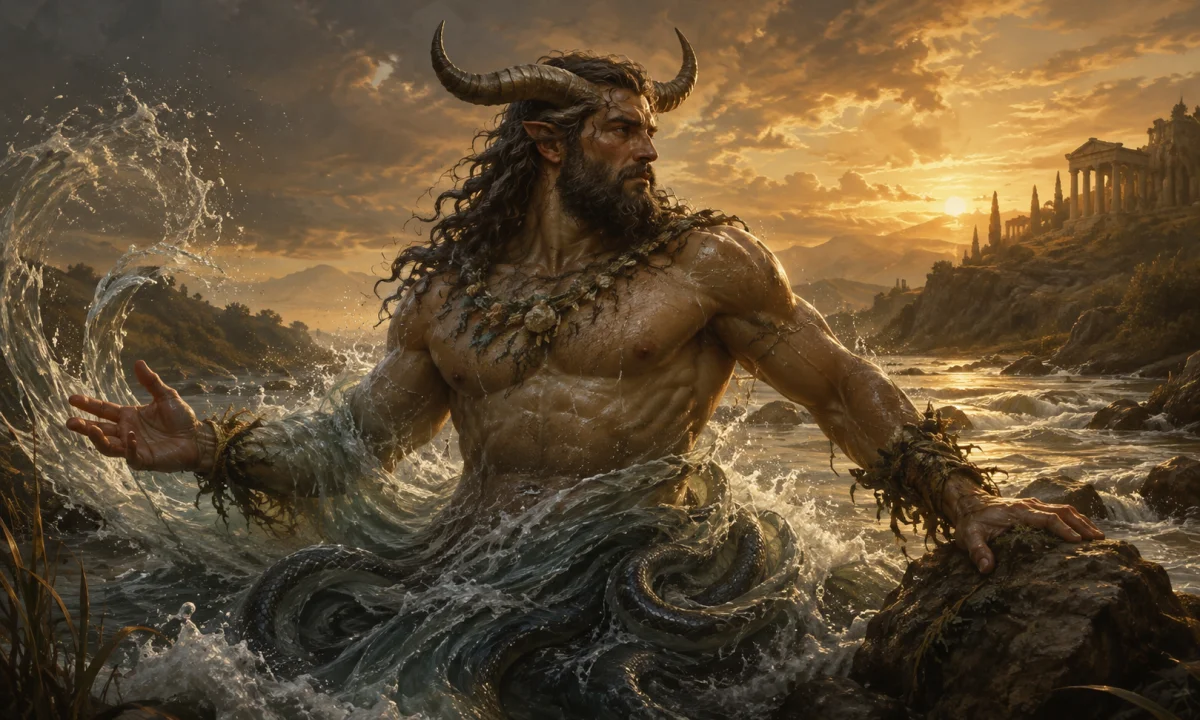
Achelous is an ancient Greek river god, one of the best-known and most enduring of the river deities in Greek tradition. He is usually associated with the River Achelous in western Greece, but in myth he is more than a local water spirit: he is imagined as a powerful, shape-shifting divinity whose strength could rival that of heroes and gods. In literary sources he appears both as a natural force and as a personified god of rivers, fertility, and flowing water, and he is often treated as the eldest or chief among river gods.
Origins and cultural setting
Achelous belongs to the religious and mythological world of ancient Greece, where rivers were not merely geographical features but living powers. Greek communities often treated rivers as divine beings with individual identities, family relationships, and cult significance. In that setting, Achelous stands out as especially important because his name is attached to a major river in Aetolia and because ancient authors use him as a representative river god more broadly.
The river called Achelous flows through western Greece and empties into the Ionian Sea. In antiquity, the river’s size, seasonal flooding, and practical importance likely contributed to the development of its divine personality. Ancient Greeks sometimes spoke of rivers as sons of the primordial gods Oceanus and Tethys, placing them within a cosmic family of watery powers. Achelous is commonly listed among these river gods, though individual sources vary in the details of divine genealogy.
As with many Greek divinities, the evidence comes from several kinds of tradition: epic poetry, tragedy, mythographic summaries, local cult practice, vase painting, sculpture, and later Roman literary retellings. The figure of Achelous is therefore not a single fixed character but a cluster of related traditions centered on a powerful river deity.
Name, identity, and classification
The name Achelous is the usual English form of the Greek Akhelôios. Ancient authors also used the name for the river itself and for the god associated with it. This double use is typical of Greek river deities, whose divine and geographical identities are closely linked.
Achelous is generally classified as a river god. In broader mythological terms, he belongs to the race of the Potamoi, the divine rivers, and in many traditions he is treated as one of their leading figures. Some writers describe him as the eldest river god or the head of the river gods, though this is a literary and mythic status rather than a universally fixed theological rank.
His identity is sometimes complicated by the way later authors and artists emphasize his shape-shifting nature. Achelous can appear as a man, as a bull, or in hybrid forms combining human and animal features. These forms are not separate beings; they are different mythic ways of expressing the same divine power.
Appearance and symbolic powers
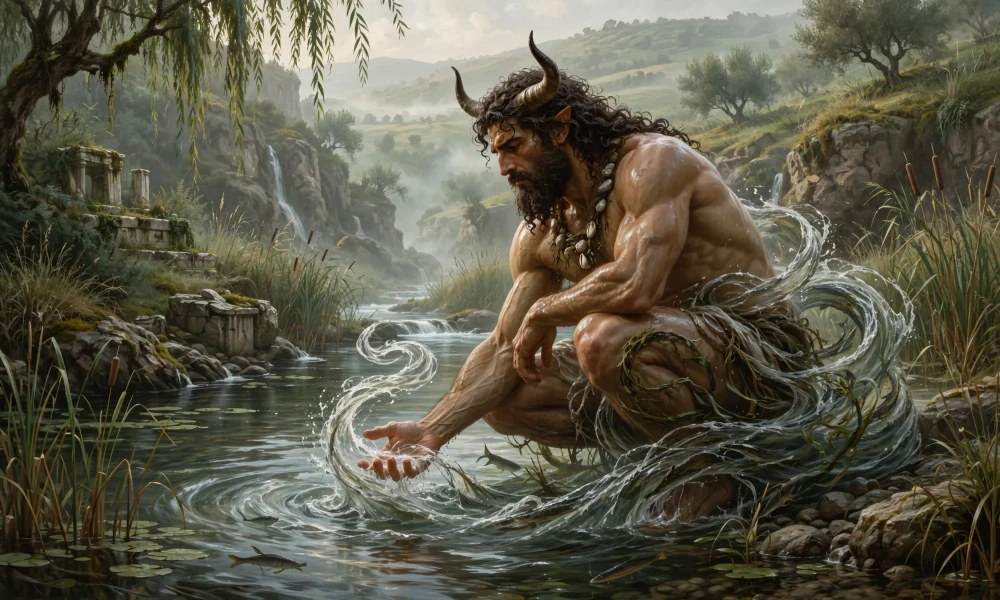
Achelous is often represented in ancient art as a strong, bearded man with river-like or bovine features. One common image is a horned, bull-like deity, especially in Greco-Roman art. Another is a composite form with a human torso and an animal body, or with a human head emerging from a bull’s body. Such images reflect the ancient tendency to visualize natural forces through mixed and metamorphic forms.
His most famous attribute is his ability to change shape. Greek mythology often presents him as a master of metamorphosis, able to transform himself into a bull, serpent, or other forms in combat or pursuit. This shape-shifting marks him as dangerous, unruly, and elemental. It also makes him comparable to other mythic figures who resist capture by changing form, though each tradition is distinct.
The bull form is especially important. In Greek culture the bull could symbolize force, fertility, virility, and the dangerous energy of nature. Achelous as bull therefore embodies both the abundance of river water and its destructive power when uncontrolled. His horned iconography is also linked with plenty; one famous tradition connects him with the cornucopia, the horn of abundance.
Major myths and stories
The contest with Heracles
The best-known myth about Achelous is his wrestling contest with Heracles for the hand of Deianira. In this story, Heracles and Achelous compete as rivals for the maiden’s marriage. Ancient sources do not always tell the story in the same way, but the core episode is stable: Achelous uses his shape-shifting power during the struggle, while Heracles overcomes him by force.
One version says Achelous transforms himself into a bull, and Heracles breaks off one of his horns. Another version describes more elaborate changes, with Achelous shifting forms in an attempt to escape or win advantage. In the end, Achelous is defeated, and from the broken horn comes the motif of the Horn of Plenty. This connection between defeat and abundance is mythically meaningful: the river’s power is symbolically converted into nourishment and fertility.
The story appears in several ancient authors, including tragic and mythographic sources, and it became a favorite subject in later art. The scene allowed ancient and later artists to contrast civilized heroism with untamed natural power, while also exploring the danger and desirability associated with marriage exchange in heroic myth.
Hercules, Deianira, and the loss of the horn
In some tellings, the broken horn is replaced or redeemed by a divine gift, making it a source of endless plenty. The exact details vary, and some later authors connect the origin of the cornucopia not strictly to Achelous alone but to broader traditions about abundance, fertility, and divine generosity. Still, Achelous is one of the most important mythic figures associated with that symbol.
The defeat by Heracles does not erase Achelous’s divine status. Instead, it places him within a familiar mythic pattern in which a local or natural deity is subdued by a hero associated with social order. Achelous remains powerful, but his wildness is made legible through the heroic narrative.
Other appearances in myth
Achelous also appears in genealogical and local myths as a father or ancestor figure. Like many river gods, he is sometimes said to have sired nymphs or other mythic beings, though the identities of his offspring vary by source. Such traditions reflect the role of rivers as sources of fertility and life, especially in regional mythologies where a river god could be tied to local lineages and sacred landscapes.
In some literary contexts, Achelous is invoked simply as a powerful river deity rather than as the central figure of a story. Poets may use his name for the river itself, for the god, or for the imaginative force of flowing water. This flexibility is part of his literary importance.
Relationships and family traditions
Ancient genealogy often places Achelous among the children of Oceanus and Tethys, the great primordial parents of rivers and waters. That ancestry situates him within the wider divine economy of the Greek cosmos. However, not every ancient source gives the same lineage, and some local or later traditions may preserve different emphases.
His relationship with Deianira is purely mythic and competitive: he is her suitor in the contest with Heracles. Deianira herself becomes an important figure in the tragic aftermath of that broader mythic cycle, but Achelous’s role is concentrated in the rivalry for marriage.
Because river gods were often imagined as fathers of nymphs, local heroes, or dynastic ancestors, Achelous sometimes functions as a genealogy marker in myth. Yet the surviving traditions do not create a single consistent family tree. As with many ancient deities, relationship lists are better understood as flexible narrative tools than as fixed doctrine.
Worship, locality, and religious meaning
Achelous had both local and wider significance in the Greek world. As the divine embodiment of a major river, he naturally belonged to the religious life of the communities living near it. Rivers were important for irrigation, travel, boundaries, and agriculture, so honoring a river god was a practical as well as symbolic act.
The cultic evidence for Achelous is not as extensive as for the major Olympian gods, but his importance is clear from literary references and from his prominence in art and regional identity. Ancient Greeks could make offerings to river gods, and the river itself could be treated as a sacred presence. In that sense, Achelous belongs to a religious landscape in which place and divinity were closely intertwined.
His association with fertility is especially significant. Flowing water was a source of life, crops, and prosperity, but it could also flood and destroy. Achelous therefore embodies both beneficence and danger. The same power that nourishes land can overwhelm it. This ambivalence helps explain why he appears as both a provider and a threat in mythic narrative.
Interpretation and cultural significance
Achelous is one of the clearest Greek examples of a deity who represents the force of nature in a personal form. He is not a distant abstraction. He is a river that speaks, fights, changes shape, and can be wounded. This makes him especially useful for understanding how ancient Greek religion imagined the natural world as animated and responsive.
Scholars often note that myths like the contest with Heracles are not only adventure stories but also symbolic confrontations. Heracles, the civilizing hero, meets the river god, the uncontrolled flow of nature. The struggle dramatizes the transformation of wild power into socially meaningful order. At the same time, Achelous is never simply defeated in a trivial sense; his power is so great that even in loss he generates abundance.
The shape-shifting aspect of Achelous may reflect broader Mediterranean ideas about water, beasts, and the instability of natural forces. Greek myth often associates gods of the margins with metamorphosis, and Achelous fits that pattern well. His hybrid forms also made him attractive to artists, who could explore visual complexity and symbolic density through his image.
Because he is tied to a river, Achelous also reveals how local geography shaped myth. The personification of a real river into a divine being shows how Greek religion integrated landscape into sacred narrative. The river is not merely named after the god or the god after the river; rather, ancient tradition moves between both senses fluidly.
Distinction from similar figures
Achelous is sometimes confused with other Greek water beings because river gods, sea gods, nymphs, and other aquatic divinities can overlap in appearance and function. He should not be conflated with Poseidon, who is a major Olympian god of the sea, earthquakes, and horses. Achelous is a river deity, not a sea god, although later literary uses can blur watery imagery.
He is also distinct from Oceanus, the primordial encircling river or sea-titan, even though genealogical traditions often make Achelous one of Oceanus’s descendants. Oceanus belongs to a more cosmic generation, while Achelous is tied to a specific river and to river divinity more generally.
Nor should Achelous be merged with unrelated local river spirits or with other shape-shifting opponents of Heracles such as Nereus or Proteus, both of whom also have metamorphic associations in Greek myth. Those figures belong to different mythic categories and different narrative settings.
Later reception and modern references
In Roman literature and art, Achelous continued to be recognized as a major river god. Roman writers often adopted Greek mythological material and sometimes gave it fresh literary treatment. The river god’s bull imagery and his link to the cornucopia remained influential, especially in decorative art and allegorical imagery associated with abundance and nature.
In modern culture, Achelous is less widely known than many Olympian gods, but he appears in works that draw on Greek myth for fantasy, historical fiction, games, and academic discussion. Modern retellings usually emphasize one of two aspects: either the river god as a powerful nature spirit or the shape-shifting rival of Heracles. Such portrayals are modern interpretations rather than ancient tradition, and they often simplify the varied older material.
In contemporary visual culture, the horned river god can also appear in symbolic or decorative forms because the image of a bull-headed deity remains striking and adaptable. When modern works use him as a name or motif, they often borrow the aura of ancient strength, fertility, and flowing power without reproducing the full complexity of Greek myth.
Why Achelous matters in Greek myth
Achelous matters because he shows how Greek mythology turns a landscape feature into a living divine personality. He stands at the meeting point of religion, geography, symbolism, and heroic storytelling. As a river god, he belongs to the sacred ecology of the ancient Greek world. As a shape-shifter, he embodies nature’s mutability. As a defeated rival of Heracles, he takes part in one of the most resonant heroic patterns in Greek narrative.
His survival in literature and art also demonstrates the durability of river gods in Mediterranean myth. Even where his worship is faintly documented, his mythic presence remains vivid. Achelous is not only the god of a specific river but also a lasting image of water as divine power: nourishing, dangerous, changeable, and impossible to hold in one fixed form.