WORLD

Atalanta
Atalanta is a celebrated heroine of Greek mythology, renowned for her speed, hunting skill and refusal to accept the restricted domestic role expected of women in many Greek legends. She is not a goddess, although her exceptional abilities sometimes give her a nearly superhuman presence. Two related but distinct traditions preserve stories about heroines named Atalanta: an Arcadian Atalanta associated with the Calydonian Boar Hunt, and a Boeotian Atalanta famous for a footrace in which her suitors had to compete against her. Later writers often combined these traditions into a single biography.
Origins and cultural setting
Atalanta belongs to the heroic mythology of ancient Greece, a world in which divine powers, royal families and monstrous creatures interact with human communities. Her stories are especially connected with Arcadia in the central Peloponnese and Boeotia in central Greece. Both regions possessed their own local myths, genealogies and heroic traditions, so the existence of more than one Atalanta is not surprising.
The most influential surviving accounts were written down during the Hellenistic and Roman periods, although the stories themselves were probably shaped by much older oral traditions. The mythographer known as Pseudo-Apollodorus describes Atalanta in his Library, while Ovid retells important episodes in the Metamorphoses. Hyginus also preserves versions of the boar hunt and the footrace. These authors do not always agree about Atalanta's parentage, husband or place of origin.
Atalanta's legends reflect several concerns found throughout Greek heroic poetry and mythology. They explore the tension between wilderness and civilisation, the danger of challenging divine powers, the vulnerability of human success and the social expectations placed upon marriageable women. At the same time, the stories give a woman an unusually active role in adventures normally dominated by male heroes.
Name and identity
The Greek name is usually written Atalantē in transliteration as Atalanta. Its precise meaning and original associations are not certain. Ancient and modern interpretations have sometimes connected the name with ideas of equality, balance or endurance, but no single etymology explains all of the evidence securely.
The two principal Atalantas can be distinguished as follows:
- Arcadian Atalanta is generally the daughter of Iasus, also called Iasion or Schoeneus in variant accounts. She is associated with the Calydonian Boar Hunt and with the birth of Parthenopaeus.
- Boeotian Atalanta is usually the daughter of Schoeneus. She is famous for defeating or nearly defeating male suitors in a footrace and for the golden apples used by Hippomenes, also called Milanion.
These identifications are not consistent in every ancient text. Some later summaries treat the two heroines as one person, and some genealogies transfer names between them. The familiar modern biography of Atalanta is therefore a synthesis rather than a completely unified account preserved by every ancient source.
Appearance, abilities and character
Ancient texts do not provide a fixed physical portrait of Atalanta. She is usually presented as a beautiful young woman, but her defining qualities are practical rather than merely ornamental. She is an outstanding runner, a skilled hunter and an expert with the bow. In the Calydonian hunt, she is the first person to wound the monstrous boar, a feat that establishes her equality with the male heroes around her.
Atalanta is also described as independent and determined. In several versions, she refuses marriage or makes marriage conditional upon a contest. Her independence is not simply a modern ideal projected backward onto Greek myth: the ancient stories themselves make her resistance to conventional marriage central to her identity. Nevertheless, the narrative often presents her freedom within a tragic framework, since the stories eventually bring her into conflict with social expectations, family authority or the gods.
Her connection with the wilderness is particularly important. In Greek mythology, forests and mountains can be places of danger, divine presence and transformation. Atalanta belongs to these spaces more naturally than to the ordered household. She hunts like a male hero but is also linked with Artemis, the virgin goddess of the hunt, even though Atalanta is not simply a human version of Artemis. Their association reflects shared themes of chastity, archery, athletic skill and life beyond ordinary marriage.
The abandoned child and the she-bear
One tradition says that Atalanta's father wanted a son and exposed her on a mountain soon after her birth. A she-bear found the infant and suckled her, after which hunters discovered and raised her. This motif belongs to a wider pattern in Greek heroic legend, in which an abandoned child survives in the wilderness and later returns to human society with extraordinary abilities.
The she-bear episode is not present in every account and should not be treated as an invariable part of Atalanta's biography. It may help explain her closeness to the wild and her rejection of ordinary domestic life, but it also places her within a familiar mythic pattern shared by other exposed heroes. Her upbringing by hunters gives a narrative explanation for her hunting skill and for her comfort in landscapes outside the city.
Some accounts connect her strongly with Arcadia, where the wilderness was a defining feature of local myth. Arcadia was associated with mountains, shepherds, hunters and the god Pan, and its legends frequently placed heroes in encounters with animals and remote landscapes. Atalanta's story fits this cultural setting without making her a goddess of the region.
The Calydonian Boar Hunt
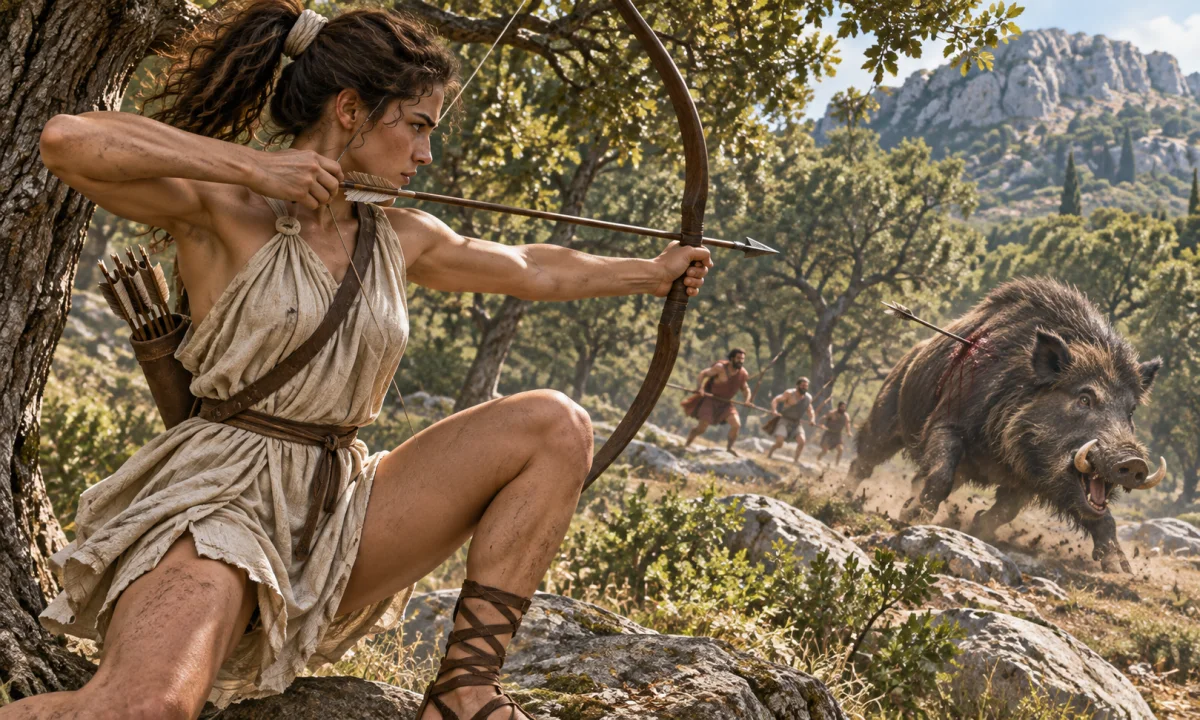
The Calydonian Boar was sent to ravage the land of Calydon after King Oeneus failed to honour Artemis with an offering. The enormous animal destroyed crops, killed livestock and threatened the inhabitants. Oeneus's son Meleager gathered a group of famous hunters from different Greek communities to destroy it.
Atalanta joined the expedition. Some male participants objected to the presence of a woman, but Meleager supported her. During the hunt, Atalanta was the first to draw blood, striking the boar with an arrow. Meleager then killed the creature, although the story's emphasis on Atalanta's first wound gives her an essential share of the victory.
In the best-known version, Meleager awarded Atalanta the boar's hide as the prize. This decision provoked a dispute with his uncles, who considered the trophy inappropriate for a woman or believed that it should belong to a male hunter. Meleager killed them in anger. The conflict eventually involved his mother, Althaea, whose brothers had been slain by her son.
According to the tragic logic of the myth, Althaea possessed a piece of wood linked to Meleager's life. She had once been told that her son would live as long as it remained unburned. In grief and rage, she placed the brand on the fire, causing Meleager to die; in some accounts she later regretted the act and killed herself. The boar hunt therefore becomes more than an adventure story: its prize leads to family violence, and heroic glory brings destruction to the household.
Atalanta's role in the hunt is significant because she is not merely a witness or prize. She contributes directly to the defeat of the monster and earns public recognition. Her success also exposes the instability of a heroic culture that praises courage while reserving authority and honour primarily for men.
The footrace and the golden apples
The most famous story about Atalanta concerns her refusal to marry. In one tradition, she had received an oracle warning that marriage would bring disaster. In another, she simply declared that she would marry only a man who could outrun her. Any unsuccessful suitor would be killed, or in some versions executed after losing the race. This arrangement allowed Atalanta to preserve her independence while turning marriage into a contest she was almost certain to win.
Atalanta was an exceptionally fast runner. She allowed the suitors a head start, then overtook them before they reached the finish. The young man who finally challenged her is called Hippomenes in some sources and Milanion in others. The variation in his name is one reason that different versions of the myth cannot always be harmonised perfectly.
Hippomenes understood that physical speed alone could not defeat Atalanta. He prayed to Aphrodite, the goddess of sexual attraction and marriage, and received three golden apples. During the race, he dropped the apples one at a time. Atalanta, fascinated by their beauty or tempted by the opportunity to retrieve them, stopped to pick each one up. The delay allowed Hippomenes to reach the finish first.
The story does not always portray Atalanta as simply deceived. Some versions imply that she had already become attracted to Hippomenes and that the apples gave her an excuse to slow down. Other tellings present Aphrodite's intervention as decisive. The race therefore combines athletic competition with divine manipulation, erotic desire and the pressure of marriage.
After Hippomenes won, he and Atalanta married. In versions that connect her with the hero Parthenopaeus, he is their son. The name Parthenopaeus means something like “maiden-faced” or “youthful-looking,” although details of his parentage vary. He later appears among the Seven Against Thebes, where he is one of the young warriors who attack the city and die in the campaign.
The punishment of Atalanta and Hippomenes
The couple's happiness does not last in the traditional story. At some point, Hippomenes forgets to thank Aphrodite for the golden apples, or the couple have sexual intercourse in a sanctuary. The location is variously associated with a temple of Zeus, Cybele or another deity, depending on the source. The offence is therefore not simply sexual behaviour but a failure to respect sacred space and divine obligation.
As punishment, the couple are transformed into lions. In some accounts Zeus carries out the transformation; in others the goddess responsible is Cybele or Rhea. The change is particularly striking because Greek writers commonly believed that lions could not mate with one another. They therefore interpreted the transformation as separating the couple permanently: lions could be yoked together, but they could not live as ordinary human spouses.
Details of the punishment vary enough that no single version should be treated as universally authoritative. The episode may also preserve a symbolic contrast between Atalanta's wild identity and her attempted entry into marriage. After becoming a lion, she returns to an animal form, but this apparent return to nature is not a liberation. It is imposed by divine punishment and ends her human agency.
Atalanta and the Argonauts
Atalanta is sometimes connected with the voyage of the Argonauts, the heroes who sailed with Jason in search of the Golden Fleece. The traditions are inconsistent. In one account she is included among the heroes, while other versions exclude her or mention that Jason did not want a woman to join the expedition because of the conflicts her presence might cause.
Her participation should therefore be described cautiously. The Argonaut story developed through several ancient poems and later mythographic summaries, and lists of the crew are not identical. Atalanta's firmly established heroic association is the Calydonian Hunt, not the Argonautic voyage. Some modern retellings make her a regular member of Jason's crew, but that is a selective adaptation rather than an uncontested feature of ancient tradition.
Interpretation and cultural significance
Atalanta's myths are unusually rich in questions about gender and social order. Greek heroic narratives often define women through marriage, motherhood or family loyalty, whereas Atalanta is first defined by athletic excellence and participation in public danger. She hunts, competes and claims a prize in circumstances from which women are frequently excluded.
Her story does not present a straightforward rejection of Greek marriage customs. The narrative ultimately brings her into marriage, and the consequences of her independence are often framed as dangerous. Yet the very prominence of her resistance shows that Greek audiences could imagine a woman who rejected domestic expectations and equalled men in physical skill. Atalanta is thus both an exceptional figure and a reminder of the limits placed upon women in the societies that preserved her story.
The golden apples have several possible meanings. They can represent erotic attraction, wealth, fertility or the seductive power of beauty. Unlike a direct contest of strength, the race is won through distraction and desire. The episode also contrasts Atalanta's natural athletic ability with Aphrodite's influence over human choice: even the fastest runner cannot easily escape the pressures of love and marriage.
Her connection with Artemis is also interpretive rather than absolute. Both figures are associated with hunting, archery and independence, but Artemis is an immortal deity with a cult and a place in religious worship, while Atalanta is a mortal heroine of legend. Ancient Greeks could honour heroes and heroines in local ways, but Atalanta should not automatically be classified as a goddess or as an alternative name for Artemis.
Distinctions from similar figures
Atalanta should not be confused with Atalante as a separate spelling in modern languages; this is generally a transliteration or orthographic variation of the same Greek name, not evidence for another being. She is also distinct from Atlanta, the modern city in the United States, whose name ultimately comes through a different literary naming history and is not a place from Greek mythology.
She is not the same figure as Artemis, although their attributes overlap. Nor is she identical to the Amazon women of Greek myth. Atalanta resembles the Amazons in her martial independence and distance from conventional domestic life, but she is normally portrayed as an individual heroine rather than a member of the Amazon nation.
Later reception
Atalanta continued to attract writers and artists because her stories combine athletic competition, romance, danger and transformation. Renaissance and later European artists often represented the race with Hippomenes and the golden apples, while poets and dramatists adapted the conflict between her independence and the expectations of marriage.
Modern novels, films, games and comics frequently expand her into a warrior, adventurer or member of the Argonauts. Such versions can draw legitimately on the ancient image of a skilled female hunter, but they often combine the Arcadian huntress, the Boeotian racer and the occasionally Argonautic heroine into one continuous character. The traditional material is more varied: Atalanta's identity changes according to the region, author and narrative being followed.