WORLD
WORLD
Antaeus
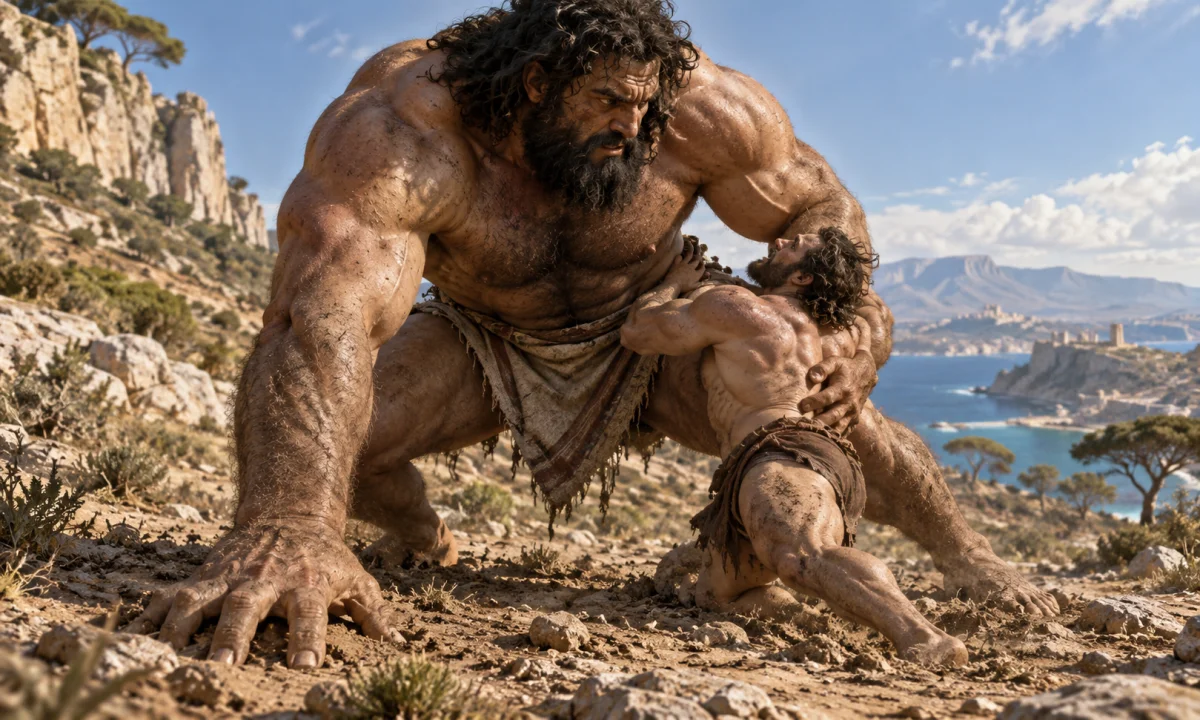
Antaeus is a powerful wrestler and giant of Greek mythology, traditionally associated with Libya in the broad geographical sense used by ancient Greek writers for North Africa. He is best known for his encounter with Heracles, who discovered that Antaeus drew renewed strength from contact with the earth. Rather than attempting to defeat him through ordinary wrestling, Heracles lifted him into the air and crushed him while he was separated from his mother, Gaia, the Earth.
Origins and cultural setting
Antaeus belongs to the mythic world of Greek heroes, monsters and extraordinary rulers who lived beyond the familiar Greek lands. Ancient authors placed his story in Libya, a name that did not have exactly the same boundaries as the modern country. In Greek geographical writing, Libya could refer broadly to much of North Africa, including regions west of Egypt and parts of the lands around the southern Mediterranean.
The setting is important because Greek mythology often represented distant countries through remarkable beings and dangerous encounters. Heracles' travels took him across the edges of the known world, where he met opponents whose strength, customs or parentage differed from those of ordinary human beings. Antaeus is presented as a local giant and ruler whose power is closely bound to the land itself.
The surviving tradition is literary rather than the record of a clearly documented historical cult. Antaeus appears in Greek and Roman accounts, including the Bibliotheca traditionally attributed to Apollodorus, works associated with Diodorus Siculus, and later Roman retellings such as Lucan's Pharsalia. Earlier allusions also occur in Greek poetry. These sources do not always provide the same details, and the fullest versions were written centuries after the period in which the myths were first circulating.
Name and identity
The Greek form of the name is Antaios, usually Latinised as Antaeus. The exact meaning and original development of the name are uncertain. Ancient and modern interpreters have sometimes tried to connect it with Greek words suggesting opposition or resistance, but such explanations should not be treated as established fact.
Antaeus is commonly described as a giant, although he should not automatically be identified with the Gigantes who fought the Olympian gods in the Gigantomachy. Greek mythology uses the word “giant” in more than one way. In Antaeus' case, it primarily indicates enormous size and superhuman strength rather than membership in one specific race of divine enemies.
His parentage is generally given as Poseidon, god of the sea, and Gaia, the primordial Earth. This combination of parents gives Antaeus a particularly striking nature. Poseidon connects him with the sea and the wider world of mythic kingship, while Gaia explains his dependence on the ground. Some local or later traditions vary in their account of his family, and not every ancient author gives the same genealogy, but the Poseidon-and-Gaia relationship is the standard form of the myth.
Appearance and powers
Antaeus is imagined as a huge, physically formidable man. His most distinctive power is not simply his size or natural strength. Whenever he touched the earth, he received fresh strength from it. This made him exceptionally difficult to defeat in a wrestling match. Even if an opponent managed to throw him down, the contact with the ground restored or increased his power.
The myth therefore treats Antaeus' strength as conditional and geographical. It is not an unlimited ability that functions in every situation. It depends on his connection with the earth, understood not merely as a surface beneath his feet but as his divine mother and source of vitality. The story's central revelation is that his apparent invincibility has a specific weakness: he must remain in contact with the ground.
Ancient accounts do not establish a single canonical physical appearance beyond his gigantic stature and extraordinary bodily strength. Later artists and writers often depict him as a muscular wrestler, but details such as armour, clothing and facial features belong to individual artistic interpretations rather than to a fixed ancient description.
Antaeus as ruler and wrestler
Several accounts describe Antaeus as a ruler in Libya. He is not presented as a distant nature spirit living apart from human society; instead, he interacts with travellers and subjects in a violent and tyrannical manner. According to the most familiar version, he challenged strangers to wrestle and killed them when he had defeated them.
One tradition says that Antaeus used the skulls of his victims to build or decorate a temple dedicated to Poseidon. This detail reinforces both his brutality and his relationship with the sea god who was said to be his father. It also follows a familiar pattern in Greek heroic myth, in which a dangerous ruler turns hospitality, athletic competition or ritual into an instrument of murder.
The accounts do not make clear whether every ancient version considered Antaeus an ordinary king, a monstrous despot or a legendary figure whose kingship was mainly a way of explaining his authority over a region. The descriptions of his rule belong to the heroic narrative and should not be read as straightforward evidence for a historical North African ruler.
The encounter with Heracles
The best-known episode occurs during one of Heracles' far-ranging journeys. In Apollodorus' account, Heracles meets Antaeus while travelling through Libya. The context is connected with the hero's larger cycle of labours, although the exact placement of the episode varies in later retellings. It is often associated with Heracles' journey toward the garden of the Hesperides, where he had to obtain the golden apples, but the Antaeus story also circulated as an independent adventure.
Antaeus challenges Heracles to wrestle, as he had challenged other travellers. At first the contest appears to favour the Libyan giant. Heracles can throw him to the ground, but Antaeus rises stronger each time because the earth restores his power. The hero eventually understands that ordinary force will not be enough.
Heracles then lifts Antaeus off the ground and holds him in the air. In some retellings he squeezes or crushes him while keeping him suspended; in others the decisive action is simply that he prevents Antaeus from touching the earth. Deprived of the source of his strength, Antaeus becomes vulnerable and dies.
This victory differs from many of Heracles' other contests. Heracles does not win because he possesses greater endurance in a conventional wrestling match. He wins by identifying the hidden condition of his opponent's power. The episode therefore combines physical heroism with observation and tactical intelligence. Heracles remains immensely strong, but he must also understand the nature of the being before him.
The meaning of the earth connection
Antaeus' dependence on Gaia has several possible meanings within Greek myth. At the most direct level, it explains the mechanics of the wrestling match: the giant is strong while grounded and weak when lifted. At a symbolic level, it links him to the ancient idea that the earth is a source of life, nourishment and renewal.
His power can also be understood as a mythic expression of autochthony, the idea of being born from or belonging intrinsically to a particular land. Antaeus is not merely a traveller who happens to live in Libya. His body and strength are inseparable from the territory that produced him. To remove him from the ground is to cut him off from his identity and ancestry.
At the same time, the myth does not present his bond with the earth as morally admirable. Antaeus uses his strength to kill strangers, and Heracles' victory ends a pattern of violence. The story may therefore be read as a warning against relying on a single source of power or assuming that overwhelming strength guarantees safety. A power that appears absolute can contain a precise and exploitable limitation.
The earth connection has also encouraged later readings concerned with home, territory and belonging. A person described metaphorically as “Antaean” may be portrayed as gaining strength from contact with native soil, familiar surroundings or a social and cultural homeland. This metaphor is a later literary use of the myth, not a separate ancient doctrine about Antaeus.
Other traditions and local associations
Some later writers connected Antaeus with places in the far western part of North Africa. A tradition associated with the city of Tingis, often identified with modern Tangier, claimed that Antaeus had been buried there. Plutarch reports a story in which the Roman commander Sertorius encountered a large tomb identified as that of Antaeus and had it opened. The enormous body allegedly found inside was part of the local legendary claim.
This account belongs to the history of ancient travel, storytelling and local identity rather than to reliable archaeological evidence. Ancient communities sometimes attached famous mythic figures to particular landscapes in order to explain unusual monuments, burial places or geographical names. The association with Tingis may reflect a local effort to connect the city with a prestigious heroic past.
Another later legend names Tinge as the wife of Antaeus and links her with the naming of Tingis. This tradition is not part of the most widely known version of the Heracles story, and details vary among authors. It should be treated as a secondary local or etymological tradition rather than as a universally accepted element of Antaeus' mythology.
Antaeus in Greek and Roman literature
Greek poets and mythographers used Antaeus as a memorable example of dangerous physical power. His story suited the heroic image of Heracles, whose travels repeatedly bring him into conflict with figures who represent unusual forms of strength, violence or resistance. The episode could be told briefly as a feat of clever wrestling, or expanded into a dramatic account of the giant's homeland and victims.
Roman literature gave the story renewed prominence. Lucan's Pharsalia includes an elaborate account of Antaeus in the course of a description of North Africa and its legendary past. Lucan emphasises the giant's descent from Earth and Neptune, the importance of his contact with the ground, and the manner in which Heracles overcame him. The Roman poem is not simply a neutral preservation of Greek myth; it reshapes the story for an epic concerned with geography, violence, memory and the relationship between legendary history and the Roman world.
These literary versions should be distinguished from direct evidence for religious worship. Antaeus was not one of the principal Olympian gods, and he did not have a cult comparable in prominence to that of Zeus, Athena, Apollo or Poseidon. References to temples, tombs and local traditions show how ancient writers situated the myth, but they do not prove that Antaeus was widely worshipped as an independent deity.
Distinction from similar figures
Antaeus is sometimes confused with other powerful figures in Greek mythology, especially the Titans and the Giants. He is not normally one of the Titans, the older generation of gods ruled by Cronus, nor is he simply another name for a member of the Gigantes who opposed Zeus. His parentage gives him a connection with primordial divine forces, but that does not place him within every category of earth-born monster.
He should also be distinguished from Alcyoneus, another giant associated with the Gigantomachy. Alcyoneus, like Antaeus, was said to draw strength from his native land in some accounts, and Heracles also plays a role in stories involving him. The two figures are nevertheless separate. Antaeus is chiefly known for his wrestling contest in Libya and his dependence on the earth, while Alcyoneus belongs to the war between the Giants and the Olympians.
Nor is Antaeus equivalent to the Minotaur, the Cyclops or other famous opponents of Heracles and Greek heroes. The Minotaur is a hybrid creature associated with Crete and the labyrinth; the Cyclopes are a distinct group of one-eyed beings with their own genealogies and myths. Similar physical danger does not indicate a shared identity.
Later reception
The image of Antaeus being lifted from the ground became a durable subject for European art, poetry and philosophical writing. Artists often show Heracles holding the giant above the earth, making the invisible source of Antaeus' power visually clear. Writers have used the episode to explore dependence on one's origins, the loss of political or cultural grounding, and the discovery of a hidden weakness.
Modern popular culture occasionally uses Antaeus as a name for a giant, wrestler, villain or superhuman character. Comic books, fantasy fiction, games and films may adapt the earth-powered strength or the struggle with Heracles while changing his personality, ancestry and role. Such versions are creative reinterpretations rather than evidence about the ancient tradition.
In the traditional myth, Antaeus remains a specifically Libyan giant whose extraordinary strength comes from Gaia through direct contact with the earth. His defeat is one of Heracles' clearest examples of victory through insight: the hero succeeds not by overpowering an apparently endless source of strength, but by separating that strength from its origin.