WORLD
WORLD
Andromeda
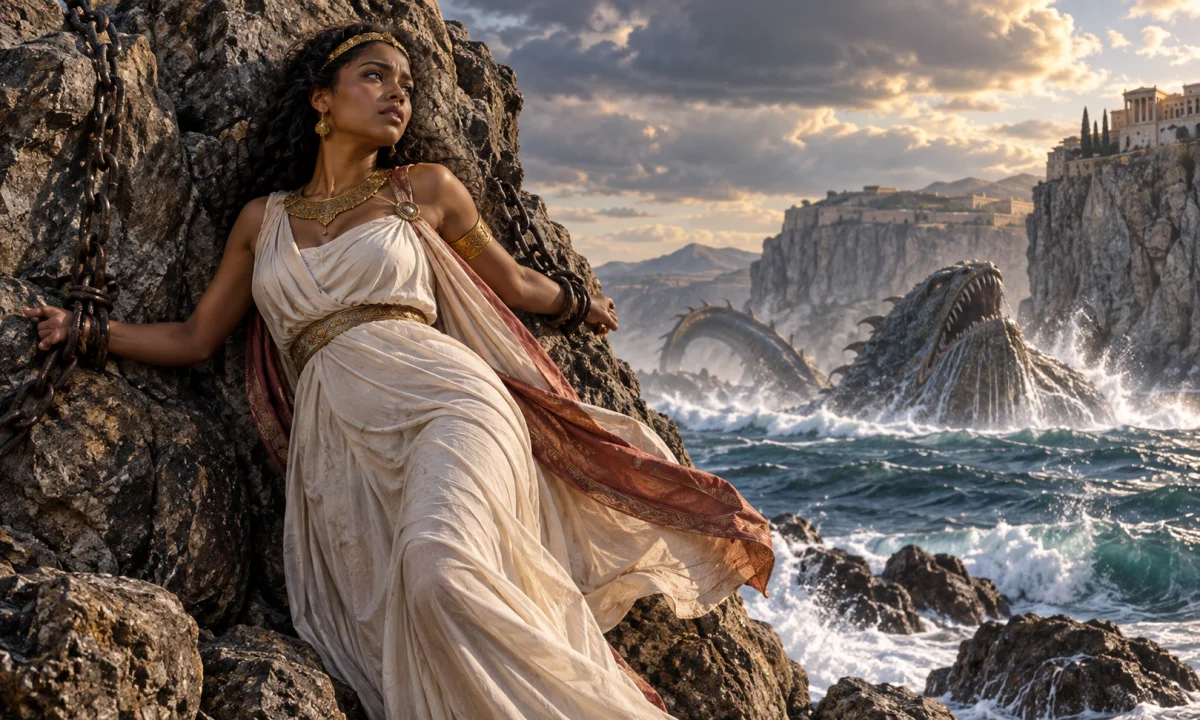
Andromeda is a mortal princess in Greek mythology, best known for being rescued from a sea monster by the hero Perseus. She is the daughter of Cepheus, king of Aithiopia, and Cassiopeia. In the best-known versions of her story, Cassiopeia’s boastful claim that she—or sometimes Andromeda—was more beautiful than the Nereids provokes divine punishment. Andromeda is chained to a coastal rock as a sacrifice, but Perseus kills the monster and later marries her.
Andromeda is not a goddess, monster or supernatural spirit. She is a human heroine whose story combines themes common in Greek legend: dangerous pride, the vulnerability of royal families, ritual sacrifice, heroic rescue, marriage, and the transformation of mortal figures into constellations. Her myth is also important because it connects Greek storytelling with ancient Greek ideas about Aithiopia, a distant land that Greek writers associated with peoples and places south or east of Egypt.
Origins and surviving traditions
The earliest complete account of Andromeda’s story does not survive in a single early Greek epic. The myth was nevertheless known in classical antiquity and appears in several literary, artistic and mythographical traditions. Important surviving versions include the account attributed to Apollodorus in the Bibliotheca, Ovid’s Latin Metamorphoses, and the works of the Roman mythographers Hyginus and Antoninus Liberalis. Greek tragedies about Andromeda were also written, including Euripides’ Andromeda, but the play survives only in fragments and quotations.
Because the sources differ in detail, no single version should be treated as the original form of every element of the myth. The central sequence is stable: Andromeda is connected with Aithiopia, a sea monster threatens the kingdom, she is exposed or chained as a sacrificial victim, Perseus arrives after defeating Medusa, and the two become associated with one another in marriage and in the stars.
Ancient visual art also contributed to the tradition. Greek vase paintings and later Roman artworks depict Andromeda beside the rock, Perseus confronting the sea monster, or the couple together after the rescue. These images sometimes show details that do not correspond exactly to any surviving literary account, reflecting the flexibility of myth in artistic representation.
Name, family and identity
The Greek name Andromeda is usually written Andromedē. It is commonly connected with Greek elements meaning “man” or “human being” and “to think of,” “care for” or “rule,” leading to interpretations such as “ruler of men.” The precise force of the name in ancient usage is not certain, and the myth does not explain it through a separate naming story.
Andromeda’s father is Cepheus, a king of Aithiopia. Her mother is Cassiopeia, whose vanity or boast is the immediate cause of the crisis. In some retellings Cassiopeia claims that she herself is more beautiful than the Nereids, the sea nymphs who accompany the god Poseidon. In others, the boast concerns Andromeda’s beauty. The version in which Cassiopeia is responsible is especially common.
Andromeda is therefore a princess rather than an independent ruler or divine figure. Her position gives her social importance, but it also makes her vulnerable to the political and religious demands placed upon her family. Her body becomes the means by which the kingdom attempts to appease a hostile god. This aspect of the story is significant: the rescue is not merely an encounter between a hero and a monster, but a conflict involving royal authority, divine punishment and the ritual exposure of a human victim.
Aithiopia in Greek tradition
Greek sources call Cepheus and Andromeda’s homeland Aithiopia. This name should not automatically be equated with the modern state of Ethiopia. In ancient Greek geographical writing, “Aithiopia” could refer broadly to lands and peoples south of Egypt, and its boundaries were not fixed in the modern political sense. Different authors used the term in different ways.
Some ancient and later traditions place the episode near the eastern Mediterranean coast, particularly around Joppa, known today as Jaffa. This location allowed Greek and Roman writers to connect the myth with a visible coastal landscape and a rock associated with Andromeda. Other traditions preserve the more general setting of Aithiopia. The ancient geography is therefore varied, and the story cannot be assigned with certainty to one modern country.
The depiction of Andromeda as an Aithiopian princess has also led to much discussion about how Greek and Roman audiences imagined her appearance and identity. Ancient art does not represent her consistently. Some images give her features associated with Greek or Mediterranean artistic conventions, while others use visual markers intended to suggest an African origin. Modern claims that all ancient artists portrayed her in one particular way are not supported by the surviving evidence.
Cassiopeia’s boast and the divine punishment
The crisis begins with Cassiopeia’s claim about beauty. She either boasts that she is more beautiful than the Nereids or declares that Andromeda surpasses them. The offended sea nymphs appeal to Poseidon, who sends a flood and a monstrous creature against the kingdom. In some accounts, Poseidon himself decides on the punishment; in others, an oracle explains what must be done to end the disaster.
The monster is generally called Cetus, from the Greek word kētos, meaning a large sea creature or sea monster. It is not always described with the precise anatomy of a later European dragon. Ancient descriptions and images vary, and the creature’s identity is closely linked to the constellation Cetus rather than to one zoologically consistent species.
An oracle tells Cepheus that the danger will cease only if Andromeda is exposed to the monster. The king and queen obey, or are forced to obey, and Andromeda is fastened to a rock beside the sea. The story presents the sacrifice as a terrible consequence of Cassiopeia’s offence, but it also raises an ethical problem: Andromeda is punished for an act she may not have committed. Even when the boast is attributed to Andromeda herself, the response is radically disproportionate, making her a victim of divine and familial conflict.
Perseus and the rescue
Perseus encounters Andromeda while returning from his mission to obtain the head of Medusa. He sees her bound to the rock and initially assumes that she is a statue because of her stillness. When he learns that she is alive and hears the circumstances of her exposure, he offers to save her. In exchange, he seeks marriage with her, usually with the agreement of her parents.
Perseus then attacks the sea monster. Some versions describe him fighting it directly with weapons, while others emphasize his use of Medusa’s severed head. By displaying the Gorgon’s head, he turns the monster to stone. Ovid’s account gives the rescue a vivid poetic setting, presenting Perseus as a heroic figure who sees the chained girl and intervenes before the monster can devour her.
The marriage arrangement is not entirely simple. In several accounts, Andromeda has already been promised to another man, Phineus, who is connected to her family. Phineus objects when Perseus claims her. He and his supporters attack the wedding or the celebratory gathering, producing a violent conflict. Perseus finally uses Medusa’s head against Phineus and his followers, turning them to stone. This episode means that the rescue story does not end when the monster dies; the question of Andromeda’s marriage remains tied to male rivalry, family promises and heroic violence.
The precise relationship between Phineus and Andromeda varies. He is generally described as her former fiancé or betrothed, but the sources do not agree in every genealogical detail. The name Phineus also belongs to other figures in Greek mythology, so he should not be confused with the blind seer Phineus who appears in the story of the Argonauts.
Marriage and descendants
After the conflict, Perseus takes Andromeda with him, and she becomes his wife. Their union links the royal house of Aithiopia to the heroic genealogy of Argos. Different mythographers list different children, and the names and number are not completely uniform. The children commonly associated with Perseus and Andromeda include Perses, Alcaeus, Heleus, Mestor, Sthenelus, Electryon and Gorgophone.
Perses is especially important in some traditions. He is said to remain in Aithiopia and become the ancestor of the Persian people, although this is a Greek mythic genealogy rather than historical evidence for the origins of Persia. The other children connect Andromeda and Perseus with the royal families of Argos, Tiryns and Mycenae. Through Electryon, the couple is placed in the ancestry of Alcmene and therefore of Heracles in several genealogical systems.
These family connections helped integrate Andromeda into the wider network of Greek heroic mythology. She is not merely a character in a single rescue tale; she becomes a link between Aithiopia, Argos, Mycenae and the heroic age. Genealogies in Greek myth often serve political, cultural or literary purposes, and they should not be read as consistent historical records.
Constellations and the image of the chained princess
Andromeda is associated with a group of constellations representing the characters in her story. These include Perseus, Cassiopeia, Cepheus, Cetus and, in some interpretations, the sea monster’s surroundings. The association was well established in ancient Greek astronomy and appears in the constellation catalogues of the Hellenistic and Roman periods. Andromeda is depicted as a woman with outstretched or raised arms, recalling the way she was bound to the rock.
The celestial placement turns a story of danger and helplessness into a permanent cosmic display. Yet the constellation does not erase the disturbing nature of the myth. Andromeda’s familiar astronomical image is still that of a young woman restrained for sacrifice, while Perseus appears as the armed hero who rescues her. Ancient mythology frequently transforms mortal figures into stars or constellations, but such transformations do not necessarily imply that the person was worshipped as a god.
The modern name of the Andromeda Galaxy comes from the constellation, not from an ancient belief that the galaxy itself was part of the myth. The galaxy’s designation is a later astronomical use of the traditional name.
Symbolism and interpretation
Andromeda’s story has often been interpreted as a myth about the consequences of hubris, the dangerous arrogance that challenges divine order. Cassiopeia’s boast resembles other Greek myths in which an insult to a god or divine group brings disaster upon an entire family. The punishment also resembles a kind of ritual logic: a pollution or offence must be answered by an offering, even when the selected victim is not personally responsible.
The myth can also be read as a story about the exchange of women in marriage alliances. Andromeda is first claimed by the sea as a sacrificial object, then promised to Phineus, and finally taken by Perseus after the rescue. Her beauty and royal status drive the actions of gods and men, while her own decisions receive little attention in the surviving narratives. This pattern is common in heroic mythology, where women may be central to the plot but have limited narrative control.
At the same time, Andromeda is not entirely passive in every version. She speaks with Perseus, explains her situation, and becomes the partner of a major hero and the mother of a significant lineage. Later writers and artists have sometimes emphasized her dignity, courage and emotional experience rather than treating her only as a prize or victim. These are interpretive developments rather than consistent features of the oldest surviving accounts.
Andromeda in art and later culture
Andromeda became a major subject in European painting, sculpture, opera and poetry, especially from the Renaissance onward. Artists often focused on the contrast between her vulnerability and Perseus’s heroic arrival. The scene provided an opportunity to depict a dramatic seascape, a beautiful captive, a monster and a winged or airborne hero. In some later artistic traditions, the encounter is closely associated with the visual conventions of the rescue of a damsel from a dragon, although the Greek story has its own religious and mythological context.
Modern adaptations frequently simplify the myth into a romance between Perseus and Andromeda or emphasize the monster fight. Films, television productions, fantasy fiction and children’s retellings may alter the setting, character motivations or chronology. Such versions belong to modern popular culture and should not be treated as evidence for ancient Greek belief. The traditional sources themselves present a more complicated narrative involving divine punishment, royal responsibility, a prior betrothal and competing genealogies.
Andromeda’s lasting importance comes from the combination of a memorable heroic episode and a broader mythic structure. She is a mortal princess placed at the intersection of divine anger, ancient geography, royal sacrifice, heroic marriage and the stars. Her story remains one of the clearest examples of how Greek mythology could connect a local landscape, a family genealogy and a constellation into a single enduring tradition.