WORLD

Athamas
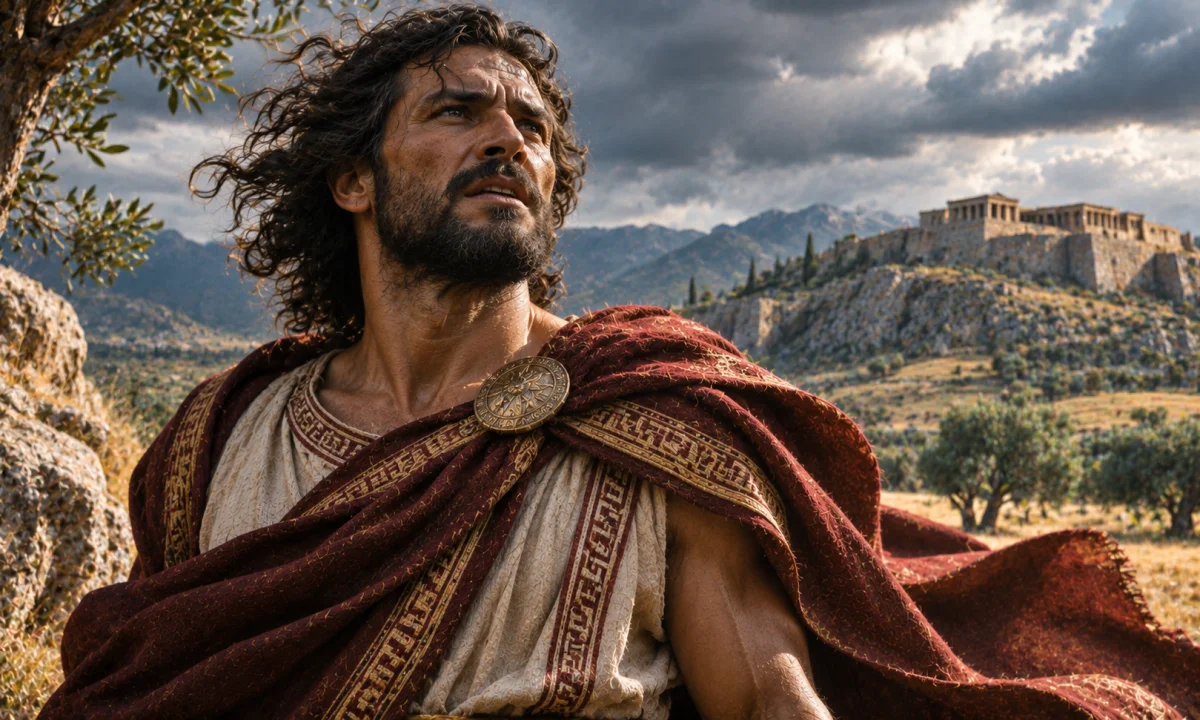
Athamas is a king and tragic hero of Greek mythology, best known for the stories of his children Phrixus, Helle, Learchus and Melicertes. He belongs especially to the mythic traditions of Boeotia and Thessaly, although ancient writers place his kingdom and descendants in more than one region. His stories connect royal succession, famine, divine punishment, madness and dangerous changes of identity. They also provide the background for the rescue of Phrixus and Helle by the golden ram whose fleece later became the object of Jason’s quest.
Identity and place in Greek tradition
Athamas is generally described as a son of Aeolus, the mythical ancestor of the Aeolians, and Enarete. Through Aeolus, he belongs to one of the great heroic genealogies of Greek mythology. The same family includes figures such as Sisyphus, Salmoneus and Cretheus, although ancient genealogical traditions are not always consistent.
He is usually presented as a mortal king rather than a god. His principal kingdom is often identified with Orchomenus in Boeotia, an important city associated with the Minyans. Other traditions connect him with Thessaly, particularly the region around Halos or the Athamantian plain. These differing locations may reflect the movement of an old local legend between communities rather than a single, fixed biography.
The name Athamas comes from the Greek Ἀθάμας. Its ancient meaning is uncertain. Proposed modern explanations have connected it with ideas such as endurance or violence, but there is no universally accepted etymology. The name should not be treated as a secure description of his character.
Ancient literary accounts of Athamas appear in several forms. His story was known through lost epic and dramatic works as well as through surviving mythographers, historians and poets. Later summaries preserve episodes that sometimes disagree over the order of events, the identities of his wives and the exact cause of his madness. There is therefore no single canonical version of the Athamas myth.
Athamas, Nephele and the golden ram
The best-known part of the story begins with Athamas’ marriage to Nephele. In this context Nephele is often represented as a cloud-like or cloud-born woman. Her name means “cloud” in Greek, and she is sometimes treated as a personification rather than as an independent goddess with a broad cult. Their children are Phrixus and Helle.
According to the most familiar tradition, Athamas later took another wife, Ino, a daughter of Cadmus and sister of Semele. Ino became jealous of her stepchildren and devised a plan to remove them. She persuaded the women of the land to roast the seed grain before it was sown. When the crops failed, the resulting famine appeared to be a natural disaster. Ino then arranged for messengers to report that an oracle required the sacrifice of Phrixus in order to restore the land’s fertility.
The details vary. Some accounts make Athamas himself responsible for agreeing to the sacrifice, while others emphasize that he was deceived by Ino or compelled by a false oracle. In the decisive moment, Nephele intervened by sending a golden ram to carry Phrixus and Helle away. The ram flew with them across the sea, but Helle fell from its back and drowned. The body of water where she fell was traditionally called the Hellespont, meaning “Sea of Helle”; it is now known as the Dardanelles.
Phrixus survived and reached Colchis on the eastern shore of the Black Sea. There he sacrificed the ram to Zeus, or to a god associated with the rescue, and gave its golden fleece to King Aeetes. The fleece was hung in a sacred grove and guarded by a dragon. In the later Argonautic story, Jason and the Argonauts travel to Colchis to obtain it.
The connection between Athamas’ family tragedy and the Golden Fleece is central to the larger heroic cycle, but Athamas himself is not an Argonaut and does not take part in Jason’s expedition. His role is that of the father and king whose domestic crisis sets one of the cycle’s most important objects into motion. The ram is sometimes described as a divine or specially sent animal, but ancient accounts do not always agree about its precise divine origin.
Ino, Dionysus and the madness of Athamas
A second major group of stories concerns Athamas’ marriage to Ino and the birth of their sons, Learchus and Melicertes. Ino was closely connected with the infant Dionysus. Dionysus was the son of Zeus and Semele, Ino’s sister, and after Semele’s death Ino and Athamas were said to have cared for the child. This guardianship angered Hera, who was hostile to the children and lovers of Zeus.
In some versions, Hera caused Athamas and Ino to lose their minds. In others, Dionysus’ presence in their household forms part of the reason for Hera’s punishment, while the immediate details differ. The madness is not portrayed as a stable supernatural power possessed by Athamas. It is a temporary but devastating state imposed upon him, usually as divine retribution or persecution.
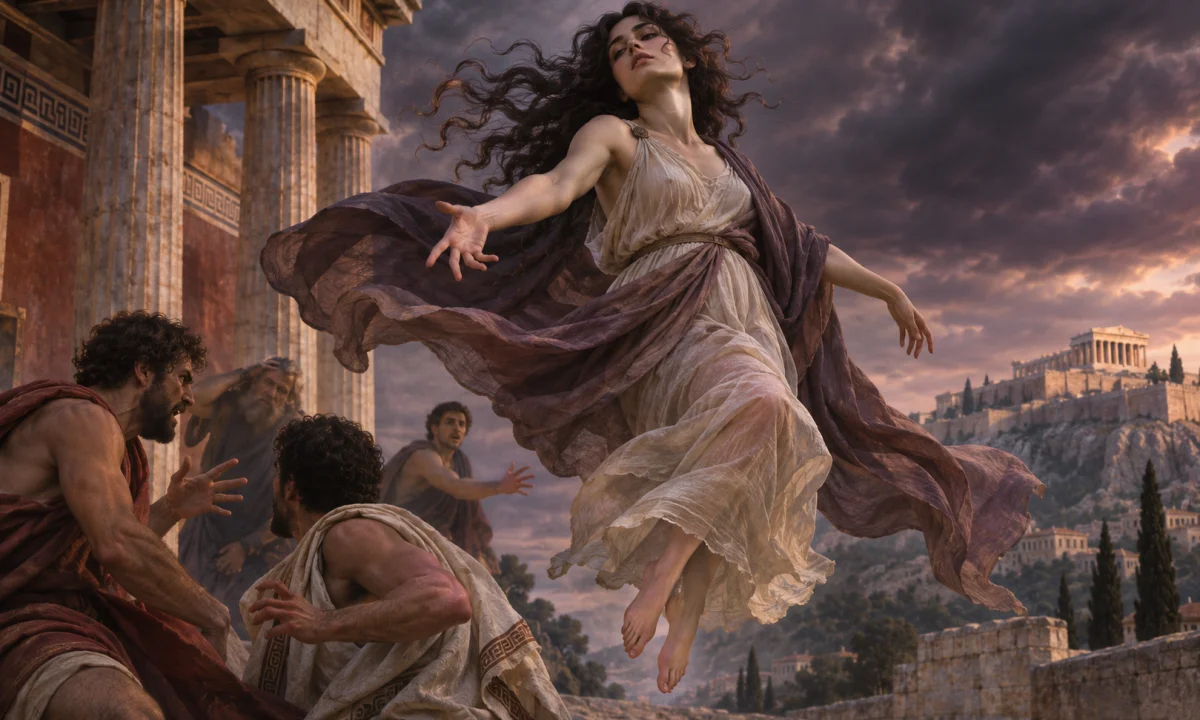
Under the influence of madness, Athamas mistook his son Learchus for a wild animal. He seized and killed him, sometimes described as smashing him against a wall or hunting him as though he were a deer. The form of the killing varies among sources, but the central theme is the destruction of a child by a father who no longer recognizes him.
Ino fled with Melicertes. She either threw herself into the sea or was driven there during the pursuit. The two were subsequently transformed into marine divinities. Ino became Leucothea, the “White Goddess,” while Melicertes became Palaemon. Their transformation helped explain cults and ritual traditions connected with protection at sea, sailors and maritime danger. Ino’s new identity is particularly important because it links a tragic Theban and Boeotian family story with the religious world of the sea.
Ino and Melicertes are not simply alternate names for Athamas or for one another. They are transformed members of his family. Likewise, Leucothea is the later divine form of Ino, while Palaemon is the later divine form of Melicertes. Ancient religious practice could preserve both the mortal and divine aspects of such figures, especially when a myth explained the origin of a cult.
The tradition of Themisto
Another important variation gives Athamas a wife named Themisto. This version usually places Themisto after Nephele and, depending on the account, after Ino. The sequence is uncertain because surviving authors arrange the marriages differently.
In the most widely repeated form of the Themisto story, Athamas has children by Ino, but Themisto does not know that Ino and her sons are present in the household. Intending to kill them, Themisto orders a servant to dress the children in dark clothing and her own children in white clothing, so that the intended victims can be recognized. The servant, who knows the truth, reverses the clothing. Themisto therefore kills her own children. When she discovers what she has done, she takes her own life.
This episode resembles other Greek myths in which concealed identity, mistaken clothing or a servant’s reversal of instructions produces catastrophe. It also shows how Athamas’ family legend could be reshaped around different wives and different forms of domestic violence. In the Themisto tradition, Athamas is less the direct killer than the king whose household becomes the setting for a cycle of jealousy, deception and recognition.
Because the stories of Nephele, Ino and Themisto overlap, it is misleading to combine every episode into one continuous sequence without qualification. Ancient authors sometimes treat them as separate versions. The number and identity of Athamas’ wives, the survival of Ino, and the reason for the family’s misfortunes can all change from one account to another.
Exile, oracle and settlement
After the killing of Learchus, Athamas was often expelled from his kingdom or forced to seek purification. Greek myth frequently represents murder, especially the killing of a close relative, as requiring ritual cleansing and a change of residence. Athamas’ exile therefore belongs to both a religious pattern and a political one: the polluted king can no longer remain safely within his former community.
One tradition says that an oracle instructed him to settle in the place where wild animals would receive him as a guest. Athamas then came upon wolves feeding on sheep. The wolves abandoned their prey and fled, leaving the king to interpret the scene as the fulfillment of the oracle. He settled in the region and founded or became associated with a community in Thessaly. The exact place and foundation are reported differently, but this story explains the connection between Athamas and parts of northern Greece.
The episode reflects a common Greek mythic theme in which an apparently strange encounter with animals marks the location of a new settlement. It also gives Athamas a second identity: first a ruler destroyed by divine madness, then an exile who establishes a new political or ancestral line. The founding story does not erase his guilt, but it provides a ritual and geographical resolution to the crisis.
Herodotus preserves a particularly striking tradition associated with Athamas and the Thessalian town of Alos. He reports that descendants of Athamas were involved in a hereditary ritual in which the eldest male of the family could be selected for sacrifice, and that special rules governed their conduct in the community. The account links the practice to the story of Phrixus and the threatened sacrifice. Details and interpretation are difficult, and the report should not be assumed to describe a general Greek custom. It is better understood as evidence for a local religious tradition that claimed descent from Athamas’ mythic household.
Symbolism and interpretation
Athamas’ myths repeatedly place the household under pressure from forces that are both divine and social. Famine, false prophecy, succession anxiety and stepfamily rivalry all threaten the stability of the kingdom. The royal family is not presented as a secure unit. Instead, it becomes the source of political and religious danger.
The story of Phrixus and Helle emphasizes rescue from an unjust sacrifice. The golden ram represents a sudden intervention that interrupts a ritual killing, but its rescue is incomplete: Helle dies during the escape, while Phrixus is carried into a distant land. The myth therefore combines deliverance with loss rather than offering a simple happy ending.
The stories involving Ino and Themisto focus on the destruction caused by mistaken perception. Athamas sees Learchus as an animal; Themisto fails to recognize which children are her own; Ino’s plot hides the true cause of the famine. Clothing, disguise and altered appearance are recurring devices. The family’s disaster comes partly from an inability to distinguish truth from appearance.
Divine anger is also central. Hera’s punishment reflects the broader conflict between the goddess and the descendants or protectors of Zeus’ illegitimate children. Yet the myths do not present Athamas as a heroic opponent of Hera. He is an instrument of divine hostility, a mortal whose authority collapses when supernatural power overwhelms his judgment.
The later transformations of Ino and Melicertes give the family a lasting religious significance. Through Leucothea and Palaemon, a story of madness and death becomes connected with protection at sea. Their cults allowed communities to interpret dangerous waters through the fate of recognizable mythic figures. Athamas himself remained primarily a heroic king and ancestor rather than a widely worshipped Olympian deity.
Distinctions from similar figures
Athamas should not be confused with Atamas or other similarly transliterated names that may appear in mythological catalogues. Greek names can have several Latin or English spellings, and ancient genealogies contain many figures linked to Aeolus, but spelling alone does not establish identity.
He is also distinct from his father Aeolus. In Greek myth, “Aeolus” can refer to more than one figure, including the keeper of the winds in the Odyssey. Athamas is not the ruler of the winds and does not possess that figure’s maritime power. His connection with the sea comes indirectly through Helle’s death and the transformation of Ino and Melicertes.
Nor is Athamas the same as Phrixus, the son he nearly sacrifices, or as Jason, the later hero who seeks the Golden Fleece. Athamas belongs to the generation whose family crisis explains the fleece’s origin. Phrixus is the survivor who carries the object to Colchis, while Jason is the hero who retrieves it.
Later reception
Athamas has remained less prominent in modern popular culture than Jason, Medea or the Golden Fleece. When he appears in modern retellings, he is usually treated as part of the prehistory of the Argonautic quest or as the tragic father in the stories of Phrixus and Helle. Adaptations often simplify the conflicting traditions by selecting one wife, one cause of the famine and one version of his madness.
Modern portrayals can also turn Athamas into a straightforward villain who willingly orders the sacrifice of his son. Ancient traditions are more complicated. He may be deceived, manipulated by Ino, driven mad by Hera or placed in a ritual crisis whose details vary by locality. His myth is therefore best understood not as a single moral biography, but as a group of related Greek traditions about a king whose family becomes the site of divine punishment, sacrificial danger and transformation.