WORLD
WORLD
Amphitryon
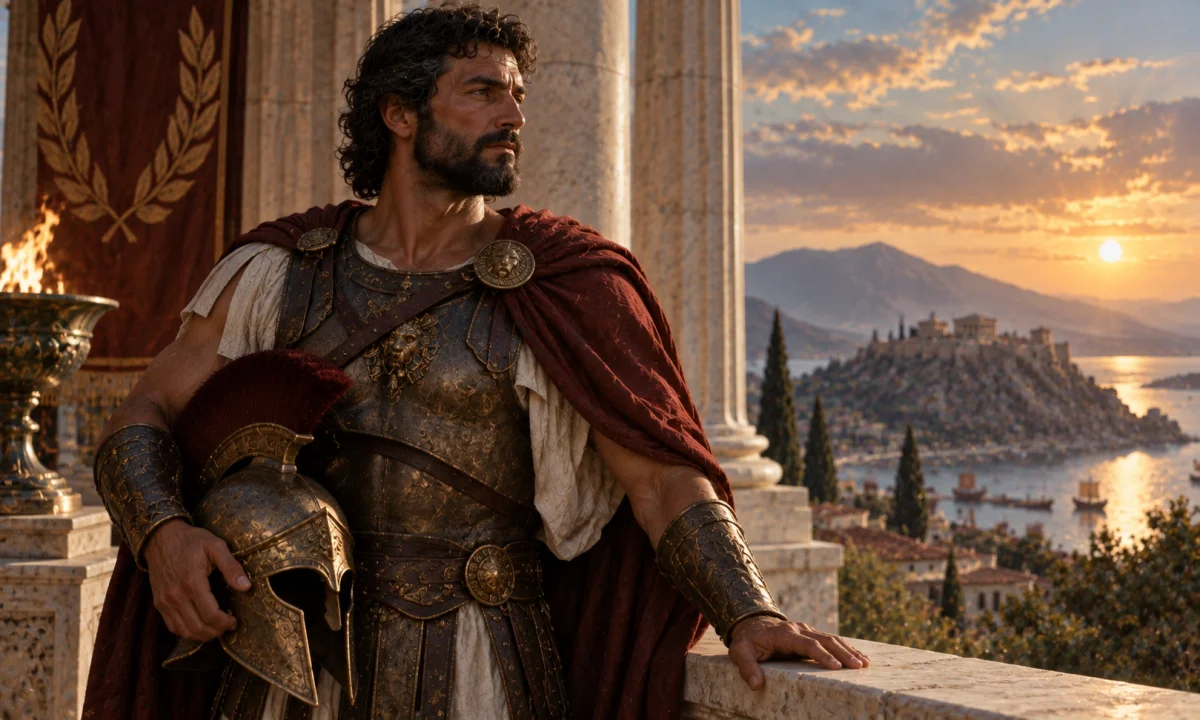
Amphitryon is a mortal king and heroic figure in Greek mythology, best known as the husband of Alcmene and the social father of Heracles. His place in the myth is shaped by a deception: while Amphitryon is away from home, Zeus takes his appearance and visits Alcmene. Alcmene later gives birth to twin sons, Heracles, fathered by Zeus, and Iphicles, fathered by Amphitryon. The story explores questions of identity, marriage, divine interference and the uncertain boundaries between human and god.
Origins and cultural setting
Amphitryon belongs to the legendary royal families of the Greek heroic age, particularly those associated with Argos, Tiryns, Thebes and the surrounding regions of the eastern Peloponnese. He is not a god or a primordial being. He is a human ruler whose life becomes entangled with the plans of Zeus and the destiny of Heracles.
The fullest surviving account of his family history appears in mythographic tradition. Amphitryon is generally described as a son of Alcaeus, king of Tiryns, and a grandson of Perseus. His mother’s name varies between sources or is transmitted in different forms, including Astydameia and Laonome. Such variations are common in Greek genealogical mythology, where local traditions and later writers frequently supplied different names for the same family relationships.
Amphitryon was connected with the royal house of Mycenae through his marriage to Alcmene. Alcmene was the daughter of Electryon, king of Mycenae, and a descendant of Perseus. Through this marriage, Amphitryon entered one of the most important heroic genealogies in Greek myth. The family was already marked by violence, exile and rival claims to kingship before the birth of Heracles.
The accidental death of Electryon
Amphitryon’s marriage to Alcmene follows a tragic incident involving her father, Electryon. The details vary, but the central event is consistent: Amphitryon accidentally caused Electryon’s death.
According to the most familiar version, Amphitryon was attempting to drive away cattle during a dispute or conflict. He threw a club or similar object at an attacking animal, but the weapon rebounded and struck Electryon. Because the death was unintended, Amphitryon was not portrayed as a deliberate murderer, yet the killing created a serious problem under the laws and customs associated with heroic kingship. Sthenelus, a relative of Electryon, used the incident as a reason to seize power and banish Amphitryon from Argos or Tiryns.
Amphitryon went into exile with Alcmene. Their marriage was not immediately consummated, because Alcmene imposed a condition connected with the death of her brothers. She required Amphitryon to avenge them before she would live with him as his wife. The exact circumstances of the brothers’ deaths differ in the mythographic tradition, but they are usually connected with raids by the Taphians or Teleboans, peoples associated with islands and coastal regions in the western Greek world.
The campaign against the Taphians
To fulfil Alcmene’s demand, Amphitryon organized a military expedition against the Taphians, also called the Teleboans in some accounts. He received assistance from other Greek rulers, including Creon of Thebes. The campaign became a major undertaking rather than a private act of revenge.
The enemy proved difficult to defeat because their king, Pterelaus, possessed a magical or divinely protected golden hair on his head. As long as this lock remained intact, he could not be killed and his city could not be conquered. In one version, Pterelaus’s daughter Comaetho fell in love with Amphitryon and betrayed her father by removing the golden lock. Pterelaus then died, allowing Amphitryon to win the war.
Comaetho’s role is morally troubling. Her actions are driven by desire or passion, but they also result in treachery and the death of her father. Amphitryon kills her after the victory rather than accepting her as a reward. This detail emphasizes the harsh values of heroic legend, in which loyalty to family, political allegiance and military honour often carry fatal consequences.
After the campaign, Amphitryon returned to Alcmene. Before he arrived, however, Zeus had already begun the deception that would transform Amphitryon’s family history.
Zeus assumes Amphitryon’s form
Zeus desired Alcmene, but she was known in myth for her exceptional loyalty to Amphitryon. Zeus therefore did not simply approach her as himself. He took the appearance of Amphitryon and presented himself as the victorious husband returning from war.
In accounts influenced by the mythographer Apollodorus, Zeus also caused the night to last three times its normal length. The unusually extended night is a narrative sign of divine intervention and gives the encounter a cosmic scale. The story does not merely describe an adulterous visit; it places a mortal marriage within the power of a god who can manipulate both physical appearance and the course of time.
Alcmene believed that the disguised Zeus was her husband and welcomed him. Zeus fathered Heracles during this encounter. When the real Amphitryon arrived later, Alcmene received him without understanding that the previous visitor had not been her husband. Amphitryon was naturally confused when she treated his return as a second visit. The seer Tiresias or another prophetic authority explains the deception in some versions, revealing that Zeus had taken Amphitryon’s form.
The episode raises a difficult issue for modern readers because Alcmene is deceived about the identity of her partner. Ancient myth often treats Zeus’s transformations as demonstrations of divine power, but the same stories can also be read as narratives of coercion and the violation of human choice. The myth does not present the deception in the language of modern consent, and interpretations should distinguish the ancient framework from later ethical responses.
Alcmene’s twin sons
Alcmene eventually gave birth to twin boys. Heracles, also called Alcides after his grandfather Alcaeus, was the son of Zeus. Iphicles was the son of Amphitryon. Their different paternity is central to the myth, but they were raised together as brothers in Amphitryon’s household.
The twins represent two overlapping lines of inheritance. Heracles possesses divine ancestry and extraordinary physical strength, while Iphicles is fully mortal. Amphitryon nevertheless acts as the father within the household, and ancient stories generally do not portray him as simply rejecting Heracles because Zeus is the boy’s biological father. His relationship with both children is part of the human side of Heracles’ upbringing.
Some traditions use the birth of the twins to explain their contrasting natures. Heracles becomes the greatest of Greek heroes, while Iphicles remains a capable but less celebrated warrior. Iphicles is nevertheless important in several myths. He accompanies Heracles in some adventures and becomes the father of Iolaus, Heracles’ close companion and charioteer.
Amphitryon as Heracles’ mortal father
Amphitryon’s importance lies less in personal supernatural abilities than in his role as the human father and guardian of a hero whose destiny is controlled by the gods. He belongs to the world that Heracles must eventually surpass, but he also provides the social identity through which Heracles is raised.
In some traditions, Amphitryon helps train the young Heracles. Heroic education commonly includes instruction in weapons, wrestling, chariot driving and music. The details of Amphitryon’s participation vary, and not every account gives him the same role. One famous story tells how Heracles killed his music teacher Linus by striking him with a lyre after being beaten or reprimanded. Amphitryon, concerned by the boy’s violent strength, sent him to tend cattle in the countryside. This episode belongs to the larger tradition of Heracles’ youth rather than to a single consistent biography.
Amphitryon’s household also appears in stories about the first signs of Heracles’ power. When the goddess Hera sent serpents against the children, Heracles strangled them while still an infant, whereas Iphicles was terrified. The scene distinguishes the brothers and reveals Heracles’ extraordinary nature. The exact roles assigned to Amphitryon and Alcmene differ, but the story commonly presents the household as the place where Heracles’ divine or superhuman qualities first become visible.
Amphitryon is sometimes said to have consulted Tiresias after the serpent episode or after other signs of the boy’s unusual nature. In these narratives, the seer confirms that Heracles is destined for greatness but will also suffer because of Hera’s hostility. The prophecy connects Amphitryon’s domestic life to the larger divine conflict surrounding Heracles’ birth.
Relationship with Zeus and Hera
Amphitryon is a victim of divine impersonation, but he is not usually portrayed as a direct rival of Zeus. The god’s actions create the circumstances of his marriage and family, yet Amphitryon remains a mortal caught within a plan he cannot control.
Zeus’s union with Alcmene was part of a wider divine intention. Heracles was expected to become a powerful hero and, in some traditions, to help secure the rule or interests of Zeus. Hera, however, hated Heracles because he was the product of Zeus’s infidelity. Her hostility affected the entire household, not only the child who bore Zeus’s blood.
Amphitryon therefore occupies a complicated position. He is both the husband whose identity Zeus steals and the father figure in whose household Zeus’s son grows up. The deception does not erase his legal or social relationship with Alcmene and the children. Rather, it produces a divided paternity: Zeus supplies divine ancestry, while Amphitryon supplies the human household, name and paternal presence.
Later episodes in the heroic tradition
Amphitryon appears in stories connected with Heracles’ family, especially those involving the hero’s marriage to Megara and the catastrophe caused by Hera’s madness. In Euripides’ tragedy Heracles, Amphitryon is an aged member of the household who witnesses the destruction of Heracles’ family. Heracles, driven mad by Hera, kills his wife Megara and their children. Amphitryon survives and helps establish the emotional and moral setting of the play.
The tragedy presents Amphitryon as a grieving father and grandfather who has endured exile, warfare and divine injustice. He is not responsible for Heracles’ madness, yet he suffers its consequences. His presence also intensifies the contrast between human endurance and divine power: mortal characters must live with the results of actions initiated by gods.
Different literary works handle Amphitryon’s later life in different ways. Greek myth did not preserve one universally fixed biography for him. Some traditions focus almost entirely on his marriage to Alcmene and the birth of Heracles; others place him within the wider stories of the Theban royal family and Heracles’ descendants.
Name and classification
The name Amphitryon is Greek, usually written Ἀμφιτρύων in ancient Greek. Its exact etymological interpretation is not entirely certain. It has often been connected with ideas such as “surrounding” or “one who is involved on all sides,” but proposed explanations differ. The name should not be treated as a securely translated descriptive title.
Amphitryon is best classified as a heroic-age mortal king, not as a god, monster or personification. Like many figures in Greek heroic genealogy, he has noble and partly divine ancestry through the Perseid royal line, but that ancestry does not make him immortal. His fame comes from his place in the story of Heracles and from his participation in warfare and kingship.
He should also be distinguished from Amphitrite, the sea goddess and wife of Poseidon. The names resemble each other, but the two figures are unrelated in the traditional myths that concern them. Amphitryon should not be confused with Amphitrite, nor with other figures whose names begin with the Greek element amphi-.
Literary reception and the meaning of “amphitryon”
The story of Amphitryon became especially influential in drama and comedy. The Roman playwright Plautus wrote Amphitruo, a comedy built around the confusion produced by Jupiter’s disguise and Mercury’s impersonation of Sosia, Amphitryon’s servant. Plautus shifts the emphasis from heroic genealogy to mistaken identity, theatrical deception and the absurd consequences of gods entering human domestic life.
Later European playwrights adapted the same material, most notably Molière in Amphitryon and Heinrich von Kleist in Amphitryon. These works do not simply reproduce the ancient myth. They use its central situation to examine marriage, status, sexual jealousy, identity and the unequal relationship between divine and human beings.
The character’s name also produced a later linguistic development. In French, amphitryon became a common noun meaning a host who receives guests, especially at a meal. This usage derives from the scene in which Zeus, disguised as Amphitryon, appears as the returning master of the house. The word’s modern social meaning is therefore a cultural afterlife of the myth, not an ancient religious title or an indication that Amphitryon was traditionally the god of hospitality.
Modern adaptations may portray Amphitryon as a comic husband, a betrayed spouse, a tragic father or a symbol of uncertain identity. These interpretations belong to later literature and theatre. In the Greek mythic tradition itself, Amphitryon remains a mortal ruler whose household is transformed by Zeus’s deception and whose human fatherhood exists alongside the divine paternity of Heracles.