WORLD

Athena
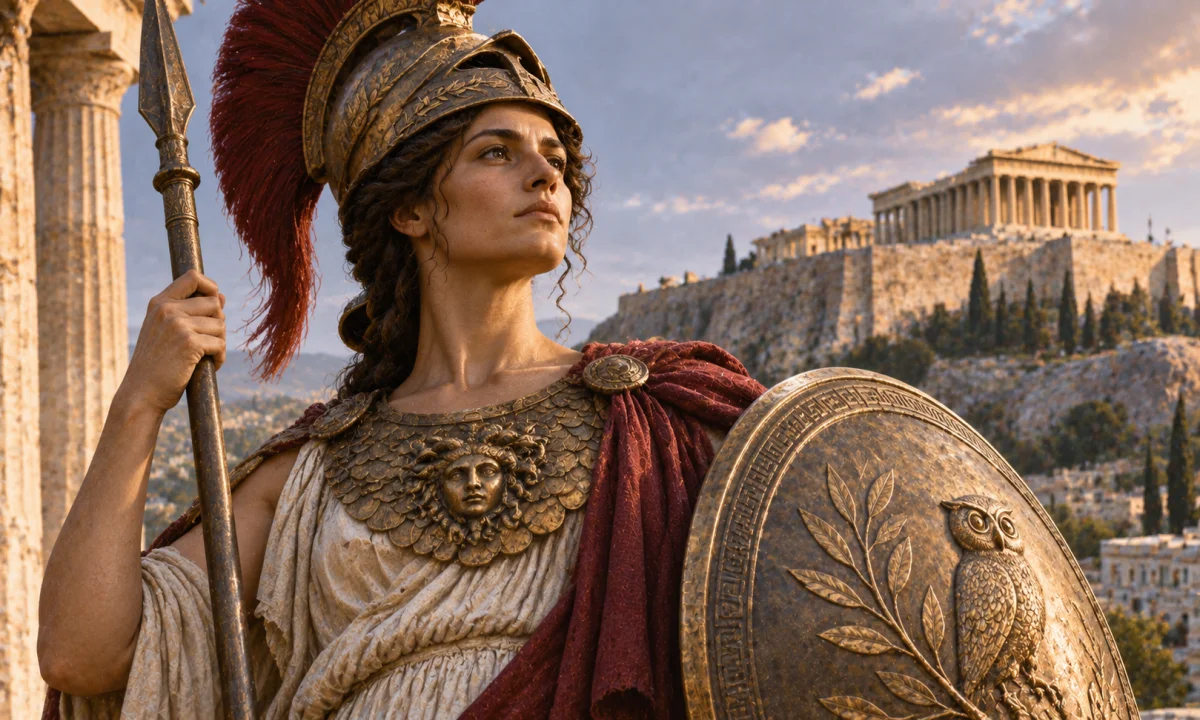
Athena is one of the principal goddesses of ancient Greek religion. She is associated with wisdom, strategic warfare, civic order, skilled crafts and the protection of cities, especially Athens, whose name was traditionally connected with hers. Unlike a goddess defined primarily by marriage, fertility or the wilderness, Athena represents disciplined intelligence: the ability to plan, build, govern, defend and create. Her character combines qualities that modern categories often separate, including martial power, practical knowledge, artistic skill and political responsibility.
Origins and cultural setting
Athena belonged to the Olympian generation of gods, although some evidence suggests that her worship has roots older than the classical Greek world. Her name appears to be reflected in a Mycenaean Greek tablet from the second millennium BCE, in a form often read as a-ta-na po-ti-ni-ja, meaning something like “Mistress Athena” or “Lady of Athens.” The interpretation is not completely certain, and the relationship between this Bronze Age figure and the later goddess cannot be reconstructed in detail. Nevertheless, it indicates that a deity connected with the name Athena may have been venerated before the literary traditions of archaic and classical Greece.
Greek religion had no single authoritative scripture or uniform mythology. Athena’s identity developed through local cults, epic poetry, hymns, drama, visual art and civic ceremonies. Different communities could emphasize different aspects of the goddess. In Athens she was the city’s guardian and patron, while elsewhere she could be honored as a protector, a warrior, a helper of heroes or a goddess of particular crafts. Greek myths often preserve these overlapping traditions rather than presenting a single consistent biography.
The most influential literary accounts come from works attributed to Homer, especially the Iliad and the Odyssey, the Homeric Hymns, and the poems and mythographic traditions associated with Hesiod. Later Greek and Roman writers expanded or altered many stories. Archaeological remains, inscriptions, religious dedications and surviving sculptures are equally important for understanding Athena, because her role in actual worship cannot be reduced to the narratives told by poets.
Name and identity
The Greek name is commonly written Athena in English, although Athene is also used, reflecting the form Athēnē in transliteration. In Homer, she is frequently called Athenaia, “the Athenian” or “of Athens,” though the precise historical relationship between the goddess’s name and the city’s name remains uncertain. Ancient Greeks themselves offered various explanations, but none can be treated as a securely established etymology.
Athena has many titles, each highlighting a particular relationship or function. Athena Polias, “Athena of the City,” expressed her role as guardian of the Athenian community. Athena Parthenos, “Athena the Maiden,” emphasized her unmarried and virgin status. Athena Nike connected her with victory, while Athena Ergane, “Athena the Worker,” referred to skilled labor and crafts. Promachos, meaning “fighting in front” or “champion in battle,” portrayed her as the city’s defender.
The epithet Pallas is especially complicated. In some traditions Athena is called Pallas, and the name became one of her most familiar titles. A later myth says that Pallas was a companion whom Athena accidentally killed during a childhood contest, after which she adopted the name in mourning. Other traditions treat Pallas as an independent divine or legendary figure, and the original meaning of the epithet is disputed. These accounts should not be treated as a single universally accepted origin story.
Birth and divine family
The best-known myth makes Athena the daughter of Zeus and Metis. Metis was an ancient goddess associated with wisdom, intelligence and cunning thought. Zeus learned a prophecy that any child born to Metis might eventually become more powerful than its father. He therefore swallowed Metis while she was pregnant. Athena later emerged from Zeus’s head, fully armed, often after Hephaestus or another divine figure opened the god’s skull with an axe.
This dramatic birth explains several features of Athena’s mythic identity. She is closely connected with Zeus’s authority, but she is not born through an ordinary maternal process. Her emergence from the head links her with intelligence, counsel and deliberate thought, while her armor establishes her immediately as a warrior. In some ancient artistic representations she appears as a small armed figure emerging from Zeus; in others, the event is shown through more elaborate imagery.
The myth does not mean that Greek tradition consistently imagined Athena as lacking all maternal or feminine associations. Rather, it presents her as an exceptional goddess whose independence from conventional marriage and childbirth is central to her identity. She is often described as a virgin, but virginity in her case signifies autonomy, inviolability and freedom from sexual subordination as much as sexual abstinence.
Roles and attributes
Wisdom and practical intelligence
Athena’s wisdom is not simply book learning or abstract knowledge. She embodies metis, the ability to devise effective plans, understand complicated situations and achieve a goal through intelligence. This makes her an important adviser to heroes and kings. In the Odyssey, she supports Odysseus because he shares her qualities of caution, disguise, eloquence and strategic thinking. She also assists Telemachus as he grows into a more capable participant in his family’s affairs.
Her wisdom is therefore active and practical. Athena knows how to apply knowledge in circumstances where force alone would fail. She may guide a warrior, inspire a craftsperson, protect a city’s laws or help establish an orderly political community. Greek ideas of wisdom were not always gentle or pacific; cleverness could be used in conflict, competition and deception as well as in civic life.
Warfare and victory
Athena is a war goddess, but her mode of warfare differs from the uncontrolled violence associated with Ares. Ares represents the fury, confusion and bloodlust of battle, whereas Athena is more often associated with planning, defensive action, discipline and victory achieved through superior judgment. The contrast is clearest in epic poetry, where Athena frequently supports warriors who display courage guided by intelligence.
She is often shown wearing a helmet and carrying a spear and shield. Her armor can include the aegis, a powerful protective covering associated with Zeus and sometimes described as a hide or breastplate. The aegis commonly bears the head of Medusa, the Gorgon whose frightening image was believed to repel enemies. Athena’s shield may likewise be decorated with the Gorgon’s head, known as a gorgoneion.
Athena’s connection with victory appears in the title Athena Nike. The small temple of Athena Nike on the Athenian Acropolis reflects this aspect of her worship. In imagery, a winged figure of Nike may appear in her hand, although Athena herself is not ordinarily a winged goddess.
Crafts, weaving and technology
Athena is also a patron of skilled production. She is associated with weaving, spinning, pottery, metalworking, carpentry, shipbuilding and other forms of technical knowledge. The title Ergane highlights her relationship with work and craftsmanship. These associations were important in Greek societies, where textiles, tools, ships and household goods required specialized knowledge and labor.
Her connection with weaving is central to the story of Arachne, a talented mortal who challenged Athena to a contest. In the version told by the Roman poet Ovid, Arachne produces a technically brilliant tapestry that mocks the gods. Athena changes her into a spider. This story is a major source for the modern association between Arachne and spiders, but its surviving literary form is Roman and should not automatically be projected back onto every earlier Greek tradition. It also explores pride, artistic competition and the dangerous consequences of challenging divine authority.
The owl, olive tree and other symbols
The owl is Athena’s most recognizable animal symbol. In ancient Greek art, the owl represented her presence and wisdom, and the phrase “little owl” was used as an epithet for her. The owl also appeared on Athenian coins, making the bird a widely recognized emblem of the city. The modern idea that an owl universally symbolizes wisdom owes much to this ancient association, although it is a later simplification of a more complex religious tradition.
The olive tree was another major symbol. According to Athenian myth, Athena and Poseidon competed for possession of Attica. Poseidon struck the ground with his trident and produced a spring or, in some versions, a saltwater source. Athena planted the first olive tree. The citizens or their rulers judged her gift more useful, and the city became associated with her. The olive represented food, oil, wood and economic prosperity, giving the story a strong civic and agricultural dimension.
Major myths and relationships
Athena and the city of Athens
The contest with Poseidon explains the goddess’s special relationship with Athens, but the story also expresses competition between different forms of power. Poseidon’s gift is dramatic and elemental, while Athena’s olive tree offers lasting practical benefits. The myth presents the city’s identity as grounded in cultivation, craft, commerce and organized civic life.
Athens celebrated Athena through the Panathenaia, a major festival held in her honor. The festival included processions, sacrifices, athletic and musical contests, and the presentation of a new woven garment to the goddess’s image. The Great Panathenaia, established or reorganized in the sixth century BCE, became one of the city’s most important public celebrations. Religious devotion, civic identity and political display were closely connected in the event.
Erichthonius and the Acropolis
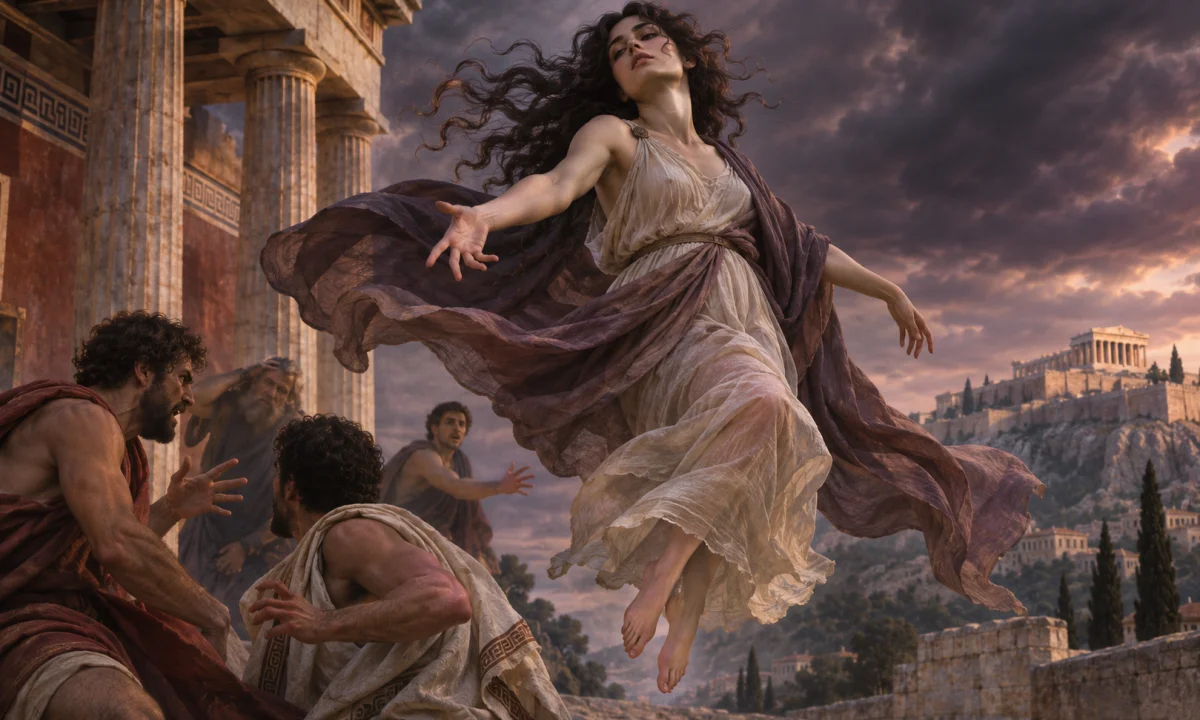
Another Athenian tradition concerns Erichthonius, an early king or culture hero. In one version, Hephaestus pursued Athena, but she resisted him. His semen fell onto the earth, and a child was born from the ground. Athena placed the infant in a chest and entrusted it to the daughters of Cecrops, warning them not to look inside. When they opened the chest and saw a serpent-like child, they were driven mad and died or fell from the Acropolis, depending on the version.
Athena then cared for Erichthonius, who became connected with the early history of Athens. The story has several variants and includes themes of autochthony, or emergence from the native soil, as well as the protection of the city by its goddess. Erichthonius was sometimes confused or closely associated with Erechtheus, another ancient king of Athens, but the two names do not represent precisely the same figure in every tradition.
Athena in epic quests
In the Iliad, Athena supports the Greeks during the Trojan War and repeatedly intervenes in battles and confrontations. Her favor is not automatic: she is one of the goddesses offended by the judgment of Paris, who awarded the golden apple to Aphrodite rather than to Athena or Hera. This dispute helps explain the hostility of these goddesses toward Troy in later mythic tradition.
In the Odyssey, Athena is the principal divine supporter of Odysseus. She assists him indirectly, advises his son Telemachus and helps restore order in Ithaca. Her relationship with Odysseus is based on shared cleverness and strategic judgment rather than simple physical strength. She also assists other heroes in different traditions, including Perseus and Heracles, although the details and prominence of her help vary among sources.
Athena’s role in the defeat of the Gorgons is particularly important in the story of Perseus. She helps Perseus approach Medusa and later receives Medusa’s severed head for her shield or aegis. This image became one of the most powerful protective symbols in Greek art. Athena is not normally identified with Medusa, however: Athena is the goddess who uses the Gorgon’s image, while Medusa is a distinct mortal or monstrous figure whose story has several differing versions.
Temples and religious significance
The most famous center of Athena’s worship was the Acropolis of Athens. The Parthenon was dedicated to Athena Parthenos and housed a monumental cult statue made by the sculptor Phidias, now lost. The building’s sculptures and architectural program connected Athena with the city’s myths, victories and political identity. The Parthenon was not merely a temple in the modern museum-like sense; it formed part of a living religious landscape involving processions, offerings, sacrifice and festivals.
The statue of Athena Parthenos was described as a large image of the armed goddess, holding a figure of Nike and accompanied by symbols including a shield and a serpent. Because the original statue no longer survives, knowledge of its appearance comes from ancient descriptions and later copies or adaptations. The serpent may relate to Erichthonius or to the protective and chthonic symbolism attached to the Acropolis.
Athena was also worshipped at other sanctuaries, including sites where particular aspects of her character were emphasized. The temple of Athena Alea at Tegea was an important Arcadian sanctuary, while the sanctuary of Athena Lindia on Rhodes preserved local traditions under the broader Greek identity of the goddess. Such regional cults demonstrate that Athena was not limited to Athens, even though Athens made her most famous.
Interpretation and distinctions
Athena’s mythology brings together traits that can appear contradictory: she is a virgin who protects households and cities, a warrior who favors order over slaughter, and a goddess of weaving who wears armor. These combinations reflect the breadth of ancient Greek ideas about intelligence and skilled action. The same capacity to plan could be expressed in a battlefield, a loom, a shipyard, a courtroom or a civic festival.
Her independence should not be mistaken for complete separation from family or society. Athena remains a daughter of Zeus, operates within the divine hierarchy and is deeply tied to the welfare of a particular community. Her power is often most meaningful when exercised in defense of collective institutions rather than as solitary rebellion.
Athena is sometimes treated as simply the Greek equivalent of the Roman goddess Minerva. The comparison is useful because Roman religion identified Minerva with wisdom, crafts and strategic skill, and the two goddesses were eventually united in the Roman Capitoline Triad with Jupiter and Juno. However, Minerva had her own Italian and Roman history, and she should not be assumed to be identical in origin or every religious function. The Greek Athena and Roman Minerva became closely associated through cultural exchange, but they remain distinct figures in their original traditions.
Later reception
Athena continued to influence European art, political imagery, literature and education long after ancient Greek sacrifice and civic cult had declined. Renaissance and neoclassical artists often presented her as an idealized embodiment of wisdom, reason, military virtue or the arts. Modern institutions sometimes use her owl, helmet or image to symbolize learning and intellectual achievement.
Contemporary novels, films, comics, games and fantasy fiction frequently adapt Athena as a powerful warrior, strategist or mentor. These portrayals may draw on genuine ancient motifs but often combine them with modern ideas about individual heroism, gender, magic and divine ancestry. A modern depiction should therefore be distinguished from the varied religious traditions in which Athena was worshipped as a civic goddess, guardian, craft deity and patron of disciplined intelligence.