WORLD
WORLD
Egungun-oya
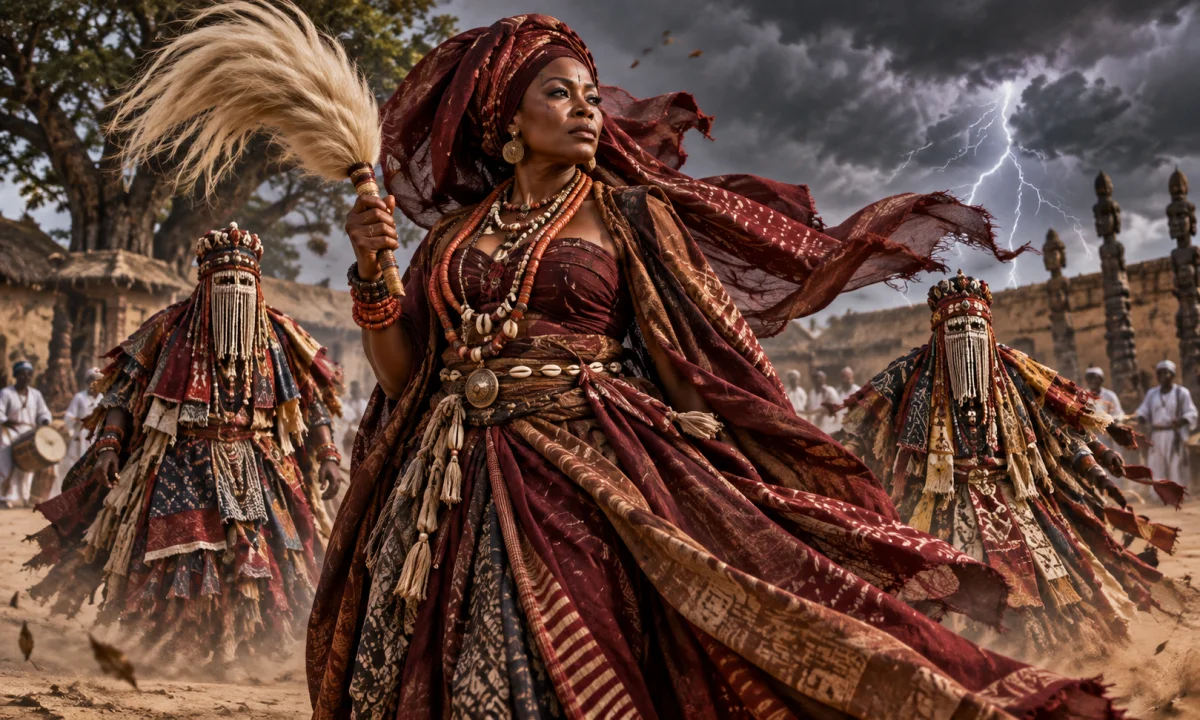
Egungun-oya is a name associated with Yoruba ancestral masquerade and with Ọ̀ya, the orisha linked in many Yoruba traditions with wind, storms, change, and the boundary between the living and the dead. The name does not refer to a single, universally defined character in the way that the names of particular orishas usually do. Depending on the community and the source, it may describe a masquerade dedicated to Ọ̀ya, an ancestral manifestation connected with her, or a ritual expression combining the ideas of egúngún and Ọ̀ya.
That uncertainty is important. Yoruba religious traditions have been preserved principally through oral transmission, ritual performance, praise poetry, family knowledge, and initiation. They do not possess one universally binding mythology in which every divine figure has the same identity, attributes, and stories. Meanings can differ between Yoruba-speaking regions of Nigeria, and between related traditions in Benin, Togo, and the African diaspora.
Meaning of the Name
Egúngún is the Yoruba term most commonly used for an ancestral masquerade or for the collective presence of the ancestors represented through that masquerade. The word is often translated in English as “ancestor,” “ancestral spirit,” or “masquerader,” although none of these translations covers its complete ritual meaning. In performance, the masked figure is not merely a dancer wearing a costume. It represents the return of ancestral power to the community under carefully regulated religious conditions.
Ọ̀ya, also written Oya or Oyá when Yoruba tone and diacritical marks are omitted, is a major orisha in Yoruba religion. She is widely associated with powerful winds, storms, sudden transformation, the marketplace, and dangerous or transitional spaces. In many traditions she is also connected with the ancestors and with the threshold between life and death. Her relationship with Ṣàngó, commonly written Shango in English, is prominent in numerous Yoruba and diaspora accounts, although details differ among communities.
The compound form Egungun-oya is therefore best treated cautiously. It may be an English-language or simplified spelling of a local ritual expression rather than the name of a separate deity. The hyphen is not a universal feature of Yoruba orthography, and forms such as Egungun Oya, Egúngún Ọ̀ya, or Oya Egungun may appear in different contexts. A particular community may use the term as the proper name of a masquerade, while another may understand it descriptively as “the egúngún of Ọ̀ya.”
Egúngún and the Yoruba Ancestors
Ancestor veneration is a central part of many Yoruba religious communities. The ancestors are not necessarily imagined as remote beings separated permanently from ordinary life. They may continue to influence the welfare, moral order, fertility, prosperity, and safety of their descendants. Ritual attention to them helps maintain a relationship between the living, the dead, and generations yet to come.
Egúngún festivals make this relationship visible. A masquerader is covered from head to foot in elaborate layers of cloth, often with a decorated headpiece, veil, mask, or other concealed structure. The clothing may be made from brightly coloured textiles, patterned fabrics, appliqué, embroidery, and strips that move dramatically as the performer dances. The concealment of the human body is essential. It indicates that the figure appearing before the community is not being presented simply as the individual dancer.
Music, drumming, praise poetry, and the behaviour of attendants guide the performance. The masquerader may whirl, leap, shake the costume, approach particular people, or respond to the drummers and singers. The moving cloth creates a powerful visual impression: the figure appears to expand, change shape, and move with a force beyond ordinary human movement. Such performances are both religious and communal. They can honour the dead, reaffirm family identity, address moral conduct, and strengthen ties among members of a town or lineage.
Egúngún should not be reduced to the idea of a frightening ghost. The masquerade can be awe-inspiring, protective, celebratory, admonitory, or politically significant. It represents a disciplined encounter with ancestral authority. Rules govern who may make, handle, perform, interpret, or approach a particular masquerade, and those rules vary between communities. Women may have important religious, organisational, musical, and economic roles in masquerade traditions even where particular performances are reserved for male performers.
Ọ̀ya and the Power of Transformation
Ọ̀ya is one of the orishas whose symbolism makes her especially relevant to ancestral masquerade. Wind is invisible, yet its effects are unmistakable: it moves leaves, raises dust, changes the weather, and can become destructive. This combination of invisibility and force resembles the way spiritual power is often represented in Yoruba ritual. Ọ̀ya’s presence may be felt through movement, sudden change, and the disturbance of ordinary boundaries.
In many accounts, Ọ̀ya is connected with storms and with the transformation of one condition into another. She is also linked with the marketplace, a place of exchange, social encounter, and uncertainty. These associations do not make her simply a “goddess of weather.” Such short labels can obscure the wider range of her religious significance. Ọ̀ya may be approached as a powerful orisha who governs change, protects or challenges communities, and mediates dangerous transitions.
Her association with the dead is expressed differently in different traditions. Some accounts connect her with the entrance to the cemetery or with the passage between the human community and the ancestral realm. Other accounts emphasise her relationship with Ṣàngó, her authority over wind and storms, or her role as a fierce and independent power. These themes help explain why a masquerade associated with Ọ̀ya may focus on movement, transformation, ancestral contact, or the sudden appearance of concealed forces.
Appearance and Ritual Performance
There is no single standard costume for Egungun-oya. If the name is used for a particular masquerade, its appearance will depend on the community that maintains it, the lineage or association responsible for it, and the ritual occasion. A costume may use red, black, white, or other colours with local symbolic meanings, but colours should not be assigned one fixed interpretation across all Yoruba communities.
The layered costume is especially significant. As the performer spins, the cloth can flare outward like a storm or a vortex. This movement can evoke wind and the unstable boundary between visible and invisible forms. A head covering or mask prevents the audience from identifying the individual body beneath the regalia. The concealment is not simply theatrical. It supports the transformation of the performer into a ritual representative of the ancestors or of the power with which the masquerade is associated.
Drummers and praise singers play an essential role. Yoruba ritual performance often depends on the relationship between speech, rhythm, movement, and identity. Praise names and verbal formulas may identify the lineage, honour the ancestors, invoke the orisha, or address the masquerade directly. The words used in one community may not be appropriate or intelligible in another, and a performance cannot be fully understood by looking at the costume alone.
An Egungun-oya performance may take place during a festival, a family observance, a commemorative event, or another religious occasion. It is not automatically a public entertainment open to unrestricted interpretation. Some aspects of masquerade practice are intended for community members or initiated participants, and observers from outside the tradition may see only part of the ritual context.
Stories and Variations
Yoruba traditions contain many narratives about the origins of masquerade, the arrival of ancestral customs, and the relationships between human beings and the orishas. These narratives are often preserved in different versions rather than in one fixed written canon. A story told in one town may place greater emphasis on a founding ancestor, while another may stress the authority of an orisha or the historical achievements of a ruling lineage.
Some oral interpretations connect Ọ̀ya with the power that allows the dead to appear among the living, while others treat her relationship with egúngún as one association among several. In some settings, a masquerade bearing her name may be understood as an embodiment of her force; in others, it may represent ancestors under her protection or authority. These possibilities should not be merged into a single definitive myth.
It is also unsafe to assume that every figure called Egungun-oya is identical. Names can be transferred, translated, shortened, or reinterpreted when ritual traditions move between regions. A term recorded by an outsider may not preserve the spelling, pronunciation, or precise meaning used by the community itself. The form of the name alone cannot establish whether it denotes a deity, a masquerade society, a particular costume, or a local title.
Cultural and Religious Significance
Egungun-oya can be understood most usefully as a meeting point between two important Yoruba religious ideas: the continuing presence of the ancestors and the transformative power represented by Ọ̀ya. The ancestral masquerade gives visible form to relationships that are otherwise unseen. Ọ̀ya adds associations of wind, movement, danger, renewal, and passage through boundaries.
This combination can make the masquerade a symbol of social as well as spiritual continuity. The ancestors are not only remembered as individuals. Through ritual, they may be understood as a collective force that protects the community, watches over moral obligations, and connects present generations with those who came before them. The performance also affirms that identity is inherited and renewed through collective action rather than possessed by an isolated individual.
The concealment of the performer has an ethical dimension as well as a supernatural one. By hiding the ordinary human body, the ritual shifts attention away from personal fame and toward lineage, community, and inherited authority. The masquerader acts within established rules and under the control of attendants, musicians, elders, and ritual specialists. This structure distinguishes the performance from an improvised costume display.
For Yoruba communities and for related traditions in the diaspora, the significance of ancestral masquerade can also include resilience. Religious forms have survived migration, colonial disruption, missionary hostility, legal restrictions, and cultural change. They have sometimes been adapted to new environments while retaining core concerns with ancestry, obligation, protection, and the relationship between visible society and unseen power. Such adaptations are not all the same, and none should automatically be treated as an exact continuation of a particular Nigerian practice.
Distinguishing Egungun-oya from Similar Figures
Egungun-oya is not simply another name for Ọ̀ya. Ọ̀ya is an orisha, while egúngún generally refers to ancestral masquerade and the ancestral presence represented through it. A masquerade may be dedicated to, associated with, or interpreted through Ọ̀ya without making the masquerade and the orisha identical.
Egungun-oya is also not the same as egúngún in general. Egúngún is a broad category with many local forms, names, costumes, and ritual organisations. Not every egúngún is associated with Ọ̀ya, and not every community uses the compound name Egungun-oya.
Nor should it be confused with the ẹ̀gùn or egun of other religious contexts merely because English spellings appear similar. Yoruba words depend heavily on tone and underdots, and the removal of these marks can make distinct terms look alike. Transliteration, pronunciation, and local usage therefore matter when identifying a particular figure or ceremony.
Later Interpretations
Modern writers, artists, religious practitioners, and popular media sometimes present Egungun-oya as a single supernatural character with a fixed appearance and a list of powers. Such portrayals may be creative interpretations or may reflect one local understanding, but they should not be treated automatically as a universal account of Yoruba tradition. Video games, fantasy fiction, illustrated mythology, and general reference material often turn a complex ritual category into an individual character because that is easier to use in a narrative.
The older religious context is more precise and more varied. Egungun-oya is best approached through the traditions of ancestral masquerade, the distinct identity of Ọ̀ya, and the particular community in which the name is used. Its meaning lies not only in a costume or supernatural description, but in the ritual relationship among ancestors, living descendants, orisha power, music, lineage, and the continuing renewal of communal life.