WORLD
WORLD
Chalmecatecuhtli
Chalmecatecuhtli is an obscure figure associated with Aztec, or more precisely Nahua, religious tradition in central Mexico. His name appears in colonial-era records and later catalogues of Nahua deities, but surviving evidence about him is limited. Unlike major gods such as Huitzilopochtli, Tlaloc, Quetzalcoatl, or Mictlantecuhtli, Chalmecatecuhtli does not possess a large, clearly preserved cycle of myths or a universally recognized image.
The available information is therefore fragmentary. Some sources and modern reference works describe Chalmecatecuhtli as a celestial lord, sometimes assigning him to one of the heavens in the Nahua cosmos. Other interpretations connect his name with ritual specialists, sacrificial practice, or the place-name Chalma. These possibilities should not be treated as equally certain. Much of what is said about him comes from attempts to classify a brief or ambiguous name within a complex religious system recorded by Spanish missionaries and Indigenous collaborators.
The cultural setting
Chalmecatecuhtli belongs to the religious world of the Nahua peoples of central Mexico, including the Mexica, commonly called the Aztecs. This tradition was not a single fixed mythology with one authoritative scripture. It consisted of temple rites, oral narratives, calendrical practices, local cults, priestly knowledge, images, songs, and histories maintained by different communities.
Religious traditions varied from city to city. A deity could have a major temple in one centre, a local manifestation in another, or a name that functioned partly as a title rather than as the name of an independent god. The Mexica capital, Tenochtitlan, incorporated gods and rituals from many parts of Mesoamerica, sometimes adapting them to the political and ceremonial needs of the empire.
Most surviving written descriptions were produced after the Spanish invasion. Important records were created by Franciscan friars working with Nahua scholars, artists, interpreters, and informants. Other accounts were written by Spanish chroniclers or compiled from Indigenous traditions. These records preserve valuable information, but they also reflect translation problems, Christian assumptions, colonial censorship, and the selective interests of their authors.
Short deity lists are especially difficult to interpret. A name may be copied with different spellings, placed in a list according to a particular author’s system, or translated without enough explanation. Consequently, the limited evidence for Chalmecatecuhtli does not support a detailed biography or a single definitive myth.
The name Chalmecatecuhtli
The name is usually written Chalmecatecuhtli, although spelling varies in English-language works and in transcriptions of Nahuatl. The ending -tecuhtli means “lord” or “noble lord.” It is a common element in the names of Nahua gods and rulers. The first part, Chalmeca-, is more difficult to interpret with certainty.
One possibility is that the name refers to Chalman or Chalma, a region and sacred landscape south of the Valley of Mexico. The name could therefore be understood broadly as “Lord of the Chalmeca” or “Lord of Chalma.” Another possibility is that it is connected with a ritual or priestly term. Nahuatl words associated with sacrifice, temple service, and ritual office can resemble place-names or divine titles when removed from their original context.
The translation “Lord of Chalma” is useful as a tentative rendering, but it should not be presented as an unquestionable literal meaning. The exact relationship between Chalmecatecuhtli and Chalma is not securely established by a surviving myth or an unambiguous inscription.
Classification and the heavens
Chalmecatecuhtli is often classified as a celestial deity. Some modern summaries identify him as a lord of one of the thirteen heavens recognized in Nahua cosmological schemes, with the ninth heaven occasionally mentioned in connection with his name. Such assignments are not consistent across all discussions, and the surviving evidence does not provide a universally accepted profile of his heavenly office.
Nahua cosmology described the universe as a layered structure. The earth occupied a central position, while multiple heavens extended above it and regions of the underworld lay below. The heavens were not simply equivalent to the modern idea of outer space. They were populated by divine powers, celestial bodies, atmospheric forces, and sacred realms. The sun, moon, stars, rain, lightning, and other phenomena could all be understood through religious relationships rather than as separate from divine activity.
The existence of several heavens also meant that a lesser-known deity could be associated with a particular cosmic level without being the principal creator or ruler of the entire universe. The title “lord” did not necessarily imply the kind of independent, all-purpose god suggested by modern categories. It could indicate authority over a place, a ritual function, a class of beings, or a particular aspect of the cosmos.
Because of this, describing Chalmecatecuhtli as a “god of the sky” can be misleading if it suggests a role equivalent to that of a major solar or storm deity. The safer description is that he is a poorly documented divine lord associated in some records and later classifications with the celestial order.
Attributes and appearance
No standard physical appearance for Chalmecatecuhtli is securely known. There is no widely accepted body of images that allows scholars to identify him confidently in the way that certain attributes help identify Tlaloc, Xipe Totec, or Xiuhtecuhtli.
Some illustrated manuscripts contain complex arrangements of gods, calendrical signs, and cosmic beings, but identifying every figure in such manuscripts is difficult. A figure’s headdress, colour, facial paint, clothing, or accompanying symbol may represent a specific deity, a ritual office, a calendrical association, or a local form of a better-known power. It is unsafe to assign an image to Chalmecatecuhtli simply because it appears in a celestial section of a manuscript.
For the same reason, claims that he had a particular animal companion, weapon, colour, or supernatural power should be treated cautiously unless they are tied to a clear primary description. Popular deity lists sometimes give obscure gods a neat set of attributes based on guesses, conflations, or information belonging to other figures. There is no strong evidence for a distinctive animal form or a standard emblem belonging specifically to Chalmecatecuhtli.
Possible ritual associations
The name may have a relationship to ritual authority. Nahua religious life depended on specialists who maintained temples, prepared offerings, observed sacred calendars, performed ceremonies, and conducted sacrifices. Titles connected with ritual work could also become associated with divine figures or sacred places.
Chalma was an important religious centre, later known especially for the worship of the Christian Black Christ at the Sanctuary of Chalma. The pre-Christian history of the site involved Indigenous sacred traditions, including the worship of a cave deity often identified in later accounts as Oztoteotl, “Cave Lord.” The existence of a cult at Chalma makes a geographical connection for Chalmecatecuhtli plausible, but it does not prove that he was the same being as Oztoteotl or that he was the principal deity of the site.
Nor should Chalmecatecuhtli automatically be identified with a sacrificial god merely because the element Chalmeca- may have ritual associations. In Nahua religion, sacrifice was connected with many deities and ceremonies. It was not the exclusive domain of one obscure figure, and the evidence does not establish a single, specific sacrificial function for Chalmecatecuhtli.
Stories and relationships
No major surviving myth centres on Chalmecatecuhtli. He is not a principal actor in the well-known narratives concerning the creation of the Fifth Sun, the birth of Huitzilopochtli, the adventures of Quetzalcoatl, the deeds of the culture hero Nanahuatzin, or the journey of the dead through Mictlan.
There is also no securely documented genealogy placing him as the spouse, parent, child, or rival of a major deity. Some online presentations give him relationships to other gods, but these often arise from attempts to complete a mythological family tree rather than from clearly preserved Nahua narratives.
The absence of stories does not mean that no community ever worshipped or discussed a figure with this name. Indigenous religious knowledge was transmitted through performances, images, ceremonies, and local traditions, many of which disappeared or were transformed during the colonial period. It does mean that modern readers should distinguish between evidence for the existence of a divine name and evidence for a fully developed mythological character.
Distinction from similar figures
Chalmecatecuhtli should not be confused with Chalmecacihuatl. The second name contains cihuatl, meaning “woman” or “female,” and is generally treated as a separate female figure or feminine counterpart in some deity lists. The documentation for Chalmecacihuatl is also limited, and the precise relationship between the two names is not consistent in every source. Similar wording alone does not establish that they were universally understood as a divine couple.
He should also be distinguished from Oztoteotl, the “Cave Lord” associated with the sacred site of Chalma in later descriptions. A geographical or linguistic connection between Chalmecatecuhtli and Chalma is possible, but the two names refer to different figures in the surviving record.
Chalmecatecuhtli is likewise not another name for Mictlantecuhtli, the ruler of the realm of the dead. Mictlantecuhtli has a much clearer mythological identity, extensive iconographic evidence, and a central role in stories about death and the underworld. A celestial classification for Chalmecatecuhtli, where accepted, points in a different direction from Mictlantecuhtli’s underworld authority.
Finally, he should not be merged with major sky, star, or creator deities such as Tezcatlipoca, Quetzalcoatl, or Ometeotl. The Nahua cosmos contained many overlapping divine powers, but overlap in a cosmic setting does not make their identities interchangeable.
Interpretation and significance
Chalmecatecuhtli is significant less because of a large surviving mythology than because he illustrates the difficulties of reconstructing Indigenous religious systems from incomplete colonial records. Modern categories such as “god,” “spirit,” “saint,” “planetary deity,” and “priestly patron” do not always correspond neatly to Nahua concepts.
His name also demonstrates how religious identity could be tied to geography. Sacred places were not merely locations where gods happened to be worshipped. Mountains, caves, springs, temples, and settlements could be understood as active points of contact between different parts of the cosmos. A title referring to a region or sacred community might therefore express authority, origin, ritual affiliation, or the presence of a local manifestation.
The uncertainty surrounding Chalmecatecuhtli is itself historically important. It encourages a distinction between attested evidence and later reconstruction. It is reasonable to say that the name belongs to the recorded Nahua religious vocabulary and that some sources associate it with a celestial or regional lord. It is not reasonable to supply an elaborate appearance, personality, family, or set of legends without clear support.
Later reception
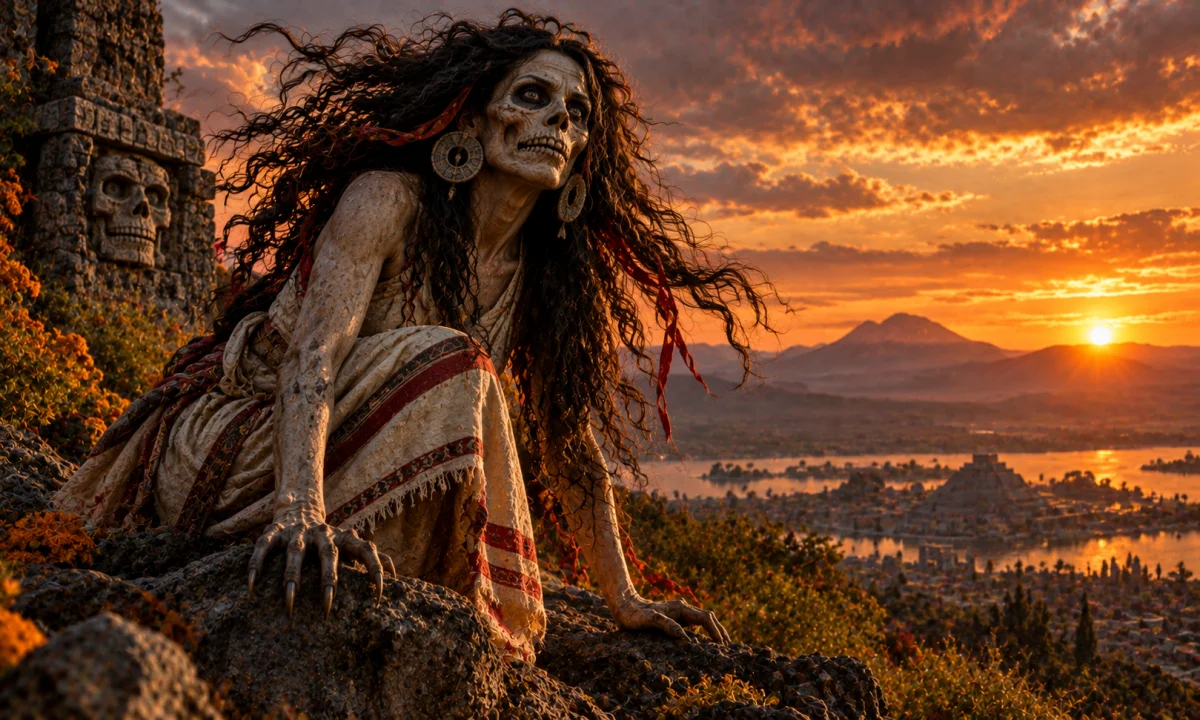
Chalmecatecuhtli has had little substantial presence in modern popular culture compared with more familiar Aztec figures. When he appears in contemporary games, websites, fantasy fiction, or illustrated deity lists, his portrayal is usually based on the small amount of surviving information supplemented by creative invention.
Modern adaptations may depict him as a sky ruler, an underworld figure, a sacrificial deity, or a guardian of a sacred region. Such portrayals can be imaginative, but they are not automatically evidence of pre-Hispanic tradition. A historically careful account keeps these reconstructions separate from the limited colonial references and acknowledges that the original identity of Chalmecatecuhtli remains uncertain.