WORLD
WORLD
Xiuhtecuhtli
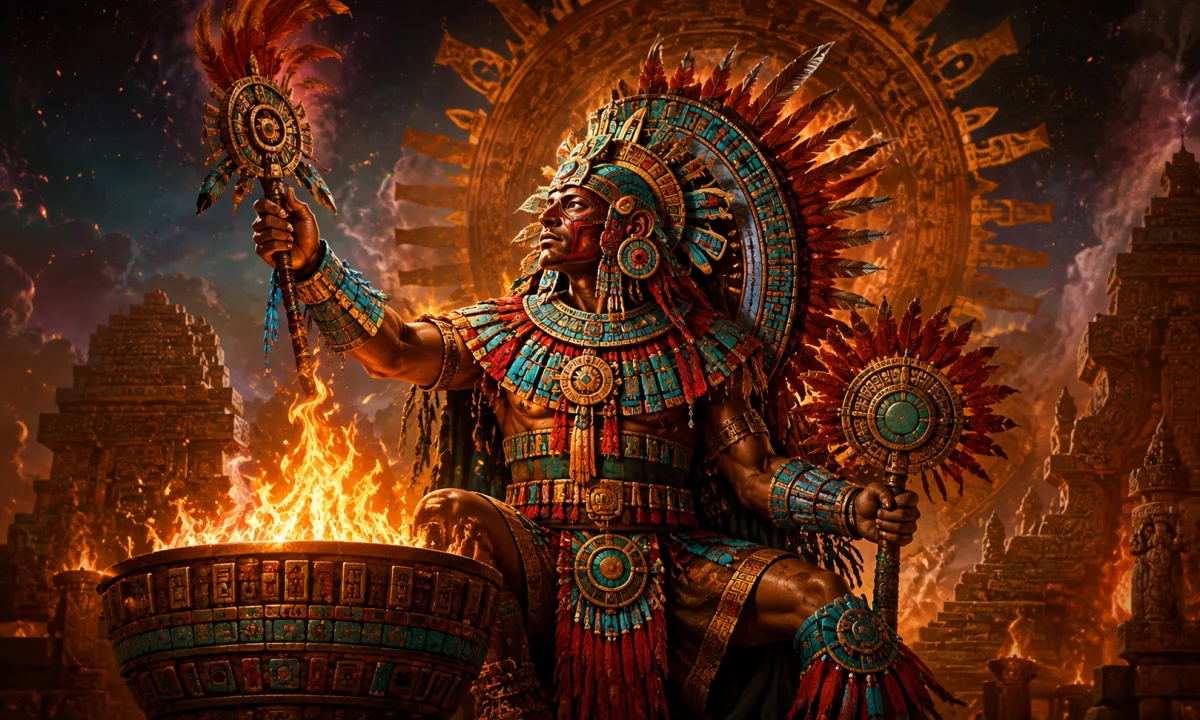
Xiuhtecuhtli is the Aztec fire deity associated with heat, light, life, and the center of the household and cosmos. In Nahua religion, he was especially important as a divine force tied to fire in many forms: the hearth, the brazier, the sun’s warmth, volcanic fire, and the renewing power of the new year. He appears in the religious traditions of central Mexico before and during the Aztec empire, and his significance is visible in ritual practice, calendrical symbolism, and imperial ideology.
Xiuhtecuhtli is a complex figure whose name is often translated as “Turquoise Lord” or “Lord of Turquoise,” though the meaning of xihuitl is not simple. In Nahuatl, the word can refer to turquoise, a year, or fire/grass-green brilliance depending on context and scholarly interpretation. Because of this, the name can carry more than one layer of meaning at once: preciousness, kingship, time, and the vivid energy of flame. Some modern explanations emphasize turquoise as a symbol of elite authority, while others stress the calendrical and fiery associations. Both readings are relevant, and the ancient tradition likely allowed for this kind of layered meaning.
Origins and cultural setting
Xiuhtecuhtli belongs to the broader religious world of the Nahua peoples of central Mexico. The best-known evidence comes from postconquest sources written in the 16th century, especially Nahuatl-language accounts and Spanish descriptions that preserve pre-Hispanic traditions in modified form. Because much of what survives was recorded after the Spanish invasion, details sometimes differ from one source to another, and later Christian interpretation may have shaped the presentation. Even so, the deity’s central role in fire cults is clear.
In Aztec religion, fire was not merely a practical necessity but a sacred power that maintained domestic life, political authority, and cosmic order. Xiuhtecuhtli stands at the intersection of these meanings. He was linked to the hearth in ordinary homes, where fire sustained family life and ritual purity, and he was also connected to state ceremonies that expressed the legitimacy of rulers and the continuity of the world itself.
He was particularly important in New Fire ceremonies, which marked the completion of a 52-year cycle in the central Mexican calendar system. The renewal of fire symbolized the renewal of time, and Xiuhtecuhtli was deeply associated with this process. In that sense, he was not only a god of flames but also a divine embodiment of cyclical time and regeneration.
Name, identity, and classification
The name Xiuhtecuhtli is commonly rendered as “Turquoise Lord,” but the interpretation is not straightforward. The element xihuitl can mean turquoise, year, or fire, and in some contexts it also relates to things that are blue-green in color. The second element, tecuhtli, means lord or noble. As a result, the name can evoke a lord of precious turquoise, a lord of the year, or a lord of fire. These meanings are not mutually exclusive and may have been intentionally intertwined in Nahua thought.
Xiuhtecuhtli is usually classified as a fire deity, but that description does not fully capture his range. He is also a cosmic central figure, associated with the axis or center point of the world. In some interpretations, he represents the fire that sits at the middle of existence, sustaining movement and order. This makes him one of the most important gods in the ceremonial and symbolic structure of Aztec religion.
Scholars sometimes discuss Xiuhtecuhtli alongside similar or overlapping fire-related divine figures in Mesoamerican traditions. That does not mean he should be merged with them. Central Mexican religious systems often used related names and overlapping functions, and different communities could emphasize different aspects of fire, age, and renewal. Xiuhtecuhtli remains a distinct deity within the Nahua tradition.
Appearance and imagery
In surviving depictions, Xiuhtecuhtli is often shown as an elderly deity, or at least as one associated with age, heat, and concentrated power. He may be portrayed with face paint, a headdress, or regalia connected to turquoise and fire. In Aztec iconography, his visual presentation can vary, and exact features depend on the manuscript or sculpture in question. Because later colonial representations were influenced by different artistic conventions, caution is needed when describing his appearance as though there were a single fixed image.
Fire itself is the most important symbol connected to him. Flames, braziers, smoking bundles, and ritual hearths all evoke his presence. Turquoise imagery also appears in his iconography, reflecting the prestige and sacred value attached to the color and material in Mesoamerican culture. Turquoise was not simply decorative; it was associated with brightness, preciousness, and divine authority.
Xiuhtecuhtli’s connection to the center of the world is also visually and conceptually important. In ritual thought, the hearth is a domestic center, but the cosmic center is on a larger scale the place where divine energy is stabilized and renewed. The deity therefore stands at both the household and cosmic levels of meaning.
Powers, roles, and symbolism
Xiuhtecuhtli’s power derives from fire’s essential role in human and cosmic life. Fire transforms raw material into cooked food, provides warmth and light, and enables ritual offerings to be consumed by the divine realm. In Aztec religion, these qualities made fire a mediator between humans and gods. Xiuhtecuhtli embodies that mediating force.
He was also associated with time, especially with renewal and continuity. The idea of fire as a force that consumes and renews fits the Aztec view of cyclical time, in which destruction and regeneration are linked. This association becomes especially important in the New Fire rites, when old fires were extinguished and a new sacred fire was kindled to ensure the continuation of the world.
At the household level, Xiuhtecuhtli was linked to the hearth, which served as the literal and symbolic center of domestic life. The hearth could be understood as a sacred point where family, sustenance, and religious order met. In a society where ritual and daily life were closely connected, the divine fire of the household also implied social continuity and ancestral connection.
He was likewise associated with rulership and political order. Precious turquoise, like other luxury materials in Mesoamerica, could signal elite status and sacred kingship. The deity’s name therefore reinforces the connection between fire, preciousness, and authority. Xiuhtecuhtli was not simply a natural force; he was a divine principle that supported legitimate power.
Ritual importance and calendrical associations
One of Xiuhtecuhtli’s most important ritual associations is with the New Fire ceremony, known from colonial-era descriptions of Aztec religion. This ceremony occurred at the completion of a 52-year cycle, when the binding of the solar and ritual calendars returned to a critical point. People extinguished household fires, and the renewal of fire symbolized the survival of the cosmos into a new cycle.
The New Fire rite illustrates how deeply Xiuhtecuhtli was tied to both time and community. The re-lighting of fire was not a private act but a public and sacred one with collective significance. It expressed trust that the world would continue and that divine order would be restored. Because these rites were recorded after the conquest, some details remain uncertain, but the basic association between Xiuhtecuhtli and cyclical renewal is well established in the tradition.
He also appears in relation to the 260-day ritual calendar and the broader structure of Nahua sacred time. Fire deities could be linked to particular feast days and ritual observances, though surviving accounts do not always agree on exact details. As with many Aztec gods, his cult was embedded in a calendrical system rather than isolated from it.
Domestic and public fire
- Hearth fire: the sacred fire of the home, associated with sustenance, family continuity, and ritual purity.
- Ritual fire: fire used in offerings, ceremonies, and temple practices.
- New Fire: the renewal fire linked to the completion of a 52-year cycle.
- Cosmic fire: the divine force thought to sustain order at the center of the world.
Stories and traditions
Xiuhtecuhtli does not survive in the same kind of narrative cycle as some other gods or heroes with clearly preserved myths. Instead, his significance is reconstructed from ritual descriptions, iconography, and references in colonial texts. This means that his “stories” are often ceremonial or symbolic rather than dramatic tales with a fixed plot.
He is sometimes presented as a primordial or ancient divine presence. In some Nahua cosmological traditions, fire is one of the oldest and most foundational elements, and Xiuhtecuhtli can appear as a deity of deep antiquity. This should not be overinterpreted as a single coherent mythic biography; rather, it reflects the way a fire god can embody permanence, age, and foundational order.
In a broader Mesoamerican context, fire deities are frequently connected with the origin of civilization, the household, or the renewal of the sun. Xiuhtecuhtli participates in these patterns, but the surviving tradition does not reduce him to a simple origin story. He is better understood as a recurring divine presence in ritual life than as a character in a fully preserved myth cycle.
Some sources and interpretations associate Xiuhtecuhtli with the older central Mexican deity Huehueteotl, often understood as an “old god” of fire. The relationship between the two is one of the most discussed issues in scholarship. In some cases they may represent aspects of the same religious complex; in others they appear as distinct but related figures. Because the historical record is limited and terminology varied, it is safest to say that they are closely connected in the tradition, but not always clearly separable in every source.
Relations with other deities
Xiuhtecuhtli’s place in the pantheon is defined more by function and symbolism than by a fixed set of family relationships. Unlike some gods whose parentage or consorts are consistently named, his relationships vary depending on the source and the ritual context. This is common in Nahua religion, where divine identity could be shaped by role, place, and calendrical function.
He is sometimes discussed alongside other deities connected with creation, renewal, or the household, but these associations do not imply a single standardized mythology. Scholars sometimes compare him with gods linked to fire, sun, or year-keeping in neighboring traditions, yet direct equivalence should be avoided unless supported by the source material.
Because fire is itself transformative, Xiuhtecuhtli can be seen as a deity whose relationships are conceptual as much as personal. He relates to rulers through authority, to households through the hearth, and to the cosmos through renewal. That flexibility may be one reason he remained central in Aztec religious life.
Interpretation and cultural significance
Xiuhtecuhtli’s importance lies in the way he unites several fundamental concerns of Nahua religion: survival, order, transformation, and sacred time. Fire is essential to life but also dangerous; it nourishes and destroys. A deity of fire therefore naturally becomes a figure of balance, requiring respect and careful ritual attention.
His association with the center of the world reflects a major Mesoamerican idea: the world is structured around a sacred axis or stable point. The hearth is a domestic version of that center, while the cosmic fire is its universal counterpart. Xiuhtecuhtli helps explain how everyday life and cosmic order were linked in Aztec thought.
The deity also shows the relationship between material culture and religion. Turquoise, one of the most valued materials in central Mexico, was not merely ornamental. It carried connotations of beauty, preciousness, and divinity. When attached to a fire deity, turquoise suggests that flame itself can be imagined as radiant, noble, and life-giving.
From a historical perspective, Xiuhtecuhtli is also a reminder that Aztec religion cannot be reduced to a list of gods with fixed personalities. Deities could be polyvalent, shifting between symbols, seasons, ritual functions, and local emphases. Fire is a particularly clear example of this flexibility: it is a substance, a god, a ritual medium, a cosmic principle, and a social necessity all at once.
Distinction from similar figures
Xiuhtecuhtli is often confused with Huehueteotl, another fire-related deity in central Mexican tradition. The confusion is understandable because both are linked to fire, age, and ritual vessels or hearth imagery in some sources. However, they are not always identical. Some scholars treat them as distinct figures, while others argue that they are different aspects or manifestations within a broader fire-god complex. The historical evidence does not resolve the issue completely, so any identification should be made cautiously.
He should also not be collapsed into general Mesoamerican sun gods or creator gods simply because fire can symbolize the sun or cosmic life. Xiuhtecuhtli is first and foremost a fire deity within the Nahua tradition, even if his symbolism extends beyond that role. Likewise, he is not merely a household spirit or domestic ancestor; his religious reach extends to state ritual and cosmology.
Modern summaries sometimes simplify him into a generic “god of fire,” but that leaves out the important calendrical and political dimensions of his cult. In Aztec religion, fire was not a narrow domain. It was a sacred power that linked family life, imperial ceremony, and the maintenance of the universe.
Modern reception and popular culture
Xiuhtecuhtli appears occasionally in modern popular culture, especially in media that draw on Aztec mythology for fantasy settings, games, or speculative fiction. In those contexts he may be reimagined as a fire boss, a divine warrior, or a symbol of ancient power. Such portrayals are modern inventions, not direct continuations of pre-Hispanic belief.
Because popular culture often prefers simple visual traits, it tends to emphasize flames, masks, or warrior imagery while ignoring the deity’s deeper connections to time, household ritual, and cosmic renewal. That simplification can be useful for storytelling, but it does not capture the full religious significance of Xiuhtecuhtli in Nahua tradition.
In scholarly and cultural discussions today, he remains important as one of the key gods through whom Aztec ideas about fire, authority, and cyclical time can be understood. His enduring presence in modern references reflects the continuing interest in Mesoamerican religious history and the richness of the Aztec symbolic world.