WORLD
WORLD
Xipe Totec
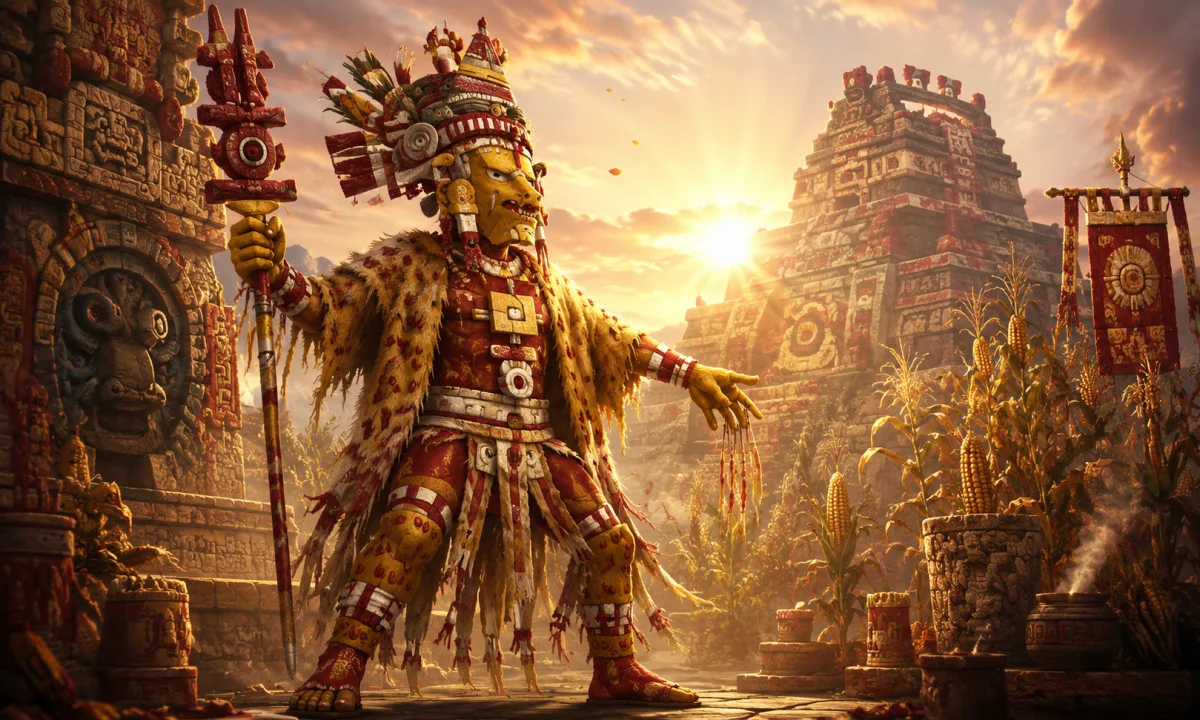
Xipe Totec was an important deity in Aztec religion and in the wider religious world of central Mesoamerica. His Nahuatl name is commonly translated as “Our Lord the Flayed One,” a reference to the ritual wearing of human skin associated with his worship. Although this image can appear shocking when removed from its historical setting, Xipe Totec was not simply a god of death or violence. He represented processes of renewal: the shedding of an old outer layer, the return of vegetation, the growth of maize, and the transformation of life through sacrifice.
His worship was especially prominent during the Aztec period, but evidence suggests that forms of the flayed-god tradition existed in Mesoamerica before the rise of the Aztec Empire. The surviving evidence comes from archaeological discoveries, painted manuscripts, colonial descriptions of Indigenous religion, and Nahuatl-language accounts recorded after the Spanish conquest. These sources do not always agree, and modern interpretations of Xipe Totec’s identity and role must take their differences seriously.
Name and identity
The name Xipe Totec is often written with the accent as Xipe Tótec in modern Spanish and English publications. The second element, tōtec, means “our lord.” The first element is connected with the Nahuatl verb xipehua, meaning to strip, flay, or remove an outer covering. For this reason, “Our Lord the Flayed One” is a useful translation, although the precise grammatical structure of the divine name is discussed by scholars.
Xipe Totec was a distinct deity, not merely another name for every god associated with sacrifice, maize, or spring. Aztec religion included many deities whose responsibilities overlapped, and a single god could have several titles and aspects. This makes rigid categories difficult. Xipe Totec was associated with agricultural renewal, but he was not identical to every maize deity. He was connected with warfare and sacrifice, but he was not simply a war god in the same sense as Huitzilopochtli. He was also linked with disease and healing, yet he should not be reduced to a god of illness.
Some colonial accounts place Xipe Totec within a group of four major divine powers sometimes described as manifestations or sons of a primordial creator pair. In certain interpretations, he is identified with the Red Tezcatlipoca and associated with the east. This classification is not consistent across all sources, however. The relationships among Xipe Totec, Tezcatlipoca, Quetzalcoatl, and other major deities vary according to the manuscript, ritual context, and modern scholarly interpretation. Xipe Totec should therefore not be treated as simply interchangeable with Tezcatlipoca.
The cultural setting of his worship
Aztec religion understood the world as dependent on reciprocal exchange between humans, gods, ancestors, and natural forces. Food, blood, prayer, precious objects, labor, and human life could all form part of this exchange. Sacrifice was not viewed only as destruction. In religious terms, it could sustain cosmic order, repay divine generosity, and make possible the continuation of the world.
Xipe Totec belonged to this religious system of transformation. The image of flaying expressed a change from one condition to another. A snake sheds its skin; a seed breaks through its covering; a plant dies back and returns with new growth. The human skin worn in his ceremonies could therefore signify both death and the emergence of new life. This symbolism did not make the ritual harmless or purely metaphorical. Human sacrifice and the treatment of captive bodies were real features of some ceremonies dedicated to him, and descriptions of them must be understood as evidence of a demanding and violent religious system.
The principal festival connected with Xipe Totec was Tlacaxipehualiztli, usually translated as “the flaying of people.” It took place during one of the eighteen twenty-day periods into which the Aztec ritual year was divided. The exact timing and details of the ceremonies are described differently in colonial sources, but the festival was associated with warfare, captive sacrifice, agricultural renewal, and the wearing of human skins.
Appearance and sacred attributes
In Aztec manuscripts and sculpture, Xipe Totec is commonly shown wearing the flayed skin of a human victim. The skin may cover his body like a loose garment, with the victim’s face positioned over the deity’s face and the hands hanging over his own hands. The figure is often represented in yellowish or reddish tones. The visual effect emphasizes that the outer body is not the god’s own flesh but a covering that has been removed from another person.
His eyes and mouth may be shown through the openings in the skin. In some images, the contrast between the living face beneath and the loose skin around it is especially clear. The representation is not intended as a naturalistic portrait. It is a religious sign that communicates transformation, sacrifice, and the wearing of another identity.
Xipe Totec may carry a shield and a rattle staff known as a chicahuaztli. The rattle staff was associated in broader Mesoamerican symbolism with rain, fertility, or the stimulation of growth, although the meaning of each object depends on its artistic and ritual context. Some depictions also show him with weapons or warrior clothing, reflecting the relationship between the festival of Tlacaxipehualiztli, military captives, and elite displays of power.
The flayed skin is his most recognizable attribute, but it should not be interpreted in isolation. His symbolism combines the body, agriculture, war, disease, healing, and seasonal change. The skin could represent an exhausted or dead surface giving way to new growth. In this sense, Xipe Totec’s frightening appearance conveyed the idea that renewal required the destruction or removal of what had come before.
Tlacaxipehualiztli and ritual performance
Colonial descriptions of Tlacaxipehualiztli report several forms of sacrifice. In one well-known ritual, a captive warrior was tied to a circular stone and required to fight an armed Aztec warrior while possessing inadequate or symbolic weapons. This event is often called the gladiatorial sacrifice. Other victims were killed by archers or by priests using ritual knives. The precise sequence, participants, and meanings differed according to the account.
After a victim’s death, priests associated with Xipe Totec wore the flayed skin for a period of time. The Nahuatl term xipe could also refer to a person wearing such a skin, and the ritual performers were not necessarily understood as the god in a simple theatrical sense. They were taking on a sacred role or presenting the deity’s presence through the transformed body.
Sources describe the skins being worn in processions and other ceremonies. At the end of the ritual period, they were removed and placed in a sacred location. The accounts also mention people who approached the skin-wearers to ask for help with illness or other needs. These details suggest that the ceremony involved more than a public execution: it created a temporary religious environment in which the dead, the deity, the priests, and the community were symbolically connected.
The practice was also tied to imperial politics. Captives taken in war could become sacrificial victims, and their deaths displayed the military strength of the victorious state. Aztec rulers used major festivals to bring together religious authority, warfare, tribute, and public spectacle. It would be misleading to describe the ceremony as only an agricultural rite, just as it would be misleading to treat it only as a demonstration of military power.
Renewal, maize, and the flayed skin
The central interpretation of Xipe Totec concerns renewal through shedding. A seed is enclosed in a covering before it sprouts. A plant’s old surface can dry or split as new growth appears. The flayed human skin was understood by many interpreters as a visual parallel for this process. The old surface was removed so that a new condition could emerge.
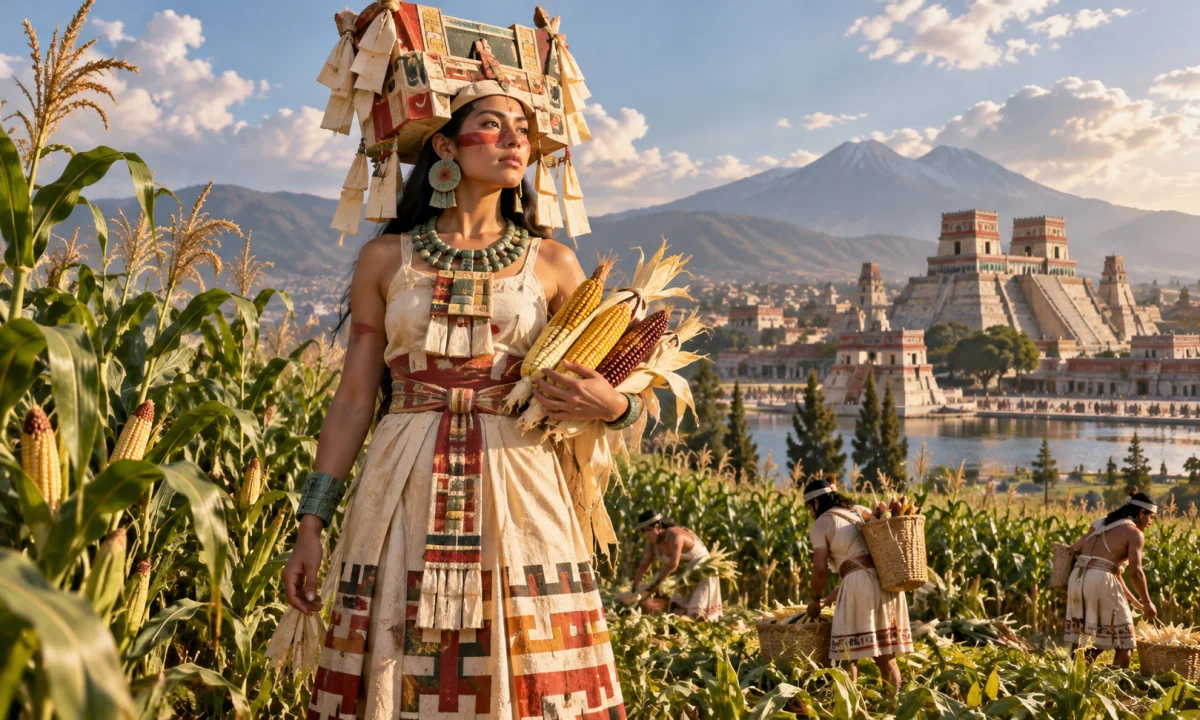
This symbolism helps explain why Xipe Totec is associated with the spring growing season and with agricultural fertility. His festival took place at a time connected with the preparation and renewal of crops, although the agricultural calendar of central Mexico did not correspond exactly to a single modern season. The deity’s connection with maize was therefore part of a wider concern with the regeneration of food and the continuation of human communities.
His association with disease and healing reflects the same pattern of danger and transformation. Some colonial descriptions connect Xipe Totec with ailments affecting the skin or eyes and with illnesses sent by the gods. People might appeal to him for relief, even while fearing the conditions associated with his power. In many traditional religious systems, a deity connected with an affliction may also be approached as a healer or protector. This does not mean that Xipe Totec was a physician in a modern sense; it indicates that illness was understood as part of a relationship between humans and supernatural forces.
Warriors, captives, and goldsmiths
Xipe Totec’s worship brought together the experiences of warriors, captives, priests, farmers, and specialized craft workers. The ritual sacrifice of enemy fighters made him important in the religious presentation of warfare. A captive’s body could become part of a ceremony that affirmed the power of the victorious city and its gods.
He was also associated with goldsmiths and metalworkers. In central Mexican thought, gold was connected with the sun, brightness, and material transformation. Goldsmiths in Tenochtitlan were known by the term teocuitlapitzque, and colonial sources describe relationships between their craft associations and Xipe Totec. The evidence is not complete enough to define every aspect of this connection, but it indicates that his sphere extended beyond agriculture and sacrificial warfare.
The association may have reflected the way precious metal was extracted, heated, shaped, and given a new outer form. As with the flayed skin and the sprouting seed, metalworking involved transformation. It also had political significance because gold and other valuable materials were controlled, exchanged, and displayed by powerful institutions.
Temples, images, and earlier traditions
Xipe Totec had a shrine or temple complex in the Aztec capital of Tenochtitlan known as Yopico, according to colonial descriptions. The name is also connected with ritual specialists and with the ceremonies performed in his honor. Written accounts of the temple and its priests were produced after the conquest, so they reflect both Indigenous testimony and the assumptions of the Spanish chroniclers who recorded or edited it.
Archaeological discoveries show that the imagery associated with a flayed deity was not confined to the Aztec capital. Stone sculptures and architectural remains from other parts of Mesoamerica have been interpreted as evidence for earlier or parallel traditions involving a flayed figure. A temple complex at Ndachjian, near Tehuacán in Puebla, has yielded sculptures that archaeologists have associated with Xipe Totec or with a closely related flayed-deity tradition. Such findings suggest that the religious idea had a history extending beyond the final centuries of the Aztec Empire.
That evidence does not prove that every earlier flayed figure was exactly the same deity worshipped in Tenochtitlan. Artistic similarities can result from shared religious ideas, political influence, or independent developments. The origins of Xipe Totec’s cult therefore remain a matter of scholarly discussion rather than a fully settled historical fact.
Sources and interpretation
Knowledge of Xipe Totec comes from sources with different purposes and limitations. The Florentine Codex, compiled in Nahuatl and Spanish under the direction of Bernardino de Sahagún, preserves descriptions of deities, festivals, priests, songs, and social practices. Other painted manuscripts, including ritual and calendrical codices, provide images of Xipe Totec and related ceremonies. Archaeology contributes sculptures, temple remains, and traces of ritual practice.
None of these sources provides a single, neutral account. The manuscripts were produced in a colonial environment after the fall of Tenochtitlan. Indigenous painters, speakers, and scholars contributed important knowledge, but Spanish friars and European categories also shaped the recording process. Images likewise require careful interpretation because a costume, a divine attribute, and a representation of a priest may overlap.
For this reason, statements about Xipe Totec’s “main power” or a single fixed mythology can be misleading. His meanings changed according to context. In one setting he could represent the renewal of crops; in another, the fate of a captive warrior; in another, illness, healing, or the specialized identity of a craft community. These aspects were not necessarily contradictions. Aztec religion often connected seemingly opposite conditions—life and death, disease and healing, loss and regeneration—within a single sacred relationship.
Distinguishing Xipe Totec from similar figures
Xipe Totec is sometimes confused with Tezcatlipoca because some sources associate him with the Red Tezcatlipoca. This is a classification within certain cosmological schemes, not proof that all references to the two gods describe one identical figure. Tezcatlipoca has his own major traditions, especially those involving the smoking mirror, rulership, fate, conflict, and supernatural power.
He can also be confused with maize deities or with unnamed “flayed gods” found in other Mesoamerican cultures. Shared themes of vegetation, sacrifice, and skin-changing do not establish that all such beings were Xipe Totec. The safest identification depends on the name, attributes, ritual setting, and cultural context of each source.
Finally, Xipe Totec should not be described as a “devil” or as an evil demon. Spanish colonial writers sometimes interpreted Indigenous deities through Christian categories that do not accurately reflect their original religious roles. His rituals involved violence and sacrifice, but within Aztec theology he was a powerful divine being involved in the maintenance and renewal of the world, not an embodiment of moral evil.
Modern reception
In modern popular culture, Xipe Totec occasionally appears in fantasy artwork, video games, fictional stories, and discussions of Aztec mythology. These portrayals often emphasize his flayed appearance because it is visually striking. Some reduce him to a violent “god of skin” or a horror figure, leaving out his agricultural, healing, craft, and renewal associations.
Modern images should therefore be distinguished from the historical tradition. A contemporary depiction may borrow the name and costume while inventing powers, relationships, or stories that are not found in Indigenous or colonial sources. The traditional figure is better understood through the complex ritual world in which sacrifice, warfare, disease, agriculture, and regeneration were connected. His image of the flayed skin was not merely a symbol of horror; it expressed the difficult Mesoamerican idea that new life could emerge only through profound transformation.