WORLD

Ayar
Ayar is the name associated with a group of ancestral brothers in one of the best-known Inca origin traditions. In the story, four brothers and their female companions emerge from a sacred place, travel through the central Andes, and establish the lineage that will rule from Cusco. The tradition is especially important because it connects the Inca ruling dynasty with sacred origins, landscape features, ancestral worship and the foundation of the imperial capital.
The Ayar tradition and its cultural setting
The Ayar story belongs to the religious and historical traditions of the Inca state, which flourished in the Andes before the Spanish conquest. It was preserved in Quechua-speaking communities and later recorded by Spanish colonial writers who gathered information from Indigenous informants, noble families and local traditions. These accounts do not present a single fixed version. Details differ according to the narrator, the region and the author who recorded the story.
The setting is the highland region around Cusco, where the Inca identified important hills, springs, caves, stones and settlements as huacas—sacred places or beings with religious power. The Ayar ancestors are therefore not simply characters in a tale about migration. They are also connected with the creation of political authority and with the sacred geography of the Cusco valley.
Several early colonial works describe related versions of the story. Juan de Betanzos gives one of the fullest accounts in his history of the Incas, while Pedro Sarmiento de Gamboa records another version. Garcilaso de la Vega, writing from an Inca and Spanish cultural background, presents a more orderly account that places particular emphasis on Manco Cápac and Mama Ocllo. These narratives should be treated as records of remembered and interpreted traditions rather than as contemporary transcripts of the pre-conquest religion.
The name and identity of Ayar
Ayar is not always the name of one individual. In the most familiar form of the tradition, it refers to the four male ancestors collectively, each of whom bears a name beginning with Ayar. Their names are commonly given as:
- Ayar Manco, later identified with Manco Cápac, the founding ancestor of the Inca dynasty;
- Ayar Auca, associated in some accounts with the occupation or taking possession of the site of Cusco;
- Ayar Uchu, who becomes connected with the sacred mountain or shrine of Huanacauri; and
- Ayar Cachi, a powerful and dangerous figure whose actions shape the early part of the migration.
The names and spellings vary in colonial manuscripts and modern publications. They may appear with different forms of accentuation, and the order of events is not identical in every account. The meaning of Ayar itself is not securely established. Proposed interpretations have linked it with Quechua words or concepts, but a definitive etymology cannot be stated with confidence. It is safest to regard Ayar as part of a traditional set of ancestral names rather than to assign it a single certain translation.
The four brothers are generally accompanied by four women. Their names are often given as Mama Ocllo, Mama Huaco, Mama Raua and Mama Ipacura, although the relationships and roles assigned to these women vary. In some traditions they are wives or sisters of the brothers; in others, the language of kinship is more complex and reflects the importance of marriage, descent and sacred ancestry in Inca political thought.
Emergence from Pacaritambo
The Ayar ancestors are commonly said to emerge from Pacaritambo, a place south of Cusco that is also called Paqariqtambo in forms closer to Quechua pronunciation. The name is often understood as relating to dawn, emergence or the place of origin, although the precise interpretation depends on linguistic analysis. Within the mythic tradition, Pacaritambo is not merely a geographical settlement. It is a place of birth and beginning.
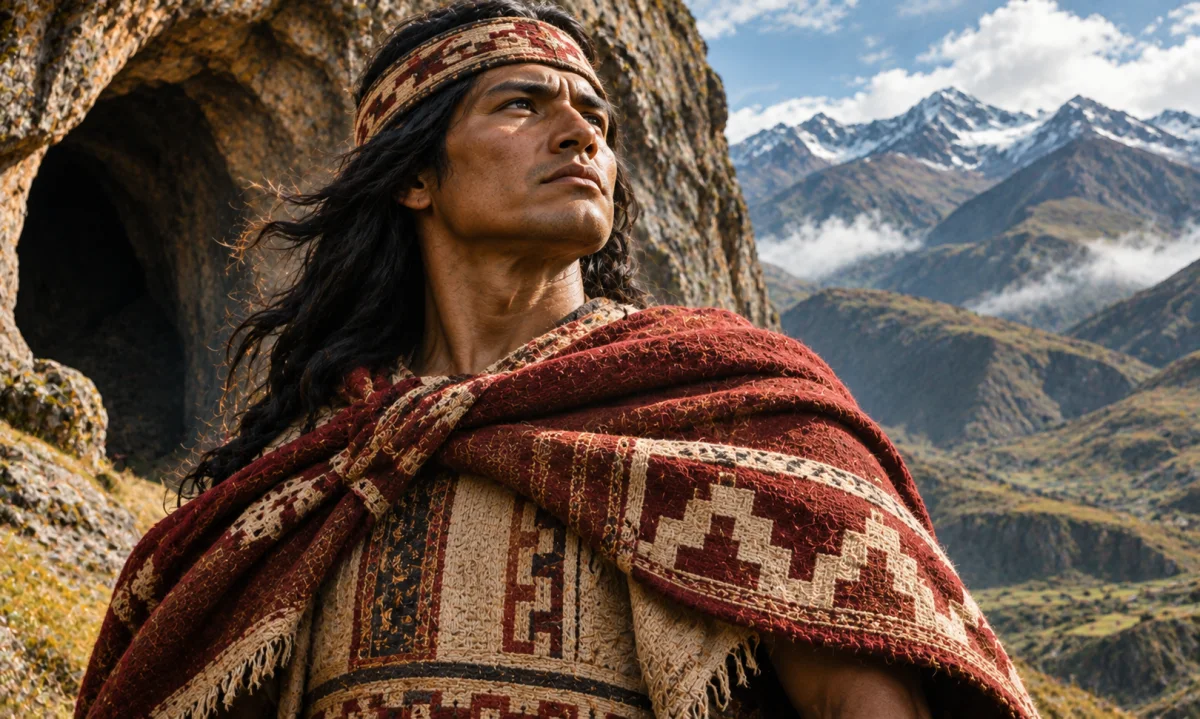
At Pacaritambo, the ancestors are associated with openings or windows in a mountain or rock formation called Tambotoco. These openings are often identified by names such as Capac Toco, Maras Toco and Sutic Toco. The number and function of the openings vary among accounts. Some narratives describe the ancestors as emerging from them, while others present the place as a sacred point from which the founding groups or their leaders came.
The emergence from a cave or mountain is significant in Andean religious terms. A place of emergence could serve as a pacarina, a sacred origin site from which a community believed its ancestors had come. Such origins did not necessarily mean that the ancestors were imagined as ordinary humans who had travelled from a distant country. They could be beings with divine, heroic or ancestral qualities who entered the human and political world through a sacred landscape.
The journey toward Cusco
After leaving Pacaritambo, the Ayar group travels through the highlands in search of a suitable place to settle. The journey is both a migration story and a process of differentiation. The brothers do not all reach the same destiny. Their actions, conflicts and transformations establish the status of later sacred places and help explain why the Inca ruling lineage, rather than one of the other ancestral lines, gained authority.
The group eventually approaches the Cusco valley and encounters Huanacauri, a mountain or hill that became one of the most important sacred sites in Inca religion. Huanacauri was associated with initiation rites for Inca nobles, especially the ceremonies through which young men were admitted into adult political and military society. In the origin narrative, the mountain marks a decisive stage in the transformation of the ancestors.
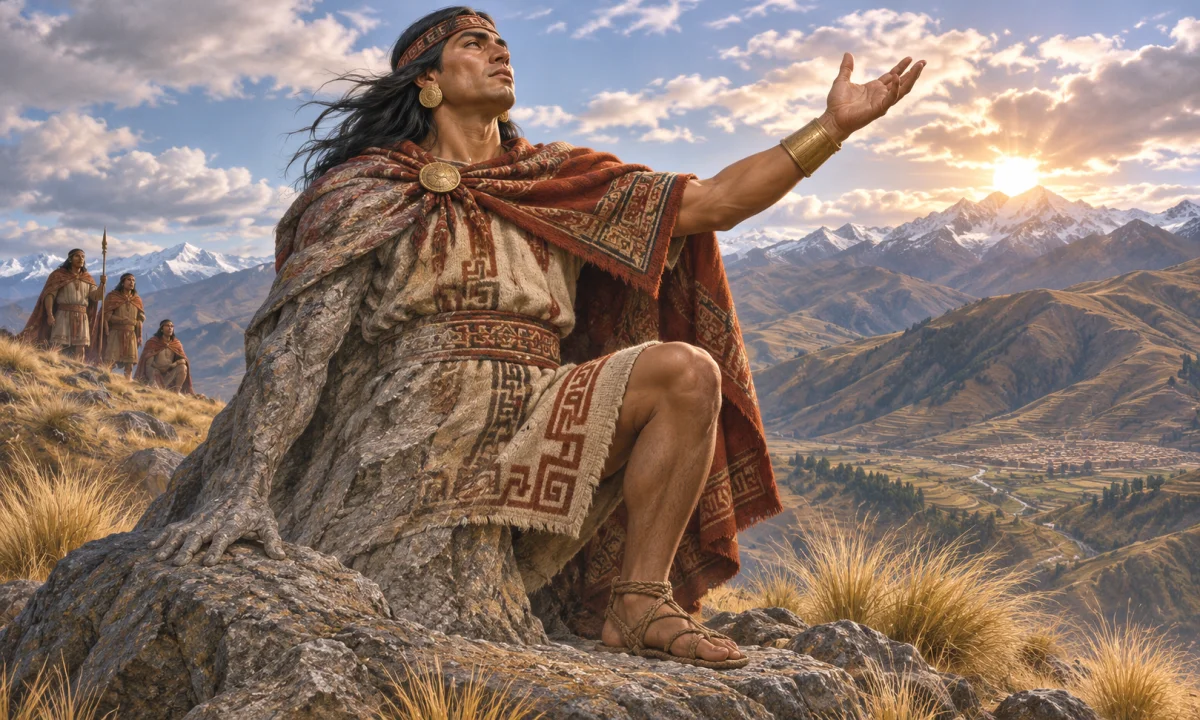
Some versions describe Ayar Uchu as becoming attached to or transformed into a stone at Huanacauri. The transformation is not necessarily a punishment in the modern sense. Becoming a stone or sacred object could signify an ancestor’s continuing presence as a huaca. Rather than disappearing, the figure became part of the landscape and remained available for ritual attention.
Ayar Cachi and the power of the founder
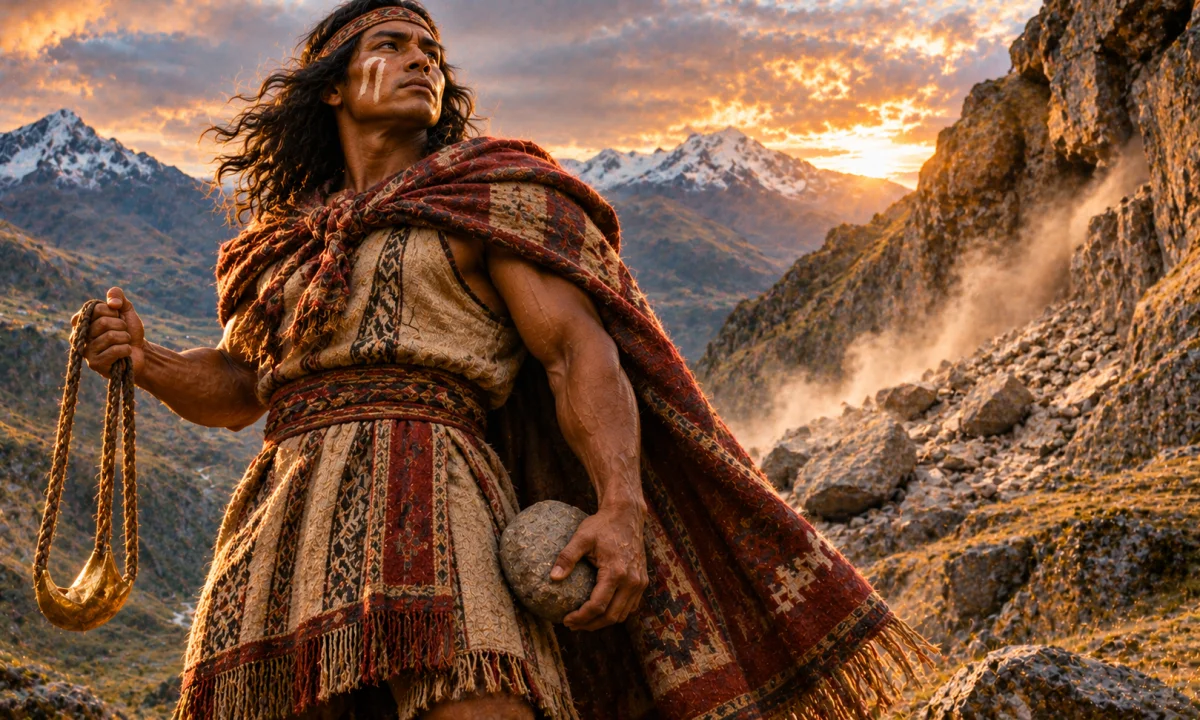
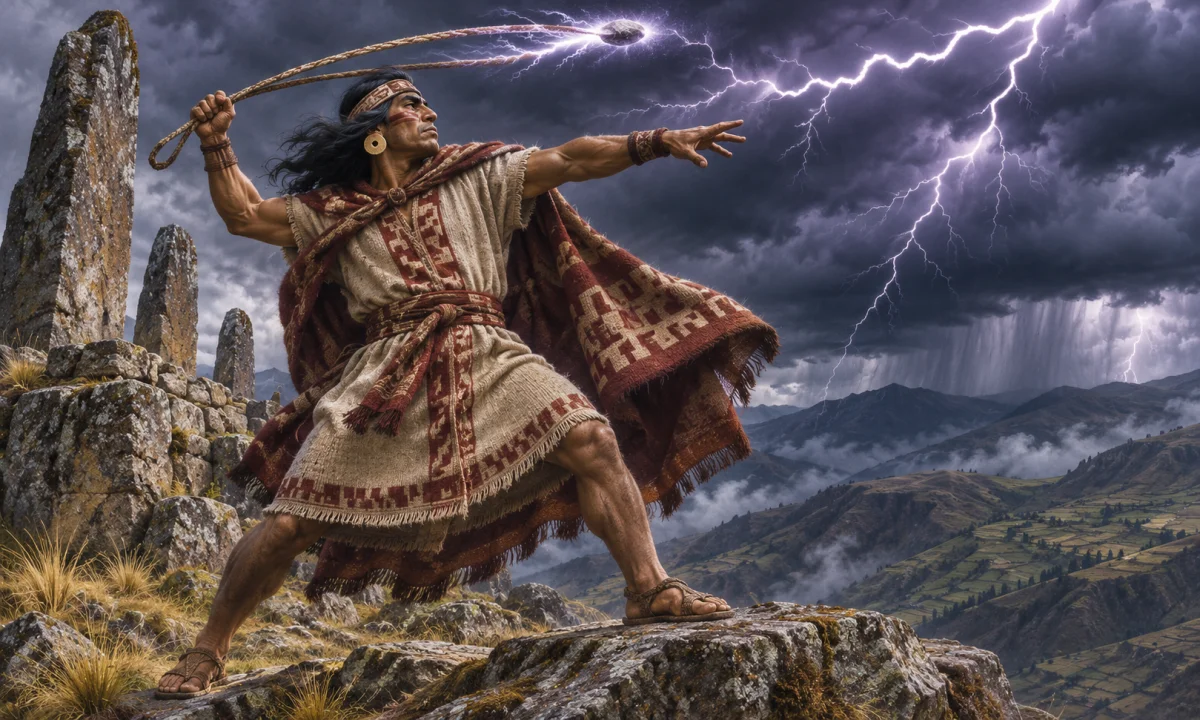
Ayar Cachi is usually portrayed as the most physically powerful and volatile of the brothers. In the account recorded by Betanzos, he possesses a sling so powerful that he can throw stones over great distances and split or disturb mountains. His strength causes fear among the other members of the group, who worry that he may dominate them or destroy the balance of the migration.
The brothers therefore persuade Ayar Cachi to return to the cave at Pacaritambo. The precise reason given varies, but the story commonly involves retrieving objects or possessions left behind. Once he has entered, the entrance is blocked or sealed. Ayar Cachi remains inside, and the group continues without him.
This episode has several possible meanings. It can be read as a mythic explanation for the separation of one ancestral power from the lineage that eventually rules Cusco. It also expresses a recurring theme in foundation traditions: extraordinary strength must be controlled before political order can be established. Ayar Cachi’s power is not simply evil, but it is too dangerous to remain unrestricted within the group.
His confinement also illustrates the way Inca traditions could locate supernatural events in specific places. A cave, mountain or stone was not only a setting for the story. It could be treated as the continuing residence or manifestation of an ancestral force.
Ayar Uchu, Ayar Auca and sacred transformation
The fate of Ayar Uchu is connected in many versions with Huanacauri. He may be described as sitting on, entering or becoming part of a stone. This event gives the mountain a direct ancestral relationship with the emerging Inca community. Later rituals at Huanacauri reinforced its importance, although the surviving accounts do not all agree on how the original transformation should be understood.
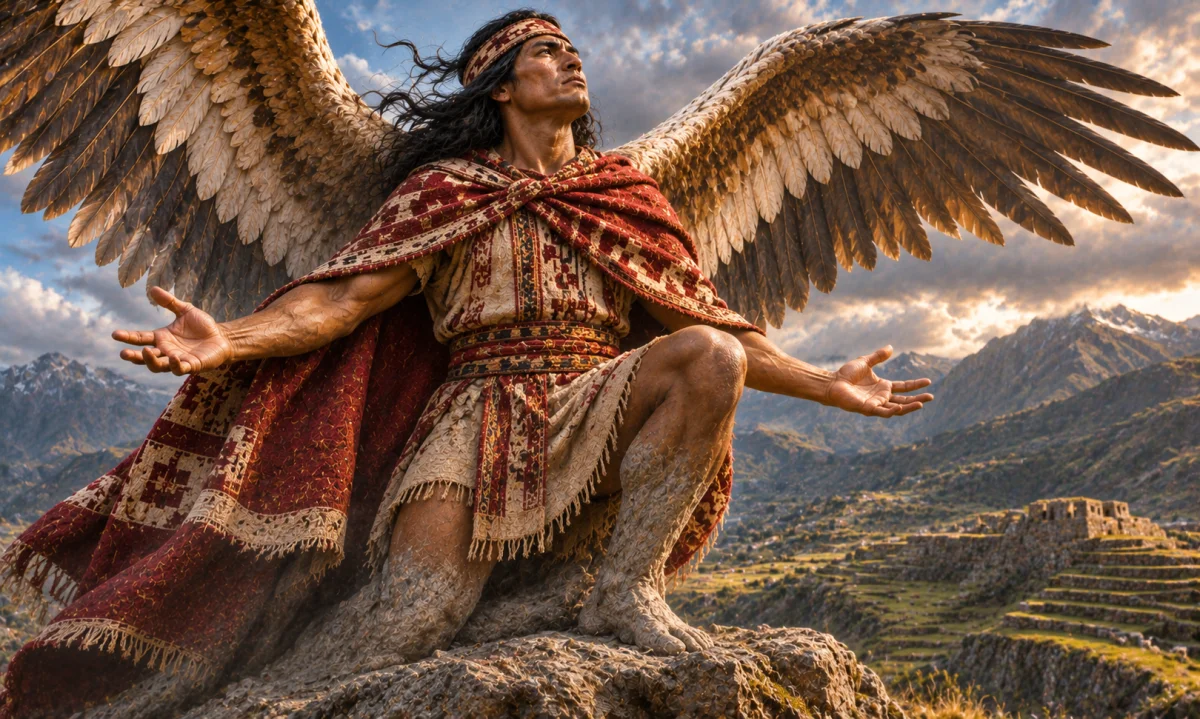
Ayar Auca is associated with the occupation of Cusco. Some accounts say that he flew toward the site or grew wings, while others describe him more simply as taking possession of the land. In one interpretation of the story, Ayar Auca becomes a stone at or near the place that will be called Cusco. The association between auca and martial or enemy-related ideas has sometimes influenced interpretation, but the exact meaning of the personal name and the details of his transformation remain uncertain.
The transformation of several brothers into stones or sacred places reflects an Andean pattern in which ancestors, communities and landscape are closely connected. A founding ancestor could remain present in a rock, spring or hill, and such a place could become the focus of offerings and ritual observance. The story thus explains both the ancestry of the Inca and the sacred character of the territory they claimed.
Manco Cápac and the establishment of Inca rule
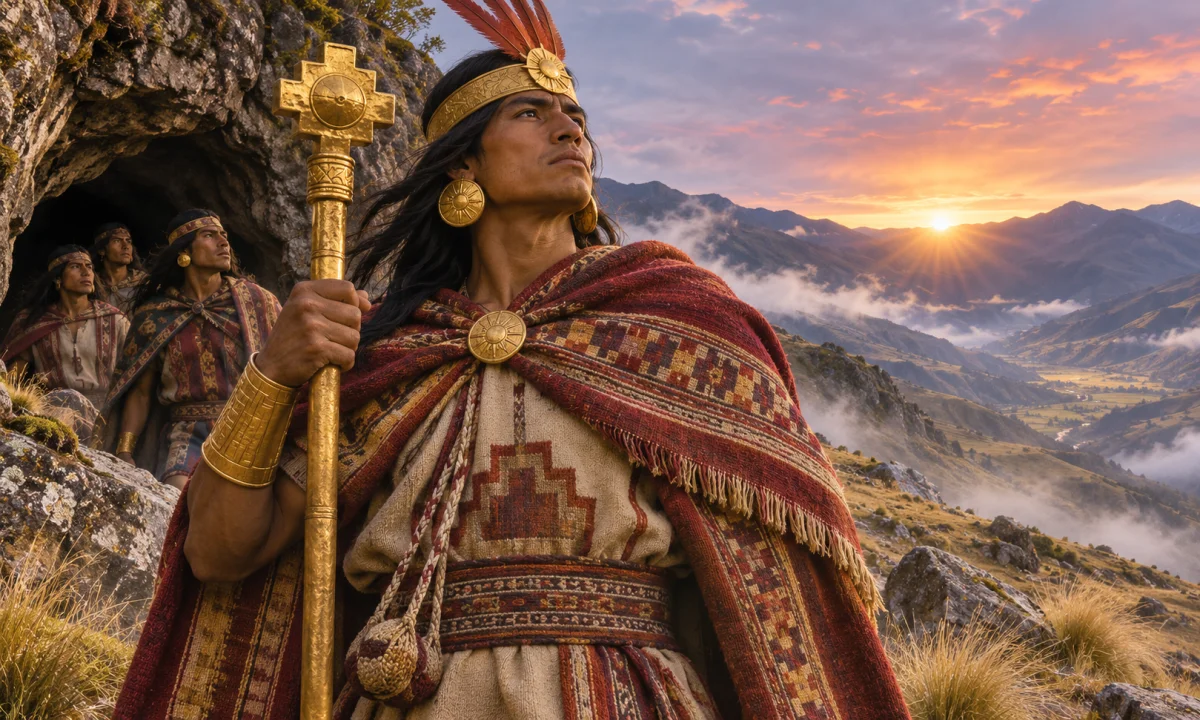
Ayar Manco is the brother who continues the foundation process and becomes Manco Cápac, the first ruler in the dynastic tradition of Cusco. The two names are not always treated in exactly the same way. In some accounts Ayar Manco is transformed into or later known as Manco Cápac; in others the connection is more direct from the beginning. The title Cápac is often translated with meanings such as powerful, noble or lordly, but its precise force in an early context is difficult to reduce to one English word.
Manco Cápac is traditionally paired with Mama Ocllo. In the Ayar narrative, Mama Ocllo is one of the women who emerges with the brothers. In another famous origin account, however, Manco Cápac and Mama Ocllo rise from Lake Titicaca and travel northward to found Cusco. These are related but distinct foundation traditions. They should not be treated as one unchanged story.
After reaching the Cusco region, Manco Cápac establishes the settlement and the dynasty that later develops into the Inca state. Some versions use a golden staff or rod to identify the place where the founders should settle: the staff sinks into the ground at the chosen site. This motif is better known from the Manco Cápac and Mama Ocllo account, and its presence should not automatically be assumed in every version of the Ayar story.
Relationships, descent and political meaning
The Ayar tradition links political legitimacy with sacred descent. The Inca rulers were not presented merely as successful chiefs who conquered neighboring communities. Their authority was connected with ancestors who emerged from a sacred origin place, travelled through a divinely ordered landscape and established a settlement chosen by signs and transformations.
The story also reflects the importance of kinship in Inca political organization. The founding brothers and women can be understood as ancestral pairs whose descendants formed the original social groups of the Cusco region. Later accounts sometimes connect these founders with ayllu communities or descent groups, although the relationship between the mythic characters and specific historical social units is not uniform or easily reconstructed.
Women in the tradition are not merely passive companions. Mama Huaco, in particular, is described in some colonial narratives as a forceful and formidable founding woman. Her role differs greatly between sources: she may appear as a warrior, a powerful ancestor, a wife or a mother within the dynastic genealogy. These variations show that the tradition could preserve several ideas about female authority, ancestry and the founding of political order.
The narrative also presents the creation of order as a process of selection and separation. One brother is confined, another becomes part of a sacred mountain, another is associated with the site of Cusco, and Manco Cápac becomes the dynastic founder. These outcomes organize a potentially diverse collection of ancestral traditions around the authority of the ruling Inca lineage.
Sources and limits of the evidence
No pre-conquest Inca manuscript setting out the Ayar story has survived. Knowledge of the tradition comes mainly from colonial-era written records, Indigenous oral histories collected after the Spanish invasion, and the sacred geography of the Cusco region. The writers often had different purposes. Some sought information about Inca history, some aimed to explain Indigenous religion, and some wrote to defend or criticize aspects of Spanish colonial rule.
Because the accounts were recorded in different circumstances, contradictions are expected. The names of the women change, the fate of the brothers is described differently, and the relationship between the Ayar story and the Lake Titicaca origin story is not consistent. The accounts may preserve older material, later political reinterpretations, or both. It is therefore not possible to reconstruct one unquestionably original version from the surviving evidence.
The term “myth” here does not mean an unimportant falsehood. In religious and cultural history, a myth can express a community’s understanding of origins, sacred power and legitimate order. The Ayar narratives perform this function by connecting the Inca dynasty with places, ancestors and rituals that were meaningful in the Cusco region.
Distinction from similar names and figures
Ayar should not be confused with a single universal “god of the Incas.” The term most often refers to the group of ancestral brothers and, by extension, to the origin tradition in which they appear. Nor should Ayar Manco automatically be separated from Manco Cápac as though every source treats them as unrelated figures. Their identification is traditional but varies in detail.
The Ayar brothers are also distinct from Viracocha, the powerful creator figure who appears in other Inca and Andean traditions. Viracocha may be connected with the creation of the world, humanity or the sun in different accounts, whereas the Ayar ancestors belong primarily to the foundation of the Inca lineage and Cusco. They are likewise distinct from the sun god Inti, although later Inca ideology associated the ruling dynasty with solar ancestry.
Continuing cultural significance
The Ayar tradition remains important for understanding how the Inca imagined the relationship between ancestry, territory and rule. Its events are tied to recognizable places around Cusco, including Pacaritambo and Huanacauri, allowing sacred history to be anchored in the Andean landscape. The story also helps explain why stones, caves and mountains could be treated as active participants in religious life rather than as inert scenery.
Modern retellings sometimes simplify the tradition into a single adventure involving four brothers who travel to found Cusco. Such versions can be useful introductions, but they often omit the differences among colonial accounts and the religious significance of transformation into sacred stones or places. The historical tradition is better understood as a group of related narratives in which ancestral beings become part of the landscape and Manco Cápac emerges as the founder of the Inca dynasty.