 WORLD

Thai mythology
Articles about Thai mythology within Asia.
Last articles
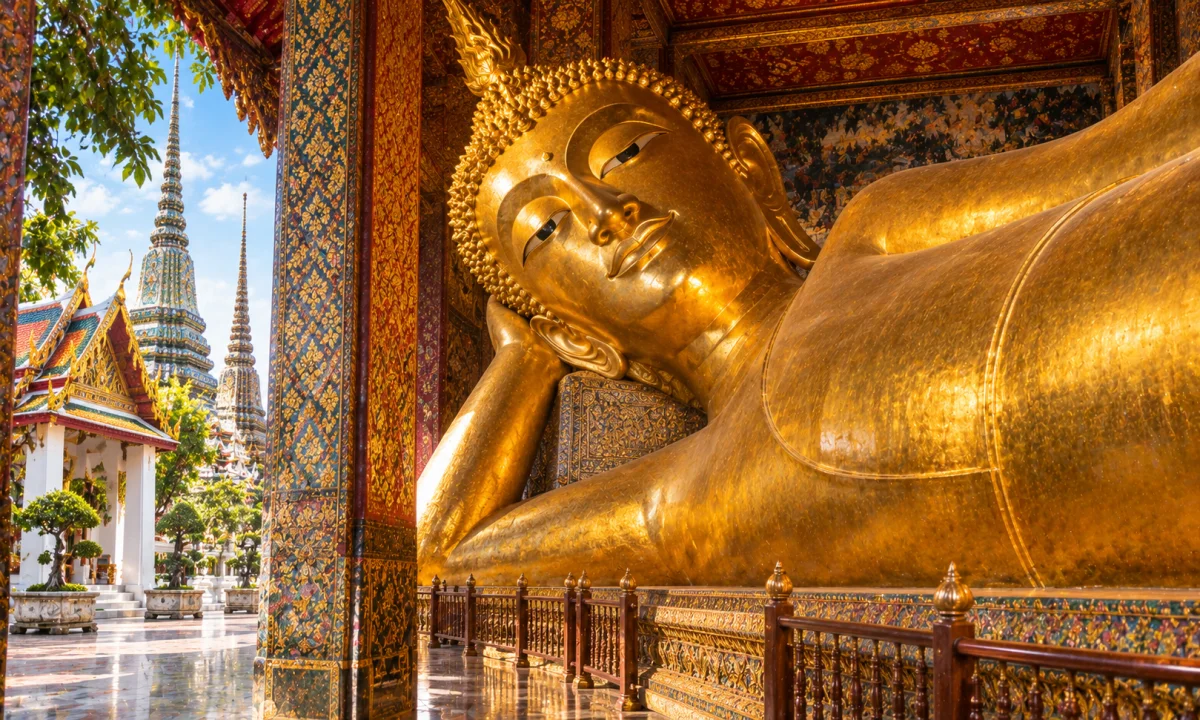
Wat Pho
Wat Pho is one of Thailand’s most important Buddhist temples and one of Bangkok’s best-known cultural landmarks. Its formal name is Wat Phra Chetuphon Wimon Mangkhalaram Rajwaramahawihan, although it is commonly called W…Thai mythology: myths, traditions and legends
Thai mythology is a broad term for the sacred narratives, supernatural beings, cosmological ideas and legendary traditions that developed within the cultures of Thailand. It does not represent one isolated or uniform religious system. Thai mythological traditions draw from Theravada Buddhism, older local spirit beliefs, Hindu and Brahmanical traditions, regional folklore, royal literature and centuries of cultural exchange with neighbouring Southeast Asian societies. Gods, nāgas, guardian spirits, heavenly beings, ghosts, heroic figures and legendary animals may therefore appear within overlapping religious and literary worlds rather than belonging to a single fixed pantheon.
The term mythology must be used carefully because Buddhism and other religious traditions represented in Thai culture are living religions. In academic usage, myth can describe a culturally significant sacred narrative without implying falsehood. Stories about Buddhist cosmology, divine beings or miraculous events may function as religious teachings, while other supernatural narratives belong primarily to local folklore or later literature. The boundaries between these categories are often fluid, but they should not be erased.
Sources and historical development
Thai mythological traditions are preserved through Buddhist scriptures and commentaries, royal literature, temple murals, inscriptions, manuscripts, theatrical performance, oral storytelling and local ritual practice. Many traditions were written down after long periods of oral transmission and were repeatedly adapted to different historical settings.
Thailand developed within a wider Southeast Asian cultural world influenced by Indic religions and literature. Sanskrit and Pali religious concepts entered the region over many centuries through trade, political connections, monastic networks and earlier Southeast Asian kingdoms. These ideas were not merely copied. They were translated into local languages and combined with established beliefs concerning ancestors, territorial spirits and sacred landscapes.
The political centres associated with Sukhothai, Ayutthaya and later Bangkok each contributed to the development of Thai religious and literary culture. Warfare, manuscript loss and rewriting mean that surviving texts do not always preserve the earliest form of a tradition.
Theravada Buddhism and mythological tradition
Theravada Buddhism provides one of the central religious frameworks of Thai culture. Its teachings concern karma, rebirth, merit, suffering and the path to liberation. Buddhist cosmology also includes numerous classes of nonhuman beings, heavenly worlds and realms of suffering.
The Buddha is not a creator god in Buddhist teaching. He is understood as an awakened teacher who discovered and taught the path to freedom from the cycle of rebirth. This distinction is essential when discussing Thai mythology because Buddhist narratives should not be reorganised into the structure of a polytheistic pantheon.
Stories of the Buddha’s previous lives, known as Jātaka narratives, have had enormous influence on Thai art, sermons and literature. They portray earlier incarnations in human and animal forms and illustrate virtues such as generosity, patience and moral discipline.
Particularly important in Southeast Asian Theravada culture are narratives associated with the final ten previous lives of the Buddha, culminating in the story of Prince Vessantara, renowned for extraordinary generosity.
Thai Buddhist cosmology
Traditional Thai Buddhist cosmology describes a vast universe containing multiple realms of existence. These include heavenly worlds, human existence, animal rebirth, hungry ghosts and various hell realms. Birth in any realm is temporary and determined by karma rather than by the permanent judgment of a creator deity.
A highly influential Thai cosmological text is the Traiphum Phra Ruang, often called the Three Worlds cosmology. Traditionally associated with the Sukhothai period, it describes Buddhist realms, cosmic geography, heavens, hells and processes of rebirth.
Mount Meru stands at the symbolic centre of the traditional Buddhist cosmos. Around it exist other mountains, continents, oceans and celestial regions. Temple architecture and religious art frequently draw upon this cosmological model.
These descriptions should not be treated as a map shared in precisely the same form by every Buddhist community. Cosmological details derive from textual traditions that have been interpreted and represented differently over time.
Devas and heavenly beings
Devas are celestial beings found throughout Buddhist cosmology. They enjoy long lives and extraordinary conditions but remain within the cycle of rebirth. They are therefore not eternal gods in the sense of an all-powerful creator.
Thai religious art frequently represents devas attending the Buddha, guarding sacred places or participating in events from Buddhist narratives. Their presence reflects the idea that even heavenly beings recognise the spiritual significance of Buddhahood.
Some devas derive from figures also known in Hindu traditions. Their Buddhist roles can differ substantially from their identities in Hindu theology, so similarity of name does not imply complete equivalence.
Indra in Thai tradition
Indra, known in Thai as Phra In, became an important celestial figure through both Buddhist and Brahmanical traditions. In Buddhist cosmology, Indra corresponds to Sakka, ruler of the Heaven of the Thirty-Three.
He often appears as a protector of Buddhism and as a celestial ruler who assists virtuous humans or participates in sacred narratives. Unlike the supreme deity of a monotheistic religion, he remains a being subject to karma and rebirth.
Thai representations of Phra In developed within local artistic and literary traditions. Although related historically to the Vedic and Hindu Indra, the Thai Buddhist figure should be understood within his Southeast Asian context.
Brahma and Brahmanical influence
Brahma appears in Thai religion under the name Phra Phrom. In Buddhist cosmology, Brahmās are inhabitants of elevated celestial realms rather than creators possessing absolute authority over existence.
At the same time, Thai religious culture has long incorporated Brahmanical ritual traditions connected with kingship, court ceremony and sacred protection. This has allowed figures with Hindu origins to occupy roles alongside Buddhist worship.
The famous four-faced representation of Phra Phrom reflects Brahmanical iconography and modern devotional practice. Popular offerings to him should not be interpreted as evidence that Thai Buddhism and Hinduism have simply merged into one religion.
Vishnu, Shiva and royal symbolism
Vishnu and Shiva entered Thai religious and political culture through centuries of Indic influence. Their images, names and myths appeared in court ritual, architecture and literature, particularly within traditions inherited from earlier Southeast Asian kingdoms.
Thai kingship historically made use of both Buddhist and Brahmanical symbolism. Vishnu could be connected with righteous sovereignty, while Shiva appeared in ceremonial and artistic contexts.
Modern observers sometimes assume that the presence of Hindu deities in Thai culture means that Thailand once practised Hinduism in exactly the same form as India. Southeast Asian courts adapted Indic religious traditions to local political and cultural structures, creating distinctive forms.
The Ramakien
The Ramakien is Thailand’s national adaptation of the Ramayana tradition. It recounts the struggle of Phra Ram against the demon king Thotsakan and preserves the central narrative framework of Rama’s exile, the abduction of his wife Sida and the war to recover her.
The Ramakien is related to the Sanskrit Ramayana but is not simply a Thai translation of one Indian version. Names, settings, episodes and characterisations were adapted through centuries of Southeast Asian transmission.
Surviving Thai versions were shaped particularly during the Bangkok period after earlier manuscripts were lost or damaged during the destruction of Ayutthaya in 1767. Royal authors and performers contributed to the forms now best known.
The Ramakien has influenced temple murals, dance, theatre and royal culture. Its characters therefore belong simultaneously to a literary tradition, artistic performance and the broader religious imagination of Thailand.
Phra Ram and heroic kingship
Phra Ram, the Thai form of Rama, represents righteous kingship, discipline and commitment to duty within the Ramakien. His identity ultimately derives from the Ramayana tradition in which Rama is associated with Vishnu.
Thai retellings place particular emphasis on royal conduct, loyalty and political order. The character therefore became relevant to Thai concepts of kingship as well as to religious storytelling.
Phra Ram should not be treated simply as a historical Thai ruler. He belongs to an epic tradition adapted to Thai cultural and political settings.
Hanuman in Thai tradition
Hanuman, the monkey warrior who serves Phra Ram, became one of the most popular figures in Thai literature and performance. He is courageous, intelligent, magically powerful and exceptionally loyal.
Thai versions of Hanuman differ significantly from some Indian portrayals. The Ramakien often presents him as adventurous and romantically active, while many Hindu traditions emphasise his devotion and celibacy.
This difference demonstrates how a figure can be culturally transformed without losing his connection to an older literary tradition. The Thai Hanuman is neither an unrelated character nor an exact duplicate of every South Asian version.
Thotsakan and the yaksha tradition
Thotsakan is the Thai form of Ravana, the principal antagonist of the Ramakien. He is ruler of Lanka and is often represented with multiple faces and arms, expressing extraordinary supernatural power.
Thotsakan belongs to a broader tradition of yaksha, known in Thai as yak, supernatural beings with roots in South Asian religious traditions. Yak can appear as dangerous opponents, powerful guardians or beings incorporated into Buddhist cosmology.
Large guardian figures at Thai temples are often called yak. Their frightening appearance does not mean that they are Christian-style demons. They may protect sacred spaces against disorder and hostile influences.
Nāgas and sacred waters
Nāgas are powerful serpent beings deeply embedded in Thai and wider Southeast Asian religious traditions. They derive from ancient South Asian traditions but have acquired distinctive local associations with rivers, rainfall, territory and sacred places.
In Buddhist narratives, the nāga king Mucalinda protects the meditating Buddha from a storm by sheltering him with his body and expanded hood. This episode became an important subject in Buddhist art.
In northeastern Thailand and the Mekong region, nāga traditions are particularly prominent. Nāgas may be associated with the Mekong River, underground or aquatic realms and the protection of Buddhist sacred sites.
They should not simply be called dragons. Although modern comparisons are common, nāgas have their own religious origins, iconography and relationships with water, fertility and Buddhism.
Garuda
Garuda, known in Thai as Krut, is a great bird-like supernatural being with origins in Indian religious traditions. In Hindu mythology Garuda is closely associated with Vishnu, while Buddhist traditions also incorporated garuda beings within their cosmologies.
Garuda and nāgas are frequently portrayed as traditional enemies. This opposition appears in South Asian sources and was transmitted widely across Southeast Asia.
In Thailand, Garuda became especially important as a symbol of royal and state authority. The emblem of Garuda is used officially in connection with the monarchy and government.
Modern national symbolism should be distinguished from the full range of mythological traditions concerning garudas as a class of beings.
Kinnari and kinnara
Kinnari and kinnara are celestial beings associated with beauty, music and graceful movement. They originated in South Asian mythological traditions and became highly prominent in Southeast Asian art.
Thai representations often depict the female kinnari with a human upper body and bird-like lower body or wings. Their elegant appearance made them especially popular in temple decoration, dance and literature.
They are not angels in the Christian sense despite occasionally being described that way in English. Their cultural background and religious position are different.
Stories involving kinnari frequently explore relationships between the human and celestial worlds, including love, separation and the difficulty of crossing supernatural boundaries.
Himavanta and the mythical forest
Thai cosmological art and literature feature a legendary forest commonly known as Himavanta or Himaphan. It lies within the traditional cosmological landscape associated with Mount Meru and is inhabited by extraordinary animals and hybrid beings.
The forest ultimately derives from Indian cosmological traditions surrounding the Himalayas, but Thai artists developed a distinctive and elaborate visual world of Himavanta creatures.
These beings combine features of lions, elephants, birds, serpents and other animals. Their forms vary considerably, and many are better understood through artistic classification than through detailed narrative mythology.
Modern fantasy sometimes treats Himavanta as a fixed bestiary with precise species rules. Traditional art is more flexible and includes substantial variation across periods and workshops.
Erawan and the divine elephant
Erawan is the Thai form of Airavata, the celestial elephant associated with Indra. Thai art often represents Erawan with three heads, although South Asian literary descriptions can give Airavata different forms and numbers of heads.
The three-headed elephant became one of the most recognisable images in Thai sacred and decorative art. It represents celestial power and the authority associated with Indra.
Erawan should therefore be understood as a Thai development within a wider Indic mythological tradition rather than as a completely separate indigenous creature.
Phi and the world of spirits
The Thai word phi covers a broad range of spirits and supernatural presences. Depending on context, a phi may be associated with the dead, a particular place, a household, dangerous circumstances or protective power.
It is misleading to translate every phi as ghost or demon. Some are feared, others respected, and some can become important guardians.
Beliefs concerning phi coexist with Buddhism rather than necessarily contradicting it. A person may make merit at a Buddhist temple while also respecting a local territorial spirit or maintaining a spirit house.
This coexistence illustrates the layered character of Thai religion, where Buddhist doctrine, local ritual and older spiritual traditions can operate together.
Spirit houses and territorial guardians
Spirit houses are visible expressions of Thai beliefs concerning local supernatural inhabitants. They may be established near homes, businesses or other buildings to provide an appropriate place for guardian spirits associated with the land.
Offerings such as food, drinks, flowers and incense may be made to maintain respectful relations with these beings.
Spirit houses are not Buddhist shrines in a strict doctrinal sense, although they exist within a predominantly Buddhist cultural environment. Their practices reflect older and continuing beliefs concerning territorial spirits.
Different types of spirit houses and guardian traditions exist, and modern commercial examples should not be assumed to represent every historical form.
Mae Nak and ghost folklore
Mae Nak Phra Khanong is one of Thailand’s most famous ghost figures. Her legend concerns a woman who dies during or around childbirth but continues living with her husband as though still alive until her supernatural condition is discovered.
The story is associated with the Phra Khanong area of Bangkok and has been retold through theatre, novels, television and numerous films. Different versions alter important details.
Mae Nak belongs primarily to ghost folklore rather than ancient Thai mythology. Her popularity illustrates how comparatively recent legends can become central to a culture’s supernatural imagination.
Modern devotion associated with Mae Nak also demonstrates how the boundary between folklore and religious practice can become fluid over time.
Krasue and nocturnal fear
The Krasue is a famous female supernatural being of Thai and neighbouring Southeast Asian folklore. She is typically described as appearing at night as a floating head with internal organs hanging beneath it.
Stories portray Krasue as feeding on impure or bodily substances and hiding her condition during the day. Details vary by region and retelling.
Related beings occur in Cambodia, Laos and other parts of Southeast Asia. Their similarity reflects a shared regional folklore complex, though each tradition possesses its own names and variations.
Krasue is primarily a folkloric being and should not be inserted into Buddhist cosmological classifications unless a specific source does so.
Krahang and other regional beings
Thai folklore includes numerous supernatural beings whose traditions developed locally rather than through classical Buddhist or Hindu literature. One example is Krahang, commonly described as a male nocturnal figure capable of flight.
Stories about such beings often differ between villages, provinces and later popular retellings. Cinema and television have helped standardise appearances that were originally much more variable.
The same caution applies to numerous ghosts associated with forests, childbirth, violent death or particular places. Their cultural significance comes from local storytelling and belief rather than membership in one formal pantheon.
Pretas and hungry ghosts
Preta beings, known in Thai religious culture as pret or through related forms, belong to Buddhist cosmology. They are beings suffering from unsatisfied hunger or other forms of deprivation as the result of karma.
Traditional images may depict pretas with extremely thin bodies, large stomachs and tiny mouths, visually expressing their inability to satisfy desire.
They differ from ordinary ghosts of dead humans in Thai folklore. A preta occupies a cosmological state of rebirth, while a local ghost may be understood through a specific death, location or personal history.
The distinction is sometimes blurred in popular storytelling, but it remains important when separating Buddhist cosmology from broader ghost traditions.
Naraka and hell beings
Thai Buddhist traditions contain vivid descriptions of Naraka, the hell realms in which beings experience suffering as the karmic consequence of harmful actions.
These realms are not eternal in the Christian sense. A being remains there for an extremely long but finite period before karma eventually permits another rebirth.
Temple murals and manuscripts often portray specific punishments in visually dramatic ways intended to communicate moral teachings. Such images played an educational role by demonstrating the consequences of violence, dishonesty and other harmful behaviour.
Hell guardians and torturers in these representations should not automatically be classified as demons opposed to the Buddha. They operate within a karmic cosmological system rather than a cosmic rebellion against a creator god.
Merit, karma and supernatural narratives
Many Thai religious stories are organised around the concepts of karma and merit. Good and harmful actions shape future experience, including the conditions of rebirth.
Supernatural narratives can therefore function as moral explanations. A ghost’s suffering may be linked with unresolved actions, while a celestial rebirth may illustrate accumulated merit.
Merit-making practices include generosity, supporting Buddhist monastics, participating in ceremonies and dedicating wholesome actions to deceased relatives.
Folklore often combines these Buddhist principles with older spirit traditions, creating stories in which ghosts seek assistance from living relatives or monks.
Protective magic and sacred objects
Thai religious life also includes protective amulets, sacred inscriptions, blessed objects and ritual practices associated with safety, prosperity and spiritual authority.
Buddhist monks may bless amulets or sacred objects, while other specialists work within traditions combining Buddhist formulas, astrology, local spirit beliefs and esoteric practices.
These practices should not all be classified as mythology or occultism. They belong to forms of lived religion whose legitimacy is understood differently by individual Buddhist teachers and communities.
Popular culture sometimes exaggerates amulets as magical devices with guaranteed supernatural powers, removing them from the ethical and ritual contexts in which many devotees understand them.
Royal mythology and sacred kingship
Thai kingship historically drew upon both Buddhist and Brahmanical models. The ideal Buddhist ruler was expected to govern according to moral principles and accumulate merit, while Brahmanical court rituals expressed cosmic and royal authority.
Names and titles associated with Rama reflect the cultural importance of the Ramayana tradition, but Thai monarchs bearing the conventional designation Rama should not be confused with the mythological Phra Ram.
Royal ceremonies could invoke deities of Indic origin while functioning within a predominantly Theravada Buddhist kingdom. This combination reflects historical Southeast Asian political culture rather than a contradiction requiring one religion to replace another.
Regional variation within Thailand
Thai mythology and folklore differ significantly between central Thailand, the north, the northeast and the south. Regional histories connect local traditions with Lao, Lanna, Khmer, Mon, Malay and other cultural worlds.
In northeastern Thailand, for example, traditions surrounding nāgas and the Mekong are particularly influential. Northern regions preserve religious and folkloric traditions connected with former Lanna culture, while southern communities developed within environments shaped by Buddhist and Malay Muslim interaction.
A story collected in one region should therefore not automatically be described as universally Thai.
Temple art and visual transmission
Temple murals, sculpture and architectural decoration are major sources for Thai mythological imagery. Scenes may depict the Buddha’s lives, Buddhist heavens and hells, episodes from the Ramakien and guardian beings.
Visual traditions sometimes combine figures from different sources within one sacred environment. Garuda, nāgas, devas and yak guardians may all appear in temple architecture without implying that they belong to one simple hierarchy.
Artistic conventions also changed historically. The appearance of a being in modern illustration or film may differ significantly from its representation in older temple art.
Modern media and common misconceptions
Thai mythology and folklore have become major sources for film, horror fiction, television, comics and games. Ghosts such as Mae Nak and Krasue are especially prominent, while Ramakien characters and Himavanta creatures continue to inspire fantasy.
Modern entertainment often combines Buddhist beings, Hindu-derived deities, local spirits and ghosts into one supernatural universe. Traditional religion does not necessarily organise them in this way.
Another common misconception treats every Thai supernatural being as either a god or demon. Devas, yak, nāgas, phi, pretas and legendary animals belong to different religious and folkloric categories whose boundaries depend upon context.
Thai mythology is therefore best understood as a layered religious and cultural field shaped by Theravada Buddhist cosmology, Indic epic and divine traditions, local spirit beliefs, regional folklore and centuries of literary adaptation. Its gods, celestial beings, nāgas, guardian spirits and ghosts reflect different historical sources, but together they reveal the distinctive ways Thai communities have understood sacred power, moral order, landscape, kingship and the continuing relationship between the human and supernatural worlds.