WORLD

Phra Sao
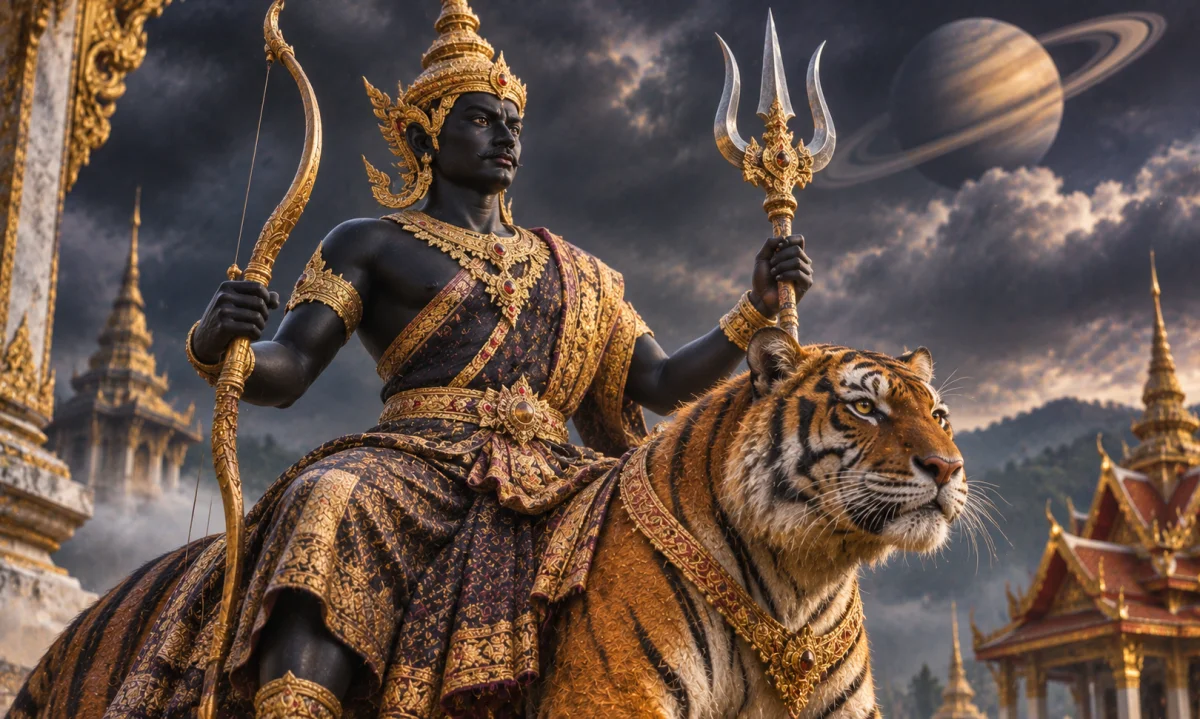
Phra Sao (พระเสาร์) is the Thai planetary deity associated with Saturday and the planet Saturn. He belongs to the astrological and religious world of Thai horasat, or traditional astrology, where the seven visible planetary bodies and two lunar nodes influence days, births, events and personal fortunes. Phra Sao is commonly understood as a Thai form of the Indian planetary power known as Shani or Śanaiścara, although Thai beliefs about him developed within a distinctive setting shaped by Buddhism, Brahmanical ritual and local customs.
Name and identity
The Thai name Phra Sao combines the honorific Phra with Sao, the Thai word used for Saturn and for Saturday. The name is sometimes rendered in English as “Lord Saturn” or “the deity Saturn.” The planet’s name ultimately belongs to the wider Sanskrit and Indic astrological vocabulary associated with Shani, the slow-moving planet.
Phra Sao is not usually treated as one of the principal gods of the Thai Buddhist pantheon. He is better described as a planetary deity or astrological power. In traditional Thai thought, the planets are not merely distant astronomical objects. They may be represented as divine or semi-divine beings whose positions and movements affect human circumstances. This does not mean that every Thai person understands Phra Sao in exactly the same way. His importance varies according to religious practice, family tradition, astrological belief and the degree to which a person follows older forms of horoscope and ritual.
The Thai planetary system belongs to a broader South and Southeast Asian tradition. Indian astrology supplied many of the concepts associated with the nine planetary powers, while Thai culture incorporated them into local calendars, court ritual, temple art, protective practices and popular fortune-telling. Consequently, Phra Sao resembles Shani in several respects but should not simply be assumed to be identical to every version of Shani found in Hindu literature.
Phra Sao in Thai religious culture
Thailand traditionally gives each day of the week a planetary association, a colour, a direction or other symbolic qualities, and a corresponding Buddha image. Saturday is governed by Phra Sao and is commonly associated with the colour black or very dark tones. These associations are especially visible in Thai astrology, birthday customs and the arrangement of images at some temples and shrines.
Thai religious life often allows several traditions to operate together. Buddhist devotion, Brahmanical ideas, astrology, spirit beliefs and royal ceremonial practices may overlap without forming a single unified theology. A person may make offerings to a planetary deity, consult an astrologer and make merit at a Buddhist temple as separate but compatible activities. Phra Sao belongs to this layered religious environment rather than to a neatly bounded mythology with one authoritative sacred biography.
Images of planetary deities may appear in groups known as the navagraha, the “nine planetary influences.” The group generally consists of the seven classical planets visible to the naked eye—Sun, Moon, Mars, Mercury, Jupiter, Venus and Saturn—together with Rahu and Ketu, the ascending and descending lunar nodes. The exact form and arrangement of such groups can vary. In a Thai setting, Phra Sao is the member corresponding to Saturn, while Rahu and Ketu are separate powers and should not be merged with him.
Appearance and symbolic qualities
Phra Sao is commonly connected with dark colouring, particularly black. The colour reflects Saturn’s traditional astrological character and his association with seriousness, delay, weight and difficult circumstances. It is not evidence that he is a demon or an evil being. In Thai and Indian astrology, a planet described as harmful or severe can also produce endurance, maturity, discipline and lasting achievement when its influence is properly placed or ritually balanced.
Descriptions of Phra Sao’s appearance are not completely uniform. In images influenced by Indian models, Saturn may be represented as a stern male deity with dark or black skin, sometimes carrying weapons or other emblems and sometimes accompanied by an animal vehicle. Thai representations of planetary beings can be highly stylised, and the details depend on the temple, artist, astrological manual or ritual context. There is no single universally fixed Thai iconography that determines every attribute.
The most secure symbolic feature is his association with Saturn and Saturday. Other details, including the exact colour of his garments, the objects in his hands, his posture and his vehicle, should be treated as variant rather than as essential characteristics. Some accounts connect Saturn with a crow or raven, following Indian traditions concerning Shani. Other Southeast Asian or Thai representations may give him different forms or vehicles. Claims that one particular animal, weapon or costume is present in all Thai depictions are therefore too definite.
Astrological character
Phra Sao is traditionally regarded as a powerful and often difficult influence. Saturn moves slowly across the sky in comparison with the visible planets, and this slow movement has long been associated with delay, persistence and events that unfold over an extended period. In Thai horoscope interpretation, Saturn can signify hardship, responsibility, poverty, separation, old age, illness, labour or obstacles. These interpretations are not identical in every astrological school, but the general image is one of severity and endurance.
His influence is not exclusively negative. Saturn can also represent patience, restraint, practical knowledge, discipline and the ability to survive prolonged difficulty. A person under a strong Saturn influence may be described as serious, hardworking, cautious or experienced. The same planet that brings delay may also support long-term achievement, particularly when success depends on persistence rather than quick fortune.
Astrologers assess Phra Sao according to a person’s birth day, the positions of planets at birth, the movement of Saturn through the horoscope and relationships between planetary forces. The interpretation may change according to whether Saturn is considered strong, weak, well placed or afflicted. This means that “Saturday influence” does not have one simple meaning. A person born on Saturday is not automatically condemned to misfortune, nor is Phra Sao necessarily understood as a purely destructive being.
Saturday and the Buddha image
A frequent source of confusion concerns the relationship between Phra Sao and the Buddha image associated with Saturday. Thai temples and devotional displays often include seven Buddha images representing the days of the week. The image for Saturday usually shows the Buddha seated in meditation and protected by the coils and hood of the serpent king, a form commonly called Phra Nak Pro, or the Buddha protected by the naga.
This Saturday Buddha is not Phra Sao. The two figures belong to different systems. Phra Sao is the planetary deity connected with Saturn and astrological influence. The Saturday Buddha is an image of the historical Buddha in a scene associated with the naga king’s protection after the Buddha’s awakening. Their connection comes from the Thai weekday system, which assigns both to Saturday, not from a myth in which Saturn is the naga or the Buddha.
Thai people may visit or pay respect to the Saturday Buddha when commemorating their birthday, while also consulting astrology or making offerings intended to ease a difficult Saturn period. These practices should not be treated as proof that Phra Sao and the Buddha image are the same being. They illustrate the way Buddhist and astrological customs coexist in Thai religious culture.
Relationship with the Indian Shani
In Indian Hindu mythology, Shani is the planetary deity of Saturn. Many Sanskrit traditions describe him as the son of the solar god Surya and Chhaya, a shadow-like mother figure. He is often portrayed as stern, slow-moving and capable of bringing the consequences of actions to those under his influence. Some stories explain his dark appearance or his dangerous gaze, while others focus on his devotion, justice and capacity to teach humility.
These stories provide an important comparative background for Phra Sao, but they should not automatically be presented as native Thai myths. Thai religious culture received Indian astronomical and astrological concepts through long processes of cultural exchange, and Thai retellings may preserve, alter or omit particular relationships. A Thai shrine dedicated to Phra Sao does not necessarily reproduce the full Hindu biography of Shani.
The two figures are therefore best described as closely related cultural forms rather than carelessly treated as interchangeable in every context. “Shani” is the Sanskrit and Hindu name with its own textual and devotional traditions. “Phra Sao” is the Thai designation used within Thai astrology and religious practice. Their shared association with Saturn is strong, while their surrounding stories and visual details can differ.
Stories and ritual responses
Phra Sao does not possess one universally recognized cycle of Thai myths comparable to the extensive story traditions surrounding figures such as Rama, Hanuman or the Buddha. Much of his significance is expressed through astrology, omen interpretation and ritual response rather than through a long narrative biography. Thai astrologers may explain his influence through planetary movement, birth charts and periods of hardship instead of recounting a single canonical story about the god.
When Saturn is judged to be harmful, people may seek to reduce its influence through merit-making, donations, ethical conduct, prayer, meditation or offerings. The appropriate practice differs among astrologers, temples and families. Some customs emphasize generosity toward the poor, support for people experiencing hardship or acts associated with patience and responsibility. Other rituals may involve offerings at a shrine to a planetary deity, the recitation of prayers or the observance of a favourable time.
These responses reflect an important feature of Thai astrology: planetary influence is not always regarded as an unavoidable sentence. Ritual and moral action may help a person endure a difficult period, alter its effects or cultivate the qualities needed to pass through it. The religious meaning of Phra Sao therefore extends beyond fear of bad luck. He can represent the demanding conditions through which wisdom, accountability and resilience are developed.
Phra Sao and Thai ideas of fate
The presence of Phra Sao in Thai astrology shows how fate is often understood as a relationship between cosmic order and human behaviour. Birth circumstances and planetary movements provide one framework for interpreting life, but merit, conduct, ritual observance and practical decisions remain important. Buddhist ideas about karma are sometimes discussed alongside astrology, although astrology and karma are not identical systems.
Karma refers to intentional action and its consequences, while a horoscope describes planetary patterns and their expected effects. In popular practice, the two may be spoken of together, but this does not mean that Saturn literally replaces the Buddhist doctrine of karma. A Thai Buddhist may understand Phra Sao as an influence, warning or symbolic description of difficult circumstances rather than as an ultimate judge who controls all events.
Saturn’s severity also gives him a moral dimension in popular interpretation. Hardship may expose irresponsibility, arrogance or careless living, while disciplined conduct may help a person withstand adversity. This reading makes Phra Sao less a personification of arbitrary evil than a figure associated with consequences, limits and the necessity of time.
Distinguishing Phra Sao from similar figures
- Phra Sao and Shani: They are closely related through the shared association with Saturn, but Phra Sao is the Thai planetary form, while Shani belongs to Sanskrit and Hindu traditions. Details from one tradition should not automatically be assigned to the other.
- Phra Sao and the Saturday Buddha: They are different figures. Phra Sao is the planetary deity; the Saturday Buddha is the Buddha image protected by a naga.
- Phra Sao and Rahu: Both occur in Thai astrology and may be represented among planetary powers, but Rahu is associated with an eclipse-causing lunar node, not with Saturn. Rahu is often given a far more explicitly devouring or eclipse-related mythology.
- Phra Sao and Ketu: Ketu is the descending lunar node in the nine-planet system. He is not another name for Saturn or for the Thai Saturday deity.
- Phra Sao and a general Thai spirit: Phra Sao is not simply a local household ghost, ancestor spirit or nature spirit. His identity comes primarily from the planetary and astrological tradition.
Place in contemporary Thailand
Phra Sao remains visible wherever traditional Thai astrology, weekday symbolism or planetary devotion is practised. His image may appear in groups of planetary deities, at shrines connected with astrology or in decorative religious settings. Saturday-born people may take a special interest in the colour, Buddha image and horoscope associated with their day, although individual observance varies widely.
Modern Thai life also treats astrology in different ways. Some people consult astrologers as part of serious religious or personal decision-making; others regard horoscopes as cultural custom, entertainment or a source of general advice. In both cases, Phra Sao continues to carry the older symbolic meanings of time, delay, difficulty and endurance.
He has not become a major independent character in globally distributed popular culture, and there is no single modern fictional version that defines him. When Phra Sao appears in contemporary media, games or fantasy projects, those portrayals may borrow the dark appearance, Saturn symbolism or stern personality associated with Shani and Thai astrology. Such adaptations should be distinguished from the traditional Thai figure, whose primary identity is that of the planetary power of Saturday within a layered religious and astrological system.