WORLD

Phra Ram
Phra Ram is the Thai form of Rama, the heroic prince and king at the centre of the Ramakien, Thailand’s national epic. The Ramakien is closely related to the Indian Ramayana, but it is not simply a Thai translation of a single Indian text. Over many centuries, the story was reshaped through Southeast Asian oral traditions, court literature, religious ideas, performance and visual art. In Thai tradition, Phra Ram is both an exemplary ruler and a manifestation of the god Phra Narai, the Thai form of the Hindu god Vishnu.
Origins and cultural setting
The story of Rama originated in South Asia and spread widely across Asia through religious teaching, literature, political culture, theatre and oral storytelling. Its best-known early Sanskrit form is the Ramayana, traditionally attributed to Valmiki, although the epic developed through a long process of composition and transmission. Versions of the Rama story reached mainland Southeast Asia before the formation of the modern Thai state and became part of the cultural worlds of several kingdoms and peoples.
In Thailand, the story became known as the Ramakien, a name usually understood as meaning “the glory of Rama” or “the story of Rama.” Earlier Thai versions are associated with the Ayutthaya kingdom, but the destruction of Ayutthaya in 1767 caused the loss of much of its written literary heritage. A major version was subsequently compiled and developed under the early Bangkok kingdom. King Rama I is traditionally associated with the restoration and compilation of the epic, while King Rama II supported adaptations for court performance. The surviving text therefore reflects both older traditions and the literary culture of the early Rattanakosin period.
The Ramakien has never existed only as a book. Its episodes have been presented in masked dance drama, recitation, painting, sculpture and court ceremony. The extensive murals at Wat Phra Kaew, the Temple of the Emerald Buddha in Bangkok, depict scenes from the epic and are among the most famous visual representations of Phra Ram’s world. Different performances and local retellings may alter details, omit episodes or emphasize particular characters.
Name and identity
Phra Ram is written พระราม in Thai. “Phra” is an honorific used for sacred, royal or highly revered persons and objects, while “Ram” is the Thai form of Rama. The name should not be confused with unrelated figures who happen to be called Ram or Rama in other cultural settings.
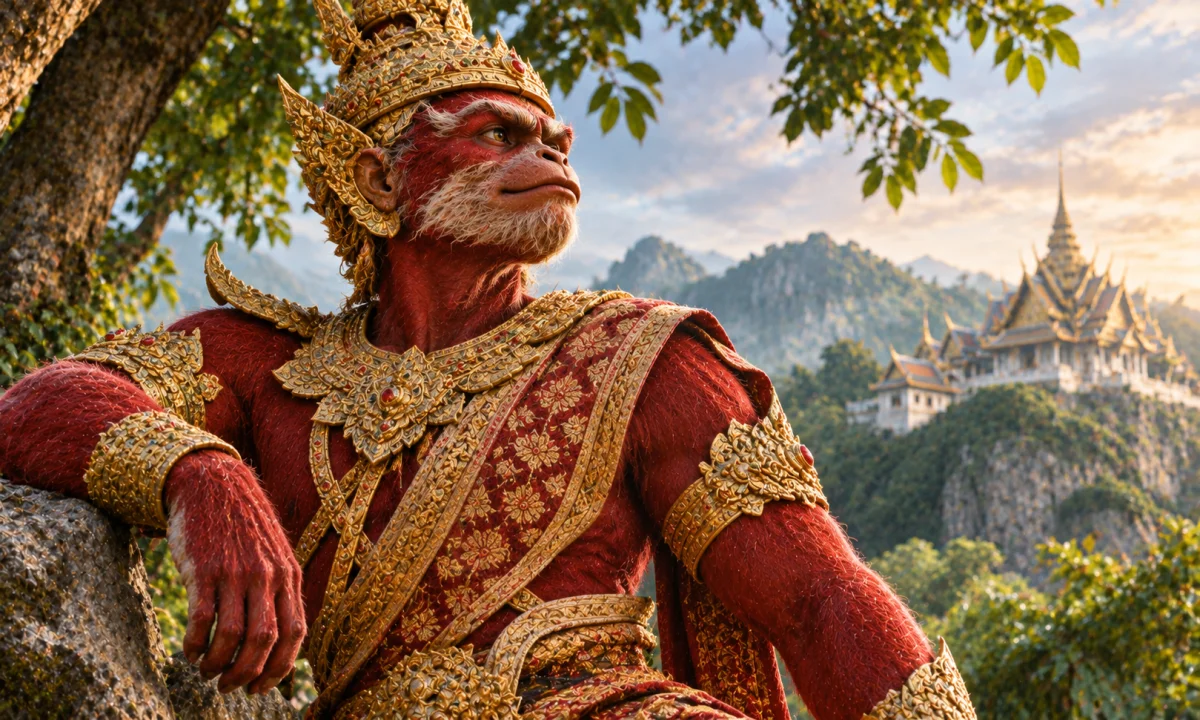
Within the Ramakien, Phra Ram is the son of King Thotsarot, the Thai equivalent of Dasharatha, and a prince of Ayothaya, the Thai form of Ayodhya. He is married to Nang Sida, corresponding to Sita, and is closely accompanied by his younger brother Phra Lak, corresponding to Lakshmana. His principal enemy is Thotsakan, the Thai Ravana, king of Longka. Hanuman, the powerful monkey warrior and general, is one of Phra Ram’s most important allies.
Phra Ram is generally understood as an incarnation or manifestation of Phra Narai. In Indian tradition, Rama is an avatar of Vishnu, and this theological identity remains present in the Thai epic. At the same time, the Thai presentation of Phra Ram is strongly shaped by ideas of kingship, loyalty and moral order. He is not represented merely as a god in human form. He is also a prince who must endure exile, obey obligations, recover his kingdom and govern as an exemplary ruler.
Appearance and character
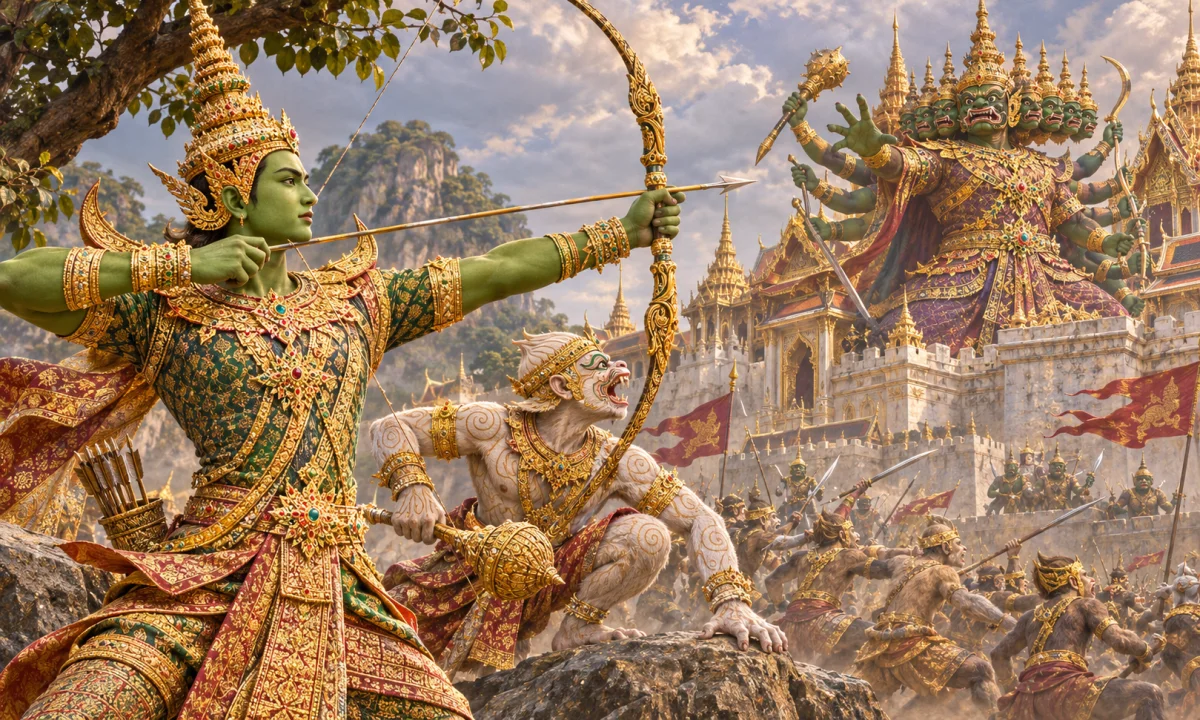
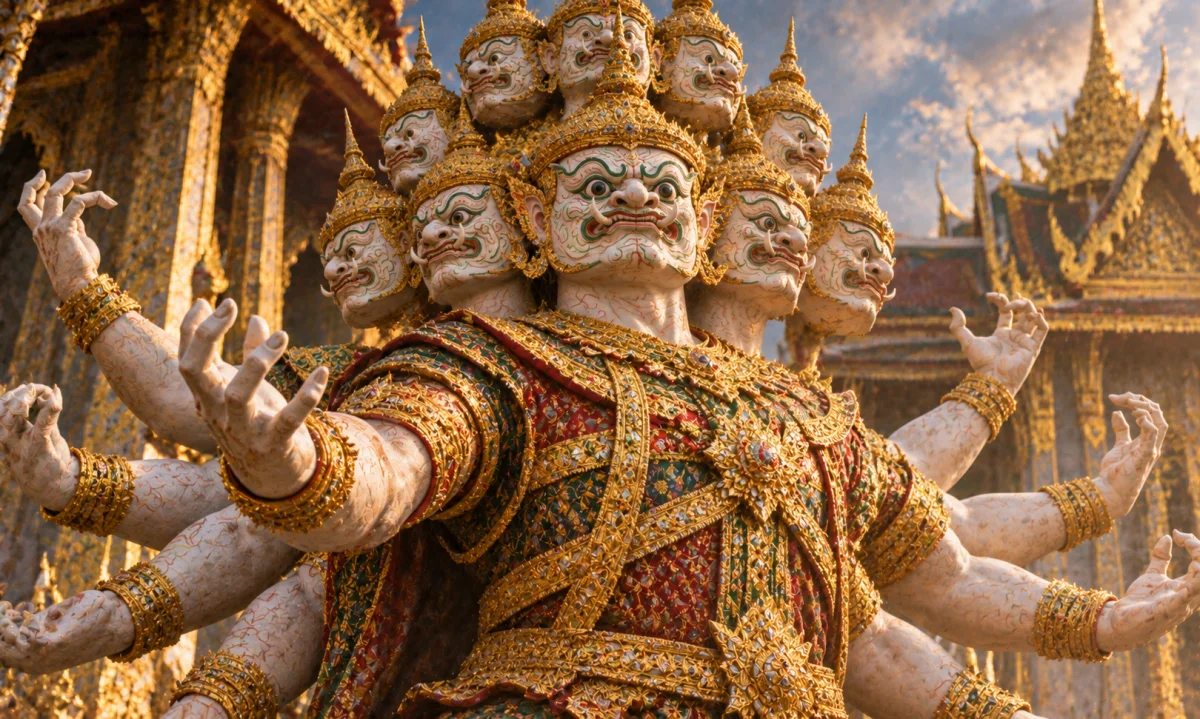
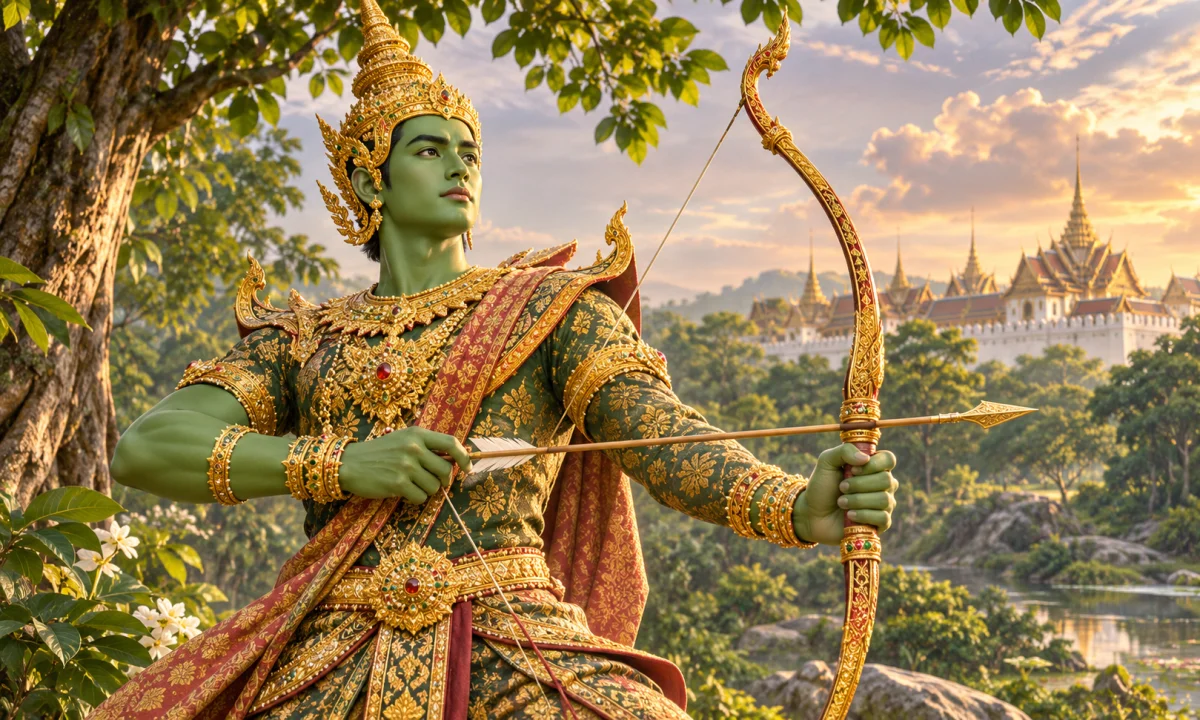
Thai art commonly depicts Phra Ram with a green face. This colour is one of the most recognizable conventions of khon, the masked dance drama associated with the Ramakien. Phra Lak is often shown with a different colour, while Thotsakan is typically represented with a green face and a many-headed crown or mask. Such colours and masks belong to the established visual language of Thai performance and should not be treated as literal descriptions found in the oldest Indian versions.
Phra Ram is portrayed as handsome, disciplined, courageous and skilled with the bow. His most important qualities are responsibility, loyalty and adherence to rightful conduct. He is expected to place duty above personal comfort, even when obedience brings suffering. His ability to command armies and defeat supernatural enemies is balanced by the ideal of restraint required from a legitimate ruler.
His weapons, especially his bow and arrows, identify him as a warrior prince. In the broader Rama tradition, the bow also symbolizes heroic legitimacy and the power to restore order. Phra Ram’s authority does not rest solely on physical strength. He receives support from human allies, monkey warriors and divine forces because he represents a lawful centre around which the disrupted world can be reorganized.
The exile of Phra Ram
As in other Rama traditions, the early story establishes Phra Ram’s right to rule and then removes him from the throne. Through a palace promise and the demands of a queen, King Thotsarot is compelled to send Phra Ram into exile and appoint another son as heir. The names and details vary between Thai and Indian versions, but the central conflict is the same: a rightful prince is separated from the kingdom because of a vow and a courtly obligation.
Phra Ram accepts exile rather than allowing his father to break his word. Nang Sida chooses to accompany him, and Phra Lak follows as well. Their departure turns the story from a royal succession drama into a journey through a dangerous landscape inhabited by hermits, spirits, giants and other supernatural beings. The forest becomes a place where the characters’ virtues are tested and where the unstable relationship between human society and the nonhuman world is revealed.
The exile also defines the bond between Phra Ram and Phra Lak. Phra Lak is more than a secondary warrior. He is the devoted younger brother who shares danger, supports Phra Ram’s authority and helps make the ideal of familial loyalty visible. Nang Sida is likewise central to the emotional and ethical structure of the narrative, although her characterization and the treatment of her agency differ between versions and performances.
Nang Sida and the conflict with Thotsakan
The central crisis begins when Thotsakan desires Nang Sida and causes her abduction. Thotsakan is a powerful ruler with extraordinary abilities, numerous heads in the conventional visual representation and command over a vast supernatural kingdom. He is not simply a monster without culture or intelligence. He is a king, scholar and formidable opponent whose pride, desire and refusal to return Nang Sida bring destruction upon his own realm.
The abduction separates Phra Ram from both his wife and his political world. He must search for Nang Sida while forming alliances with beings who are outside the ordinary royal order. The encounter with the monkey kingdom is especially important. Through the monkey leader Sugriva and other allies, Phra Ram gains an army capable of challenging Longka. In Thai versions, Hanuman becomes an exceptionally prominent and energetic figure, often receiving more elaborate adventures and comic or romantic episodes than he does in some Indian tellings.
Hanuman’s loyalty to Phra Ram is one of the epic’s most celebrated relationships. He is a warrior, scout, messenger, strategist and supernatural agent. His ability to change form, leap great distances and overcome magical obstacles makes him indispensable. Thai performances often give him a lively personality, combining bravery with wit, playfulness and confidence. These traits are traditional features of Thai Ramakien performance, not signs that Hanuman has ceased to be a sacred or heroic figure.
The war in Longka
The campaign against Thotsakan culminates in a long war between Phra Ram’s forces and the armies of Longka. The fighting includes giant warriors, magical weapons, aerial journeys, disguises, curses and feats of extraordinary strength. Phra Ram and his allies must overcome not only military resistance but also deception and supernatural intervention.
One of the best-known tasks is the construction of a causeway across the sea. In the wider Rama tradition, the monkey army builds a bridge so that Phra Ram’s forces can reach the enemy’s island kingdom. Thai representations of this episode frequently emphasize the collective effort of the monkey warriors and the organizing power of Phra Ram’s command.
The Thai epic contains episodes and characters that are not identical to those in Valmiki’s Ramayana. In some Thai versions, Hanuman encounters Suvannamaccha, a mermaid associated with Thotsakan, during the construction of the bridge. Other episodes involve the demon king Maiyarap, who captures Phra Ram and takes him to an underworld realm before Hanuman rescues him. Such stories belong to the developing Thai tradition and should not automatically be attributed to every form of the Indian epic.
The conflict ends with the defeat and death of Thotsakan. Phra Ram’s victory restores the possibility of rightful rule, but the narrative does not present war as a simple celebration of conquest. The destruction of Longka is also the consequence of a ruler’s uncontrolled desire, arrogance and refusal to recognize moral limits. Thotsakan’s grandeur makes his fall more significant: he is defeated not because he lacks power, but because power has been placed in the service of selfishness.
Phra Ram as an ideal ruler
Phra Ram’s return to Ayothaya and restoration to kingship express the ideal of order after disorder. His rule is associated with justice, stability and prosperity. The royal dimension of the story has been especially important in Thailand, where the epic has been connected with court culture and representations of legitimate authority.
The connection between the Rama tradition and Thai kingship requires careful distinction. The Chakri monarchs have used the regnal name Rama in international and historical contexts, but Phra Ram is the mythic and literary hero of the Ramakien, not a description of any particular historical king. The shared name reflects a long-standing association between Rama and ideal kingship; it does not mean that Thai monarchs are literally identical with the epic character.
Phra Ram’s authority is also interpreted within a predominantly Buddhist cultural environment. The Ramakien is not a Buddhist scripture, and its theology comes substantially from the Hindu Rama tradition. Nevertheless, Thai retellings exist within a society where Buddhist ethics, merit, karma, monastic institutions and ideas of righteous rule have influenced how stories are understood. The epic’s concerns with duty, self-control, loyalty and the consequences of harmful action can therefore be encountered alongside Buddhist moral frameworks without making the characters Buddhist equivalents of figures from Buddhist scripture.
Phra Ram, Sita and moral complexity
The relationship between Phra Ram and Nang Sida is central but not uncomplicated. In many Rama traditions, their separation and reunion are followed by tests of Nang Sida’s fidelity and purity. Thai versions and performances do not always treat these episodes in precisely the same way, and adaptations may soften, rearrange or emphasize them differently.
These parts of the narrative raise questions about the demands placed on women, the reputation of royal households and the conflict between personal affection and public duty. Phra Ram can be admired as a model of lawful kingship while still being examined critically when his adherence to public expectations causes suffering to Nang Sida. Modern readers and performers may therefore interpret him both as an ideal ruler and as a figure whose decisions reveal the limitations and pressures of patriarchal royal society.
Distinction from related figures
Phra Ram should be distinguished from Phra Lak, who is his brother and companion, and from Hanuman, who is his monkey ally and military champion. He is also distinct from Thotsakan, his demon-king opponent, even though both characters may appear in similarly elaborate royal costumes in Thai art and drama.
Phra Ram is the Thai Rama, not a separate version of the Hindu god Vishnu under another name. The relationship is one of manifestation or incarnation: Phra Narai is the divine identity, while Phra Ram is the heroic royal figure who lives through the epic’s human and political events. Nor should Phra Ram be confused with the historical founders, kings or saints named Rama in India or elsewhere. Similar names reflect related linguistic and religious traditions, but they do not establish that every person called Rama belongs to the same mythology.
Traditional and modern reception
The Ramakien remains important in Thai cultural heritage through khon masked dance, classical music, temple murals, sculpture, school education and literary study. In performance, Phra Ram’s mask, posture, movement and measured conduct contrast with the more flamboyant or aggressive styles assigned to demons and comic characters. His presence helps organize the dramatic world even when another character receives greater theatrical attention.
Modern adaptations may retell the story in illustrated books, television, animation, tourism displays and popular stage productions. These versions can simplify the plot, reinterpret relationships or emphasize Hanuman, Thotsakan or Nang Sida rather than Phra Ram. Such adaptations belong to the continuing reception of the epic and should not be treated as evidence that every modern invention is part of the older Thai tradition.
Phra Ram endures because he brings together several identities that are not easily separated: divine manifestation, exiled prince, warrior, husband, brother and king. His story belongs to a vast Asian family of Rama traditions, but its Thai form has its own language, characters, performance conventions and historical development. Through the Ramakien, Phra Ram represents the difficult restoration of rightful order, while the variations surrounding him show how a shared epic can be continually remade within a distinct cultural world.