WORLD

Phra Isuan
Phra Isuan (พระอิศวร), also written Phra Isuan or rendered as Phra Iswara, is the Thai name for Shiva, the major Hindu deity known in Sanskrit as Śiva or Īśvara. In Thai religious and literary traditions, he appears as a powerful god associated with creation, destruction, asceticism, divine authority, fertility, and cosmic transformation. He belongs to the Brahmanical and Hindu strand of Thailand’s religious culture, although his worship and imagery have long existed alongside Theravada Buddhism, local spirit traditions, and royal ceremonial practices.
The Thai name does not necessarily indicate a separate indigenous god distinct from Shiva. Isuan is a Thai form related to Sanskrit Īśvara, meaning “Lord” or “Sovereign.” The honorific Phra marks a sacred or exalted being and is also used for other deities, Buddhist figures, royal objects, and revered persons. Consequently, Phra Isuan is best understood as the Thai religious and literary form of Shiva rather than as an entirely separate figure.
Origins and religious setting
Shiva developed within the religious traditions of South Asia over many centuries. He is connected with earlier Vedic and post-Vedic ideas, including the god Rudra, but the Shiva known from later Hindu traditions emerged through the growth of devotional, philosophical, temple, and mythological traditions. His character combines apparently opposite qualities: he is an austere ascetic and a fertile householder, a benevolent protector and a terrifying destroyer, a solitary yogi and the husband of Parvati, and a god who withdraws from the world while also governing its transformation.
Thai culture received Indian religious concepts through long-standing cultural exchange involving South and Southeast Asia. These influences reached the region through religious specialists, political ideas, literature, art, ritual practice, and networks of trade. Thai kingdoms did not simply reproduce Indian religion unchanged. Imported deities were interpreted through local ideas of kingship, Buddhist cosmology, spirit worship, and regional artistic traditions.
As a result, Phra Isuan can appear in several overlapping contexts. He may be treated as a Hindu god in a Brahmanical shrine, as a member of the divine world represented in Thai literature, as a guardian of royal and ritual order, or as a powerful deity respected by Buddhists without being the supreme object of Buddhist teaching. These contexts are related but should not be treated as identical.
Thailand’s religious life has historically included a close interaction between Buddhism and Brahmanical ritual. Theravada Buddhism became the dominant institutional religion of Thai kingdoms, yet Brahmanical specialists continued to perform ceremonies connected with royal legitimacy, calendrical rites, auspicious occasions, and court traditions. Gods such as Phra Isuan, Phra Narai, Phra Phrom, and Phra In could therefore remain culturally important without replacing the Buddha as the central figure of Buddhist doctrine.
Name and identity
The Thai form Phra Isuan derives from a pronunciation and adaptation of Īśvara. In Sanskrit, Īśvara is a title meaning “Lord,” and it can be applied in different Hindu philosophical and devotional contexts. In Thailand, however, Phra Isuan is generally recognized specifically as Shiva. English spellings vary because Thai and Sanskrit names can be transliterated in more than one way. Forms such as Isuan, Isvara, Ishvara, and E-Suan may appear in English-language discussions, although “Phra Isuan” is a common Thai-based form.
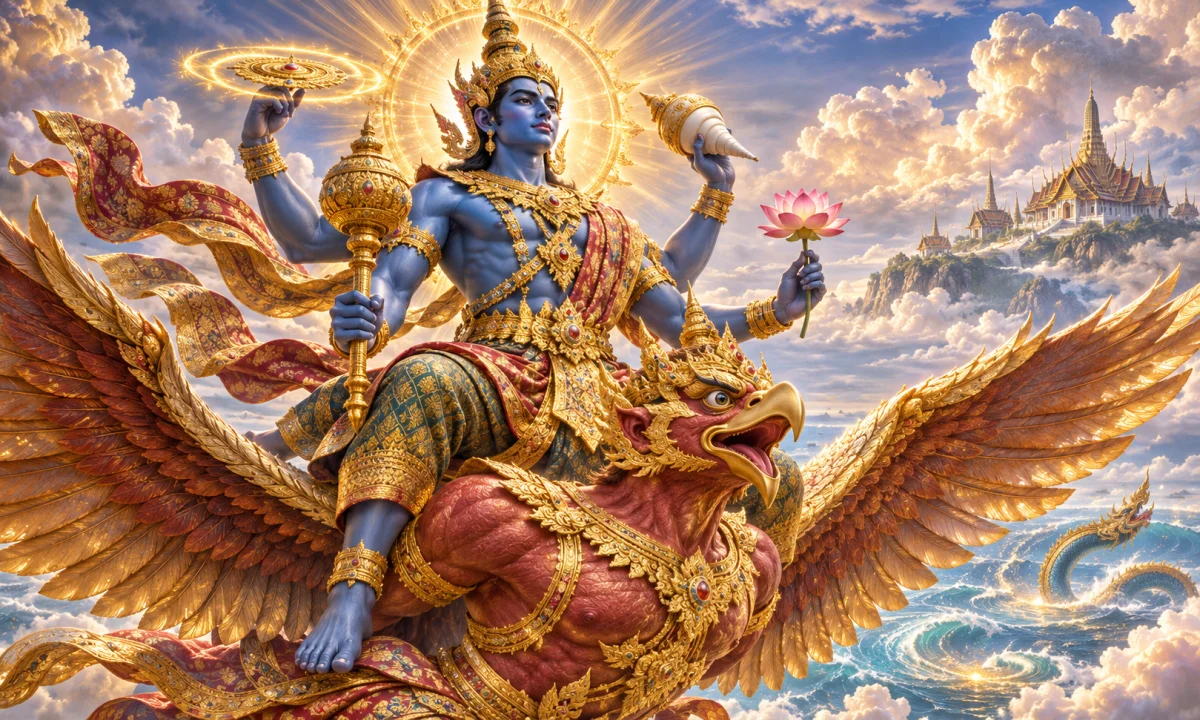
The title should not be confused with a personal name in the modern Western sense. It emphasizes divine status and sovereignty. Similar Thai names reflect the adaptation of Indian religious vocabulary into the Thai language, including Phra Narai for Vishnu, Phra Phrom for Brahma, and Phra In for Indra.
Phra Isuan is also not simply interchangeable with every figure called a creator, lord, or great god in Thai folklore. Different texts and ritual settings may give him varying degrees of authority. Some stories portray him as a supreme or senior deity, while others place him within a larger divine hierarchy or Buddhist universe. These differences reflect the coexistence of several traditions rather than a single standardized Thai theology.
Appearance and sacred attributes
Thai representations of Phra Isuan draw on the established iconography of Shiva while adapting it to local artistic conventions. He may be shown as a powerful male deity with a high crown or piled hair, elaborate jewelry, a divine garment, and a calm or majestic expression. In images influenced by South Asian models, he may instead appear as an ascetic with matted hair. The form chosen often depends on the shrine, artistic period, ritual purpose, and whether the image emphasizes royal power or yogic austerity.
Common attributes associated with Shiva include:
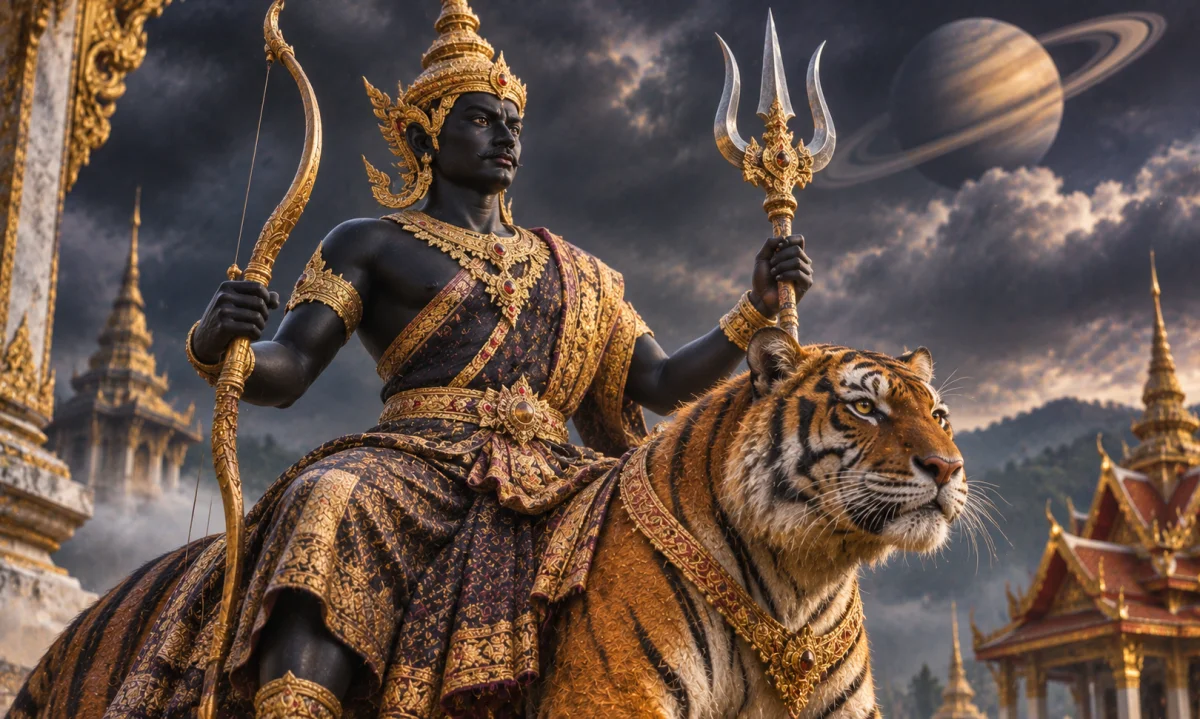
- The trident: the trident, or trishula, is one of Shiva’s most recognizable weapons and can symbolize divine power, destruction of obstacles, or the threefold structure of existence.
- The third eye: placed in the centre of the forehead, it represents heightened perception and destructive spiritual insight. In Hindu mythology, the opening of Shiva’s third eye can release devastating fire.
- The crescent moon: the moon in Shiva’s hair connects him with time, cyclical renewal, and control over the rhythms of the cosmos.
- The serpent: serpents are associated with Shiva’s power over dangerous and chthonic forces, as well as with vitality and transformation.
- The drum: the small hourglass-shaped drum, or damaru, is linked with rhythm, creation, sound, and the ordering of the universe.
- The bull Nandi: Nandi is Shiva’s bull vehicle and devoted attendant. In South and Southeast Asian temple traditions, a seated bull may face a Shiva shrine.
- The ascetic’s ornaments: matted hair, animal skin, ashes, and a remote mountain setting emphasize Shiva’s identity as a yogi and lord of wilderness.
Not every Thai image includes all these attributes. A courtly image may present Phra Isuan as an ornamented god with a tall crown and formal posture, while a more explicitly Shaivite image may focus on the trident, ascetic hair, or the lingam. The presence or absence of a particular attribute should therefore be considered alongside the image’s setting rather than used as an absolute identification rule.
The lingam is a major symbol of Shiva in Hindu worship. It is commonly understood as a sign of Shiva’s divine presence, generative power, and transcendence of ordinary form. In Thailand, the lingam is known in some Hindu and Brahmanical contexts, but it is not the defining form of every Thai representation of Phra Isuan. A crowned anthropomorphic image may be more familiar in Thai public art and literary illustration.
Phra Isuan in Thai literature
Phra Isuan is an important divine figure in Thai retellings of the Ramayana, especially the Ramakien. The Ramakien is not a word-for-word translation of the Sanskrit Ramayana. It is a Thai literary tradition shaped by earlier Southeast Asian versions, court culture, performance, visual art, and local storytelling. Its gods and supernatural beings therefore reflect Thai conventions as well as inherited Indian mythology.
Within the Ramakien tradition, Phra Isuan belongs to the high divine order and can intervene in the affairs of gods, demons, and heroic beings. He is associated with the granting of boons, the distribution of divine weapons, and decisions that affect the balance between celestial and demonic powers. The exact details vary among literary and artistic versions, so individual episodes should not be treated as though every Thai telling presents them in precisely the same way.
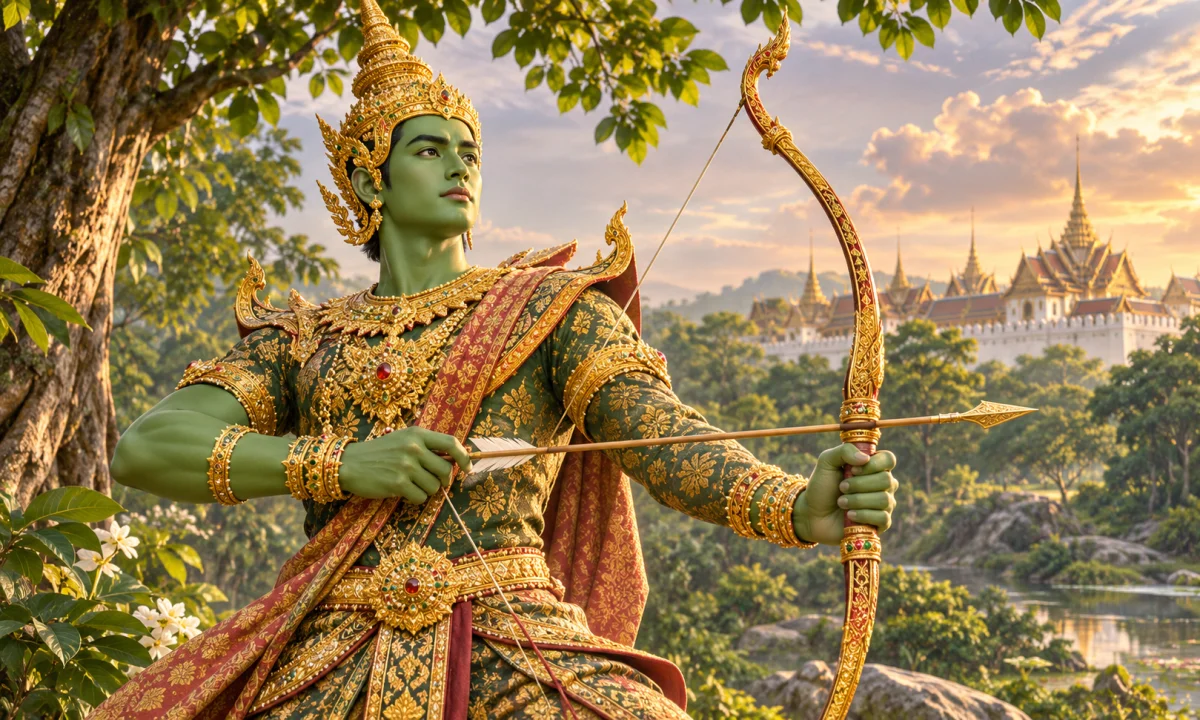
His relationship with Phra Narai, the Thai form of Vishnu, is especially important. In the broad Hindu mythological background, Vishnu and Shiva can be portrayed as rival supreme deities, complementary powers, or mutually revering manifestations of the divine. Thai literature often presents them within a functional hierarchy in which Phra Narai descends into the world as Phra Ram, the hero of the Ramakien, while Phra Isuan remains a senior deity in the celestial realm. This relationship does not always correspond exactly to the theology of any one Hindu sect.
Phra Isuan’s presence in the Ramakien also helps establish the epic’s cosmic scale. The conflict between Phra Ram and the forces led by Thotsakan is not merely a human war. It involves divine incarnations, supernatural ancestry, heavenly judgments, magical weapons, and the consequences of boons granted in the divine world. Phra Isuan is part of the sacred order that makes these events possible, even when he is not the central actor in every episode.
Thai literary depictions of Shiva should be distinguished from the full range of Shaivite mythology found in India. Stories of Parvati, Ganesha, Kartikeya, the descent of the Ganges, the burning of Kama, and Shiva’s dance have broad Hindu significance, but they do not all have an equally prominent or standardized place in Thai popular tradition. A Thai reference to Phra Isuan may be drawing on the Ramakien, temple iconography, court ritual, or general Hindu knowledge rather than on one specific narrative cycle.
Cosmic power and symbolism
Phra Isuan’s importance lies partly in the fact that destruction does not mean simple evil in the Shaivite understanding of Shiva. Destruction can clear away disorder, end a phase of existence, and prepare the conditions for renewal. Shiva’s frightening aspects therefore coexist with his roles as protector, teacher, healer, and giver of boons.
His ascetic character expresses control over desire and the senses. His marriage and family relationships express the opposite principle: participation in worldly life, fertility, household continuity, and generative power. The tension between these aspects is central to Shiva’s identity. He is not adequately described as only a destroyer, just as Phra Isuan is not merely a warlike god or a stern ruler.
In Thai settings, these meanings can be joined to ideas of royal power and auspicious order. The image of a powerful god who governs cosmic forces is compatible with courtly concepts of sacred kingship, while the god’s association with Brahmanical rites reinforces the ceremonial dimension of authority. This does not mean that Thai kings were simply identified with Shiva in every period or context. It means that Hindu divine imagery contributed to a wider language of power, legitimacy, protection, and ritual order.
Worship, shrines, and public presence
Phra Isuan may be encountered in Hindu temples, Brahmanical ritual spaces, museum collections, literary murals, and public religious settings. Some Thai shrines are dedicated primarily to Shiva, while others house several Hindu deities. Such shrines may be used by Thai Buddhists, Hindus, visitors, and people who approach the deity for different reasons, including protection, success, health, fertility, or the removal of obstacles.
Practices vary considerably. Offerings can include flowers, incense, lamps, fruit, and other objects appropriate to the shrine’s established customs. A visitor’s act of paying respect does not always indicate adherence to a formal Hindu theological system. In Thailand, religious participation often crosses institutional boundaries, and people may honour Buddhist, Hindu, and local sacred beings within the same broader religious life.
Some highly visible Hindu shrines in Thailand are associated with Brahma or other deities rather than Phra Isuan. Public familiarity with Hindu gods should therefore not be used to assume that every shrine with Indian imagery is dedicated to Shiva. The shrine’s name, icon, attributes, and ritual tradition are more reliable guides.
Distinctions from related figures
- Phra Narai: Phra Narai is Vishnu, the preserver in many Hindu frameworks. In the Ramakien, he becomes Phra Ram. He is not another name for Phra Isuan, although the two may appear together in Thai religious and literary traditions.
- Phra Phrom: Phra Phrom is Brahma, associated with creation and the four faces in his most familiar Thai image. He is distinct from Shiva, whose Thai form is Phra Isuan.
- Phra In: Phra In is Indra, the ancient Vedic and Hindu lord of the heavens and rain, later incorporated into Buddhist cosmology as a powerful celestial being. He is not the same as Shiva.
- Nandi: Nandi is Shiva’s bull vehicle and attendant, not a separate equivalent of Phra Isuan. A bull image near a Shiva shrine may represent Nandi’s presence.
- Rudra: Rudra is an earlier Vedic deity often regarded as an important predecessor or associated form in the historical development of Shiva. The names are related in religious history but are not automatically interchangeable in every text.
Confusion can also arise because Thai religious art gives gods local crowns, costumes, gestures, and facial styles. A figure’s Thai appearance does not make the deity a wholly separate Thai invention, nor does it mean that every detail comes directly from classical Indian iconography. Religious images are often products of cultural adaptation.
Later reception and modern representation
Phra Isuan continues to appear in Thai religious art, public sculpture, devotional practice, theatre, dance, literature, and retellings of the Ramakien. His image may also be used in cultural presentations of Thailand’s connections with South and Southeast Asian religious traditions. Modern depictions sometimes emphasize the dramatic features most familiar to a broad audience—such as the third eye, trident, matted hair, or cosmic dance—while leaving aside the complex theological differences among Hindu traditions.
Commercial and popular representations may present Phra Isuan as a general symbol of power, transformation, success, or protection. Such uses can be meaningful to devotees, but they should not automatically be treated as complete descriptions of Shiva’s religious identity. The traditional figure includes philosophical, devotional, ascetic, familial, ritual, and cosmological dimensions that cannot be reduced to a single modern slogan.
In Thai culture, Phra Isuan therefore occupies a position shaped by several histories at once: the development of Shiva in South Asian religion, the transmission and transformation of Indian traditions in Southeast Asia, the literary world of the Ramakien, Brahmanical court ritual, Thai visual art, and contemporary devotional practice. His identity is most accurately understood not as an isolated character from a single fixed mythology, but as a Thai form of a major Hindu god whose meanings have been interpreted through Thailand’s distinctive religious and cultural landscape.