WORLD

Phra In
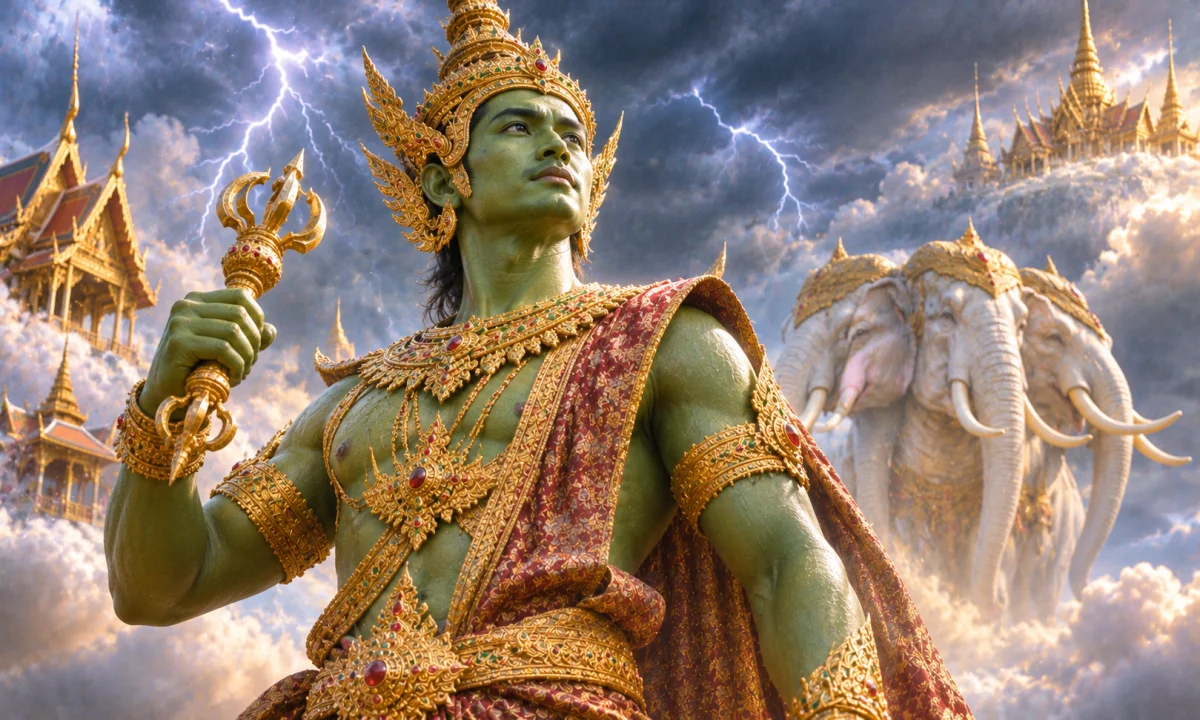
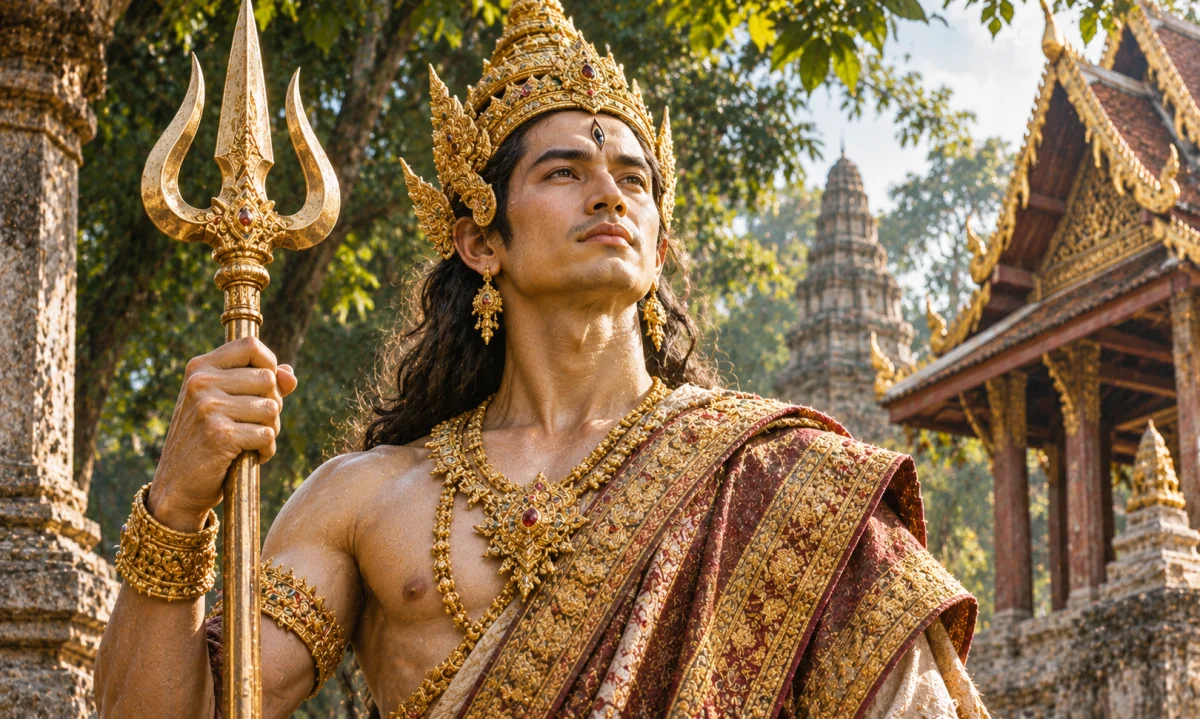
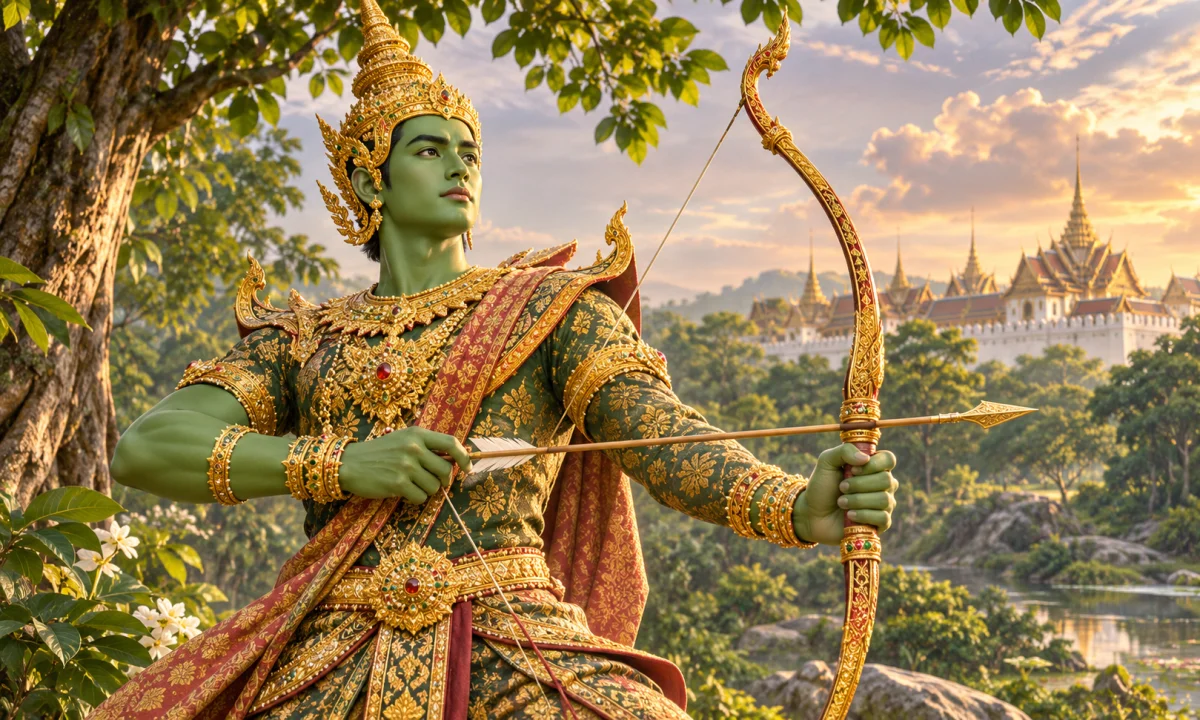
Phra In (พระอินทร์), usually identified with the Indian deity Indra and the Buddhist figure Sakka, is an important celestial ruler in Thai religious tradition. He is regarded as the king of the devas who inhabit Tāvatiṃsa, the “Heaven of the Thirty-Three,” situated in Buddhist cosmology on or near Mount Sumeru. Thai stories and images commonly associate him with a crowned green figure, the thunderbolt, rain, and the celestial elephant Erawan.
Phra In is not normally understood in Thai Buddhism as an eternal creator or an all-powerful god. Like other deva beings, he occupies a high but temporary position within the Buddhist universe. His authority results from accumulated merit, and his life, although extraordinarily long, remains subject to change, death, and rebirth. His importance therefore combines royal and protective imagery with a distinctly Buddhist teaching about the impermanence of even the highest heavenly status.
Name and identity
The Thai name Phra In derives from the Sanskrit name Indra, transmitted into Thai through the religious vocabulary of Indian Buddhism and Brahmanical traditions. The related Pali name is Sakka, or Sakko devānam indo, meaning “Sakka, lord of the devas.” Thai religious language generally treats Phra In and Sakka as the same figure, although the names reflect different textual and linguistic environments.
The honorific phra is used for revered sacred beings, royal persons, and important religious objects. It does not by itself indicate that Phra In is the supreme deity of Thai religion. His position is better described as that of a heavenly king within Buddhist cosmology. Depending on the context, he may also be called Indra, Sakka, Thao Sakkarat, or a related Thai form of these names.
There are two important layers behind his identity. The first is the ancient Indian Indra, a major deity in Vedic literature who is associated with storms, warfare, kingship, and the defeat of cosmic enemies. The second is Sakka in Buddhist literature, where the earlier deity has been incorporated into a universe governed by karma and the Buddha’s teaching. Thai Phra In belongs primarily to this Buddhist development, although older Indian associations with rain, thunder, sovereignty, and celestial power remain visible.
Religious and cultural setting
Thai Buddhism developed within a wider Southeast Asian religious environment shaped by Theravāda Buddhism, Sanskrit and Pali learning, Brahmanical ritual, local spirit traditions, and older Khmer cultural influence. As a result, Phra In does not belong to one isolated system. He appears in Buddhist cosmology, temple painting, sermons, literary works, royal symbolism, and popular devotional imagination.
The main textual background is the Pali Buddhist tradition. Sakka appears in several parts of the Pali Canon, including dialogues with the Buddha and stories in which he observes, tests, protects, or rewards virtuous people. Thai monks, storytellers, and artists received these materials through Pali scripture, commentarial literature, Jātaka narratives, and Thai cosmological works.
One especially influential Thai cosmological text is the Traiphum Phra Ruang, traditionally associated with King Lithai of Sukhothai. Its dating, composition, and relationship to earlier Indian and Buddhist cosmological materials are matters for historical study, but it became a major source for Thai ideas about the structure of the universe, heavens, hells, rebirth, and merit. In this cosmological framework, Phra In rules a celestial realm that remains part of the cycle of existence rather than standing outside it.
Temple murals and illustrated manuscripts have also played a major role in preserving the figure’s identity. In scenes from the life of the Buddha, Jātaka tales, and depictions of the Buddhist cosmos, Phra In may appear among rows of devas or in a position of special authority. Artistic details differ according to period, region, workshop, and subject. Not every crowned or green celestial figure in Thai art is necessarily Phra In.
Position in Buddhist cosmology
Phra In is the ruler of Tāvatiṃsa, one of the heavenly realms associated with the sensual sphere of Buddhist cosmology. The name “Thirty-Three” refers to the traditional group of gods connected with this heaven. Phra In is the leading figure among them, although his authority does not make him independent of the moral law of karma.
Tāvatiṃsa is commonly located on the summit of Mount Sumeru, the cosmic mountain at the centre of the Buddhist universe. Traditional descriptions place Phra In’s palace and gardens in a splendid celestial environment filled with divine beings, music, fragrance, and extraordinary pleasures. Such images communicate the results of great merit, but Buddhist teaching also uses them to show the limitations of heavenly pleasure. A deva may enjoy a vast lifespan and immense power while still remaining trapped in saṃsāra.
Phra In’s relationship with the Buddha illustrates this hierarchy. He may honour the Buddha, ask questions, seek instruction, or assist the Buddhist community, but he is not the Buddha’s creator or superior. In Buddhist narratives, even a heavenly king benefits from hearing the Dharma. His reverence for the Buddha is therefore part of the larger Buddhist theme that wisdom and liberation are higher than worldly or celestial power.
Appearance and attributes
Thai representations often show Phra In as a handsome, richly dressed celestial king. He may wear a tall crown, elaborate jewellery, and courtly garments. His complexion is frequently shown as green, a visual convention strongly associated with him in Thai art, although colour is not completely uniform across all periods and representations.
His principal vehicle is Erawan, the Thai form of Airāvata, the elephant associated with Indra in Indian and Southeast Asian traditions. In Thai art and public imagery, Erawan is particularly famous as a three-headed elephant. Some depictions present a single elephant head with multiple trunks, while others show three distinct heads. These variations reflect artistic conventions rather than a single universally fixed description.
Phra In may carry or be associated with the vajra, the thunderbolt weapon known in Thai as a weapon of divine authority. In Indian mythology, Indra’s thunderbolt is a weapon of war and storm power. In Buddhist contexts, the vajra can also carry broader meanings connected with power, protection, and the force of spiritual truth. Thai images do not always place the weapon prominently, so its presence should not be assumed in every portrayal.
Rain, thunder, fertility, and protection are among the qualities linked with Phra In in popular Thai understanding. These associations partly reflect the older Indian Indra and partly arise from the general image of a celestial king who supports order and prosperity. In Buddhist stories, however, his role is broader than that of a weather deity. He is a guardian of righteous conduct, a patron of the Buddhist community, and a ruler who acts within the moral universe of karma.
Phra In in Buddhist stories
The questioner and devotee
One of the best-known Buddhist portrayals of Sakka occurs in the Sakkapañha Sutta, or “Discourse on Sakka’s Questions.” Sakka approaches the Buddha and asks about the causes of conflict, desire, and suffering. The conversation presents him not as an independent supreme god but as a powerful being who seeks understanding from the Buddha.
This episode is significant because it places Phra In within a recognisably Buddhist relationship to knowledge. His royal status does not grant perfect wisdom. He must listen, question, and learn. Thai interpretations commonly preserve this respectful but subordinate relationship between the heavenly king and the Buddha.
The protector of virtuous people
In Jātaka literature and related Buddhist stories, Sakka often appears when a person’s generosity, truthfulness, self-control, or devotion is tested. He may disguise himself, present a difficult request, or intervene when a moral crisis reaches its height. These episodes are not all identical, and details vary between texts and retellings, but they share a common pattern: heavenly power is used to reveal or respond to human virtue.
In the Vessantara Jātaka, for example, Sakka is associated with a decisive test of Vessantara’s generosity. Disguised as a brahmin, he asks Vessantara for Maddī, Vessantara’s wife. The request intensifies the story’s exploration of generosity and attachment. Sakka later helps prevent the consequences from becoming irreparable and grants appropriate blessings. Thai mural cycles and sermons have made this Jātaka one of the important narrative settings in which a figure corresponding to Phra In may be recognised.
Other stories show him protecting the Buddha, supporting the righteous, or helping to preserve the proper order of events. His interventions do not cancel karma or replace human responsibility. Rather, they dramatise the idea that good conduct can attract support from the wider cosmos.
His relationship with the Buddha
Phra In is often included among the devas who honour the Buddha during major events in Buddhist sacred history. He may appear in accounts of the Buddha’s birth, awakening, teaching career, and final passing, although the precise details depend on the particular text or artistic tradition.
These appearances help establish the cosmic importance of the Buddha while also showing that devas remain participants in the same world of conditioned existence as humans. They possess power and splendour, but they still benefit from the Dharma. In Thai religious art, a crowned Phra In attending the Buddha can therefore represent both heavenly reverence and the subordination of worldly authority to spiritual awakening.
Thai interpretations and symbolism
In Thailand, Phra In can symbolise the ideal of a powerful ruler who protects order while acknowledging a higher moral law. This does not mean that every depiction is a direct statement about Thai kingship, nor that Phra In has a single political meaning. Royal and courtly imagery has influenced representations of many divine and celestial beings, and the interpretation changes according to historical period and setting.
His association with rain gives him practical significance in an agricultural society, where seasonal water is essential to crops and livelihoods. Popular religious imagination may therefore connect him with abundance, the restoration of balance, and relief from drought. Such associations should be distinguished from formal Buddhist doctrine: the Buddhist texts do not reduce Phra In to a simple rain god, and local beliefs may combine several ideas about weather, spirits, merit, and divine protection.
The image of Phra In riding Erawan also expresses the grandeur of the heavenly realm. The elephant represents strength, majesty, and royal transport, while the unusual number of heads in Thai artistic convention makes the creature visibly supernatural. Erawan can be represented independently in Thai art and architecture, so an elephant image alone does not always identify Phra In.
Distinctions from similar figures
Phra In is often confused with other important figures because Thai religious art uses similar crowns, colours, vehicles, and courtly forms for many celestial beings. He should not automatically be identified with Phra Phrom, the Thai form of Brahmā. Brahmā is associated with a higher Brahmā realm and is commonly represented with four faces. Phra In, by contrast, is the ruler of Tāvatiṃsa and is normally connected with Erawan and the role of Sakka.
He is also distinct from Phra Isuan, the Thai name for Shiva, and Phra Narai, the Thai name for Vishnu. Those figures belong primarily to Hindu traditions, although they appear in Thai art, literature, royal ceremonies, and religious environments shaped by interaction between Hindu and Buddhist ideas. Phra In may coexist with them in a Thai cultural setting without being identical to either of them.
The Erawan Shrine in Bangkok provides a particularly common source of confusion. Despite its name, the shrine is dedicated to Phra Phrom, the Thai form of Brahmā, not to Phra In. “Erawan” became associated with the shrine through the name of a hotel and its connection with Brahmā’s elephant symbolism, but the central four-faced image is Brahmā. A three-headed Erawan carrying or accompanying Phra In belongs to a different iconographic and religious association.
Later reception
Phra In continues to appear in Thai temple murals, Buddhist storytelling, educational illustrations, decorative arts, and religious performances. His image may also be used in contemporary fantasy, animation, games, and tourism-related design. Such modern uses often emphasise the green complexion, crown, thunderbolt, or Erawan, sometimes combining Phra In with general ideas of a powerful sky god.
These adaptations can be visually recognisable while simplifying or altering the traditional figure. In particular, modern fantasy may treat Phra In as an immortal superhero or as a straightforward equivalent of a Western thunder god. Traditional Thai Buddhist understanding is more complex: Phra In is a magnificent but impermanent deva, a ruler who may protect and assist living beings, and a figure who ultimately remains within the cycle from which Buddhist liberation seeks release.