WORLD

Phra Lak
Phra Lak is the Thai name commonly used for Lakshmana, the devoted younger brother and companion of Phra Ram in the Ramakien, Thailand’s national epic. The character derives from the wider South and Southeast Asian tradition of the Ramayana, but Thai storytelling, court culture, visual art and performance have given him a distinct place within Thai religious and literary life. Phra Lak is not usually worshipped as an independent major deity. He is chiefly remembered as a heroic prince whose courage, loyalty and self-discipline support the cause of justice represented by Phra Ram.
Origins in the Ramayana tradition
The oldest surviving Sanskrit form of the Ramayana is associated with the poet Valmiki, although the epic developed through a long process of transmission and redaction. Its stories travelled widely across Asia, where they were translated, adapted and combined with local ideas about kingship, morality, heroism and the supernatural. Lakshmana, the younger brother of Rama, became one of the most consistently retained figures in these regional versions.
In Thailand, the epic is known as the Ramakien, usually translated as “The Glory of Rama” or “The Story of Rama.” The Thai version is related to Indian and Khmer Ramayana traditions, but it is not simply a literal translation of the Sanskrit epic. Names, relationships, episodes, settings and emphases were reshaped in accordance with Thai literary conventions and the political culture of the Thai court.
Much earlier Thai Ramayana material was probably lost when Ayutthaya was destroyed in 1767. The best-known surviving royal recension was assembled and revised during the reign of King Rama I in the late eighteenth century. Later kings, especially Rama II, also contributed to the literary and theatrical forms of the tradition. Because the Ramakien existed in oral, dramatic, manuscript and courtly forms, no single version represents every Thai telling of Phra Lak.
Name and identity
Phra Lak is the Thai form of Lakshmana, whose Sanskrit name is usually written Lakṣmaṇa. In Thai, Phra is an honorific used for exalted persons, sacred images, royalty and important religious or legendary figures. Lak is a shortened Thai form of the name. English-language works may therefore use Phra Lak, Phra Lakshman, Lakshmana or Lakman, depending on their transliteration system and the tradition being discussed.
Phra Lak should not be confused with Phra Ram, the Thai equivalent of Rama. The two are closely related and often appear together, but they have different roles. Phra Ram is the central king-hero, while Phra Lak is his younger brother, companion and principal supporter. Nor should Phra Lak be confused with Lao Phra Lak Phra Lam, the name of a Lao epic centred on Lakshmana and Rama. The Lao title refers to a related but distinct literary and cultural tradition, not to a separate Thai character.
In the Thai Ramakien, Phra Lak belongs to the royal family of Ayodhya and is one of the sons of King Thotsarot, the Thai counterpart of King Dasharatha. The epic’s family details do not always correspond exactly to those in the Sanskrit Ramayana, and different retellings may give varying emphasis to the princes’ mothers and birth circumstances. What remains consistent is Phra Lak’s status as Phra Ram’s younger brother and trusted companion.
Appearance and heroic character
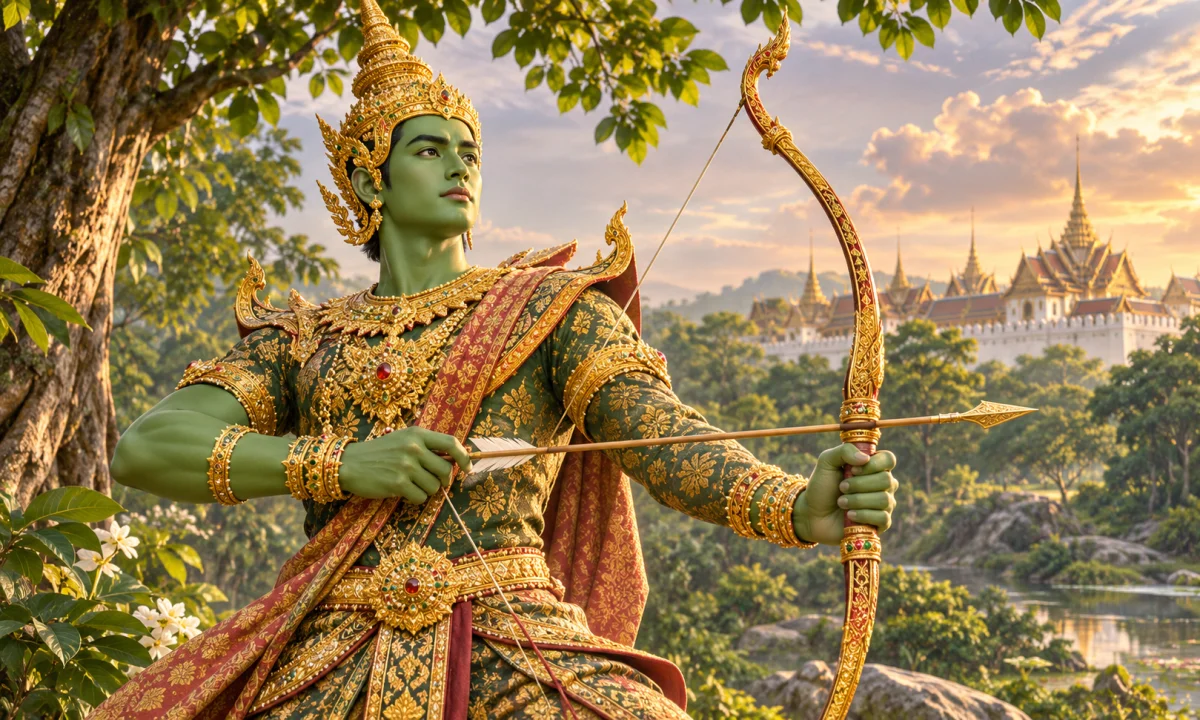
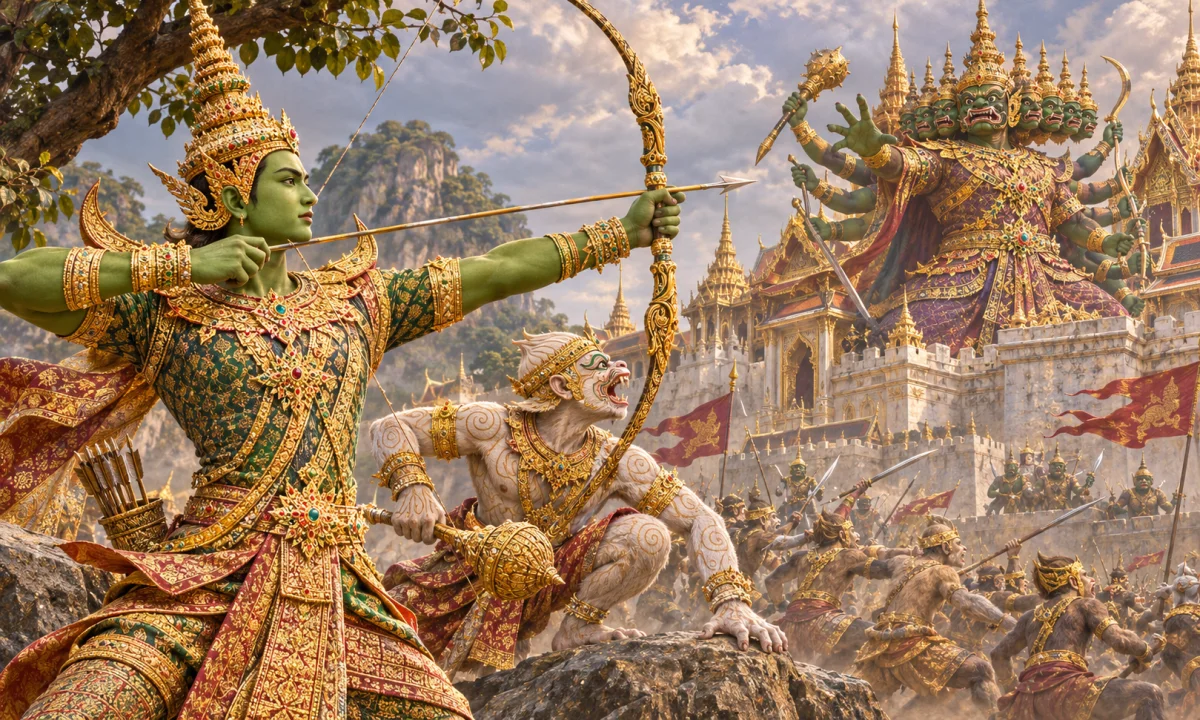
Phra Lak is usually presented as a handsome royal warrior rather than as a monstrous or animal-shaped being. Thai mural painting, manuscript illustration and theatrical performance represent him in the dress of a prince, with a crown or elaborate headdress, royal ornaments and military weapons. His appearance distinguishes him from the monkey warriors, demons and other nonhuman beings who populate the Ramakien.
His most important attribute is unyielding loyalty. Phra Lak accompanies Phra Ram during hardship, including the period of exile that forms a major part of the epic’s story. He is not merely a passive attendant. He acts as a fighter, adviser and protector, sharing danger and helping to preserve the hero’s mission when Phra Ram faces enemies, separation or supernatural threats.
Phra Lak’s bravery is balanced by obedience and emotional restraint. He accepts the authority of his elder brother while still demonstrating initiative on the battlefield. This combination reflects an ideal of princely conduct: courage should be guided by duty, and personal strength should serve family, kingdom and moral order rather than private ambition.
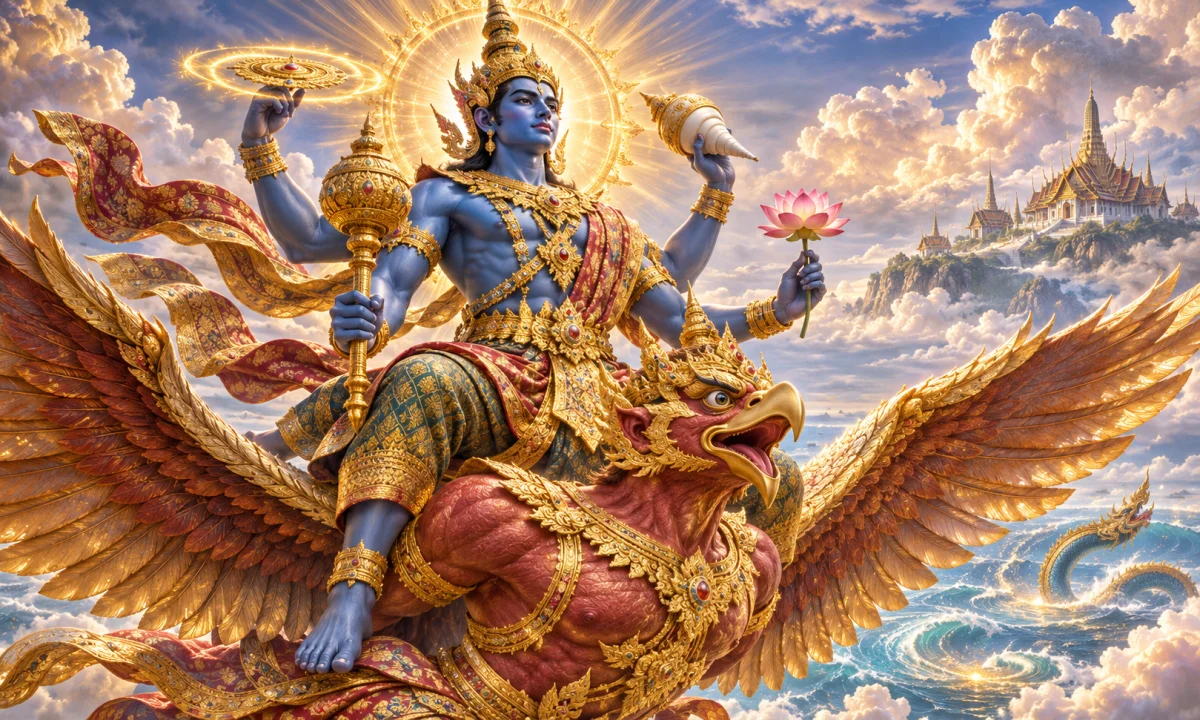
Some interpretations connect Lakshmana in the broader Ramayana tradition with the cosmic serpent Shesha, the divine serpent associated with Vishnu. In many Indian traditions, this relationship helps explain Lakshmana’s extraordinary devotion to Rama, who is identified with Vishnu. Thai treatments may preserve or echo Indic ideas about divine incarnation, but the significance of Phra Lak is not limited to a single theological explanation. In Thai performance and visual culture, he is also appreciated as a loyal prince and accomplished warrior within the human-like royal world of the epic.
Phra Lak in the Ramakien
The exile of Phra Ram
As in other Ramayana traditions, the Thai epic places Phra Ram’s exile at the centre of the early narrative. Through palace intrigue and a promise made by Thotsarot, Phra Ram is required to leave the royal capital. Sida, the Thai form of Sita, accompanies him, and Phra Lak goes with them rather than remaining safely at court.
This decision establishes Phra Lak’s defining relationship with Phra Ram. He is not compelled to share the exile in the same way as the banished prince. His choice to follow shows that kinship, loyalty and moral commitment matter more to him than comfort or immediate political advantage. The three figures form the principal human-like group at the heart of the early story: Phra Ram as the rightful hero, Sida as his wife and Phra Lak as his faithful younger brother.
The exile also places Phra Lak between domestic devotion and military responsibility. He helps guard Phra Ram and Sida in the wilderness, where they encounter hermits, magical beings, hostile forces and the wider supernatural world that surrounds the epic. Thai versions vary in the details of these encounters, but Phra Lak’s role as protector remains central.
The abduction of Sida and the war with Longka
The major conflict begins when Sida is carried away by Thotsakan, the demon king of Longka. Thotsakan is the Thai form of Ravana, although the Thai character has his own visual identity, genealogy and narrative development. Phra Ram sets out to recover Sida, and Phra Lak becomes one of the principal participants in the campaign.
In the search for Sida and the war against Longka, Phra Lak works alongside Hanuman and the armies of the monkey kingdom. Hanuman is one of the most popular figures in the Ramakien, and Thai performances often give him a more expansive and playful role than is found in many Indian versions. Phra Lak’s relationship with Hanuman is therefore part of a larger alliance between the human or divine princes and the monkey forces that oppose Thotsakan.
Phra Lak is especially important in battles against the powerful champions of Longka. He faces supernatural weapons, demon princes and illusion-producing enemies. The name of Indrajit, Ravana’s formidable son in the Sanskrit epic, appears in Thai forms and may be rendered differently in English. The details of the combat differ among recensions and performances, but the underlying pattern is familiar: Phra Lak’s courage is tested by an enemy whose strength is enhanced by magic and divine protection.
Wounding and recovery
One of the best-known episodes inherited from the wider Ramayana tradition is Phra Lak’s serious wounding in battle. He is struck by a supernatural weapon and lies close to death, creating a crisis for Phra Ram and the allied army. His condition demonstrates that even a heroic prince is vulnerable and that the campaign cannot succeed through courage alone.
The rescue requires rare medicinal aid, and Hanuman is sent to obtain it. In versions of the Ramayana across Asia, this episode may involve a healing plant, a mountain or difficulty identifying the correct remedy. Thai retellings and performances adapt the episode to their own dramatic conventions. Its basic meaning is clear: Phra Lak’s life is preserved through cooperation among the heroes, and Hanuman’s devotion becomes an essential counterpart to Phra Lak’s devotion to Phra Ram.
The episode also reveals the emotional depth of the brothers’ relationship. Phra Ram’s distress is not only the concern of a commander who has lost an important warrior. It is the grief of an elder brother whose closest companion is in danger. Phra Lak’s recovery allows the campaign to continue, but the event marks the cost of the war and the seriousness of the forces opposing them.
Relationships with other figures
- Phra Ram: Phra Lak’s elder brother, kingly ideal and closest companion. Their relationship is the central bond in Phra Lak’s story.
- Sida: Phra Ram’s wife and Phra Lak’s sister-in-law. Phra Lak helps protect her during the exile and joins the effort to recover her from Longka.
- Thotsarot: The king of Ayodhya and father of the royal brothers. He represents the family and royal authority from which Phra Lak comes.
- Hanuman: The celebrated monkey hero and military ally of Phra Ram. Hanuman’s resourcefulness complements Phra Lak’s disciplined princely courage.
- Thotsakan: The demon king who abducts Sida and becomes the principal enemy of Phra Ram’s forces. He is a rival of the whole allied army, not Phra Lak’s personal counterpart alone.
- Phra Phrot and Phra Satrut: Other royal brothers corresponding broadly to Bharata and Shatrughna in the Sanskrit tradition. Their importance varies according to the episode and version.
These relationships should not be treated as identical in every Ramayana tradition. The names and family arrangements may change, and the relative prominence of the brothers can differ. In Thai storytelling, however, Phra Lak’s bond with Phra Ram is consistently more important than any independent political or romantic storyline.
Religious and cultural significance
The Ramakien belongs to a cultural environment shaped by both Buddhism and older Hindu-derived ideas about gods, kingship and cosmic order. Thai audiences have not always approached the epic as a fixed theological scripture. It functions simultaneously as court literature, sacredly resonant mythology, dramatic entertainment, visual art and a source of moral examples.
Phra Lak’s significance lies in the ethical qualities expressed through his actions. He embodies loyalty to family, readiness to accept hardship, respect for legitimate authority and courage in the defence of justice. His virtues are relational rather than solitary. He becomes admirable not because he seeks independent glory, but because he uses his abilities in service of a rightful cause and refuses to abandon those who depend on him.
The character also reflects ideals associated with the traditional warrior-prince. A prince must be physically capable, disciplined, alert to danger and willing to risk himself for the kingdom. At the same time, he must control anger and personal desire. Phra Lak’s obedience to Phra Ram can therefore be read both as devotion between brothers and as a model of proper conduct within a hierarchical society.
Thai representations of Phra Lak are especially important in the arts. Episodes from the Ramakien appear in murals, illuminated manuscripts, sculpture, masked dance and dramatic performance. At Wat Phra Kaew in Bangkok, extensive mural paintings depict scenes from the Thai epic, including its royal heroes, demon armies and monkey warriors. In khon, the classical masked dance-drama of Thailand, Phra Lak is identified through costume, movement and performance conventions rather than through facial expression alone, since masks cover the performers’ faces.
Distinguishing Phra Lak from similar figures
Phra Lak is sometimes described simply as “Lakshmana,” which is correct as an identification but can obscure the difference between the Sanskrit and Thai traditions. Lakshmana in Valmiki’s Ramayana, Phra Lak in the Thai Ramakien and the Lakshmana figure in Lao, Khmer, Javanese or Cambodian adaptations share a narrative ancestor, yet their stories are not interchangeable.
He is also distinct from Phra Phrot, the Thai counterpart of Bharata. Both are brothers of Phra Ram, but Phra Phrot’s story is associated more directly with the succession crisis and the kingdom’s response to Phra Ram’s exile. Phra Lak is the brother who accompanies Phra Ram into danger and takes an active role in the wilderness and the war against Longka.
Nor is Phra Lak the same as a generic “guardian prince” in Thai folklore. His identity depends on the Ramayana narrative and its Thai transformations. References to a figure named Lak or Lakshman outside that narrative may concern another person, a different regional adaptation or merely a variant spelling.
Later reception
Phra Lak remains most visible through traditional Thai arts rather than through a large body of independent modern fiction. His image continues to appear in performances of khon, educational presentations of the Ramakien, museum displays and reproductions of Thai mural art. Contemporary productions may shorten episodes, modernise staging or place greater emphasis on particular characters, but they generally retain Phra Lak’s role as Phra Ram’s faithful brother and warrior.
Modern retellings sometimes focus on Hanuman, Sida or Thotsakan because these figures offer especially strong possibilities for spectacle, romance or comic performance. Phra Lak is less often treated as a standalone protagonist. His relative lack of independent modern franchises should not be mistaken for insignificance: within the traditional epic, his presence is structurally essential. The quest, the battles and the emotional stakes of the story depend in large part on the loyalty he represents.