WORLD

Phra Athit
Phra Athit (พระอาทิตย์) is the Thai personification and sacred name of the sun. The expression can mean “the Sun” or “Lord Sun,” and it appears in religious, astrological, literary and everyday contexts. Phra Athit belongs to the cosmological world of Thai Buddhism, which developed through a long interaction between Theravada Buddhist teachings, Indian religious ideas and older Southeast Asian traditions. He is not always presented as a single character with one fixed mythology. In many contexts, Phra Athit is the visible sun itself; in others, he is a divine or celestial being associated with sunlight, Sunday, royal power and the ordering of time.
Name and identity
The Thai word athit is related to the Sanskrit term āditya, a name connected with the sun and, more broadly, with the solar deities descended from Aditi in ancient Indian tradition. Thai adds the honorific phra, a word used for revered religious figures, sacred objects, royalty and beings of elevated status. Phra Athit therefore means something like “the sacred Sun” or “Lord Sun.”
The name should not be treated as evidence that Thai tradition preserves one completely separate and unified sun god corresponding exactly to the Indian god Surya. Thai religious culture has adopted and reshaped Indian cosmological vocabulary, while placing it within a predominantly Buddhist social and ritual setting. As a result, Phra Athit can overlap in symbolism with Surya without being identical to every form of Surya worship or every story told about the Indian solar deity.
In ordinary Thai usage, phra athit also simply means “the sun.” The same word appears in Wan Athit, “Sunday,” literally the day of the sun. This practical meaning is important: references to Phra Athit do not always indicate a ritual invocation or a distinct mythological person. Context determines whether the term refers to the astronomical sun, a cosmological being, a planetary power or a religious symbol.
Religious and cultural setting
Thai mythology is not a single, formally bounded system. Its traditional narratives and images draw on Theravada Buddhist scriptures and commentaries, Brahmanical and Hindu ideas, Khmer court culture, local spirit traditions, astrology and epic literature. The sun therefore appears in several overlapping frameworks rather than in one canonical cycle of myths.
Within Buddhist cosmology, the sun and moon are celestial bodies that travel through the structure of the universe and help regulate day, night and the divisions of time. Buddhist cosmological descriptions are generally more concerned with the arrangement and functioning of the world than with giving the sun a long genealogy or a dramatic personality. Thai illustrated cosmological manuscripts and Buddhist literary works may portray the sun as a powerful heavenly presence, but these accounts should not automatically be read as a separate solar religion.
One important Thai expression of Buddhist cosmology is the tradition associated with the Traiphum, or “Three Worlds.” Texts connected with the Traiphum Phra Ruang describe realms of existence, celestial beings, geography and the workings of the cosmos. The text is traditionally associated with King Lithai of Sukhothai, although its textual formation and relationship to earlier Buddhist materials are matters for historical study. In this kind of literature, the sun belongs to an ordered universe governed by karma and cosmic law. It is significant and sacred, but it is not the supreme creator of the world.
Thai courts and temples also preserved Brahmanical ritual knowledge alongside Buddhism. Hindu priests served in royal ceremonies, and deities associated with the planets, the sun and the protection of kings could appear in courtly or astrological settings. This explains why Phra Athit may be treated with divine honor while remaining part of a culture in which the Buddha, Buddhist teachings and accumulated merit occupy a different religious category.
Phra Athit and the days of the week
Phra Athit is especially important as the celestial ruler or emblem of Sunday. Thai calendrical and astrological traditions associate each day of the week with a heavenly body, a color, a direction or other auspicious qualities. Sunday is connected with the sun, and people born on that day may be described as being under the influence of Phra Athit in astrological interpretations.
The Thai weekday system is not merely a modern calendar convention. It reflects a wider South and Southeast Asian association between the days of the week and planetary or celestial powers. In the Thai arrangement, Sunday belongs to the sun, Monday to the moon, Tuesday to Mars, Wednesday to Mercury, Thursday to Jupiter, Friday to Venus and Saturday to Saturn. Rahu, a shadow planet associated with eclipses, is also important in Thai astrology, although it does not occupy an ordinary day of the seven-day week.
Astrological descriptions connected with Sunday may associate Phra Athit with vitality, authority, brilliance, confidence, reputation and leadership. Such interpretations vary by school and period. They are part of traditional astrology rather than universally accepted religious doctrine, and they should not be presented as fixed teachings shared by all Thai Buddhists.
Sunday is also one of the days represented by a weekday Buddha image in Thai devotional practice. These images allow worshippers to honor the Buddha according to the day of their birth or another personally significant day. The Sunday image is sometimes discussed alongside Phra Athit because both belong to the symbolic system of the days of the week. They are not the same being: the weekday Buddha is an image of the historical Buddha in a particular posture, while Phra Athit is the sun or its celestial personification.
Appearance and attributes
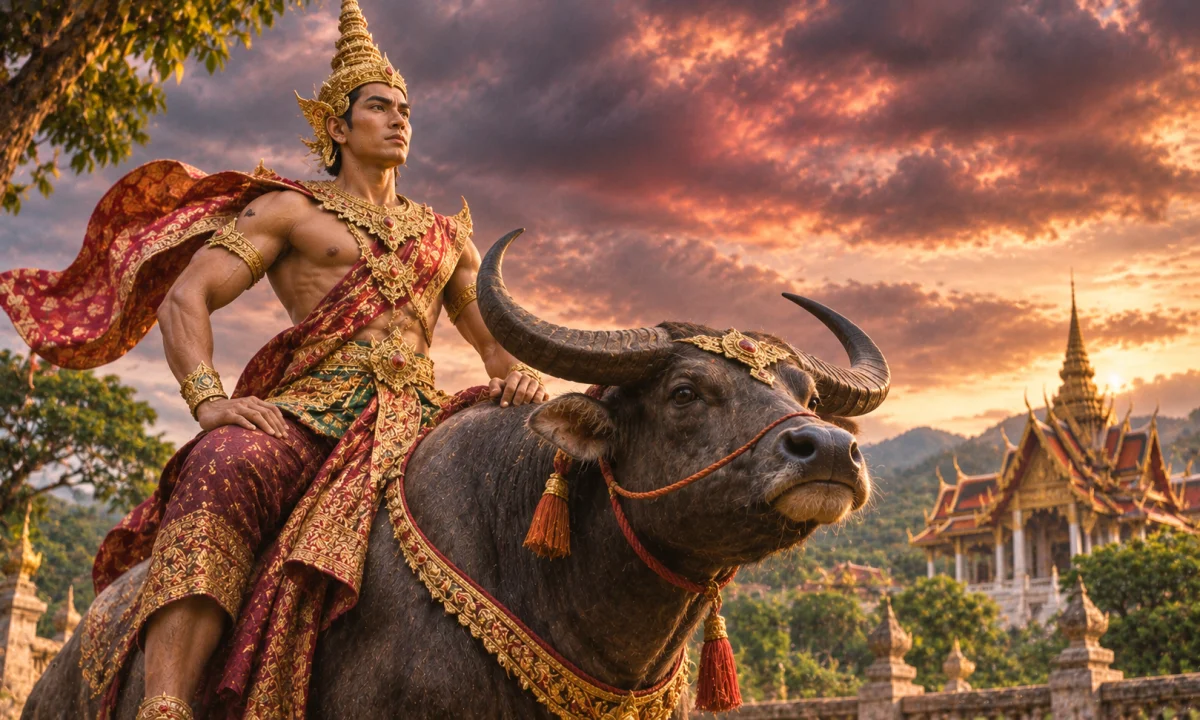
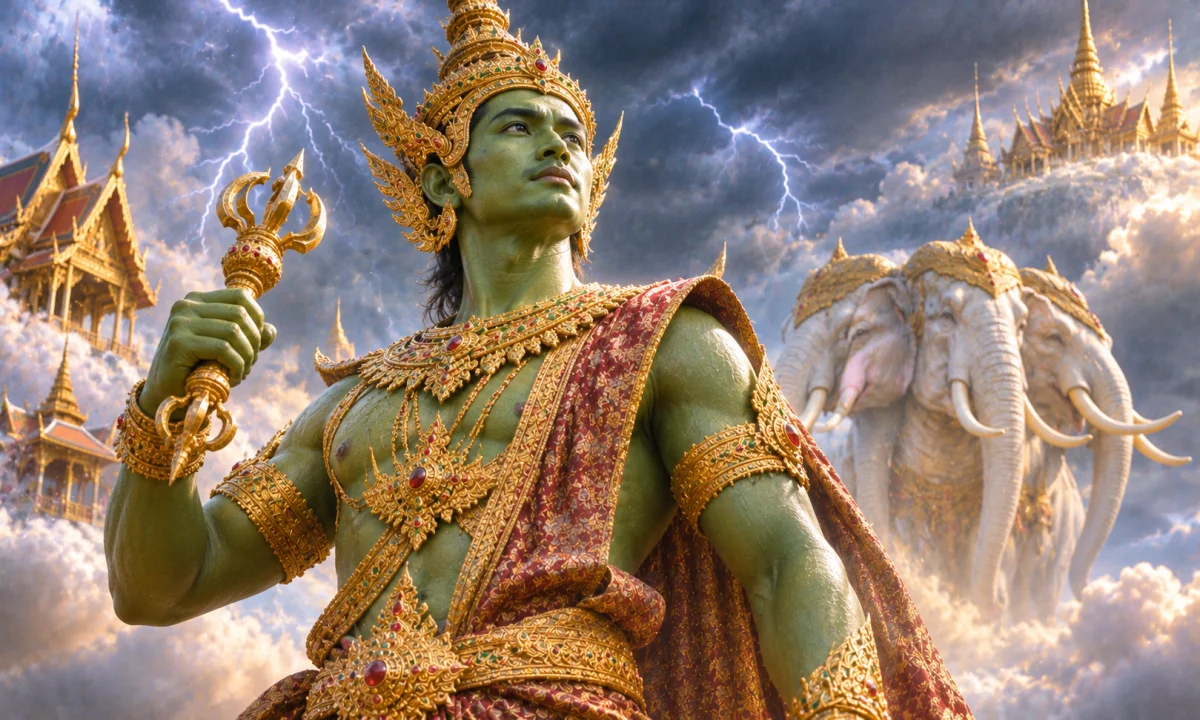
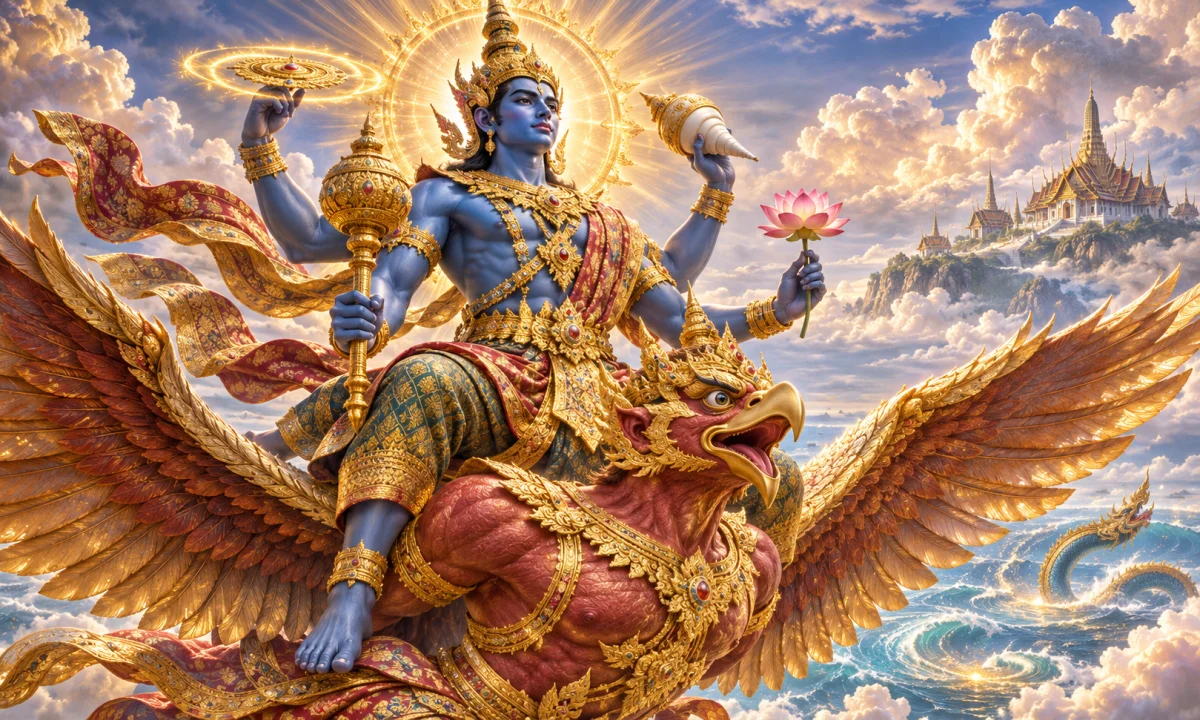
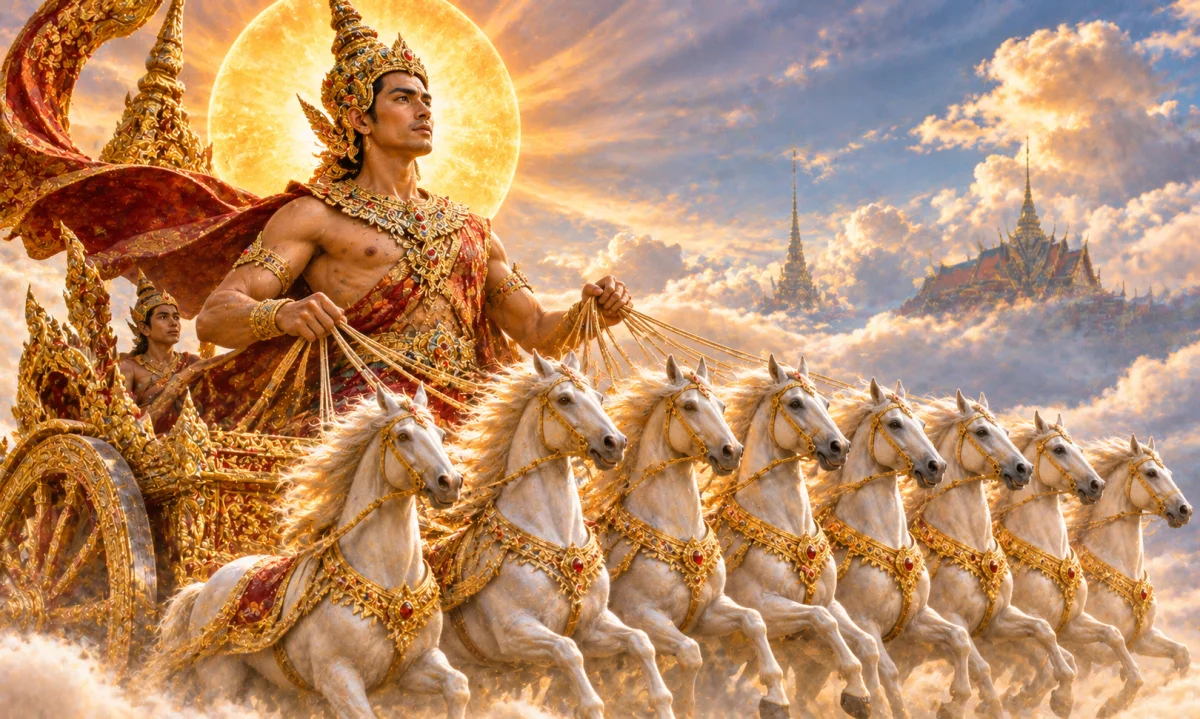
There is no single universally standardized Thai image of Phra Athit. His appearance depends on the artistic and religious context. When represented in a distinctly solar form, he may be shown as a radiant male figure with a golden, red or orange complexion, reflecting the colors of sunrise and the heat of the sun. A halo, rays of light or a solar disk can identify him as a sun deity.
Some representations follow the broader South Asian iconography of Surya. In that tradition, the sun god may stand or sit in a chariot drawn by horses, often associated with the movement of the sun across the sky. Images with a chariot and horses should therefore be understood as part of a shared Indic visual language rather than as proof of a uniquely Thai story about Phra Athit. Thai artists and ritual specialists have adapted these motifs in different ways, and many local or Buddhist contexts show the sun without a personified figure at all.
Common symbolic attributes include light, heat, regular movement, visibility and life-giving power. The sun makes ordinary human activity possible, supports agriculture and marks the daily rhythm by which communities organize work and ceremony. At the same time, excessive heat and drought can make the sun dangerous. Phra Athit consequently represents both benevolent energy and an impersonal force that must be respected.
Gold and red are particularly suitable colors for solar imagery. Gold suggests radiance, preciousness and royal splendor, while red can indicate the rising sun, heat, strength and the distinctive color assigned to Sunday in Thai astrological symbolism. These associations are customary rather than absolute; local images and texts may use different colors.
Cosmic role and symbolism
Phra Athit’s most fundamental role is to regulate the visible division between day and night. Through the sun’s regular course, time becomes measurable. Dawn marks renewal and the beginning of activity, while sunset signals the end of the ordinary working day. In a predominantly agricultural society, the solar cycle also influenced planting, harvesting, travel and seasonal expectations.
The sun’s visibility gives it a close relationship with truth and public authority. What is illuminated can be seen, judged and ordered. Solar imagery can therefore suggest clarity, knowledge, fame and the ability of a ruler or institution to make order visible. These meanings are not exclusive to Thailand, but they are compatible with the prestige traditionally attached to kingship, court ritual and cosmic order in Southeast Asia.
Phra Athit can also symbolize impermanence. The sun appears every day, yet each day passes. Its regularity does not remove the Buddhist insight that all conditioned phenomena change. In Buddhist contexts, even celestial beings and heavenly realms are not beyond the cycle of birth and death. The sun may be powerful and beautiful without being eternal or morally supreme.
This distinction separates Buddhist cosmology from a simple interpretation of the sun as an all-powerful creator. Phra Athit is a celestial power within a larger universe, not normally the source of Buddhist liberation. The Buddha’s awakening is not attributed to solar worship, and devotion to the sun does not replace the ethical and meditative practices central to Buddhism.
Stories and literary traditions
Phra Athit does not possess one universally recognized body of Thai myths comparable to the complete narrative cycles of figures such as Rama or Hanuman. References to the sun are more often cosmological, astrological or poetic than narrative. Thai Buddhist and literary works may describe the sun rising, crossing the heavens, shining upon the world or interacting symbolically with the moon and other celestial bodies.
The sun and moon frequently function as a pair. The sun governs daylight and is associated with heat, brilliance and active power; the moon governs night and is associated with coolness, reflected light and changing phases. Their opposition helps structure stories and images concerned with balance, time and the alternation of visible and hidden things. This relationship does not necessarily mean that Thai tradition preserves one fixed myth explaining their origin.
Thai retellings of Indian-derived epics may also contain solar figures or episodes influenced by the Sanskrit tradition. In Indian mythology, Surya is connected with several important genealogies and heroes, including the solar lineage of kings and the epic figure Karna. Thai adaptations such as the Ramakian draw on the Ramayana but are not exact translations of the Sanskrit epic, and the presence of solar motifs in Indian source traditions should not be turned into unsupported claims about a separate Thai genealogy for Phra Athit.
In poetic language, the rising sun may be addressed with honorific terms or compared with the splendor of a monarch, a sacred image or a heroic figure. Such literary personification is not always evidence of formal worship. Thai language commonly gives natural forces human or divine qualities for artistic effect.
Relationship to Surya and other solar figures
Phra Athit is often compared with Surya, the Hindu solar deity. The comparison is reasonable because the Thai name is related to Sanskrit solar vocabulary, and Thai iconography has received Indian and Khmer influences. Both may be represented through light, a solar disk, radiant color and a chariot drawn by horses.
Nevertheless, the terms should not be used as perfect synonyms in every context. Surya belongs to the diverse religious traditions of India, where he has distinct myths, hymns, temples, genealogies and ritual practices. Phra Athit is the Thai expression of solar power within a different historical environment, especially one shaped by Theravada Buddhism, Thai astrology and local court culture. A Thai reference to Phra Athit may simply mean “the sun,” whereas a reference to Surya may invoke a specific Hindu deity and body of Sanskrit or regional traditions.
Phra Athit should also be distinguished from Phra Chan, the moon deity or lunar power associated with Monday. The two are complementary celestial figures, but they are not interchangeable. Nor should Phra Athit be confused with a weekday Buddha image, a royal ancestor, a local guardian spirit or any modern character whose name happens to contain the word for sun.
Ritual and cultural significance
In contemporary Thailand, people encounter Phra Athit most often through language, calendars, astrology, temple imagery and cultural symbolism rather than through a single organized cult devoted exclusively to him. A person may identify with Sunday as a birth day, consult astrological interpretations, observe the color associated with that day or visit a temple containing images linked with the weekdays without regarding Phra Athit as an independent supreme deity.
The sun also remains important in ceremonies and visual culture because it conveys auspiciousness, energy and royal dignity. Golden solar motifs may appear in architectural decoration, ceremonial design and religious art. Their meaning depends on context: a sunburst can indicate cosmic order, Buddhist radiance, royal grandeur or simply the beauty of dawn.
Modern Thai references to Phra Athit generally continue these older meanings rather than presenting a single standardized character. Popular media may turn the sun into a speaking god, superhero-like figure or fantasy deity, but such portrayals are creative adaptations. They should be distinguished from the more fluid traditional usage, in which Phra Athit may be a sacred name for the sun, an astrological power, a cosmological being or a poetic personification.