WORLD
WORLD
Amalthea
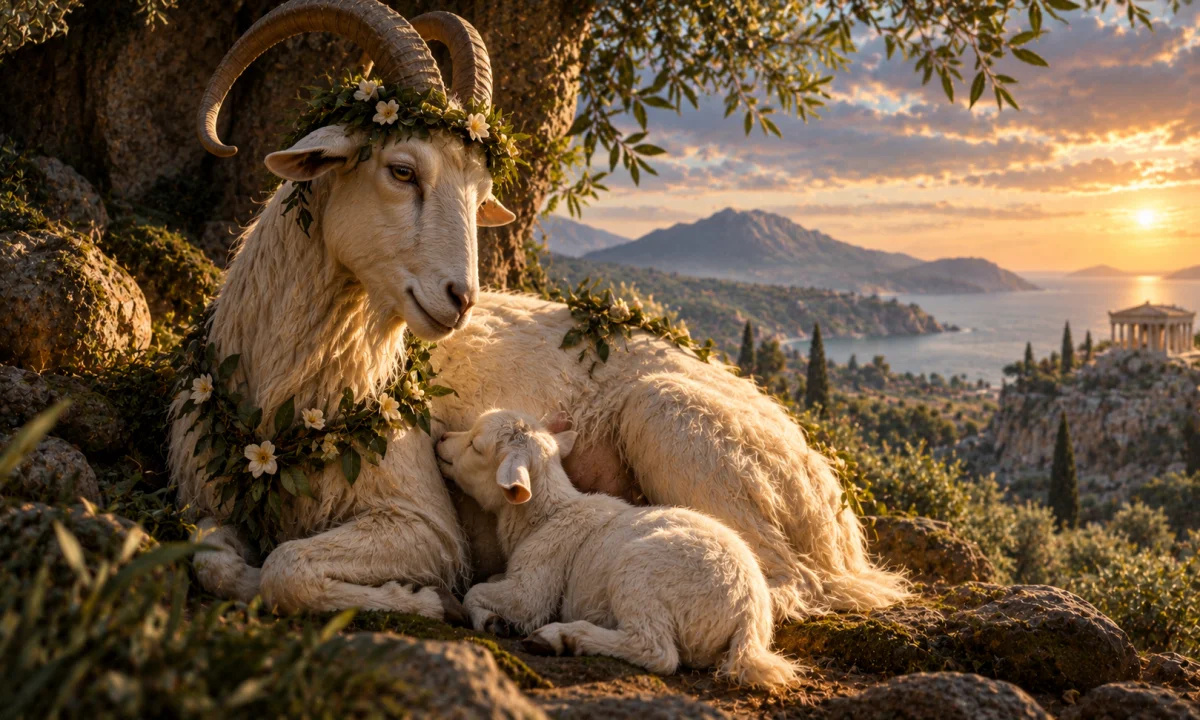
Amalthea is a figure of Greek mythology associated with the infancy of Zeus. In the most familiar version of the story, she is the goat whose milk nourished Zeus while he was hidden from his father, Cronus. Other ancient and later traditions describe Amalthea as a nymph who owned or cared for the goat, rather than as the animal herself. This variation is important: Amalthea is not presented consistently as a single type of being in every surviving source.
Her story belongs to the wider myth of Zeus’s secret upbringing in Crete. Rhea concealed her youngest child from Cronus, who had swallowed his earlier children because he feared a prophecy that one of them would overthrow him. Amalthea’s nourishment helped preserve Zeus until he was strong enough to challenge the older god. She is therefore linked with protection, maternal care, nourishment and abundance, although she is not normally classified as an Olympian goddess or as the subject of a major independent cult.
Origins and ancient setting
The myth is set during the succession struggle between the older divine generation, represented by Cronus and the Titans, and the younger gods who would become the Olympians. Cronus had learned that one of his children would eventually depose him. To prevent this, he swallowed each child as soon as Rhea gave birth. Rhea eventually concealed Zeus and presented Cronus with a stone wrapped in swaddling clothes instead.
Different accounts place Zeus’s hiding place in different Cretan locations, especially a cave connected with Mount Ida or Mount Dicte. Armed youths called the Curetes guarded the infant and concealed his cries by clashing their weapons and shouting. Nymphs also appear as his nurses or protectors in several versions. Amalthea belongs to this group of protective figures, but the exact role assigned to her changes from one account to another.
The oldest surviving versions do not provide a complete, fixed biography of Amalthea. In Hesiod’s Theogony, an important early Greek account of the divine generations, Zeus is hidden in Crete and protected by the Curetes, but Amalthea is not clearly named as his nurse. The goat and the name Amalthea become more prominent in later literary and mythographic traditions. This does not mean that the story was invented at a particular moment; rather, it shows that Greek myth circulated in multiple forms, with details being expanded, rearranged and combined over time.
Name and identity
The identity of Amalthea is one of the most debated aspects of the myth. In some accounts, Amalthea is a she-goat whose milk fed Zeus. In others, she is a nymph, while the goat is an associated animal. Some retellings use the name for the goat and the nymph together, treating them as different expressions of the same nurturing tradition.
There is no universally accepted translation of the name. Ancient and modern interpreters have proposed connections with Greek words associated with nourishment, tenderness or abundance, but the precise origin remains uncertain. It is safer to treat “Amalthea” as a traditional mythological name whose meaning cannot be established with confidence from the surviving evidence.
Apollodorus’s Bibliotheca, a later Greek mythographic compilation, describes Zeus as being nourished with the milk of Amalthea while the Curetes guarded him. The wording supports an interpretation of Amalthea as the goat, although the wider story also includes the nymphs Adrasteia and Ida as nurses. Other ancient sources make the animal more explicit, while later writers and artistic traditions sometimes turn Amalthea into a nymph who possesses the miraculous goat.
For this reason, describing Amalthea simply as “the Greek goddess of goats” is misleading. She is not generally a goddess with a clearly established domain comparable to Hera, Athena or Demeter. She is better understood as a nurturing mythic figure whose form varies between goat, nymph and a nymph-goat relationship.
The nurse of Zeus
Amalthea’s principal role is the nourishment of the infant Zeus. Hidden in Crete, Zeus needed to remain alive without being discovered by Cronus. The goat’s milk provided sustenance, while the Curetes’ noise prevented Cronus from hearing the child cry. In versions that emphasize nymphs, the nymphs supervise or share in the care of the infant, making Amalthea part of a larger protective household rather than the sole nurse.
The episode reflects a recurring pattern in Greek mythology: a future ruler survives through concealment and the care of marginal or nonhuman allies. Zeus is not raised openly in a royal palace. Instead, his survival depends on a remote landscape, a cave, female nurses, a goat and armed guardians. This inversion of normal kingship emphasizes both his vulnerability as an infant and the extraordinary protection surrounding his destiny.
The Cretan setting also gives the myth a strong pastoral character. Goats were familiar animals in the rugged mountains of Greece and Crete, where they could live in terrain unsuitable for agriculture. A goat that feeds a future god combines everyday pastoral experience with divine wonder. The animal is both ordinary and miraculous: a creature of the landscape that becomes essential to the cosmic change brought about by Zeus.
The horn and the cornucopia
Amalthea is often connected with the cornucopia, or horn of plenty. In one tradition, Zeus accidentally broke one of her horns. He then gave it a magical power: it would always provide whatever food or produce its owner desired. The horn therefore became a symbol of inexhaustible abundance.
The details are not consistent across all ancient accounts. Some versions describe the horn as belonging to Amalthea herself; others connect the cornucopia with the river god Achelous, whose horn Heracles broke during their struggle. These are separate mythic explanations that were sometimes brought together in later retellings. The cornucopia should not automatically be treated as an object created by Amalthea in every version of Greek mythology.
When the horn is associated with Amalthea, its symbolism grows naturally from her role as Zeus’s provider. Her milk sustains the hidden child, and her horn becomes a source of limitless nourishment. The myth transforms the body of a domestic animal into an emblem of prosperity. In ancient art and later allegory, the horn could represent agricultural fertility, wealth, generosity and the abundance granted by a benevolent power.
The cornucopia also helped Amalthea’s story survive beyond the specific narrative of Zeus’s childhood. Even when audiences no longer knew the details of the Cretan hiding place, the overflowing horn remained a recognizable image. It could be associated with goddesses, personifications of prosperity, rulers and the fertile earth without necessarily preserving Amalthea’s identity.
Amalthea and the aegis
Some later mythographic traditions connect Amalthea with the aegis, the protective object associated especially with Zeus and Athena. According to one account, Zeus used the hide of the goat that had nursed him as a protective covering or shield during his struggle against the Titans. This hide was called the aegis, and later traditions could place the Gorgon’s head upon it.
This explanation is not the only ancient account of the aegis. In Homeric poetry, the aegis is already a powerful divine object, often associated with Zeus, and its precise physical nature is not always clear. It may be imagined as a shield, a protective skin or a terrifying symbolic garment. Its connection with Amalthea belongs chiefly to later mythographic interpretation rather than to every early description of the object.
The association gives Amalthea a second role in Zeus’s rise to power. She first preserves him as a helpless child and later, in the relevant tradition, provides the material for his protection in war. The same animal that nourishes the future ruler also becomes part of his defensive equipment. This creates a symbolic link between care in infancy and strength in adulthood.
Amalthea among the stars
Ancient star myths associate a goat that nursed Zeus with the heavens. The goat is commonly linked with Capra, a star or stellar figure in the constellation Auriga. In these traditions, Zeus placed the grateful animal among the stars as a reward for her service. The nearby stars known as the Kids were also interpreted in connection with goats in ancient astronomical lore.
The exact identification varies, and ancient constellation traditions do not map neatly onto every modern constellation boundary. Amalthea should not be automatically identified with the constellation Capricorn. Capricorn is conventionally represented as a sea-goat and has its own complex history of interpretation, including associations with the god Pan or related pastoral figures in some traditions. The goat connected with Zeus’s nursing is more often discussed in relation to Capra and Auriga than as the origin of Capricorn itself.
The celestial placement extends the theme of gratitude. A humble animal that helped preserve the ruler of the gods receives a permanent place in the sky. Such stories also reflect the ancient practice of explaining conspicuous stars and constellations through memorable mythic figures. The astronomical tradition does not establish that Amalthea was worshipped as a star goddess; it presents a mythological explanation for a celestial image.
Relationships with other figures
Amalthea’s most important relationship is with Zeus. She is not his mother: his mother is Rhea, daughter of Uranus and Gaia in the standard genealogical tradition. Nor is she normally described as his wife, consort or divine ancestor. Her relationship with Zeus is that of nurse, provider and protector.
Rhea remains central to the concealment plot. She saves Zeus from Cronus and arranges for him to be hidden, while the Cretan guardians and nurses keep him alive. The Curetes defend the child by making noise, and nymphs such as Adrasteia and Ida appear in some versions as his attendants. Amalthea’s place within this group varies, but she is usually connected specifically with nourishment through milk.
Cronus is Amalthea’s indirect antagonist. He does not usually confront her personally. His threat is directed at the infant Zeus, and the secrecy surrounding the goat’s care is part of the larger effort to defeat his attempt to prevent the prophecy. Amalthea therefore contributes to the overthrow of Cronus without becoming a warrior or political actor in her own right.
Symbolism and religious significance
Amalthea embodies the power of nourishment to preserve a threatened future. Zeus’s destiny depends not only on prophecy or divine conflict but also on milk, shelter and guardianship. The story gives mythic importance to forms of care that are often less visible than battles between gods.
Her goat form also carries associations with mountain environments, pastoral life and fertility. Goats were valuable for milk and could survive in difficult landscapes, making them practical animals as well as symbols of resilience. The miraculous goat of the Zeus myth turns these familiar qualities into cosmic ones.
At the same time, there is limited evidence for a widespread, independent cult of Amalthea. She should not be treated as a major fertility goddess simply because later symbolism connects her with abundance. Greek mythology contains many figures who are important in stories without receiving the formal worship, temples or ritual prominence associated with major deities. Amalthea is best understood through her narrative functions and later symbolic associations rather than through an assumed religious cult.
Distinguishing Amalthea from similar figures
- Rhea: Rhea is Zeus’s mother and the figure who deceives Cronus to save him. Amalthea is his nurse or associated goat, not his birth mother.
- Adrasteia and Ida: These nymphs are named as nurses or caretakers of Zeus in some accounts. They are not simply alternative names for Amalthea in every tradition.
- The Curetes: The Curetes are armed guardians who conceal Zeus’s cries with their dancing, shouting and clashing weapons. They are protectors, not nurses.
- Aegina: Aegina is a different Greek mythological figure, an island nymph and the mother of Aeacus in a separate tradition. Her name should not be confused with Amalthea.
- Capricorn: The sea-goat constellation is not automatically the same as the goat that nourished Zeus. Their stories and traditional identifications differ.
- Achelous: The river god Achelous is associated with another explanation of the cornucopia, involving the loss of one of his horns to Heracles.
Later reception
Amalthea’s image continued through the survival of the cornucopia, star lore and classical mythography. Renaissance and later European artists often represented her as a goat, a nymph with a goat or a maternal figure connected with the infant Zeus. These images sometimes combine details from several ancient sources, especially the nursing story, the broken horn and the celestial reward.
In modern culture, the name Amalthea is also used for characters, places and celestial objects. The most prominent scientific use is Amalthea, a moon of Jupiter, discovered in 1892. Its name recalls the mythological connection between Zeus and the goat or nurse who helped him survive. This astronomical naming is a modern commemoration of the myth, not evidence that ancient Greeks identified the moon with Amalthea.
Modern retellings often choose one version of the figure and present it as definitive. Some make Amalthea entirely a goat; others portray her as a nymph with a sacred animal; still others emphasize the cornucopia or the aegis. The ancient evidence supports a more flexible picture. Amalthea is a name at the meeting point of several traditions about Zeus’s Cretan childhood, and her significance lies precisely in the way those traditions connect nourishment, protection, abundance and the preservation of divine succession.