WORLD
WORLD
Aegina
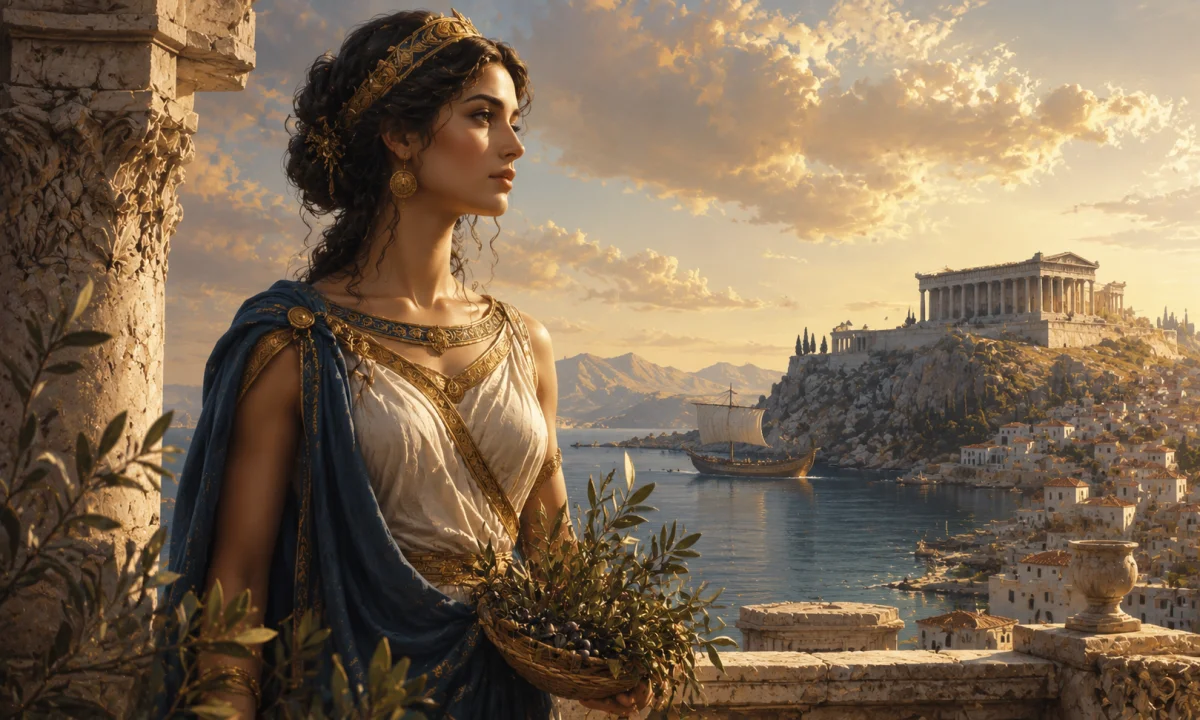
Aegina is a figure of Greek mythology best known as a river nymph, the daughter of the river god Asopus and the mother of the hero Aeacus. Her story explains the mythic naming of the island of Aegina in the Saronic Gulf and connects the island to Zeus, the royal lineage of Aegina, and the heroic families of later Greek legend. She is not usually presented as one of the great Olympian goddesses, but as a local or regional divine figure whose importance comes from ancestry, place, and mythic genealogy.
Origins and cultural setting
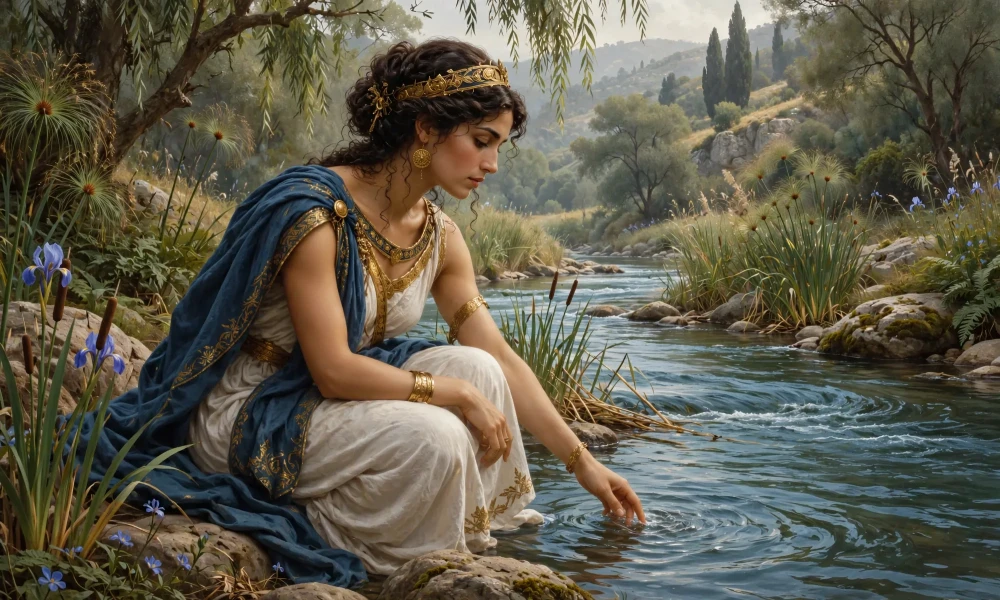
Aegina belongs to the wide network of Greek myths that personify rivers, springs, mountains, islands, and other features of the natural landscape. Rivers were often imagined as ancient male gods, while their daughters could appear as nymphs associated with water, fertility, and particular territories. Aegina’s father, Asopus, is one of these river gods. The name Asopus was attached to more than one river in the Greek world, especially rivers associated with Boeotia and the region around Phlius in the northeastern Peloponnese. Because Greek myth preserved several local genealogies, the precise geographical identity of Asopus can vary between traditions.
Aegina’s mother is usually called Metope, herself a river daughter. This makes Aegina part of a divine family formed from waterways and landscapes rather than one descended from the major Olympian dynasties. Such genealogies were not merely decorative. They gave communities a sacred history by linking a place to an old divine lineage and by explaining relationships between cities, rivers, islands, and heroic houses.
The surviving literary tradition is not contained in one single, complete narrative. Aegina appears in different forms in early Greek poetry and later mythographic accounts. Pindar’s Olympian Ode 8, composed for an athletic victor from Aegina, gives particular importance to Aeacus and the island’s heroic ancestry. Later mythographers, especially the author known as Apollodorus, preserve a more developed account of Zeus’s pursuit of Aegina and Asopus’s attempt to recover his daughter. The details differ, and no single version should be treated as the only ancient form of the myth.
Name and identity
The name Aegina belongs both to the mythological figure and to the island associated with her. In myth, she is primarily a nymph, although the word “nymph” covered a broad range of female nature divinities. Nymphs could be connected with springs, rivers, trees, mountains, islands, or particular localities. They were divine or semi-divine, but they did not occupy a fixed rank comparable to Hera, Athena, or Aphrodite.
Ancient traditions also used an earlier name, Oenone, for the island. In the mythic explanation of its name, the island came to be called Aegina after Zeus brought Aegina there. This is an example of an eponymous myth: a story that explains how a place, people, or community received its name by connecting it with a legendary ancestor or founding figure.
Aegina should therefore be understood in two related but distinct ways. She is a mythological woman with a divine parentage and a role in heroic genealogy, while Aegina is also a real island with its own religious institutions, political history, and local traditions. The myth connects them, but it does not mean that every religious practice on the island was devoted to Aegina herself.
The union of Zeus and Aegina
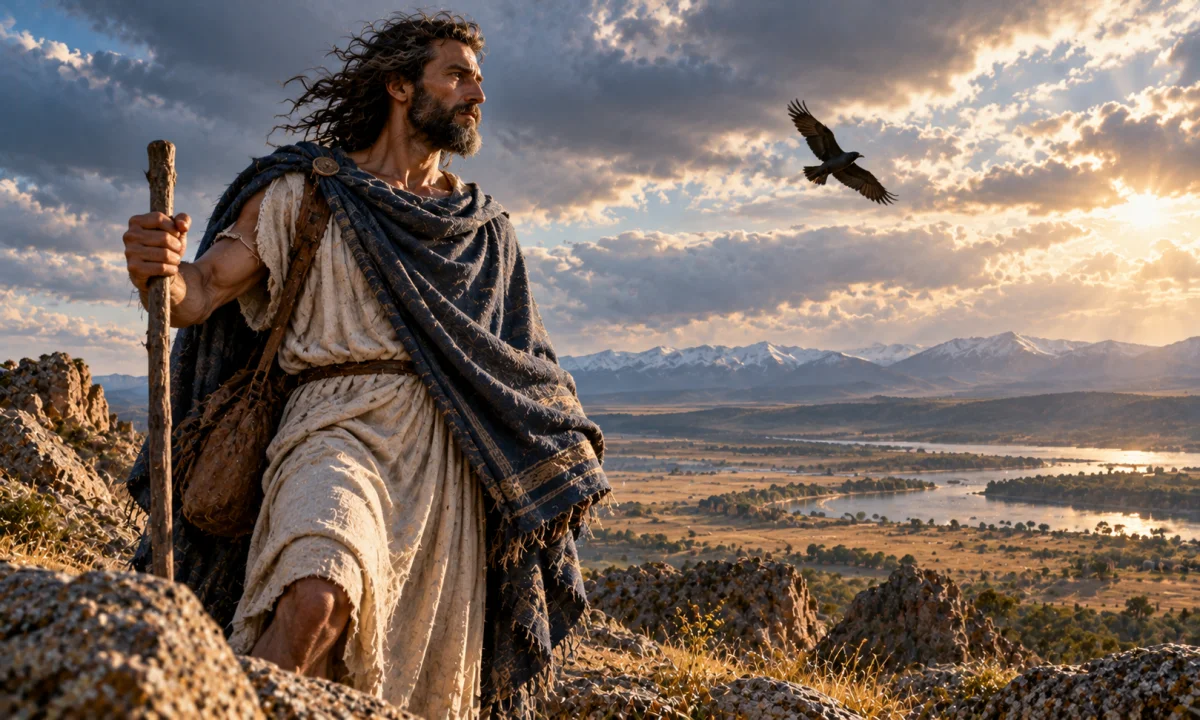
The central story begins when Zeus sees Aegina and desires her. In the most familiar version, Zeus carries her away from her homeland and brings her to the island then known as Oenone. Ancient accounts vary in how the abduction occurs. Some traditions describe Zeus taking the form of an eagle or using an eagle in the episode, while other versions simply say that he carried Aegina away. The transformation is consistent with wider Greek stories in which Zeus approaches mortal women or nymphs in changing forms, although the specific form and details are not uniform across the sources.
Asopus discovers that his daughter has disappeared and seeks to find her. In one influential version, the god of the river is told that Zeus has taken Aegina. Asopus pursues them, but Zeus uses thunderbolts to drive him back. This detail reflects the unequal power between a great Olympian god and a local river deity. It also offers a mythic explanation for the river’s course or for features of the landscape associated with it, although the story should not be treated as a literal account of geographical history.
On the island, Aegina gives birth to Aeacus, who becomes one of the most respected heroic kings in Greek mythology. Zeus’s connection with the island makes Aeacus a son of the chief Olympian, while Aegina’s descent from Asopus gives him a link to an older and more local divine order. Through Aeacus, the island becomes connected to some of the most important heroic families of Greek legend.
The story contains a familiar pattern in Greek myth: a powerful male god removes a female figure from her original home, and the resulting union establishes a new dynasty or explains the origin of a place. Modern readers may view the episode critically because the ancient narrative treats Aegina’s abduction as part of divine and royal genealogy rather than focusing on her consent or personal agency. In the traditional sources, the emphasis falls largely on Zeus’s power, Asopus’s failed pursuit, and the birth of Aeacus.
Aegina and Aeacus
Aegina’s most important mythological role is as the mother of Aeacus. In many accounts, Aeacus is born on the island and becomes its first king. He is famous for his justice, piety, and wisdom. His reputation eventually becomes so great that, after death, he is appointed one of the judges of the dead in the underworld, alongside Minos and Rhadamanthys.
The myths surrounding Aeacus also explain the special relationship between the island and its inhabitants. One story says that Aegina suffered a devastating plague after Hera became jealous of Zeus’s relationship with Aegina or angry at the honor given to Aeacus. The island’s population was destroyed, leaving Aeacus alone. In response to his prayer, Zeus transformed ants into human beings, producing the Myrmidons, whose name is connected with the Greek word for “ant.” This episode belongs primarily to the mythology of Aeacus and the island rather than to Aegina’s own independent narrative, but it reinforces her importance as the mother of the island’s founding king.
Ancient versions do not always connect the plague and the Myrmidons in exactly the same way. The story is especially important in later accounts of the heroic ancestry of Achilles. The Myrmidons who follow Achilles in the Iliad are associated in later mythology with the descendants of Aeacus, although the earliest epic traditions do not always present the full genealogical chain in the form familiar from later mythographers.
The Aeacid dynasty
Through Aeacus, Aegina becomes an ancestor of several major heroes. Aeacus has two principal sons, Telamon and Peleus, although some traditions also include Phocus as a son born to him by the Nereid Psamathe. Telamon is traditionally the father of Ajax the Great, the powerful warrior of the Trojan War. Peleus is the father of Achilles through his marriage to the sea goddess Thetis.
These relationships give Aegina an indirect place in the stories of both the Trojan War and the generation of heroes before it. The family line is often called the Aeacid or Aeacian dynasty, after Aeacus. Achilles, Ajax, and other figures associated with this lineage inherit a connection to Zeus and to the island of Aegina through Aeacus and his mother.
The myth of Phocus introduces conflict into the family. According to later traditions, Telamon and Peleus became jealous of Phocus and killed him, or were responsible for his death in another form of the story. They were then driven from Aegina by Aeacus. These events belong to the next generation and do not feature Aegina as an active character, but they show how her role as mother of Aeacus places her at the beginning of a lineage marked by both glory and violence.
Aegina in Pindar and local identity
Aegina was particularly important to the cultural identity of the historical island and its communities. Pindar’s poetry celebrates Aeginetan athletes and repeatedly invokes the island’s heroic past. In the Olympian Ode 8, the story of Aeacus and his divine ancestry helps elevate the status of the victor’s homeland. Athletic success was not understood as an isolated personal achievement: it could bring honor to a city, a family, and the heroic ancestors claimed by that community.
Pindar’s treatment of the myth is not a simple retelling. His poetry uses divine genealogy and heroic memory to explore fame, human limitation, justice, and the relationship between present achievement and the past. Aegina’s significance in this setting lies less in a detailed portrait of her personality than in the way she anchors the island’s connection with Zeus and Aeacus.
The island itself was a significant Greek community with religious sanctuaries, maritime connections, and a strong local identity. Its best-known sanctuary was that of Aphaia, a goddess whose identity and relationship to other Greek goddesses have been debated. Aegina also had a sanctuary of Zeus Hellanios, “Zeus of all the Greeks,” on Mount Oros. These cults demonstrate that the island’s actual religious life was broader than the myth of Aegina alone. It would be misleading to assume that the island was simply a cult center for its eponymous nymph.
Symbolism and interpretation
Aegina’s myth combines several recurring themes in Greek religious storytelling:
- Divine possession of landscape: the island becomes associated with Zeus through his union with Aegina and receives a sacred genealogy.
- Conflict between local and Olympian powers: Asopus represents an older, regional divinity, while Zeus represents the authority of the Olympian order.
- Dynastic foundation: Aegina gives birth to Aeacus, whose descendants include some of the greatest heroes of Greek epic.
- Water and movement: as the daughter of a river god, Aegina connects inland waterways with an island across the sea.
- Place-name explanation: the story provides a mythic reason for the island’s name and distinguishes its identity from that of neighboring lands.
The story can also be read as a myth of displacement. Aegina is removed from her parental home and becomes the mother of a new local dynasty elsewhere. The movement from river territory to island territory mirrors the way Greek communities used myths to explain relationships between regions. Such stories could support claims of kinship or shared origin, even when the communities involved were politically independent.
There is no single ancient interpretation of Aegina’s character. Some accounts present her mainly as a passive object of Zeus’s desire, while the wider genealogy gives her lasting importance as the mother of a king and ancestor of heroes. It is therefore useful to distinguish between her narrative agency and her genealogical significance. She has relatively few independent adventures, but her position at the beginning of the Aeacid line gives her considerable mythic weight.
Distinguishing Aegina from similar figures
Aegina is sometimes confused with other women in Greek mythology whose stories involve Zeus or whose names are associated with places. She is not Io, the Argive heroine transformed into a cow, and she is not Europa, whom Zeus carries away in the form of a bull. The general pattern of a divine abduction can make these stories seem interchangeable, but their genealogies and local settings are different.
She should also be distinguished from Aegina as a geographical name. References to the island, its city, its inhabitants, or its political history do not automatically refer to the nymph. Ancient writers could move between mythic and geographic meanings without explaining the distinction each time. Context is essential.
Aegina is also not the same figure as Aegle, a name applied to several different mythological women, including a Hesperid and a daughter of Asclepius in separate traditions. Nor should she be merged with the many other daughters of river gods who appear in Greek genealogies. Similar family structures do not mean that the figures share an identity.
Later reception
Later Greek and Roman writers preserved Aegina chiefly through the story of Aeacus and the heroic genealogy that followed. Her name continued to matter because it identified the island and the ancestry of figures central to epic and tragedy. Artistic representations more often focus on Zeus, Aeacus, Achilles, or the Myrmidons than on Aegina herself.
In modern treatments of Greek mythology, Aegina may appear in retellings of Zeus’s many relationships or in accounts of the ancestry of Achilles. Popular adaptations sometimes simplify the genealogy, omit Asopus and Metope, or portray Aegina as one example among many of Zeus’s romantic encounters. Such presentations can obscure her local significance and the importance of the island’s own identity.
Modern discussions also tend to examine the power imbalance in the story more directly than ancient sources do. The episode is often described as an abduction rather than a romance, since the traditional narrative centers on Zeus taking Aegina away and provides no sustained account of her willing participation. This distinction matters when separating ancient mythic conventions from modern ideals about consent, agency, and representation.
Aegina remains significant not because she has a large cycle of independent adventures, but because she stands at the meeting point of landscape, divine genealogy, and heroic memory. Through her, an island receives a mythic name, a river god’s family enters the Olympian order, and the line of Aeacus leads toward Telamon, Peleus, Ajax, and Achilles.