WORLD
WORLD
Adrasteia

Adrasteia is a figure of Greek mythology whose identity varies between different ancient traditions. She is best known as a nymph who helped protect and raise the infant Zeus in Crete, but the name Adrasteia was also used as an epithet of Nemesis and as a name associated with unavoidable divine order. These traditions are related by the meaning of the name—often understood as “the inescapable” or “she from whom there is no escape”—but they should not automatically be treated as accounts of one single, consistently defined goddess.
Origins and cultural setting
The most familiar story of Adrasteia belongs to the Cretan traditions surrounding the childhood of Zeus. According to Greek myth, Zeus was the youngest child of the Titans Cronus and Rhea. Cronus feared a prophecy that one of his children would overthrow him, so he swallowed his children as soon as they were born. To save Zeus, Rhea concealed his birth and arranged for him to be raised secretly in Crete.
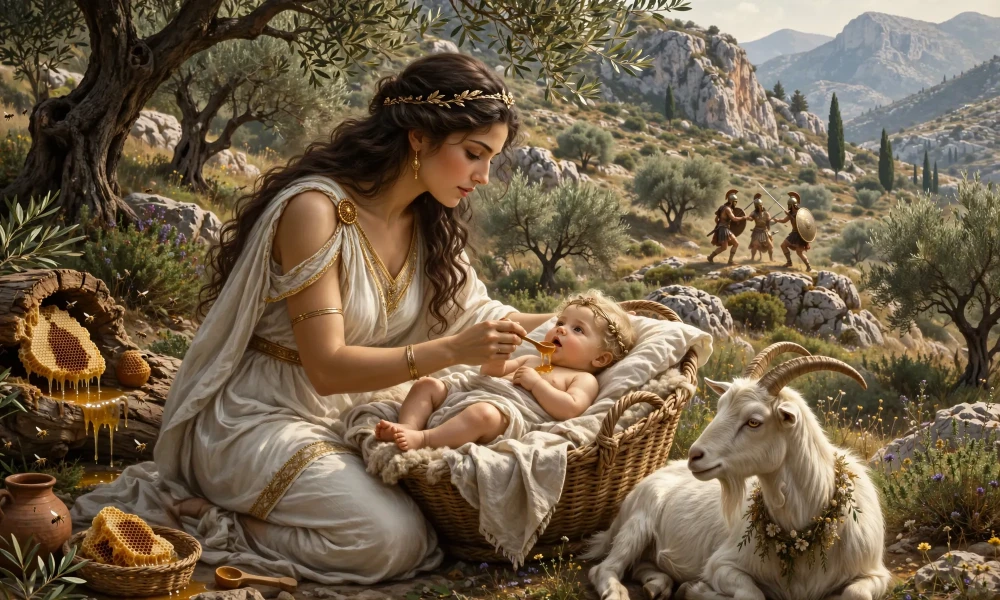
In versions recorded by later ancient mythographers, Adrasteia was one of the nymphs entrusted with the care of the infant god. She is commonly presented alongside Ida, another nymph, and both are described as daughters of Melisseus, a Cretan figure whose name is connected with bees or honey. The traditions reflect the importance of Mount Ida and Cretan sacred landscapes in stories about Zeus’s early life. The location of the cave where Zeus was hidden varies, and ancient writers did not preserve one universally accepted version of the episode.
Zeus’s concealment required more than a hiding place. The infant god’s cries had to be prevented from reaching Cronus. The armed Curetes, or in some accounts the and Idaean Dactyls, performed noisy dances and clashed their weapons together whenever Zeus cried. Their noise concealed him from his father. Adrasteia and Ida, meanwhile, belonged to the group of divine or semi-divine female guardians who nourished and protected him.
These stories combine several strands of Cretan religious imagination: mountain caves, fertility, sacred dancing, armed ritual attendants, bees, honey, goats, and the protection of a divine child. They are not a single primitive version of the myth preserved unchanged through time. Instead, they represent mythic traditions that were collected, adapted, and connected by Greek and Roman-era authors.
The name Adrasteia
The name Adrasteia is usually explained in relation to the Greek idea of something that cannot be escaped. It is often translated as “the inescapable,” “the unavoidable,” or “she who cannot be fled.” Such meanings help explain why the name could be applied to a powerful goddess of retribution or destiny as well as to a protective nymph in the story of Zeus.
Ancient names and epithets did not always function like modern personal names. A divine epithet could describe an attribute, a power, a place of worship, or a particular relationship with worshippers. Consequently, the appearance of the name Adrasteia in different contexts does not prove that all those contexts concerned the same mythological personality.
Adrasteia is also sometimes confused with Astraea, the personification of justice associated in later tradition with the constellation Virgo. The two names resemble one another in English and in transliteration, but they refer to different figures. Adrasteia should likewise be distinguished from Adrastus, the Argive king and one of the leaders in the legendary expedition of the Seven against Thebes.
Adrasteia as a nurse of Zeus
In the Cretan story, Adrasteia is not usually portrayed as a major independent goddess with a long cycle of myths. Her importance comes from her role in preserving Zeus during the dangerous period of his infancy. By keeping the child alive, she participates indirectly in the overthrow of Cronus and the establishment of Zeus’s rule over the gods.
Some accounts describe Adrasteia and Ida as nourishing Zeus with the milk of the divine goat Amalthea. Other traditions distinguish the goat from the nymphs more clearly, making Amalthea the animal who fed Zeus while the nymphs cared for him. The surviving accounts are not fully consistent about whether Amalthea was a goat, a nymph, or both in different versions. This is one reason that details of Zeus’s upbringing should be presented as variant traditions rather than as one fixed story.
Adrasteia is also associated in some retellings with a remarkable toy made for the infant Zeus: a golden ball with circles or bands around it, described as resembling the paths of the heavens. The object is a minor detail in the larger myth, and it does not appear in every account. Where it does occur, it gives the hidden child an object with cosmic imagery, suggesting that the apparently helpless infant already possesses a nature greater than that of an ordinary child.
The young Zeus’s protection has a strongly ritual character. The Curetes’ shouting, dancing, and clashing weapons are often interpreted as mythic reflections of Cretan ceremonial practices. Ancient writers connected Cretan religious traditions with ecstatic movement, mountain sanctuaries, and armed youth or warrior attendants. The story of Adrasteia therefore belongs not only to a family drama among the Titans but also to a broader Greek interest in explaining the rituals and sacred customs of Crete through divine stories.
Relationships with Ida, Amalthea and the Curetes
Adrasteia’s closest mythological relationship is with Ida. The two are often named together as the nymphs who raised Zeus, and their shared association reflects the importance of Mount Ida in Cretan mythology. “Ida” can refer to a mountain and also to a nymph or other mythic figure, so the name itself has more than one use in ancient sources. It is important not to assume that every reference to Ida concerns the same character.
Amalthea is another figure frequently brought into the story. In the best-known version, Amalthea’s milk sustains Zeus, and the infant’s nurse or nurses protect him in the cave. Later storytelling often combines these roles, making the nymphs and the goat part of one group of guardians. Adrasteia is therefore sometimes described as Zeus’s nurse, while Amalthea is described as his foster mother or provider of nourishment. The exact division of roles depends on the source.
The Curetes are not simply interchangeable with the nymphs. They are male armed attendants whose noise prevents Cronus from hearing Zeus. Some traditions link them with the Corybantes or Idaean Dactyls, while others treat these groups as distinct. Their names and functions overlap in later mythographic writing, but the ancient evidence does not support reducing all of them to one precisely defined group.
Adrasteia and Nemesis
A second major use of the name appears in connection with Nemesis, the goddess who imposes retribution, especially when human pride violates the proper limits established by the gods. Adrasteia could function as an epithet of Nemesis, emphasizing that divine retribution cannot ultimately be avoided. In this context, Adrasteia is not primarily the nurse of Zeus but an expression of the unavoidable consequences of arrogance, injustice, or excessive success.
Nemesis was especially associated with Rhamnous in Attica, where she had an important sanctuary. Ancient descriptions of the Rhamnousian goddess use the name Adrasteia in a way that connects her with inevitability and divine correction. The epithet may have strengthened the idea that no person, however powerful or fortunate, could escape the balance enforced by the gods.
The relationship between Adrasteia and Nemesis should be described carefully. In some settings Adrasteia appears to be a title or aspect of Nemesis rather than a separate goddess with an independent cult. In other philosophical or literary contexts, the name takes on a wider meaning connected with necessity, cosmic law, or the inescapable structure of existence. The evidence does not establish one universally accepted genealogy for this form of Adrasteia.
Philosophical and cosmic meanings
Greek philosophical writing sometimes uses divine names to express principles that are not represented as ordinary mythological characters. Adrasteia can therefore appear in discussions of necessity, moral order, and the consequences of the soul’s actions. In such contexts, the name suggests a law or power that even gods and souls cannot evade.
This philosophical usage should not be confused too quickly with the Cretan nursing nymph. The connection between them lies in the name’s central idea of inevitability, not necessarily in a continuous narrative biography. The nurse of Zeus protects a god who is destined to overthrow Cronus; the epithet of Nemesis represents the unavoidable working of divine justice; the philosophical figure expresses a cosmic or moral order. These are overlapping meanings rather than securely documented stages in the life of one goddess.
The concept also reflects a recurring theme in Greek religion and literature: power does not abolish limits. Kings, heroes, wealthy individuals, and even divine beings may face consequences when they exceed the boundaries appropriate to their condition. Adrasteia, in her association with Nemesis, gives a name to that inescapable limit.
Attributes and symbolism
Adrasteia does not have a single standard appearance preserved across Greek art. As a Cretan nymph, she belongs to the broad category of nature-associated female beings connected with mountains, springs, caves, trees, and the care of young gods. She may be imagined as a youthful guardian or nurse, but ancient evidence does not provide a fixed costume, emblem, or visual type that can be confidently assigned to her alone.
Her most important attributes are therefore narrative rather than physical:
- Protection: she helps keep the infant Zeus hidden from Cronus.
- Nurture: she belongs to the group responsible for feeding and raising the young god.
- Cretan mountain tradition: she is connected with the sacred landscape of Crete, especially the traditions surrounding Mount Ida.
- Inescapability: through her name and association with Nemesis, she represents consequences that cannot be avoided.
- Cosmic order: in philosophical and literary contexts, she can signify the necessity governing divine and mortal existence.
The combination of maternal care and inevitability may seem unusual, but Greek mythology often allows one divine name to operate in different symbolic registers. A figure who protects the future ruler of the cosmos can also lend her name to the principle that no being escapes the order of the cosmos.
Sources and uncertainty
The surviving evidence for Adrasteia is scattered. She appears in mythographic accounts of Zeus’s infancy, in traditions concerning Nemesis, and in philosophical or cosmological language. These sources were written at different times and for different purposes. A mythographer compiling genealogies was not necessarily preserving the same tradition as a poet describing ritual, and a philosopher using the name as a symbol of necessity was not necessarily recounting a cult myth.
For that reason, several details remain uncertain. Adrasteia’s parentage is not uniform in all traditions. Her precise relationship to Ida, Amalthea, the Curetes, and the Dactyls varies. It is also unclear whether every reference to Adrasteia as an “inescapable” power reflects a separate goddess, an epithet of Nemesis, or a more abstract personification. The name’s meaning provides a link among these uses, but it does not remove the differences between them.
There is also no strong basis for treating Adrasteia as one of the principal Olympian gods. She does not occupy a stable position in the Olympian family tree, nor does she have a large independent mythological cycle comparable to those of Athena, Artemis, or Aphrodite. Her significance is more specialized: she is a guardian in the story of Zeus’s survival and, under another use of the name, an embodiment of unavoidable divine retribution or necessity.
Distinguishing Adrasteia from related figures
Adrasteia and Nemesis: Adrasteia may be an epithet or aspect of Nemesis, particularly in contexts involving unavoidable retribution. This does not mean that every story about Adrasteia is a story about Nemesis.
Adrasteia and Amalthea: Amalthea is usually the goat, nymph, or foster figure who nourishes Zeus. Adrasteia is one of the nymphs associated with his protection and upbringing. Some later accounts blend their roles, but they are not automatically the same being.
Adrasteia and Ida: Ida is both the name of a Cretan mountain and the name of a nymph connected with Zeus’s childhood. Adrasteia and Ida are frequently paired, but their names should not be treated as alternate names for one character.
Adrasteia and Astraea: Astraea is associated with justice and the constellation Virgo in later Greek and Roman tradition. Despite the similar spelling, Astraea and Adrasteia are different figures.
Adrasteia and Adrastus: Adrastus is a male heroic and legendary king associated with Argos and the expedition against Thebes. The resemblance of the names does not indicate a mythological relationship.
Cultural significance
Adrasteia is valuable for understanding how Greek mythology linked local religious traditions with stories about the gods. The Cretan nurse belongs to a sacred landscape of caves, mountains, armed dancers, bees, and hidden divinity. Her presence helps explain how the childhood of Zeus could be imagined as a communal act of protection involving nymphs, supernatural attendants, and the natural world.
At the same time, the name’s use for Nemesis shows how a local or specialized divine identity could acquire a broader moral meaning. “The inescapable” became an appropriate title for a power that corrected human excess and maintained the limits of the divine order. Adrasteia is therefore best understood not as a goddess with one uncontested biography, but as a name operating across several connected areas of Greek religious and literary thought.