WORLD
WORLD
Adro
Adro is a name associated with the religious traditions of the Lugbara people of north-western Uganda and the adjoining areas of the Democratic Republic of the Congo. In English-language writing, the name may also appear as Adroa, and descriptions do not always use the terms in the same way. Some accounts present Adroa as the supreme creator or high god, while others distinguish the high god from adro, a broader category of spiritual beings or powers. The evidence comes primarily from Lugbara oral traditions and ethnographic descriptions rather than from a single canonical scripture, so the identity and classification of Adro must be treated with care.
Cultural setting
The Lugbara are an African people whose communities have historically occupied a region divided by the modern border between Uganda and the Democratic Republic of the Congo. Their religious traditions developed in a landscape of hills, streams, cultivated land, forests and settlements, and they connect human life with ancestors, spirits, social obligations and the powers present in the natural world.
Lugbara religion is not easily reduced to a fixed list of gods. Religious knowledge has traditionally been transmitted through oral narratives, ritual practice, family instruction, proverbs and the interpretation of unusual events. Different communities, narrators and researchers may therefore use names differently. A word recorded as Adro in one account may be written Adroa in another, while related terms such as adroanzi may refer to other spiritual beings connected with the same religious sphere.
It is also important not to treat “African mythology” as a single unified system. Adro belongs specifically to a Lugbara cultural and religious context. Similar-sounding names in other African traditions do not establish a relationship, and descriptions of Adro should not automatically be applied to unrelated gods, spirits or legendary beings elsewhere on the continent.
Name and identity
The spelling Adroa is often used for the Lugbara creator deity or high god. Adro can function as a shorter or variant form, but the relationship between the two terms is not presented consistently in all surviving descriptions. Transliteration is partly responsible for the variation: Lugbara words have been represented in European languages by writers using different spelling systems, and oral terms can carry meanings that do not map neatly onto a single English word.
Some accounts describe Adroa as the creator of the world, humanity and the order of life. In these accounts, the deity is remote from ordinary human affairs but remains the ultimate source of existence. Other accounts emphasize a division between a heavenly or benevolent aspect and an earthly or dangerous aspect. These accounts should not automatically be interpreted as describing two completely separate gods. The division may instead express different manifestations or dimensions of divine power.
The term adroanzi is also important when discussing Adro. It is generally used for spirits associated with Adroa, often understood as children, servants or manifestations of the creator. These beings are connected with particular places in the natural landscape and may be encountered around trees, rocks, streams or other sites considered spiritually significant. Because the words are related, English-language summaries sometimes merge Adro, Adroa and the adroanzi. They are better treated as connected but not identical concepts.
Adro as creator and high power
In traditions that identify Adroa as the supreme creator, the deity stands at the beginning of cosmic and human history. Adroa is not simply a spirit inhabiting one location. Rather, the name refers to a power above the other spiritual beings and to the source of the world in which humans, animals, ancestors and spirits exist.
Creation narratives associated with the Lugbara may describe the first human beings and the establishment of the human condition. The details vary in retelling, and there is no universally fixed version comparable to a single written creation text. The central religious idea is that human life has an origin beyond ordinary society and is dependent on a power greater than any individual clan or community.
The high god is often portrayed as distant. This does not mean irrelevant. In many traditional religious systems, a remote creator is approached differently from local spirits or ancestors. Everyday concerns may be addressed through family rites, ancestral observances, divination or relationships with local spiritual powers, while the creator remains the ultimate foundation of life and moral order.
Descriptions of Adroa’s character sometimes include both benevolent and threatening dimensions. A creator can give life, fertility and order, but divine power can also be feared when the world becomes disordered or when human conduct violates accepted obligations. It is therefore misleading to force Adro into a simple category such as “good god” or “evil god.” The contrast between heavenly and earthly aspects may communicate the ambivalent nature of sacred power rather than a modern moral division between two personalities.
The adroanzi and the living landscape
Adro is frequently discussed alongside the adroanzi, spiritual beings associated with the creator. In many descriptions, the adroanzi inhabit or guard wild and distinctive places. A large tree, an isolated rock, a stream, a hill or another striking feature of the landscape may be understood as a place where spiritual presence is concentrated.
These spirits are not merely decorative characters in stories. Their presence helps explain why particular places demand caution and respect. A person who enters a spiritually charged location without regard for local restrictions may be exposed to danger, illness or misfortune. The associated tradition therefore links religious belief with practical rules about movement, conduct and the treatment of the environment.
Some accounts describe the adroanzi as appearing in unusual or incomplete human forms, sometimes with only one side of the body or with other striking physical irregularities. Such descriptions should be understood as features of particular ethnographic and oral accounts, not as a universally agreed portrait. They may symbolize the spirits’ otherness: these beings resemble humans enough to be recognized but are not ordinary people.
Stories also portray some adroanzi as following travellers at night or as punishing people who behave disrespectfully. The exact consequences vary in retelling. The broader pattern is clear: the spirits mark a boundary between ordinary human space and places where human beings do not possess complete control. Their stories reinforce vigilance, respect and awareness of unseen forces.
Appearance and manifestations
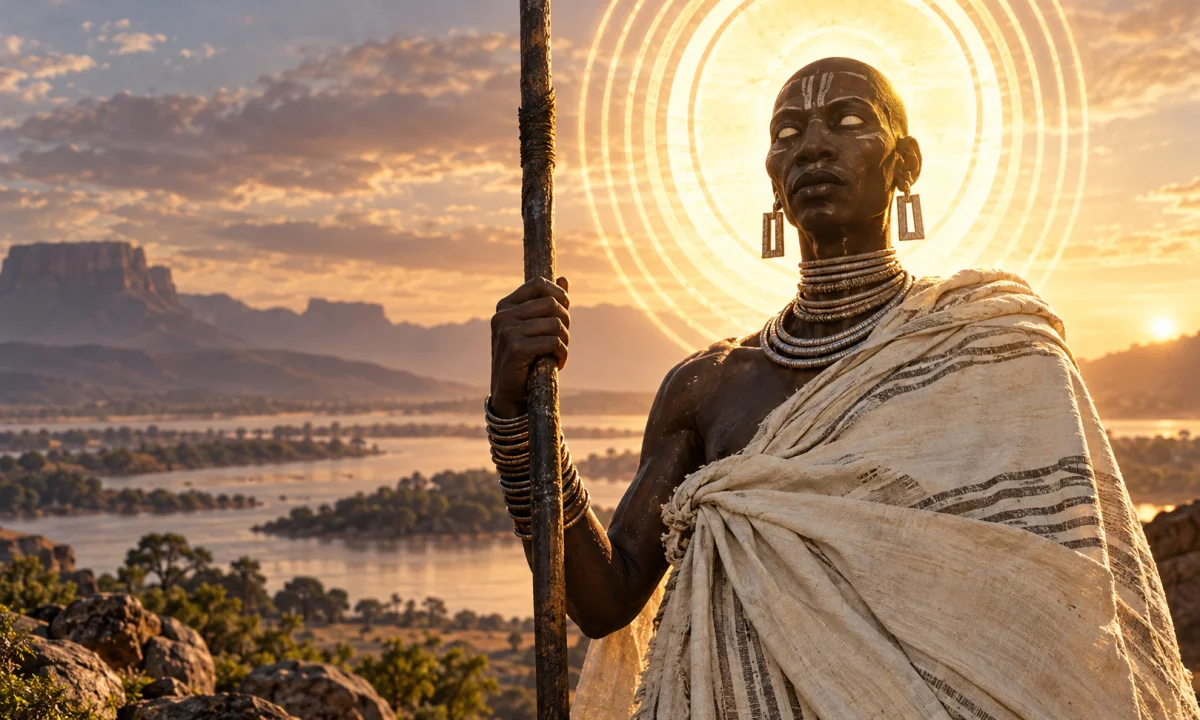
There is no single authoritative physical description of Adro himself. The creator deity is not generally represented as a standard anthropomorphic figure with a fixed costume, weapon or emblem. Descriptions of a visible, strangely proportioned or divided body more often belong to accounts of the adroanzi or to symbolic explanations of the creator’s different aspects.
References to a division between a white or heavenly side and a dark or earthly side appear in some discussions of Lugbara religious ideas, but such details should not be presented as universal doctrine. The meanings of colour and bodily division can also be altered when oral concepts are translated into European religious and anthropological vocabulary. A “good” and “bad” side may be a convenient explanatory formulation rather than the exact structure of Lugbara theology.
Adro’s most important characteristic is therefore not a particular appearance but a position within the sacred order. The name can point toward divine creation, the power behind life, or the spiritual forces connected with particular parts of the world. Physical imagery belongs mainly to the narratives and representations through which that power becomes imaginable.
Stories and relationships
Lugbara origin narratives connect the creator with the beginning of humanity and with the division between the divine realm and the human world. The stories are preserved in variant forms, and details can differ according to the community, narrator and purpose of the telling. Some versions focus on the first ancestors; others emphasize the role of spiritual beings in the continuing relationship between people and the landscape.
The adroanzi are commonly understood as related to Adroa rather than as independent deities of equal status. Their exact relationship is described variously: they may be called the creator’s offspring, servants, guardians or manifestations. These differences reflect the flexible nature of oral religious classification. A category such as “spirit,” “child of the god” or “guardian” may describe a being’s function without defining a strict genealogy in the manner of a literary pantheon.
Adro also belongs to a wider network of Lugbara religious relationships involving ancestors and other spiritual agencies. Ancestors are associated with family and lineage, while local spirits are connected with places and events. The high creator occupies a more distant level of the religious universe. These powers should not be collapsed into one another: an ancestor is not an adroanzi, and an adroanzi is not simply another name for Adroa.
Religious meaning
Adro’s significance lies partly in the way Lugbara traditions connect the visible and invisible worlds. Creation is not treated as a remote event with no consequences for daily life. The natural world can remain spiritually active, and human conduct within it matters. Sacred power is encountered through places, relationships, obligations and signs rather than only through formal worship of a personal deity.
The traditions surrounding Adro also express the limits of human knowledge. The creator is greater than the human community, while local spirits represent forces that people may encounter but cannot fully command. Narratives about danger in the bush, at night or near certain natural features teach that the world contains more than what is immediately visible.
This religious outlook should not be described simply as “nature worship.” The adroanzi are associated with the landscape, but the traditions also concern social boundaries, respect, family responsibility and the consequences of improper conduct. The natural and social worlds are connected rather than separated into distinct religious and secular spheres.
Because the traditions are oral, variation is not necessarily evidence that one version is authentic and all others are false. A ritual specialist, elder, storyteller or outside researcher may emphasize different aspects of the same religious vocabulary. Careful interpretation therefore distinguishes between broadly recurring themes—creation, spiritual presence, danger and the connection between places and unseen powers—and details that belong only to a particular account.
Distinguishing Adro from related figures
- Adro or Adroa: These names may refer to the creator or high god in Lugbara religious traditions, although their use varies between accounts.
- Adroanzi: Related spirits associated with Adroa and with spiritually significant natural places. They are not simply alternative names for the creator.
- Ancestors: Deceased members of family or lineage who have a different religious status and relationship to the living.
- Unrelated African deities: Names from other African traditions should not be identified with Adro merely because their roles involve creation, nature or a high god.
Confusion is especially likely when a short encyclopedia entry uses “Adro” as a general label for several Lugbara spiritual concepts. A more cautious description recognizes the variant spelling Adroa, explains the connection with the adroanzi and notes that the terminology is not uniform across sources.
Documentation and modern presentation
Knowledge of Adro comes through Lugbara oral tradition and through accounts written by outsiders who recorded aspects of Lugbara religion. Such records are valuable, but they are not neutral transcripts of a single official theology. Researchers translated Lugbara concepts into categories such as “god,” “spirit,” “demon” or “nature deity,” and those categories can introduce assumptions that were not part of the original system.
Modern reference works and mythology websites sometimes present Adro as a neatly defined character with a fixed appearance, a complete family tree and a standardized set of powers. That format can make the subject easier to read, but it may conceal genuine uncertainty. The most responsible presentation keeps the central Lugbara context visible and marks the difference between widely repeated interpretations and details found only in particular retellings.
Adro has not become a major standardized figure in global popular culture comparable to gods from Greek, Norse or Egyptian mythology. When the name appears in modern fantasy, games or online lists of African deities, those uses may simplify or rearrange Lugbara material. Such adaptations belong to contemporary invention or popular reception, not automatically to traditional Lugbara religion. The traditional significance of Adro remains rooted in the relationship between the creator, spiritual beings, human communities and the living landscape of the Lugbara world.