WORLD
WORLD
Adroa
Adroa is a supreme creator deity associated primarily with the religious traditions of the Lugbara people of northwestern Uganda and the adjoining regions of the Democratic Republic of the Congo. Lugbara traditions describe Adroa as the creator of the world and humanity, but the deity is not always presented as a simple, single-person god. Many accounts distinguish between a heavenly or benevolent aspect, often called Adroa Gaa, and an earthly aspect known as Adroa'd or by related spellings. The precise meanings and applications of these names vary in translations and recorded accounts.
Cultural setting
The Lugbara are a Central Sudanic-speaking people whose communities have historically lived in the West Nile region of Uganda and in neighbouring parts of the Democratic Republic of the Congo. Lugbara religious life traditionally includes beliefs about a supreme creator, ancestral powers, spirits connected with particular places, ritual specialists, family obligations and moral conduct. These elements belong to a living cultural tradition rather than to a single canonical mythology with one universally fixed version.
Knowledge of Lugbara religion has been preserved chiefly through oral tradition, ritual practice, family narratives and accounts recorded by outsiders. Missionaries, colonial officials and anthropologists sometimes translated Lugbara religious concepts into terms such as “God,” “spirit,” “devil” or “deity.” Such translations can be useful, but they may also impose categories from Christianity or European folklore on ideas that do not correspond exactly to them.
For that reason, descriptions of Adroa should be treated as accounts of a varied tradition. Stories can differ according to locality, informant, language, period and the purpose for which they were recorded. A brief encyclopedia description may present Adroa as a god with a clear division between good and evil, while a fuller understanding of Lugbara belief suggests a more complex relationship between the creator, the world, human beings and spiritual forces.
Name and identity
The name is written in several forms, including Adroa and Adro. The spelling Adroa Gaa is often used for the transcendent or heavenly aspect of the creator. The earthly aspect is frequently written as Adroa'd, although punctuation, apostrophes and translations differ between sources. These variations do not necessarily indicate separate gods.
Adroa is generally classified as a creator god or supreme deity. In many descriptions, Adroa created the heavens, the earth and the first human beings, and remains the ultimate source of life and order. Yet Adroa is not always depicted as a personal ruler who intervenes constantly in everyday affairs. Traditional religious attention may be directed more immediately towards ancestors, local spirits, family rituals and the causes of illness, misfortune or social disorder.
The division between Adroa Gaa and Adroa'd is particularly important. Adroa Gaa is associated with the sky, remoteness and a positive or life-giving aspect of divinity. Adroa'd is connected with the earth and with the deity's presence within the human world. Some older descriptions characterize the earthly aspect as dangerous, destructive or morally negative. However, equating Adroa'd simply with an independent “evil god” can oversimplify the tradition. The two aspects are commonly understood in relation to one another, rather than as unrelated beings in a straightforward battle between good and evil.
Creation and the first people
Creation narratives associated with Adroa explain the origin of the world and of human society. In commonly reported versions, Adroa created the first human beings, who are often named Gborogboro and Meme. Gborogboro is usually identified as male and Meme as female, although the details of their emergence and their descendants vary in different tellings.
Some accounts connect the first people with natural features such as a termite mound, a tree or the earth itself. These details are not consistent across all records, and it is safer to regard them as regional or narrative variants rather than as parts of a single fixed creation story. The importance of the myth lies less in a standardized sequence of events than in its explanation of humanity's dependence on a creator and its placement of human origins within the Lugbara moral and social universe.
Stories about the first generations may also address the appearance of death, the growth of families and the establishment of relations between human beings and the spiritual world. In oral traditions, these themes are often interwoven rather than separated into distinct myths. A story about the first people may therefore explain not only where humans came from but also why they suffer, die, marry, form communities and remain accountable to forces beyond themselves.
Appearance and unusual form
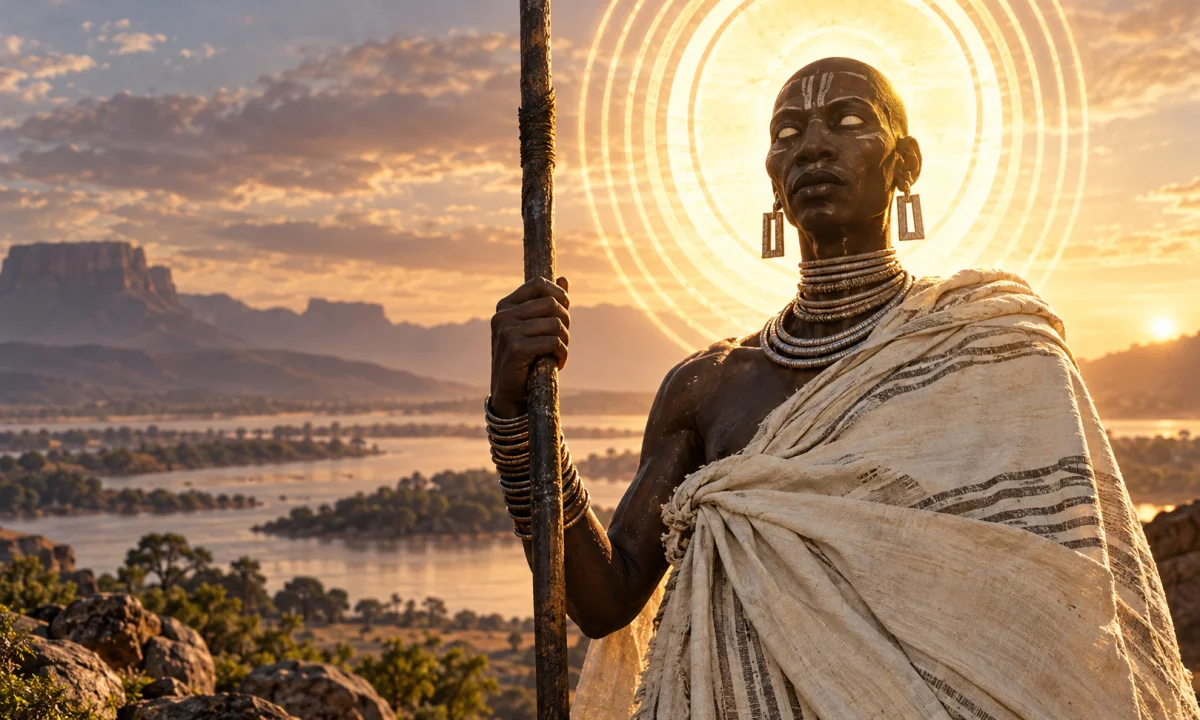
Adroa is sometimes described in folklore summaries as having an incomplete or asymmetrical body. Reported features include one eye, one arm, one leg or one side of the body. Other accounts describe a tall, thin or partly formed figure. These striking details have made Adroa especially memorable in modern reference works, where the deity may be presented as a bizarre or monstrous being.
The descriptions should be handled with caution. They do not amount to a single, universally recognized iconographic portrait, and Lugbara religious tradition is not known for a standardized image of Adroa comparable to the formal statues or painted representations associated with some other religious systems. The unusual body is most often encountered in narrative descriptions of the deity's manifestation or appearance to human beings.
Interpreters have sometimes suggested that the divided or incomplete body symbolizes Adroa's dual nature, with one aspect belonging to heaven and another to earth. That is a possible scholarly reading, but it should not be presented as a universally accepted explanation held by all Lugbara communities. The physical imagery may also express the strangeness of a being that does not belong wholly to the human world. In oral storytelling, an abnormal body can mark a figure as sacred, supernatural, dangerous or difficult to classify.
Power and role
As creator, Adroa stands at the highest level of the Lugbara spiritual order. The deity is associated with the origin of life, the natural world and the conditions that make human society possible. Adroa's authority is therefore cosmic as well as moral. The god is not merely a local spirit tied to one river, forest or settlement.
Adroa's earthly aspect is sometimes associated with encounters involving danger, death or punishment. In some recorded traditions, the deity appears to people who are approaching death or who have entered a spiritually significant situation. Such stories do not necessarily mean that Adroa is solely a death god. Rather, they emphasize the creator's power over the boundary between life and death and the unsettling nature of direct contact with the divine.
The contrast between the heavenly and earthly aspects can also be understood as a contrast between transcendence and immanence. Adroa Gaa belongs to the remote sphere above the human world, while Adroa'd represents divine power as it is experienced on earth, where life includes illness, conflict, danger and mortality. This is an interpretive framework rather than a complete definition, but it helps explain why the figure can be described as both benevolent creator and frightening presence.
Adroa and other spiritual beings
Adroa should not be confused with every spirit mentioned in accounts of Lugbara religion. The creator deity occupies a different position from ancestors and from localized spiritual beings. Ancestors may remain involved in the lives of their descendants, while local spirits can be associated with particular natural places or unusual events. Adroa, by contrast, is generally understood as the source of creation itself.
Confusion is also possible because the forms Adroa and adro may appear in discussions of Lugbara spiritual vocabulary. Similar-looking words do not automatically refer to the same category of being. Transcriptions from Lugbara into European languages vary, and the meaning of a term depends on its grammatical form and context. A reference to a creator called Adroa should therefore not be casually merged with references to ordinary spirits or with the personal names of ancestral beings.
Nor should Adroa be identified with creator figures from other African traditions simply because they perform a similar function. African religious systems are highly diverse. A creator god in one tradition may have little in common with a creator god in another beyond the broad role of bringing the world into existence. Adroa's association with Lugbara ideas about ancestors, earth, sky and moral life is what gives the figure its specific cultural identity.
Good and evil in interpretations of Adroa
Older descriptions often present Adroa as having a good side and an evil side. This language reflects both some reported interpretations and the vocabulary used by earlier observers. It can be misleading if it turns a complex dual structure into a simple Christian-style opposition between God and Satan.
Adroa'd is not best understood as an entirely separate rival who opposes Adroa Gaa from outside the divine order. In many accounts, the earthly and heavenly forms belong to one creator. The contrast may concern where the deity is encountered and how divine power is experienced rather than two independent gods competing for control of the cosmos.
The negative qualities assigned to the earthly aspect may reflect the human experience of the world as a place of suffering, death and uncertainty. A creator who is present in the earth is not encountered only through fertility and protection; the same power may be visible in natural danger, illness or the collapse of ordinary life. This does not remove the moral dimensions of Lugbara religion, but it shows why the figure cannot be reduced to a neatly divided personification of good and evil.
Oral tradition and the problem of fixed mythology
There is no single authoritative Lugbara scripture that fixes every detail of Adroa's identity. Narratives have been transmitted through speech, ritual knowledge and social teaching. Oral traditions can preserve stable names and major themes while allowing variation in episodes, imagery and interpretation.
Written accounts also need to be read in context. An outsider may have recorded a story during a particular conversation, translated a Lugbara term into a familiar European religious category or selected unusual details because they appeared especially striking. Later books and websites may then repeat those details without explaining their limited context. The result can be a portrait of Adroa that is vivid but narrower than the broader religious tradition.
Spelling is another source of uncertainty. Adroa, Adro, Adroa Gaa and Adroa'd may be treated differently in different publications. The use of apostrophes and the translation of words associated with “heaven,” “earth,” goodness or danger are not fully uniform. These differences should be acknowledged rather than silently presented as evidence for several unrelated deities.
Cultural significance
Adroa's importance lies in the way the figure connects creation with the lived religious world. The deity represents the origin of humanity, but also the continuing tension between the remote source of existence and the difficult conditions of earthly life. The distinction between heaven and earth offers a framework for thinking about why the creator can be both distant and present, protective and frightening, life-giving and associated with death.
The stories also demonstrate that a creator deity need not resemble the all-good, all-powerful figure familiar from one particular theological tradition. Lugbara concepts developed within their own social and ritual environment. Their meaning cannot be recovered fully by translating Adroa into the categories of “angel,” “devil,” “sky father” or “monster.” Those comparisons may be useful for orientation, but they are not equivalents.
Modern reception
Adroa has appeared in encyclopedias of mythology, comparative religion websites and collections of legendary beings. Modern summaries often emphasize the deity's unusual physical form or describe Adroa as a “two-faced” god of good and evil. Such presentations can make the figure accessible to a broad audience, but they may also detach the name from the Lugbara cultural setting and turn a religious being into a character in a catalogue of monsters.
There is no broadly established modern popular-culture version of Adroa comparable to figures from Greek, Norse or Egyptian mythology. When the name appears in contemporary fantasy or online mythology lists, those uses should be distinguished from Lugbara tradition. The traditional figure is a creator deity rooted in a specific African religious culture, not a generic supernatural creature whose attributes can be freely combined with those of unrelated beings.