WORLD
WORLD
Adroanzi

Adroanzi is the name commonly given to a class of spirits in the traditional religious thought of the Lugbara, a people whose communities are found mainly in north-western Uganda and the adjoining north-e eastern Democratic Republic of the Congo. They are generally described as spirits connected with the natural world and as children, descendants or emanations of Adroa, the supreme creator figure in Lugbara tradition. Accounts differ in detail, and English-language descriptions sometimes use “Adroanzi” loosely for several kinds of supernatural beings. The term should therefore be treated as a traditional category whose meaning can vary by locality and source, rather than as the name of one single character with a fixed biography.
Cultural setting
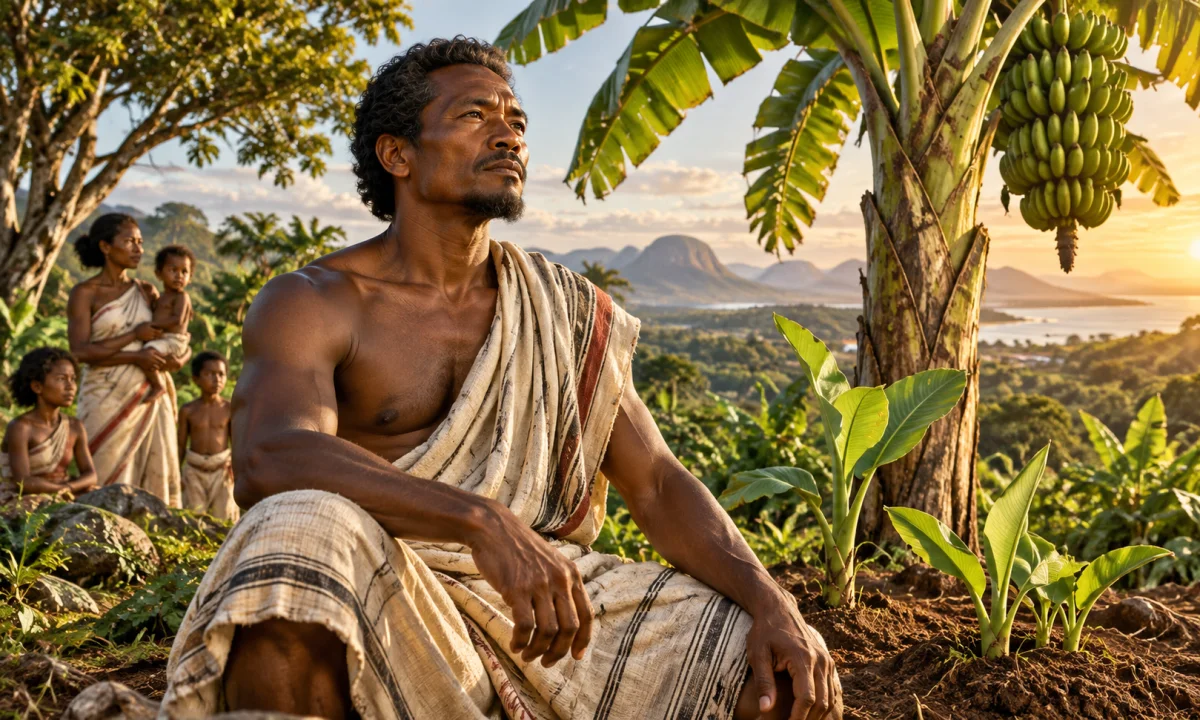
Lugbara religious tradition developed within an agricultural and pastoral society whose communities were closely connected to particular hills, streams, groves, trees and cultivated places. The landscape was not understood as spiritually empty. Natural features could possess a presence, a history and a relationship with human communities. Spirits associated with such places formed part of a wider religious world that also included the creator, the dead, ritual specialists and forces capable of causing illness or misfortune.
Knowledge about these beings was preserved principally through oral tradition, ritual practice, personal experience and stories told within families and communities. There is no single sacred book that defines all Adroanzi, nor is there one universally authoritative version of their myths. Ethnographic descriptions collected from different regions may consequently emphasize different features. Some accounts present the Adroanzi as protective spirits of nature, while others stress their danger to people who behave carelessly or fail to respect their territory.
Descriptions of Lugbara religion were written down by outsiders, often using categories such as “god,” “spirit,” “demon” or “nature spirit.” These terms can be useful for comparison but do not always reproduce indigenous distinctions exactly. Calling an Adroanzi a “nature spirit” indicates its association with the landscape; it does not mean that Lugbara religious thought necessarily separated nature and society in the same way as modern Western classifications do.
The name and identity of the Adroanzi
The word Adroanzi is commonly explained as referring to beings related to Adroa. In many accounts, they are called the children of Adroa, although “children” may describe a religious relationship rather than biological offspring in a literal human sense. They are subordinate to the creator but are more directly connected with particular places and encounters than Adroa is.
English spellings vary. The related name Adroa may be written in slightly different forms in older publications, and terms from Lugbara can be represented inconsistently when they are transferred into English. These differences do not necessarily indicate separate beings. At the same time, similar-looking names should not automatically be treated as identical, since records of Central African religions sometimes combine traditions from neighboring communities or use broad labels for local figures.
Adroanzi are not usually portrayed as human ancestors. Ancestors occupy their own important place in many African religious systems, but the Adroanzi are more often associated with the non-human or other-than-human environment. Nor are they simply equivalent to European fairies, ghosts or demons. Such comparisons may help communicate a general idea, but they can obscure the particular Lugbara relationship between spiritual beings, land and social conduct.
Connection with Adroa
Adroa is commonly described as the high creator or supreme deity of the Lugbara. Accounts of Adroa vary, but often present the deity as having contrasting aspects or manifestations, sometimes connected with benevolence and danger. The complexity of Adroa is important because it cautions against reducing Lugbara religion to a simple opposition between a wholly good god and wholly evil spirits.
The Adroanzi are linked to this larger divine order but are not merely smaller versions of Adroa. Their sphere is more immediate. They belong to particular locations and can affect people who enter those locations. In this respect, they help connect the remote creator with everyday experience: a person may not encounter Adroa directly, but may encounter the spiritual presence attached to a tree, stream, rock or stretch of wilderness.
Some descriptions speak of the Adroanzi as the children of Adroa and regard them as numerous. This language reflects their distribution across the landscape. Rather than being one universal spirit with a single personality, the Adroanzi are often understood as a multiplicity of beings, each with a local presence and a particular relationship to its surroundings.
Places and natural features
Adroanzi are frequently associated with elements of the natural environment, including trees, rocks, rivers and other striking or secluded places. A location connected with one of these spirits could be treated with respect, especially at times of day or under circumstances considered spiritually dangerous. The spirit’s presence did not necessarily make the place evil. Instead, it marked the place as subject to rules that human visitors needed to observe.
This association reflects a broader religious idea found in many societies: particular places may possess agency or spiritual ownership, and people who enter them do so as guests rather than as absolute masters. The Adroanzi therefore belong to a moral geography. Boundaries between settlement and wilderness, safety and danger, ordinary time and spiritually charged time could be expressed through stories about them.
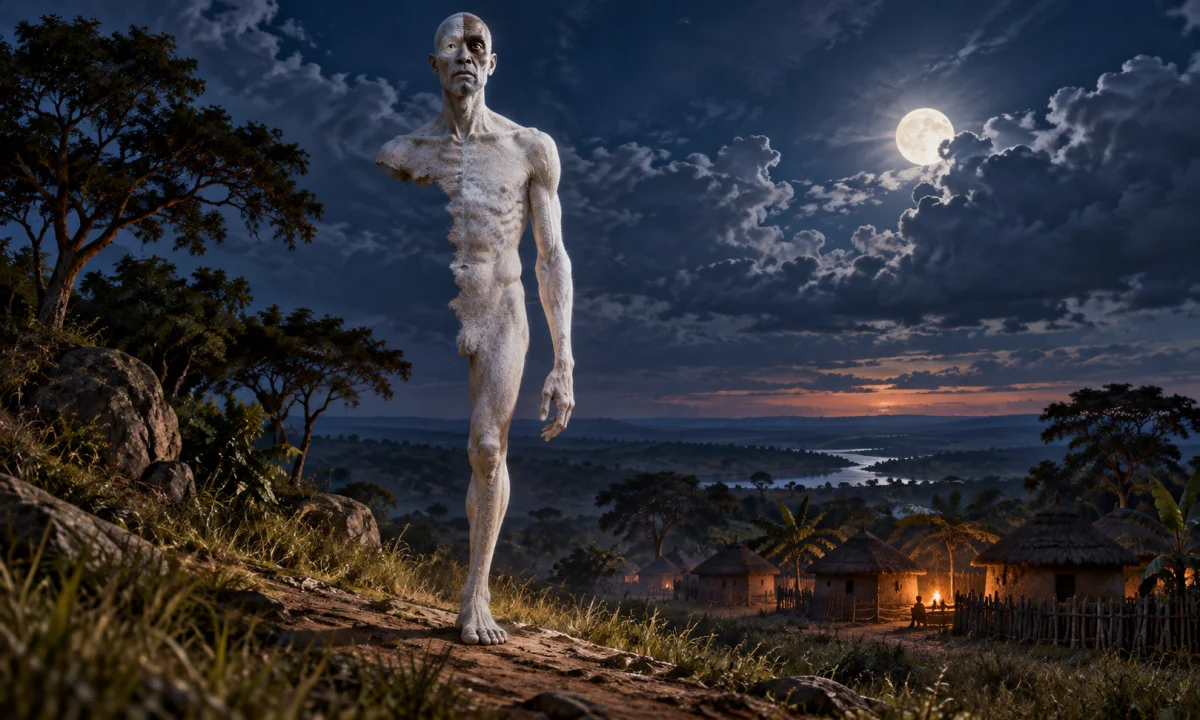
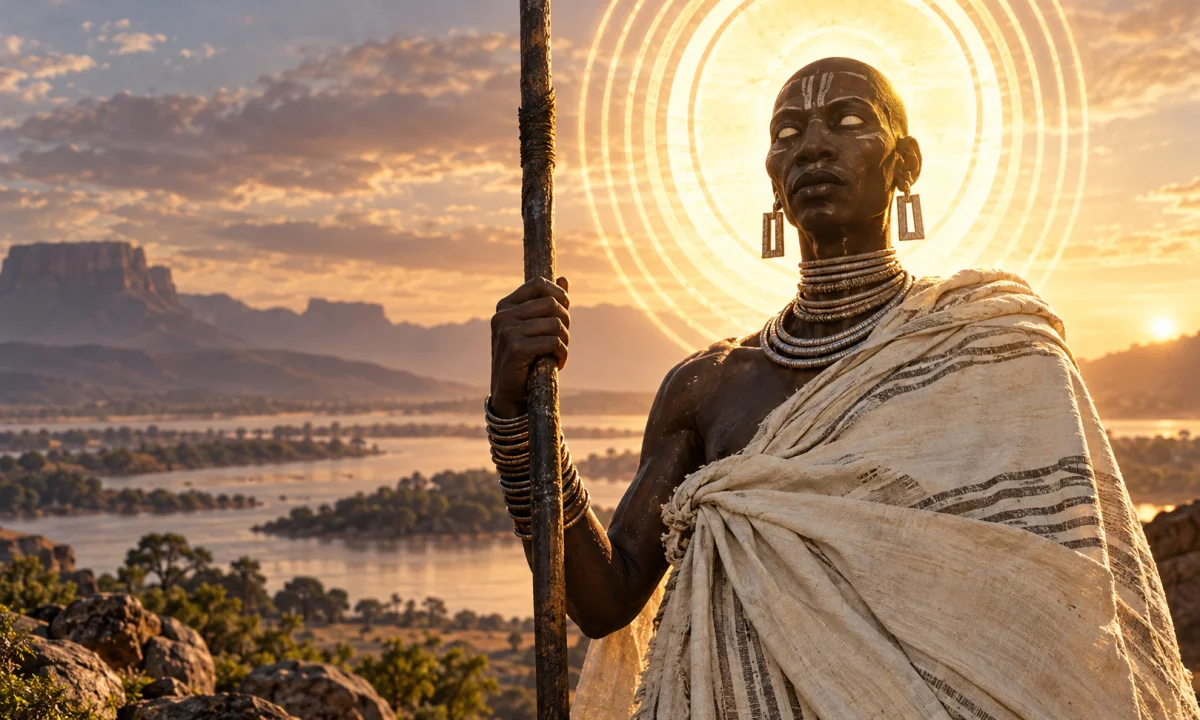
Descriptions of an Adroanzi’s appearance are less consistent than descriptions of its behavior. Some accounts emphasize that the spirits are normally invisible. Other retellings give them a more definite form, but these visual details are not uniform across the available tradition. There is no securely established, universally accepted image of the Adroanzi comparable to the standardized pictures created for many figures in modern fantasy.
The night-time follower
The most widely repeated story about the Adroanzi concerns a person who encounters one while travelling at night. An Adroanzi follows the traveller from behind. The central rule is that the person must not turn around to look at the spirit. If the traveller resists the impulse to look back, the Adroanzi may protect the person from other dangers along the road. If the traveller turns and sees it, the encounter becomes fatal in many versions of the story.
The tale is often summarized as a warning that looking back brings death, but its meaning is more complex than a simple prohibition. It describes a test of composure and respect. The traveller knows, or suspects, that a presence is behind them but must continue without demanding visual proof or challenging the being. The danger arises from breaking the rule governing the encounter.
The story also gives the Adroanzi an ambiguous character. The spirit is frightening and potentially lethal, yet it can act as a guardian. It does not fit neatly into the categories of benevolent protector or malicious monster. Its response depends on how the human behaves. Protection is possible, but it cannot be claimed by force, curiosity or entitlement.
In some retellings, the Adroanzi follows a person within the area under its power, particularly at night. The association with darkness may reflect the practical danger of travelling through unfamiliar places as well as the religious significance of times when ordinary human control is reduced. The story should not be treated as a single canonical episode with fixed characters and a fixed ending; it is better understood as a recurring narrative pattern within accounts of the spirits.
Roles and symbolism
The Adroanzi can be understood as guardians of place, though “guardian” is only an approximate English description. They do not simply protect humans from every threat. Their conduct is conditional, and they may themselves be dangerous. A person who respects the rules of a place may receive assistance, while a person who intrudes, mocks the spirit or violates a prohibition may suffer.
Several themes meet in the traditions surrounding them:
- Respect for the landscape: forests, waterways, rocks and trees are not merely resources but may be spiritually inhabited or protected.
- Limits on human knowledge: the traveller must accept the presence of something unseen without trying to force it into view.
- Self-control: the refusal to look back turns fear and curiosity into a moral test.
- Conditional protection: supernatural help is possible, but it depends on appropriate behavior.
- Danger at boundaries: night roads and remote places represent situations in which ordinary social safeguards are weakened.
These themes do not prove that every Lugbara person interprets the Adroanzi symbolically or in the same way. In a living religious tradition, a spirit can be at once a narrative figure, a presence connected with a real place, an explanation for an experience and a subject of moral teaching. Scholarly interpretation can identify recurring patterns, but it should not replace the meanings given to the beings by the communities concerned.
Relationship to other spiritual beings
The Adroanzi should be distinguished first from Adroa. Adroa is generally presented as the supreme creator, whereas the Adroanzi are subordinate spirits associated more closely with particular parts of the world. The two names are related, but they do not designate the same figure.
They should also be distinguished from the spirits of the dead. Ancestors may influence family welfare, ritual obligations and social morality, while Adroanzi are usually described as beings of the natural environment. A spirit encountered near a tree or on a night road is not automatically an ancestor. Treating all invisible beings as ghosts removes an important distinction in Lugbara religious thought.
Finally, Adroanzi should not be confused with figures from the mythology of other African peoples merely because those figures are also associated with forests, rivers or night travel. Africa contains thousands of distinct religious and cultural traditions. Similar motifs, such as a dangerous guardian of a sacred place or a spirit that follows a traveller, do not by themselves establish a shared origin.
Sources and limits of interpretation
What is known about the Adroanzi comes through a combination of oral traditions and written descriptions by researchers, missionaries and other observers. Written accounts are valuable records, but they were shaped by the questions, terminology and assumptions of their authors. Some may compress local variations into a single category or translate Lugbara concepts into familiar European religious language.
For that reason, claims about the Adroanzi should be expressed carefully. It is reasonable to identify them as spirits associated with Adroa and with natural places, and to discuss the recurring story of the night-time follower. It is less secure to assign every reported physical feature, power or family relationship to all Adroanzi everywhere. The tradition is not a fixed catalogue of traits, and local knowledge may preserve distinctions that broad summaries do not record.
The continuing importance of the Adroanzi lies less in a standardized list of supernatural abilities than in the relationship they express between people and the places they inhabit. They make the landscape morally charged: a road, stream or tree may require attention, restraint and respect. In the night-time story, the most dangerous mistake is not simply entering the spirit’s territory, but refusing to recognize that one has entered a world governed by rules beyond ordinary human control.