WORLD
WORLD
Uke-mochi
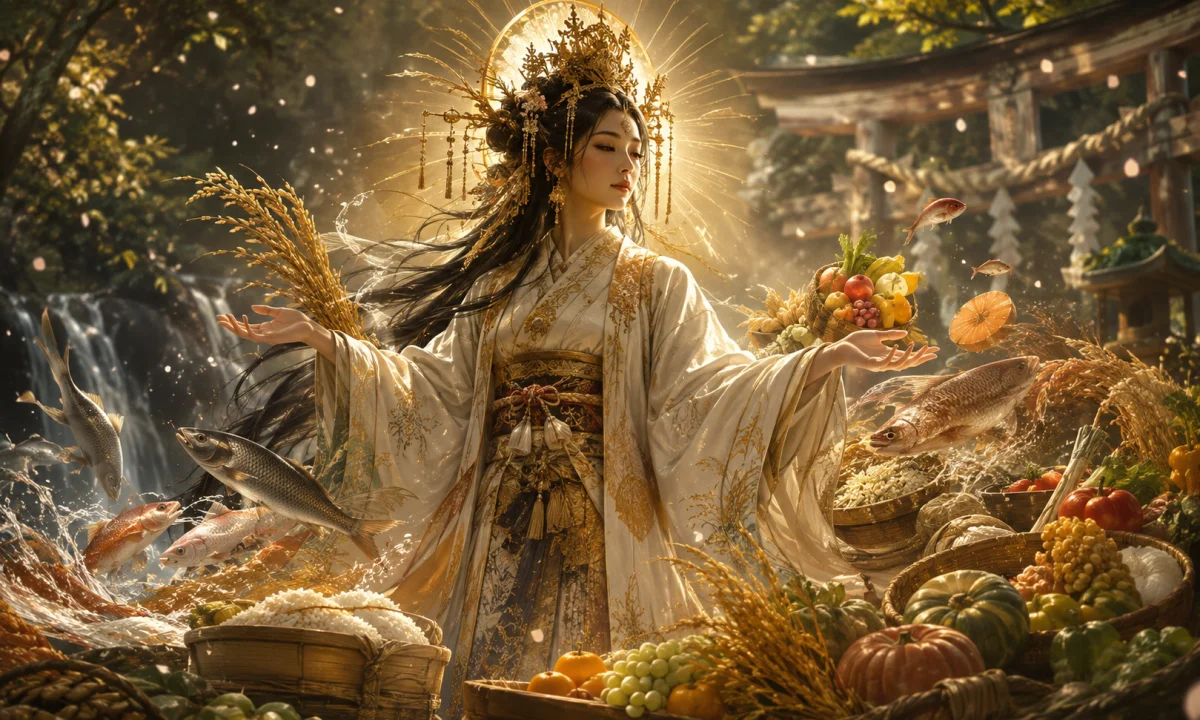
Uke-mochi is a Japanese food and fertility deity associated with the provision of grain, fish, game and other foods. In surviving tradition, Uke-mochi appears most clearly in Shinto mythic and ritual contexts, although the exact character of the deity varies by source and by region. The best-known story involving Uke-mochi is the death of the deity at the hands of the moon god Tsukuyomi, an episode that helps explain both the sacred value of food and the distance between celestial and earthly powers in Japanese myth.
Uke-mochi is not among the most widely worshipped kami in modern popular practice, and the name is not always treated in the same way across historical sources. Some traditions identify Uke-mochi closely with Ōgetsu-hime, another food deity who is also said to produce food from the body. Because the surviving material is limited and sometimes inconsistent, scholars and religious historians treat Uke-mochi as part of a broader cluster of Japanese food-providing deities rather than as a fully fixed figure with one universal form.
Sources and cultural setting
Knowledge of Uke-mochi comes mainly from early Japanese mythological texts and later shrine traditions. The deity is associated above all with the Shinto worldview, in which kami may embody natural forces, productive processes, local sacred power, or beings tied to human life and ritual purity. Food deities have a particularly important place in this setting because rice, grain, fish, and other staples were central not only to daily survival but also to offerings made to the gods and ancestors.
In early Japan, the boundary between agriculture, ritual, and political authority was closely connected. A deity who governs food is therefore not simply a figure of abundance; such a being also stands for the reliable ordering of the world and the proper exchange between humans and kami. Uke-mochi belongs to that religious landscape. The myths associated with the deity emphasize that food is sacred, that sustenance comes from divine power, and that the manner in which food is obtained can itself carry moral or cosmic meaning.
Historical evidence for the cult of Uke-mochi is uneven. Unlike major kami with large national shrines and extensive liturgical records, Uke-mochi is more often encountered through textual myth, local worship, and association with other food-related deities. That makes the figure important to Japanese religious history, but not easy to define in a single, absolute way.
Name, meaning and classification
The name Uke-mochi is commonly understood in relation to food and possession or production, though the precise etymology is not always handled identically in every source. Japanese mythological names often carry meaning through sound, usage, and later interpretation rather than through one uncontested ancient definition. In practice, the name signals a deity connected with the provision of sustenance.
Uke-mochi is generally classified as a kami, the broad Shinto category for divine or numinous beings. Within that category, the deity is usually described as a food or harvest deity. The figure is not typically presented as a creator god in the grand cosmic sense, nor as a war deity or imperial ancestor. Instead, Uke-mochi represents a more intimate and everyday sacred function: the generation of nourishment.
Because Japanese mythic figures are often linked through overlapping names, local identifications, and later theological interpretation, Uke-mochi is sometimes discussed alongside or even identified with Ōgetsu-hime. That relationship is not always presented in identical terms across texts and later commentaries. Care is needed not to assume that every reference to a food deity with miraculous bodily food production refers to exactly the same being in every tradition.
The myth of death and food creation
The best-known narrative involving Uke-mochi appears in the Kojiki, one of Japan’s earliest surviving mythological compilations. In that story, the moon god Tsukuyomi is sent to visit the food deity. Uke-mochi then produces food in a manner that is both miraculous and unsettling to the visitor: food appears from the deity’s body, associated with different parts of the face and body rather than with ordinary cooking or agriculture.
Accounts of the episode vary in detail, but the essential pattern is consistent. Uke-mochi’s body becomes a source of food, and Tsukuyomi reacts with disgust or outrage and kills the deity. From the body of the slain kami, new food plants and resources emerge. The story has often been read as an origin myth for cultivated or domesticated foods, explaining why humans can obtain nourishment from the earth after the loss of a primordial divine provider.
This episode is important because it combines abundance and violence. Uke-mochi gives food freely, yet the food is created through a body that is violated and destroyed. The myth therefore highlights a recurring religious theme in many traditions: sustenance is sacred, but it may also involve sacrifice, transformation, and the crossing of boundaries between life and death.
The story also reveals something about the mythology of purity and disgust. Tsukuyomi’s reaction suggests that divine provision is not always experienced as beautiful or comfortable. The act of eating depends on processes that humans may hide from view. Uke-mochi makes those processes visible in mythic form, turning the origin of food into a dramatic and memorable sacred event.
Relationship to Tsukuyomi and other deities
Uke-mochi’s most famous relationship is with Tsukuyomi, the moon god. The myth of the visit and killing is significant not only as a story about food but also as a reason for the separation of the moon deity from the sun goddess Amaterasu. In some traditions, Tsukuyomi’s act leads to estrangement from Amaterasu, explaining why sun and moon are not together in the sky. The exact narrative sequence differs by source, but the wider mythic function is clear: a violent interruption in the realm of food and hospitality becomes a cosmic division.
The relationship between Uke-mochi and Ōgetsu-hime is more complicated. In some later or parallel accounts, Ōgetsu-hime is the food goddess who also produces food from the body and is killed under similar circumstances. Because of the similarity in role and narrative pattern, the two figures are sometimes treated as equivalent or closely related, but the identification is not uniform. It is safer to say that Uke-mochi and Ōgetsu-hime belong to a shared mythic type: deities whose bodies generate food.
Uke-mochi is also relevant to broader Japanese patterns in which rice, grains, and agricultural fertility are linked to divine power. This does not mean that the deity should be reduced to a simple “rice goddess.” Instead, Uke-mochi belongs to a wider sacred economy in which all forms of nourishment, whether from field, water, forest, or kitchen, can be understood as gifts mediated by kami.
Appearance, powers and symbolism
Traditional sources do not provide a stable visual description of Uke-mochi comparable to the iconography of Buddhist buddhas or widely standardized kami images. In other words, there is no single canonical appearance. The deity is best understood through role and story rather than portraiture.
Uke-mochi’s main power is the miraculous production of food. The deity embodies abundance in an immediate and bodily way. Food appears not simply as an external gift but as an expression of divine substance. This makes Uke-mochi especially powerful as a symbol of fertility, provision, and the hidden generative capacity of nature itself.
The body-to-food transformation in the myth has prompted a range of interpretations. Some readers see it as a mythic reflection of agricultural processes, in which seeds buried in the earth “die” and then return as crops. Others see it as a ritual image of sacrifice and renewal, or as an expression of the uncanny way food emerges from life processes that are normally invisible. These are scholarly interpretations rather than established ancient explanations, and the myth probably carried multiple resonances for different audiences.
In religious symbolism, Uke-mochi also represents hospitality. The deity is approached as a host, yet the host is destroyed. That reversal makes the myth especially stark: it warns against dishonouring the source of sustenance, while also suggesting that the sacred gift of food may be fragile and can be lost through violence or disrespect.
Variants and interpretive issues
Japanese mythological tradition rarely preserves only one version of a story. The Uke-mochi narrative has variants in wording, emphasis and identification. Some versions stress the miraculous emergence of specific foods from different parts of the body; others focus more on the death of the deity and the subsequent appearance of new life-giving plants. The surviving sources do not always align perfectly.
There is also some uncertainty about how to classify the deity historically. Uke-mochi may be understood as a distinct kami, but the overlap with Ōgetsu-hime suggests that later tradition sometimes blurred the boundaries between related food deities. This is common in Japanese religious history, where local cults, textual redaction and later theological systems often brought separate figures into close association.
Interpretation of the myth varies widely. Some modern readers emphasize the gendered body and the violence inflicted on a female deity, while others focus on the ritual logic of food and purity. From a historical perspective, it is important not to project a single modern meaning back into the ancient text. The story likely operated on several levels at once: cosmological, agricultural, ritual and moral.
Another issue is the relationship between myth and actual worship. A deity may appear prominently in a story without having been the center of a large, organized cult. Conversely, local reverence may leave only faint traces in the literary record. Uke-mochi stands somewhere between those poles: clearly significant in mythic imagination, but not always fully visible in the surviving evidence of shrine practice.
Food, purity and ritual meaning
Uke-mochi is especially revealing when considered in the context of Japanese ideas about food and purity. In Shinto, purity is not simply moral cleanliness; it also concerns the proper order of life, death, pollution and renewal. Food is central to these concerns because it connects the human body to the natural and divine world.
The myth of Uke-mochi suggests that food comes from a sacred source but is not necessarily pleasant in origin. The deity’s body becomes the site where nourishment is created, and the violent interruption of that process marks a rupture in the divine-human relationship. In ritual terms, this may help explain why food offerings matter so much in Shinto: food is not ordinary matter, but a substance worthy of respect and reciprocity.
The myth may also resonate with the agricultural calendar. The apparent death of the provider followed by the emergence of food plants can be read as a seasonal pattern of loss and return. Such readings are interpretive, not explicit ancient commentary, but they fit the larger logic of agrarian myth around the world.
Place in Japanese religious history
Uke-mochi occupies a smaller but meaningful place in Japanese religious history. The figure helps illuminate how early Japanese myth connected cosmology to daily survival. Food was not merely practical; it was divine, relational and ritually charged. A deity who embodies food therefore stands at the intersection of household life, agricultural labour and sacred narrative.
The myth also illustrates how Japanese traditions often present gods through action rather than abstract doctrine. Uke-mochi is known primarily because of what the deity does and what happens to the deity, not because of detailed theology or elaborate doctrinal explanation. This is typical of many kami in classical myth, where story functions as both revelation and explanation.
At the same time, the limited evidence means that later devotion to Uke-mochi should not be overstated. The deity is important in the mythic record, but surviving documentation does not support sweeping claims about nationwide dominance or a universally shared cult. Regional reverence, shrine association and textual influence likely varied considerably.
Distinction from similar figures
Uke-mochi is sometimes confused with other Japanese food or grain deities because several kami share overlapping roles. The most common source of confusion is Ōgetsu-hime, whose myth and function closely resemble those of Uke-mochi in some traditions. When discussing either figure, it is best to note that the relationship is not fully settled and may reflect regional, textual or later interpretive differences.
Uke-mochi should also not be confused with deities whose fertility, agriculture or household protection is broader than food provision alone. Many kami can be linked indirectly to harvest or sustenance, but that does not make them equivalent. Uke-mochi’s distinctive feature is the direct and miraculous generation of food.
Nor should the deity be treated as a Buddhist figure. Although Japanese religious history includes extensive exchange between Shinto and Buddhism, Uke-mochi belongs primarily to the Shinto mythic world. Any Buddhist associations would need separate evidence and should not be assumed.
Later reception and modern relevance
In modern Japan, Uke-mochi is not among the most widely recognized mythic figures outside specialist or shrine-related contexts. The deity nonetheless remains of interest to scholars, practitioners and readers of classical myth because the story condenses so many enduring themes: divine sustenance, bodily transformation, the cost of nourishment and the separation of cosmic powers.
In contemporary popular culture, Japanese myths often reappear in manga, anime, games and novels, but Uke-mochi is a relatively specialized figure compared with more famous kami such as Amaterasu, Susanoo or Inari. When Uke-mochi does appear in modern media, the character is usually drawn from the traditional mythic image of a food deity rather than from a large independent narrative cycle. Because adaptations vary widely, each should be assessed on its own terms rather than treated as a direct extension of ancient belief.
For readers interested in Japanese mythology, Uke-mochi is valuable precisely because the deity is both concise and enigmatic. The surviving traditions preserve only a small cluster of stories, yet those stories touch on major aspects of Japanese religious imagination: the sanctity of food, the relationship between divine bodies and the natural world, and the tension between abundance and destruction.