WORLD
WORLD
Tlahuizcalpantecuhtli
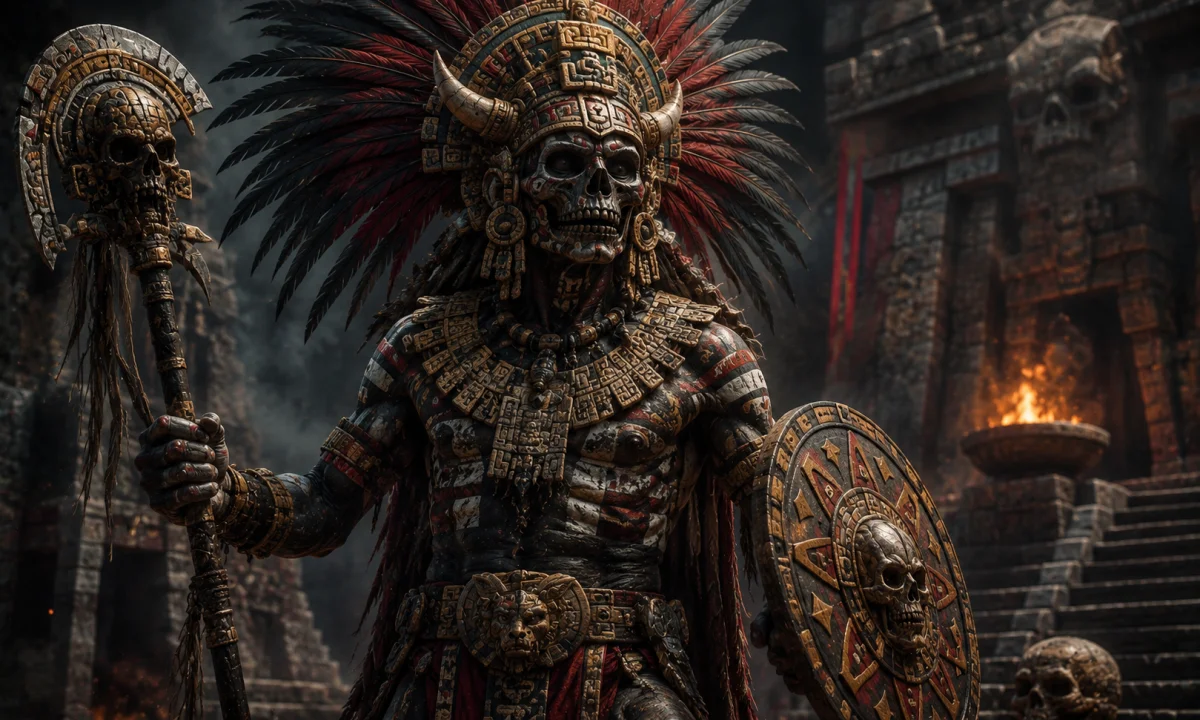
Tlahuizcalpantecuhtli is a deity and divine manifestation associated with the morning star in the religious traditions of central Mexico. His name is commonly translated as “Lord of the Dawn” or “Lord of the House of Dawn.” In Nahua thought, he is especially connected with Venus during its appearance before sunrise, a celestial event regarded as powerful, dangerous and rich in omens.
The figure is closely related to Quetzalcoatl, the Feathered Serpent. Some traditions treat Tlahuizcalpantecuhtli as a manifestation or aspect of Quetzalcoatl rather than as an entirely separate god. Other accounts present him as a distinct celestial being who participates in stories about the sun, cosmic ages and the dangers of the morning star. Because the surviving evidence comes mainly from colonial-period records and pictorial manuscripts, his identity and role vary between sources.
Origins and cultural setting
Tlahuizcalpantecuhtli belongs to the wider religious world of the Nahua peoples of central Mexico, including the Mexica, often called the Aztecs. His worship and symbolism should not be understood as belonging only to the Mexica capital of Tenochtitlan. Related religious ideas circulated among several communities, and different cities, priestly traditions and manuscript painters could preserve different versions of a deity’s character.
Venus was one of the most significant celestial bodies in Mesoamerican religion. Its movements are complex: it appears at times as a morning star, disappears from view, and later returns as an evening star. These changes were observed over a repeating cycle of approximately 584 days. Mesoamerican astronomers did not necessarily describe the planet in the same conceptual terms used by modern astronomy, but they carefully recognized its periodic appearances and disappearances.
For Nahua communities, the first appearance of Venus before sunrise was not simply a beautiful natural event. It could be interpreted as the arrival of a dangerous power. The morning star’s rays were imagined as capable of striking people, rulers or communities. This association helps explain why Tlahuizcalpantecuhtli is sometimes represented as an armed warrior or as a being who launches darts from the sky.
The evidence for these beliefs survives in several kinds of material. Colonial-era scholars and Indigenous informants recorded Nahuatl traditions in works such as the Florentine Codex and other historical and mythological compilations. Pictorial manuscripts, including the Codex Borgia and related ritual codices, preserve images connected with Venus, calendrical divination and celestial omens. These sources were produced after the Spanish invasion, but many of their concepts, artistic conventions and ritual structures derive from precolonial traditions.
Name and identity
The name is written in several forms, including Tlahuizcalpantecuhtli, Tlahuizcalpantecutli and forms with long-vowel markings such as Tlāhuizcalpantecuhtli. Differences in spelling reflect the way Nahuatl was transcribed by colonial writers and later scholars. The name is generally understood as referring to dawn and lordship, although translations may vary in their treatment of the compound.
Tlahuizcalpantecuhtli is often described as the morning-star form of Quetzalcoatl. This connection is particularly strong in traditions where Quetzalcoatl’s death or transformation leads to the creation of the morning star. Yet it is too simple to say that every reference to Tlahuizcalpantecuhtli is merely another name for Quetzalcoatl. In some narratives the two names designate related but distinguishable figures, while in others they form part of a single divine identity expressed in different states.
Quetzalcoatl himself had several dimensions. He could appear as the Feathered Serpent, as a priestly or culture-bearing figure, as a wind deity under the name Ehecatl, and in certain historical traditions as the priest-ruler Topiltzin Quetzalcoatl of Tollan. These identities overlap without being identical in every source. Tlahuizcalpantecuhtli belongs to this network of associations, but should not automatically be treated as the same figure in every story involving Quetzalcoatl.
Appearance and attributes
Images of Tlahuizcalpantecuhtli in central Mexican manuscripts emphasize his celestial and dangerous nature. He may be shown in a human or partly supernatural form, with strong body colours, facial markings, an elaborate headdress and weapons. The details differ between manuscripts, and the figures in ritual codices often combine several symbolic systems at once rather than providing a single standardized portrait.
One of his most recognizable attributes is the atlatl, or spear-thrower, accompanied by darts or arrows. The weapon expresses the belief that the morning star could send harmful influences down toward the earth. In ritual and calendrical contexts, such weapons may also signify aggressive force, warfare, sacrifice or the piercing rays of a celestial body.
Some depictions present him with a dark or strongly contrasting body, painted markings and a face that appears severe or transformed. Others emphasize a warrior’s costume. These visual features do not establish a fixed physical appearance for all Nahua communities. Pictorial manuscripts use colour and costume symbolically, and the same deity may look different according to the manuscript’s purpose and regional artistic tradition.
Tlahuizcalpantecuhtli’s central attribute is therefore not a particular garment or animal companion but the morning star itself. He represents the moment when Venus emerges into the eastern sky, a moment that could announce danger, change and the renewal of a cosmic cycle. His power is both illuminating and threatening: he brings light before sunrise, but that light is imagined as a weapon capable of causing harm.
The morning star and celestial danger
The morning appearance of Venus was connected with divination and the timing of ritual actions. In the broader Mesoamerican world, the first visible appearance of Venus could be treated as an omen for warfare, sacrifice, rulership and the welfare of communities. Nahua traditions similarly regarded the planet as an active celestial power rather than an inert object.
This outlook helps explain the violent imagery associated with Tlahuizcalpantecuhtli. His darts can be understood as the rays of Venus, but they also express a theological idea: heavenly events affect human life. A ruler or priest who observed the sky was not merely collecting astronomical information. He was interpreting the intentions and movements of divine powers that participated in the maintenance of the world.
Modern accounts sometimes describe Tlahuizcalpantecuhtli simply as “the Aztec god of Venus.” That description is useful as a basic introduction, but it can hide the complexity of his role. He is particularly connected with Venus as the morning star, while the planet’s evening appearance, periods of invisibility and wider cycle could be described through related figures and changing aspects of Quetzalcoatl. The evidence does not support a single universally accepted division between separate morning-star and evening-star gods.
Quetzalcoatl’s transformation into the morning star
One important story appears in the Anales de Cuauhtitlan, a Nahuatl historical and mythological record compiled in the colonial period. In this tradition, Quetzalcoatl is associated with Tollan and eventually undergoes death, burning or self-destruction. Afterward, his heart rises and becomes the morning star. Once transformed, he is identified with Tlahuizcalpantecuhtli.
The story links personal transformation with a cosmic event. Quetzalcoatl’s death is not simply the end of a ruler’s life; it changes him into a celestial power. His heart ascending into the sky reflects the importance of the heart in Mesoamerican ideas about vitality, identity and sacrifice. The account also presents the morning star as the renewed presence of a powerful sacred figure.
Different versions and interpretations of the Quetzalcoatl traditions should not be forced into one continuous biography. Some accounts focus on Quetzalcoatl as a priest-ruler, others on the Feathered Serpent deity, and still others on the creator and culture hero who obtains bones from the underworld to make humankind. These stories were collected and organized by colonial writers from traditions that had already circulated in different forms.
Tlahuizcalpantecuhtli in the story of the Suns
Another well-known episode appears in the tradition commonly called the Leyenda de los Soles, or “Legend of the Suns.” In this account, after the creation of the present sun, Tlahuizcalpantecuhtli becomes angry at the sun’s brightness and attempts to attack it with darts. The exchange fails to defeat the sun. The sun retaliates, striking Tlahuizcalpantecuhtli and transforming him into Itztlacoliuhqui, a figure associated with frost, coldness, rigid judgment and other powers depending on the interpretation.
This story is significant because it presents Tlahuizcalpantecuhtli as an independent acting figure rather than merely as a name for Quetzalcoatl’s celestial state. It also connects the morning star with conflict between heavenly powers. The episode may express the limits of Venus in relation to the sun: Venus appears near sunrise, but the sun’s greater power eventually overwhelms it.
The narrative should not be treated as proof that Tlahuizcalpantecuhtli and Itztlacoliuhqui were always the same deity. It is a transformation within a particular mythic account. Elsewhere, the two figures have different associations and visual identities. As with many Mesoamerican gods, transformation does not necessarily erase earlier identity; it can reveal another aspect of a power or explain the origin of a related deity.
Relationship with Xolotl
Tlahuizcalpantecuhtli is also discussed in relation to Xolotl, a deity associated with twinship, transformation, the evening star in some interpretations, and the passage of the sun through the underworld. Quetzalcoatl and Xolotl are frequently described as paired or complementary figures. Their relationship reflects the importance of duality in Nahua religious thought: day and night, life and death, visibility and disappearance, or one form of a celestial power and another.
However, the relationship between these figures is not a simple family tree shared by all sources. Xolotl should not automatically be called Tlahuizcalpantecuhtli’s brother, twin or evening-star equivalent without qualification. Such descriptions often combine details from different traditions or from modern scholarly reconstructions. The safest interpretation is that the figures can be related through Quetzalcoatl’s complex symbolism and through the changing phases of Venus, while retaining their own distinct myths and attributes.
Religious and cultural significance
Tlahuizcalpantecuhtli illustrates how astronomy, ritual and mythology were integrated in Nahua culture. The observation of Venus was not separated from religious meaning. A celestial cycle could be recorded, interpreted and incorporated into ceremonies, political decisions and stories about the origin and maintenance of the world.
His dangerous character also reveals a broader Mesoamerican understanding of sacred power. Deities were not necessarily benevolent or hostile in a permanent, modern sense. They possessed forces that could sustain life, authorize rulers, bring victory or cause disaster. The morning star’s light could announce renewal, yet its rays could also strike the vulnerable. Proper ritual knowledge was therefore essential for responding to the movements of the heavens.
The god’s warrior imagery has sometimes led modern writers to describe him primarily as a war deity. That classification is incomplete. Weapons are important because they visualize the penetrating power of Venus, not because Tlahuizcalpantecuhtli functions simply as a patron of warfare in the manner of a purely martial god. His symbolism remains fundamentally celestial, calendrical and transformative.
Distinguishing him from related figures
- Quetzalcoatl: Tlahuizcalpantecuhtli may be a morning-star manifestation of Quetzalcoatl in some traditions, but the names are not interchangeable in every source.
- Xolotl: Xolotl is a distinct deity associated with twinship, transformation and underworld passage. His connection with Venus is relevant to certain interpretations, but he should not be merged with Tlahuizcalpantecuhtli.
- Tonatiuh: Tonatiuh is the sun deity or personification of the present sun in important Mexica traditions. The story in which Tlahuizcalpantecuhtli attacks the sun presents them as opposing celestial powers.
- Itztlacoliuhqui: This figure is associated with frost, coldness and related forms of rigid or destructive power. He becomes connected with Tlahuizcalpantecuhtli in one transformation story, but the two are not identical across all traditions.
- Mayahuel and other pulque deities: These figures belong to different religious complexes and should not be linked to Tlahuizcalpantecuhtli merely because they appear in the same pantheons or ritual manuscripts.
Later reception
Knowledge of Tlahuizcalpantecuhtli today depends heavily on records created after the Spanish conquest. Indigenous painters, Nahuatl-speaking informants, missionaries and colonial historians all contributed to the surviving record. Their works are invaluable, but they do not provide a perfectly uniform account of precolonial religion. Christian categories, translation choices and the reorganization of Indigenous traditions influenced the form in which many stories were preserved.
In modern books, games, illustrations and online mythology collections, Tlahuizcalpantecuhtli is often presented as a single standardized “Aztec god of the morning star,” sometimes with a fixed costume, personality and list of powers. Such portrayals can be creative interpretations, but they should not be mistaken for a complete ancient description. Traditional evidence supports his association with Venus, dawn, celestial danger, weapons and Quetzalcoatl-related transformation; it does not establish every attribute assigned to him in modern popular culture.