WORLD
WORLD
Itztlacoliuhqui
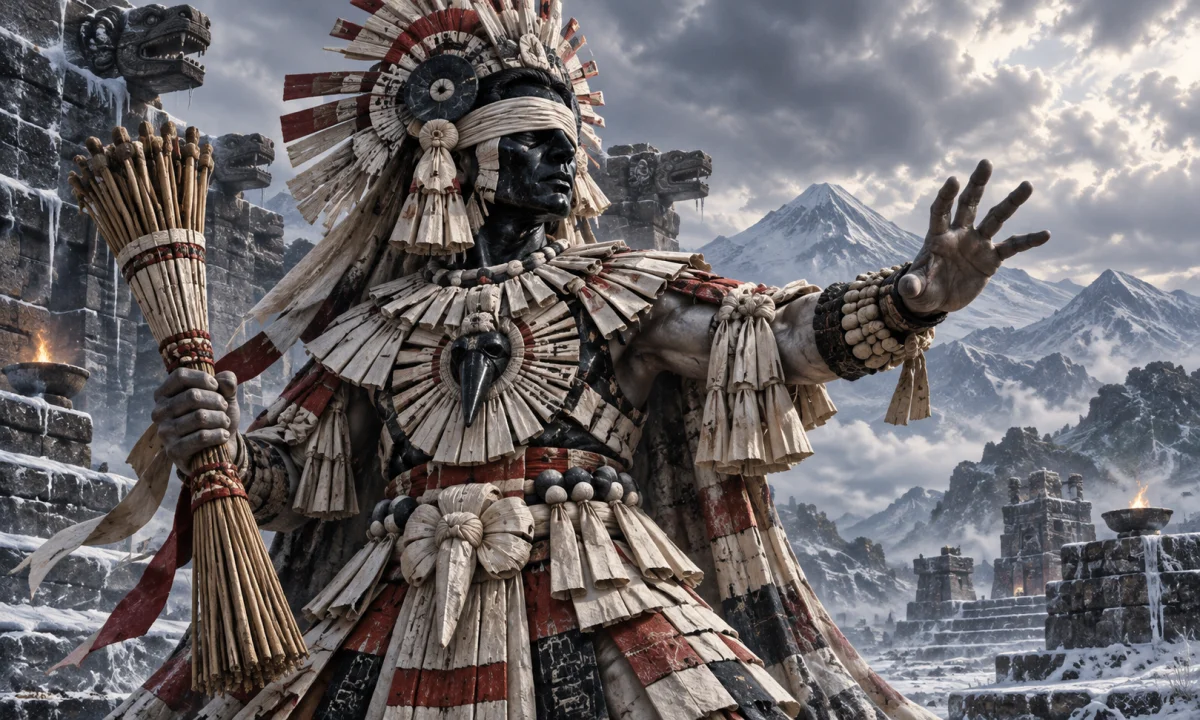
Itztlacoliuhqui is a complex figure in Aztec and wider Nahua religious thought, associated with frost, cold, rigidity, punishment and the dangerous power of the obsidian blade. His name is also connected with a covered or blindfolded face, and he is sometimes represented as a deity whose eyes are concealed. In surviving sources, Itztlacoliuhqui is closely related to Tlahuizcalpantecuhtli, the Lord of the Dawn and a personification of Venus as the morning star. Depending on the source and interpretation, he may appear as a distinct deity, an aspect of Tlahuizcalpantecuhtli, or a transformed state of that celestial figure.
Name and identity
The name is written in several ways, including Itztlacoliuhqui and Iztlacoliuhqui. Nahuatl words were recorded by Spanish-speaking scribes using inconsistent spelling systems, so variation in the initial consonants does not necessarily indicate different beings. The name is commonly interpreted as referring to a “curved obsidian blade” or “the curved one of obsidian.” The exact grammatical analysis is not entirely settled, however, and translations differ.
Another name associated with the deity is Ixquimilli, often interpreted as “he whose face or eyes are covered.” This name reflects one of his most recognizable features in pictorial representations: a band or covering across the eyes. The image has sometimes encouraged comparisons with a blindfolded figure of justice, but that comparison should be treated cautiously. The surviving Aztec evidence connects Itztlacoliuhqui more directly with cold, punishment, danger and cosmic transformation than with the modern Western symbol of impartial justice.
Itztlacoliuhqui does not fit neatly into a single category such as “god of winter.” Aztec religious beings frequently combined natural forces, calendrical powers, celestial identities and moral or social meanings. Frost could be a physical threat to crops, a manifestation of divine power and a form of punishment. Obsidian was a valuable and dangerous volcanic glass used for blades, mirrors and ritual objects. A curved or broken blade could therefore suggest violence, sacrifice, limitation, destruction or a change from an active celestial force into something cold and hardened.
Cultural and religious setting
The Aztec Empire formed part of a broader Nahua cultural world in central Mexico. Its religious traditions were preserved through temple ritual, oral teaching, calendrical practice, painted manuscripts and the work of priests and specialists. Much of the surviving written evidence was recorded after the Spanish invasion, often by colonial authors working with Indigenous informants. These records are indispensable, but they do not provide a single, perfectly consistent account of every deity.
Important evidence for Itztlacoliuhqui comes from colonial descriptions of Nahua religion and from pre-Hispanic or early colonial painted manuscripts, including calendrical and divinatory codices. The images do not function like modern illustrations accompanied by fixed biographies. A figure’s costume, body paint, position in a calendar sequence and relationship to other signs could communicate several meanings at once. As a result, identifying a figure in a codex may involve comparison among different manuscripts rather than reliance on one universal appearance.
The calendrical system was central to Aztec religious life. The 260-day ritual calendar, often called the tonalpohualli, combined numbered days with twenty day signs. Each day could have associations with deities, omens, ceremonies and forms of human conduct. A deity appearing in a calendrical context was not merely the patron of a modern-style abstract category. The figure could influence the character of a day, the fate of a person born under it and the ritual actions appropriate to that period.
Appearance and attributes
Itztlacoliuhqui is commonly shown with a covering across the eyes or upper face. In some representations, the covering resembles a band or strip, while the details vary according to the manuscript. His name Ixquimilli is important in interpreting this feature, but the precise meaning of the visual sign is debated. It may indicate blindness, concealed sight, a ritual covering or a broader condition of being unable or unwilling to see.
Obsidian imagery is equally important. Obsidian blades were sharp enough to cut flesh and were used in warfare, bloodletting and sacrificial practices. Obsidian mirrors also carried associations with sight, divination and the hidden or reflective aspects of divine power. The name Itztlacoliuhqui may therefore evoke both the physical edge of a blade and the symbolic force of a material that could reveal, wound or kill.
Descriptions and images associate the figure with frost and cold. In central Mexico, frost could destroy maize and other crops, threatening the food supply on which communities depended. Unlike snow in some northern cosmologies, frost was not primarily a picturesque seasonal condition. It could be an abrupt and damaging force. A deity of frost represented the vulnerability of agriculture and the possibility that divine or cosmic disorder could enter ordinary life.
Itztlacoliuhqui is also linked with hardness, stiffness and immobility. These qualities contrast with the movement and radiance of a celestial body such as Venus. They may help explain why the figure appears in a myth as a transformed form of Tlahuizcalpantecuhtli. The brilliant morning star becomes associated with a colder, more dangerous and restricted condition. The “crooked” or “bent” quality in his name may similarly suggest damage, distortion or a deviation from an expected path.
Colonial accounts additionally connect Itztlacoliuhqui with punishment and wrongdoing. Some translations describe him as a deity of frost, sin or vice, while other interpretations emphasize retribution and the consequences of transgression. These terms reflect both Nahua concepts and the difficulties of translating them into European religious vocabulary. It would be misleading to reduce him to a simple “god of sin,” since the surviving material does not present a complete moral theology centered on him.
The transformation of Tlahuizcalpantecuhtli
The best-known mythological connection involving Itztlacoliuhqui appears in the story of the creation and ordering of the present world. In accounts concerning the Fifth Sun, the gods establish the celestial order and the sun begins its course. Tlahuizcalpantecuhtli, the Lord of the Dawn, attempts to attack the sun with a projectile. The attack fails, and the sun retaliates. Tlahuizcalpantecuhtli is struck and becomes Itztlacoliuhqui.
The details differ among versions and translations, and the episode should not be treated as a single unchanged canonical story. Its central pattern, however, is consistent: a proud or aggressive dawn-star deity is defeated and transformed into a figure associated with cold, obscurity, punishment and the curved obsidian blade. The myth links celestial motion with danger. Venus appears as a powerful and potentially hostile presence, not merely as a beautiful light in the morning sky.
In this context, Itztlacoliuhqui can be understood as a transformed aspect of Venus rather than an unrelated god who happens to resemble Tlahuizcalpantecuhtli. Yet the relationship is not identical in every source. Some interpretations describe the two as manifestations of one complex deity, while others preserve a distinction between the morning-star lord and the frost or punishment figure. The evidence supports a close relationship, but not a simple claim that all references use the names interchangeably.
Venus had considerable importance in Mesoamerican astronomy and ritual. Its cycles could be observed and calculated, and its first appearance as the morning star was associated with military and sacrificial danger in some Nahua traditions. The myth of Tlahuizcalpantecuhtli and Itztlacoliuhqui expresses this danger through conflict, defeat and transformation. The cold figure is not simply a seasonal god; he belongs to a larger system in which astronomical events could affect political power, warfare, agriculture and ritual timing.
Frost, punishment and social order
Itztlacoliuhqui’s associations with punishment may be connected to the wider Aztec idea that disorder had consequences at several levels. A person could violate social or ritual expectations, a ruler could fail in duty, or a deity could disrupt the cosmic balance. Frost offered a powerful image for such consequences because it immobilizes living things and threatens the harvest. It is destructive without being a battlefield weapon, and it can arrive as an external force that human beings cannot easily control.
The figure’s covered eyes may also be understood within this field of meaning, although interpretations remain uncertain. Concealed sight can evoke blindness, ignorance, hidden judgment or the inability to escape a sentence. It can also represent a deity whose power is not expressed through ordinary human perception. Rather than assigning one fixed meaning, it is safer to recognize several overlapping possibilities: the covered eyes are an established iconographic feature, while their exact theological significance is not fully known.
Obsidian adds another layer. An obsidian knife cuts, while an obsidian mirror reflects. These two uses bring together destruction and vision, bodily danger and supernatural knowledge. Itztlacoliuhqui’s identity may have drawn on this tension. The deity is visually or linguistically marked by a material that can expose hidden realities but can also injure or kill. Such associations are especially significant in a religion where blood, sacrifice, warfare and divination were interconnected rather than treated as separate subjects.
Calendar and manuscript associations
Itztlacoliuhqui appears in discussions of the ritual calendar and in painted manuscripts that organize deities according to days, periods or divinatory patterns. His presence in these contexts indicates that his power could be experienced through time as well as through myth. A calendrical deity could influence omens, personal fortune and the suitability of an activity, while also embodying a larger cosmic force.
Exact assignments vary according to the manuscript and the scholar’s method of identification. Similar headdresses, face coverings and body signs can make figures difficult to distinguish, especially when a manuscript uses abbreviated artistic conventions. Colonial labels may also have been added after the images were produced, and different Nahua communities could have emphasized different aspects of a deity. Claims that Itztlacoliuhqui always belonged to one specific day or one unchanging calendar position should therefore be made with care.
The codices also show why Aztec gods should not be imagined as characters with standardized appearances in the modern fictional sense. A deity could be presented through a particular costume in one ritual context and through a related sign in another. A single image might identify an astronomical body, a calendrical influence, a natural danger and a mythic episode at the same time.
Distinguishing Itztlacoliuhqui from related figures
Tlahuizcalpantecuhtli
Tlahuizcalpantecuhtli is the Lord of the Dawn and is strongly associated with Venus as the morning star. He is the figure most directly connected with Itztlacoliuhqui through the transformation myth. They should not automatically be treated as two entirely separate gods, but neither should every image or reference to Tlahuizcalpantecuhtli be relabeled as Itztlacoliuhqui. Their relationship is one of the central interpretive questions surrounding the deity.
Tezcatlipoca
Itztlacoliuhqui is sometimes discussed alongside Tezcatlipoca because both can be connected with obsidian, darkness, danger and forms of supernatural power. Tezcatlipoca, however, is a major deity with his own myths, names, iconography and ritual history. The two figures are not simply interchangeable. Shared associations with obsidian or concealed sight do not erase their distinct identities.
Tonatiuh and other solar figures
Tonatiuh is the sun deity who defeats Tlahuizcalpantecuhtli in the transformation story. This relationship does not make Itztlacoliuhqui a solar god. Instead, the myth contrasts solar radiance and celestial aggression with frost, defeat and altered identity. Other gods of rain, wind or agricultural fertility may also influence crops, but they should not be merged with Itztlacoliuhqui merely because frost affects agriculture.
Scholarly interpretation and limits of the evidence
Interpretations of Itztlacoliuhqui often focus on the connection between Venus, frost and punishment. One approach emphasizes the astronomical cycle: the dangerous morning star is defeated and becomes a colder or less radiant power. Another stresses the agricultural impact of frost and the social meaning of punishment. A further approach examines the visual language of covered eyes, obsidian and bent forms without assuming that each symbol had one fixed definition.
These interpretations can complement one another, but none should be presented as a complete and universally accepted explanation. The evidence is fragmentary, and much of it passed through colonial recording practices. Nahua religious concepts were translated into Spanish categories that sometimes changed the emphasis of the original terms. At the same time, the painted manuscripts preserve visual information unavailable in many written accounts. Understanding Itztlacoliuhqui therefore requires comparison among language, imagery, calendrical context and myth rather than dependence on a single gloss.
There is no substantial modern popular-culture tradition that has established Itztlacoliuhqui as a universally recognized character in the way that Quetzalcoatl or Tezcatlipoca sometimes appear in fantasy, games and film. When the deity is adapted in contemporary fiction, creators may emphasize the blindfold, the obsidian blade, frost or the connection with Venus. Such portrayals are creative reinterpretations, not evidence for additional ancient attributes. The traditional figure remains best understood within the intertwined religious, astronomical, agricultural and calendrical systems of Nahua culture.