WORLD
WORLD
Ehecatl
Ehecatl is the Nahuatl word for wind and the name of a major wind deity in the religious traditions of central Mexico. In Aztec, or Mexica, religion, Ehecatl was commonly understood as a manifestation or aspect of Quetzalcoatl, the feathered serpent deity. The combined name Ehecatl-Quetzalcoatl is therefore often used by scholars and museums, although the relationship between the two names could vary according to context.
As a divine force, Ehecatl represented moving air, breath, speech, storms and the vital movement that makes life possible. He was not simply a personification of ordinary breezes. Wind could refresh the world, carry rain, clear the sky and animate living beings, but it could also arrive as a destructive storm. Ehecatl’s importance reflects a broader Mesoamerican understanding of wind as both a physical power and a sacred principle connected with creation, fertility and transformation.
Name and identity
Ehecatl comes from Nahuatl and means “wind” or “air.” The name is also written with different spellings in modern publications, including Ehécatl, Ehecatl and Ehecatl-Quetzalcoatl. The accent mark in Ehécatl is a modern convention used to indicate stress; colonial and modern spellings are not always consistent.
In Aztec religious practice, Ehecatl was frequently identified with Quetzalcoatl. Quetzalcoatl was a complex deity associated with wind, knowledge, priesthood, rulership, creation, the planet Venus and the feathered serpent. The wind aspect emphasizes his invisible but active power: air moves through the world, carries sound, drives clouds and permits breathing. In this form, Quetzalcoatl could be represented not only as a feathered serpent but also as a humanlike wind god wearing a distinctive mask.
It is useful to avoid treating Ehecatl and Quetzalcoatl as either completely separate gods or perfectly interchangeable names in every context. Indigenous religious traditions often allowed a deity to possess several names, forms and functions. Colonial sources also recorded Nahua beliefs through European writing systems and categories, which can make the boundaries between divine aspects difficult to reconstruct. Ehecatl is best understood as the wind manifestation of Quetzalcoatl, while recognising that the two names could carry different emphases.
Religious and cultural setting
The Mexica established their capital, Tenochtitlan, in the Basin of Mexico, a region of lakes, mountains and seasonal rainfall. Wind was part of everyday environmental experience. It moved across the lake, announced changes in weather, helped bring rain-bearing clouds and sometimes arrived with dangerous force. In a religious system deeply concerned with agricultural cycles and cosmic balance, wind was naturally connected with rain, fertility and the renewal of the world.
Ehecatl belonged to a wider family of Mesoamerican wind and storm concepts. Other cultures of the region had their own wind deities and sacred interpretations of air. Similarities between them do not mean that all were the same being. The Maya, Zapotec, Mixtec and other peoples possessed distinct religious systems, languages and historical traditions. Ehecatl specifically belongs to Nahua religious tradition, especially the forms documented for central Mexico in the late Postclassic period.
The best surviving information comes from early colonial records produced after the Spanish invasion. The most important materials include Nahuatl-language descriptions collected by Bernardino de Sahagún and his Indigenous collaborators, along with painted manuscripts and other records that preserve elements of pre-Hispanic religion. These sources are indispensable but require care. They were created in a colonial setting, often by Christian missionaries, and they do not provide a single, uncontested version of Mexica belief.
Appearance and sacred attributes
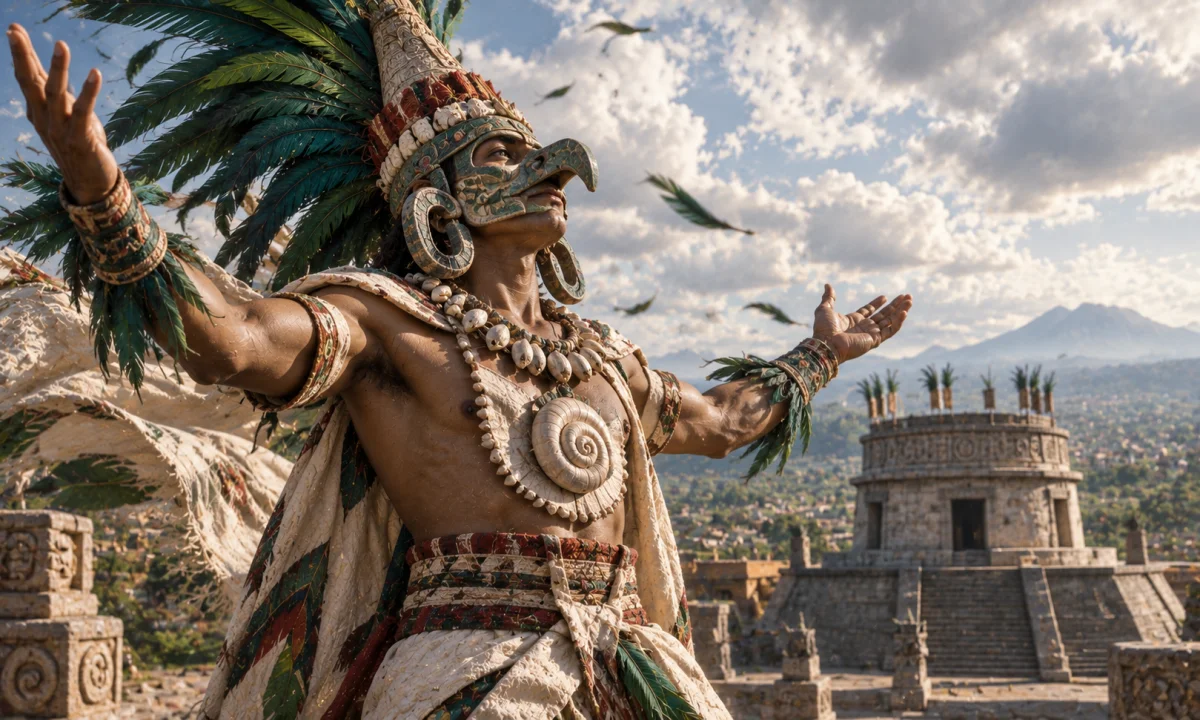
Ehecatl is most recognisable by a mask or mouthpiece that projects outward from the face. It is often described or depicted as a beak-like device, sometimes compared to the bill of a bird. The mask may represent the opening through which wind emerges, although interpretations differ. In art, the projecting mouth can make the deity immediately distinct from other forms of Quetzalcoatl.
Representations of Ehecatl may show him wearing a conical or pointed headdress and ornaments associated with Quetzalcoatl. A particularly important object is the ehecailacacozcatl, a spiral or wind-jewel ornament associated with the god. Its name is often translated in connection with a “wind jewel” or a spiral shell. The form evokes the whirling movement of air and may also suggest the conch shell’s relationship to sound, breath and sacred announcement. Exact translations and interpretations of Nahuatl terms vary.
Spirals are especially appropriate symbols for wind because they suggest circulation and motion. They can also recall whirlwinds and the curled form of a shell. The association between air and sound is equally important: breath becomes speech, song, prayer and the spoken word. Ehecatl therefore had significance beyond meteorology. Wind was a medium through which divine power could be felt, heard and experienced in the body.
Temples associated with Ehecatl often had unusual circular or rounded forms rather than the rectangular plans common to many Mesoamerican temples. Archaeological examples linked with the wind god have been found at several central Mexican sites, although the identification and interpretation of individual buildings can depend on archaeological evidence and local context. The rounded structure may have helped evoke the movement of air and offered less resistance to the wind, but the exact ritual meaning of these architectural forms is not fully known.
Wind, breath and life
Wind was closely connected with breath, and breath was understood as a life-giving force. This relationship appears in many religious traditions, but it had particular significance in Nahua thought, where the animating principle of a living person could be associated with breath and the heart. Ehecatl’s power thus concerned the movement that distinguishes living bodies from still matter.
The god was also connected with speech. Human speech begins with breath, and the movement of air makes language audible. As an aspect of Quetzalcoatl, Ehecatl could therefore be associated with communication, ritual knowledge and the transmission of divine order. These associations should not be reduced to a simple claim that he was a “god of language” in the same way that a modern category might suggest. His significance arose from the relationship between air, breath, voice and sacred action.
Wind could also clear the way for rain. In agricultural societies of central Mexico, rain and crop growth were matters of survival, and no single natural force operated in isolation. Clouds, storms, wind, mountains, springs and agricultural fertility belonged to an interconnected sacred landscape. Ehecatl was not identical with Tlaloc, the major rain and storm deity, but wind could act alongside rain-producing powers. This distinction is important: Ehecatl’s role concerns the moving air that brings change, whereas Tlaloc’s powers centre more directly on rain, water, storms and mountain fertility.
Ehecatl in creation traditions
Several Nahua traditions connect Quetzalcoatl with the restoration or creation of human beings. In one well-known account preserved in colonial sources, Quetzalcoatl travels to the underworld, Mictlan, to obtain the bones of earlier generations. He brings the bones back so that humanity can be restored, but the work requires sacrifice and divine effort. Versions of the story differ in their details, and not every version gives Ehecatl a separate role from Quetzalcoatl.
Wind appears in wider creation traditions as a force that sets the cosmos in motion. The second of the celebrated “Suns” or world ages is often called Nahui Ehecatl, “Four Wind.” According to accounts of the successive cosmic ages, this world was destroyed by wind, and its inhabitants were transformed into monkeys. The numbering belongs to the Mesoamerican calendrical and cosmic system, in which a day-sign name and a number together identify a particular sacred date or era.
The Four Wind age should not be treated as a straightforward biography of Ehecatl. It is a cosmological episode in which wind becomes an elemental power of destruction and transformation. The story shows the double character of the deity’s domain: wind can sustain life and movement, but overwhelming wind can also end an established world and produce a new order.
Another important narrative concerns the birth or recovery of the sun and moon, in which Quetzalcoatl and other gods participate in acts of sacrifice and cosmic ordering. Because the surviving versions were recorded in different texts and periods, it is difficult to assign every episode specifically to Ehecatl rather than to Quetzalcoatl. Interpretations that present one fully standardised mythology often smooth over these differences.
Mayahuel and the movement of the sky
In a widely circulated Nahua narrative, Quetzalcoatl falls in love with Mayahuel, a young goddess associated with the maguey plant and the drink later known as pulque. The story involves their transformation and the violent intervention of Mayahuel’s grandmother or other hostile relatives, depending on the version. Quetzalcoatl’s connection with this story is sometimes discussed alongside his wind aspect, but the surviving accounts do not always identify the protagonist simply as Ehecatl.
The relationship between wind, Quetzalcoatl and Mayahuel has encouraged later interpretations linking Ehecatl with fertility and agricultural abundance. Such interpretations can be meaningful when grounded in the wider associations of wind, rain and plant growth, but they should not be presented as though every source gives Ehecatl the same role in the Mayahuel story.
Calendar and ritual associations
Ehecatl was also one of the twenty day signs used in the tonalpohualli, the 260-day ritual calendar of central Mexico. It follows Cipactli, the crocodile or earth-monster sign, in the standard sequence. A day bearing the sign Ehecatl could be interpreted through its number, its broader calendrical cycle and the ritual system of the community using the calendar.
Day signs were not simple labels for individual gods. A sign could carry a range of omens, qualities and ritual associations, and its meaning depended on the number accompanying it and the larger calendar count. It is therefore misleading to say that everyone born on an Ehecatl day possessed one fixed personality or destiny. Colonial descriptions of calendrical divination preserve valuable information, but they also reflect the efforts of missionaries to describe Indigenous systems within unfamiliar religious categories.
The first day of the 260-day cycle was often 1 Cipactli, making the second day 2 Ehecatl. This did not necessarily make Ehecatl a universal “second god” or establish a simple hierarchy among deities. The calendar was a complex system used for divination, ritual timing and the organisation of sacred time.
Temples and archaeological evidence
Archaeology provides evidence for buildings and images associated with the wind god, particularly through circular temple platforms and sculptures showing the characteristic projecting mouthpiece. A famous example is the circular temple traditionally associated with Ehecatl at the archaeological site of Calixtlahuaca in the modern State of Mexico. Circular structures connected with Ehecatl have also been identified in or near other central Mexican urban centres.
These buildings are evidence of a regional architectural pattern, not proof that every rounded structure served exactly the same function. Archaeologists interpret structures through their location, associated offerings, sculptures, construction history and relationship to other buildings. The religious life of a temple cannot always be recovered in full from its surviving foundations.
Images of Ehecatl are particularly valuable because they show how the god’s invisible force was made visible. The mask, spiral ornaments and association with circular architecture transformed moving air into a recognisable divine presence. At the same time, artistic conventions changed across regions and periods, so not every figure with a birdlike mouth should automatically be identified as Ehecatl.
Distinguishing Ehecatl from related figures
Ehecatl is sometimes confused with several other Mesoamerican beings. The most important distinction is between Ehecatl and Quetzalcoatl. They are closely related in Aztec tradition, but Quetzalcoatl has a wider range of associations, while Ehecatl highlights the wind aspect. The term “Ehecatl-Quetzalcoatl” reflects this close relationship rather than naming an entirely unrelated god.
Ehecatl should also be distinguished from Tlaloc. Tlaloc is associated with rain, water, storms, mountain springs and agricultural fertility. Ehecatl governs wind and moving air, though the two divine powers could interact in weather and agricultural symbolism. They are not simply two names for one weather god.
Nor should Ehecatl be identified with every feathered serpent in Mesoamerican art. Feathered-serpent imagery was used in more than one region and period, and the meaning of a serpent with feathers was not identical everywhere. The Aztec Quetzalcoatl tradition has connections with earlier Mesoamerican feathered-serpent traditions, but those traditions should be studied in their own historical and cultural settings rather than collapsed into a single timeless deity.
Historical change and modern understanding
The Spanish conquest, Christian conversion and destruction or alteration of Indigenous institutions profoundly changed the ways Nahua religious traditions were practised and recorded. Some traditions survived through adapted ceremonies, local knowledge, language and community memory, while others were reframed by colonial writers. Modern knowledge of Ehecatl therefore combines archaeological evidence, Indigenous-language texts, colonial descriptions and comparative scholarship. None of these sources alone provides a complete account.
Contemporary popular culture sometimes presents Ehecatl as a fantasy wind warrior, a generic Aztec god or merely another name for Quetzalcoatl. Games, novels, artwork and online summaries may borrow his mask, feathered-serpent associations or power over air without reproducing the religious context. These portrayals are modern inventions or adaptations, not direct evidence for ancient belief.
For historical and cultural purposes, Ehecatl is best approached as a Nahua divine power whose central theme is wind as breath, motion and cosmic change. His mask gave form to an invisible force; his relationship with Quetzalcoatl linked wind to creation and sacred knowledge; and his place in the calendar and architecture connected the movement of air with ritual time and public worship. The surviving evidence does not produce one perfectly uniform mythology, but it consistently presents Ehecatl as one of the most important expressions of the sacred power of wind in central Mexican tradition.