WORLD
WORLD
Taiowa

Taiowa is a creator figure associated with Hopi religious tradition in the American Southwest. In published accounts, Taiowa is described as the supreme creative power who existed before the ordered universe and brought about the beings and processes through which the worlds were formed. The name is especially familiar because of twentieth-century books that presented Hopi cosmological narratives to a broad audience. Those books are important to the modern reception of Taiowa, but they should not be treated as a single, universally authoritative Hopi scripture.
Hopi cultural and religious setting
The Hopi are an Indigenous people whose ancestral homeland is in northeastern Arizona. Hopi religious life includes ceremonies, clan traditions, sacred places, prayers, ritual specialists and teachings concerning the origins, structure and proper ordering of the world. Knowledge is not always public or uniform. Different villages, clans, ceremonial societies and families may preserve particular versions of stories, and some religious knowledge is restricted or intended for particular ritual contexts.
For that reason, “Hopi mythology” should not be understood as a fixed body of tales comparable to a single written canon. Much of the tradition was transmitted orally, while outsiders recorded selected accounts at different times and for different purposes. A published narrative may preserve genuine elements of Hopi thought while also reflecting the choices, language and interpretations of the recorder.
The most detailed modern account of Taiowa’s place in a creation sequence comes from The Book of Hopi, published in 1963 by Frank Waters in collaboration with Hopi informants, including Oswald White Bear Fredericks. The book has had considerable influence on popular descriptions of Hopi cosmology. At the same time, its presentation has been questioned as a literary synthesis rather than a complete or universally accepted representation of Hopi religious teaching. Accounts of Taiowa should therefore distinguish between Hopi tradition as a living and varied religious culture and the particular form in which that tradition reached modern readers.
Name and identity
Taiowa is generally presented as the Creator or supreme spiritual principle. In accounts that use this name, Taiowa is not usually portrayed as a humanlike god living within the physical world. Instead, Taiowa stands beyond or prior to the created cosmos and establishes the larger order within which the worlds, spiritual beings and living creatures exist.
The meaning and use of the name are not entirely uniform in English-language sources. Spellings and identifications can vary, and the name is sometimes connected or equated with Tawa, a major Hopi solar being. That identification should not be made automatically. Some popular summaries use “Taiowa” and “Tawa” as if they were interchangeable, while other presentations distinguish Taiowa as the transcendent Creator from Tawa as the Sun Spirit or a solar power active within the universe. The available published material does not justify treating every occurrence of the two names as referring to exactly the same figure.
Nor is Taiowa best understood as simply a “god” in the narrow sense of a deity with a human personality, a defined body and a permanent residence in one part of nature. The figure is closer, in many accounts, to the originating intelligence or sacred source of the universe. Descriptions such as “supreme god” are useful approximations for English readers, but they can obscure the broader religious meaning of a creative power that is not confined to one visible form.
Taiowa and the creation of the worlds
In the cosmological narrative most closely associated with Taiowa, Taiowa exists before the creation of the ordered universe. Taiowa then brings forth Sotuknang, a powerful being who acts as an agent in the work of creation. Sotuknang is often described as Taiowa’s nephew, although this familial language should not necessarily be read as a biological relationship in the ordinary human sense. It expresses a relationship of origin, authority and delegated purpose.
Sotuknang is instructed to organize the universe and prepare it for life. He creates or arranges the worlds and the conditions in which beings can live. In versions derived from the modern published narrative, the cosmos includes multiple worlds, with a heavenly or divine realm and several worlds intended for living creatures. The number and structure of these worlds are part of a particular cosmological presentation rather than a universally fixed doctrine documented across every Hopi community.
The first inhabited world is commonly called Tokpa in the English-language accounts that describe the successive worlds. It is populated by the first people and other beings. The creation is not presented merely as a mechanical act. The worlds are also stages in a moral and spiritual history. Their inhabitants must learn how to live in proper relation to the Creator, to one another and to the forces that sustain existence.
Other beings assist in the preparation of life. Spider Woman, often called Kokyangwuti in Hopi-based accounts, is a central creative figure. She is associated with the making of living forms and with guidance during the early stages of existence. The twins Poqanghoya and Palongawhoya are also important in the creation narrative. Their activities are connected with the shaping and animation of the earth, including the establishment of movement and order in the natural world.
These figures should not be reduced to subordinate characters in a simple hierarchy. Hopi cosmological stories commonly express creation through relationships among distinct sacred beings, each with a particular function. Taiowa represents the originating source, while Sotuknang and other beings carry out specific aspects of the work. The narrative therefore describes creation as an ordered process involving cooperation, delegated power and continuing responsibility.
The successive worlds and emergence
A well-known form of the Hopi creation cycle describes a series of worlds through which humanity passes. The first worlds are eventually destroyed or abandoned when their inhabitants lose the proper relationship with the sacred order. In the narrative associated with Taiowa, destruction may occur through fire, freezing or water. These events are not random disasters; they mark transitions between eras and expose the consequences of disorder, violence, greed or spiritual forgetfulness.
After each destruction, the surviving people move toward another world. A passage through the earth, often associated with the sipapu, links the underworld or earlier realm with the next stage of existence. The sipapu has an important ceremonial and symbolic role in Pueblo traditions, although its precise meaning and ritual use belong to particular cultural contexts and should not be reduced to a generic symbol of “rebirth.” In Hopi accounts of emergence, it represents a passage into a new world and a continuation of the human story.
The world inhabited by contemporary humanity is commonly identified in these published narratives as the Fourth World. It is not simply a finished creation. Human beings remain responsible for living in accordance with the order established by the Creator. The possibility of another transformation or destruction gives ethical weight to ordinary conduct, communal obligations and ceremonial observance.
Because the detailed sequence of successive worlds is most widely known through modern literary presentations, it is important not to imply that every Hopi person describes the cosmology in precisely the same way. “The Hopi creation myth” is often used by outsiders as though it named one standardized text. In reality, the public record combines oral traditions, ethnographic reports, Hopi-authored explanations and later interpretations.
Attributes and religious significance
Taiowa is not generally associated with a single canonical image, costume or animal form. The figure’s most important attribute is creative authority. Taiowa establishes the possibility of the cosmos and provides the larger purpose within which the worlds unfold. The role is therefore more theological than visual.
In the accounts that emphasize Taiowa’s transcendence, the Creator is associated with existence beyond ordinary space and time. Taiowa does not need to be depicted as a resident of the sky in the same manner as a weather spirit or solar being. Such language reflects an attempt to describe a reality beyond the visible world rather than a location that can be mapped physically.
The stories connected with Taiowa also express a principle of ordered interdependence. Human beings depend on the earth, water, plants, animals, celestial powers and one another. The universe is not a collection of unrelated objects. Its parts have roles, and the well-being of the whole depends on maintaining proper relationships. In this setting, morality is closely connected with cosmology: to behave destructively is not merely to break a social rule but to damage the balance on which life depends.
Hopi religious teachings are often discussed in relation to humility, reciprocity, responsibility and the need to live in accordance with the world’s sacred order. These themes should not be presented as a complete definition of Hopi ethics, but they help explain why creation stories are not only accounts of a distant beginning. They address how people ought to live in the present world.
Important relationships and distinctions
Sotuknang
Sotuknang is the being most directly associated with Taiowa in the widely circulated creation narrative. Taiowa brings him forth and entrusts him with the organization of the universe. Sotuknang is consequently both a creator and an executor of Taiowa’s purpose. He should not be treated as merely another name for Taiowa.
Spider Woman
Spider Woman is a powerful creative and protective figure in Hopi traditions and in broader Pueblo cultural contexts, though names, stories and roles vary among communities. In the Taiowa-related narrative, she helps bring living beings into form and guides early humanity. Her presence demonstrates that creation is distributed among several sacred figures rather than performed by a solitary creator in every detail.
Tawa
Tawa is commonly described as a sun spirit or solar power in Hopi-related sources. Some writers identify Tawa with Taiowa, while others distinguish the two. The safest approach is to preserve the distinction unless a particular source explicitly makes an identification. Taiowa is generally treated as the transcendent Creator in the accounts under discussion; Tawa is more directly connected with the sun and its life-giving power. English-language popularizations frequently blur this difference.
Maasaw
Maasaw is another major Hopi sacred figure who should not be merged with Taiowa. Maasaw is associated in published accounts with the earth, mortality, stewardship and the conditions of life in the present world. He may appear in emergence narratives and stories about the responsibilities of human beings, but he is not simply an alternative name for the Creator.
Katsinam
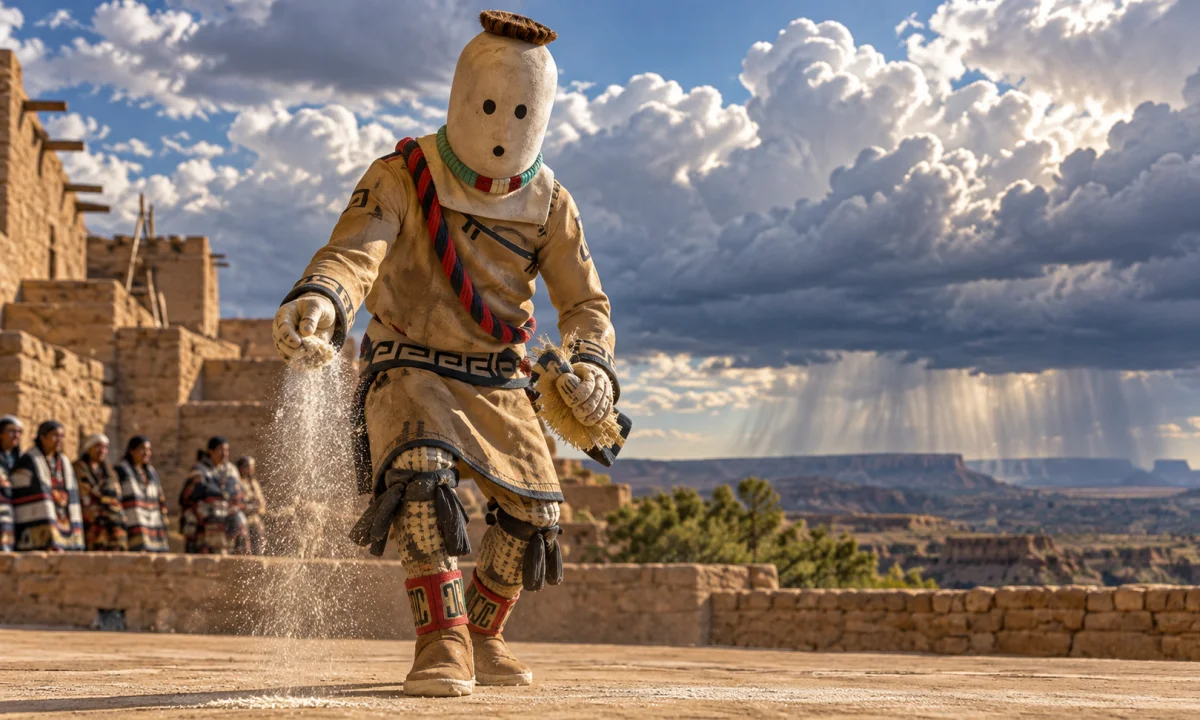
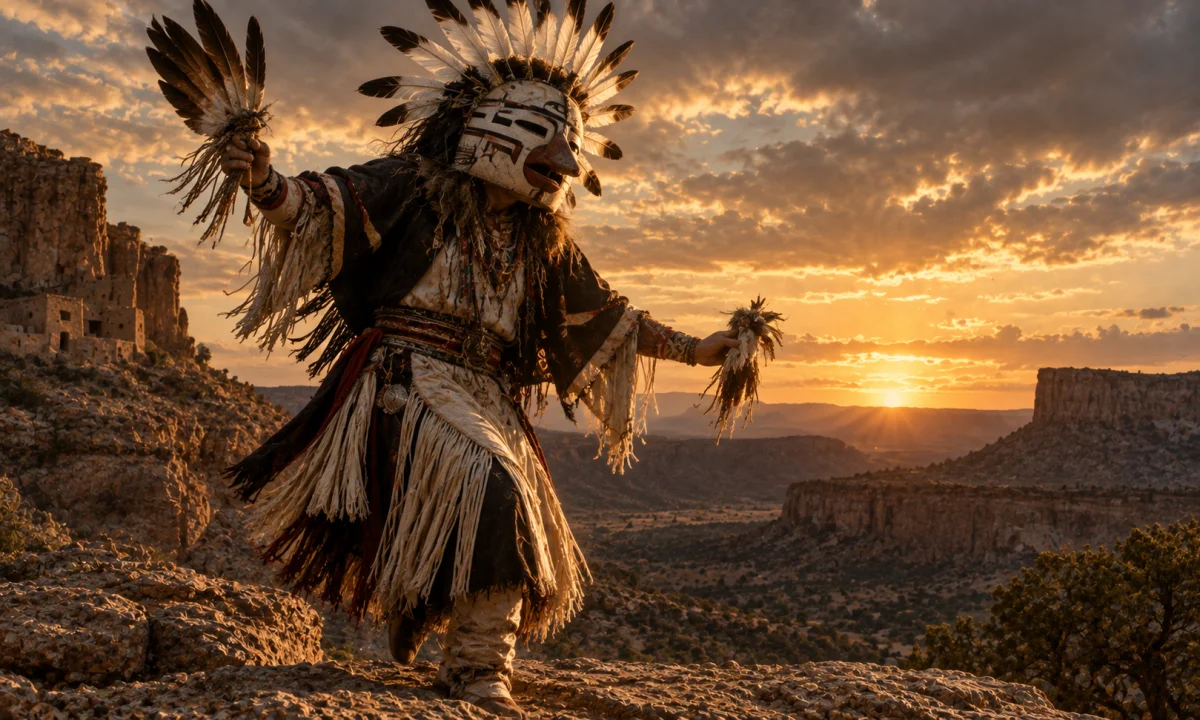
Taiowa is also distinct from the katsinam, often rendered in English as kachinas. Katsinam are a broad class of spiritual beings represented in Hopi ceremonial life, including through dances, songs and masked performances. The word “kachina” is sometimes used loosely for the masks or dancers themselves, but the religious meaning is more complex. Taiowa is not normally classified as just one katsina among many.
Interpretation and cultural context
Readers sometimes interpret Taiowa as equivalent to the all-powerful creator of Christian, Jewish or Islamic theology. Such comparisons may help identify a broad functional similarity, but they can also distort Hopi concepts. Hopi religious traditions developed within a different cultural and ceremonial framework, with distinct understandings of personhood, sacred power, emergence, the natural world and community obligations.
It is also misleading to describe Taiowa as evidence that all Indigenous religions share one universal “Great Spirit.” That phrase has often been imposed by outsiders who wished to compress diverse Indigenous traditions into a familiar category. Taiowa belongs to Hopi contexts and should be discussed through Hopi terminology and relationships rather than used as a generic label for Indigenous belief.
The public presentation of Taiowa raises an additional issue. Some Hopi writers and cultural representatives have sought to explain aspects of Hopi history and religion to non-Hopi audiences, while other knowledge remains private or ceremonial. A respectful account must therefore avoid claiming complete access to Hopi religion through a single book or website. Published versions are valuable evidence of how the tradition has been recorded and interpreted, but they do not replace living Hopi authority.
Later reception
Taiowa has had a modest but noticeable presence in modern books about comparative mythology, Indigenous spirituality and esoteric cosmology. In these settings, the figure is sometimes recast as an abstract cosmic intelligence or merged with solar deities from other traditions. Such treatments may use the name symbolically, but they are modern reinterpretations rather than direct descriptions of Hopi ceremonial teaching.
There is no single, widely established popular-culture portrayal of Taiowa comparable to the depictions of Greek, Norse or Egyptian gods in film and games. Most contemporary references derive from retellings of Hopi emergence narratives, educational writing or New Age interpretations. These later uses should be kept separate from the Hopi religious context in which Taiowa is understood as the Creator and as part of a larger network of sacred relationships.