WORLD
WORLD
Sotuknang

Sotuknang is a powerful being in accounts of Hopi cosmology, where he appears as an agent of the creator Taiowa and an organizer of the universe. He is especially associated with the creation and ordering of the worlds, the movement of the cosmos, and the destruction of worlds that have fallen out of balance. The name and stories connected with Sotuknang are best understood within Hopi religious traditions rather than as part of a single, universally fixed mythology.
Cultural and religious setting
The Hopi are an Indigenous people whose communities are centred in northeastern Arizona. Hopi religious life includes ceremonial societies, clan traditions, sacred places, ritual knowledge, and teachings passed through oral transmission. Stories about the origin of the world and the emergence of humanity are not simply literary myths in the modern sense. They are connected with obligations, ethical conduct, relationships to place, and the proper ordering of human life.
There is no single ancient Hopi scripture that sets out a complete and uniform account of Sotuknang. Different communities, clans, ceremonial authorities, and individual narrators may preserve different emphases or may restrict parts of their knowledge. Published accounts therefore need to be treated carefully. Some are based on statements given by Hopi people, while others are interpretations or retellings shaped by non-Hopi authors.
One of the best-known written presentations appears in The Book of the Hopi, published in the twentieth century by Frank Waters after conversations with Hopi informants. That work helped make names such as Taiowa, Sotuknang, Spider Woman, and the Ant People familiar to a wide audience. At the same time, it should not be treated as a definitive transcript of all Hopi tradition. Its presentation combines oral material, editorial arrangement, and the interpretive framework of its author.
Name and identity
The name is commonly written Sotuknang, although spelling and pronunciation may vary in English-language sources. Some publications use accent marks or slightly different forms. The meaning of the name is not consistently explained in reliable public sources, so confident popular etymologies should be approached with caution.
Sotuknang is often called a creator deity, sky being, or cosmic organizer in English summaries. These terms are useful approximations, but none maps perfectly onto Hopi religious categories. In the narratives most frequently published for a general readership, Sotuknang is not the ultimate source of existence. That position belongs to Taiowa, an originating or supreme creative power. Sotuknang acts on Taiowa's behalf, carrying out the work of forming and governing the created universe.
This relationship makes Sotuknang both subordinate to Taiowa and immensely powerful in relation to the worlds inhabited by other beings. He is not merely a craftsman who makes objects. He oversees large cosmic processes and takes responsibility for preserving order when creation becomes morally disordered.
Sotuknang and the creation of the worlds
In published versions of the Hopi emergence tradition, Taiowa exists before the ordered universe and brings forth Sotuknang as a helper or nephew. Taiowa then gives Sotuknang the task of creating and arranging the cosmos. Sotuknang makes or organizes the worlds and brings forth other beings who will participate in the work of creation.
The number nine is significant in many written accounts. These accounts describe a central world surrounded by additional worlds, with the whole arrangement forming a structured universe. The details differ between retellings, and the scheme should not be assumed to represent every Hopi community's teaching. It is also misleading to treat the worlds as equivalent to planets in modern astronomy. They belong to a sacred cosmological system in which physical space, spiritual order, and human responsibility are closely connected.
Sotuknang's creative role is often presented as a process of establishing relationships rather than simply producing matter. The worlds must be arranged, the powers of nature must be coordinated, and living beings must receive an appropriate place within creation. This emphasis on balance is central to the way the stories are commonly interpreted.
Spider Woman and other helpers
Sotuknang is closely linked in published narratives with Spider Woman, usually called Kokyangwuti in Hopi contexts. He brings her into the creative work, and together they are associated with the formation of living beings and the preparation of the first world. Spider Woman is often portrayed as a wise maternal and creative power, while Sotuknang represents a more explicitly cosmic and organizing authority.
Some versions also describe the creation of twin beings, often named Pöqanghoya and Palöngawhoya. Their duties concern the forces that keep the world functioning, including movement, vibration, or the rotation of the earth in the language of popular retellings. These details are not presented identically in every account, and public descriptions may combine material from different narrators. The twins should therefore not be treated as interchangeable with Sotuknang or Spider Woman.
The Ant People also play an important part in many accounts of the successive worlds. They are not simply animals or minor underground spirits. During periods of cosmic destruction, they shelter and preserve human beings beneath the earth. Their role demonstrates that survival depends on cooperation among different beings and on respect for powers that humans do not control.
The successive worlds and their destruction
Hopi emergence narratives commonly describe humanity as living in a series of worlds. The current world is not necessarily understood as the first or final stage of existence. Earlier worlds were inhabited by people and other beings, but they were eventually destroyed when their inhabitants lost the proper relationship with the creator and with one another.
In widely circulated written versions, the first world is destroyed by fire. Human beings become absorbed in conflict, selfishness, or disregard for the sacred order, and Sotuknang brings about a destruction that removes the corrupt world. The Ant People protect those who remain faithful by taking them underground. The destruction is therefore not an arbitrary act of violence. It is part of a larger cycle in which a damaged world is cleared so that life can begin again.
The second world is commonly said to end through ice or extreme cold. The precise narrative details vary, but the pattern remains similar: moral failure affects the whole creation, a cosmic catastrophe follows, and the survivors receive protection before emerging into a renewed world. The third world is generally associated with destruction by flood. Some versions connect the survival of human beings with a hollow reed or another passage through which they rise toward the next world.
These stories are sometimes presented as predictions of future disasters, especially in modern books about hidden knowledge or supposed Hopi prophecies. That presentation can distort their religious meaning. The narratives are concerned with emergence, ethical transformation, and the continuing responsibilities of human beings. They are not simply a sequence of apocalyptic forecasts, and no single public version should be used to represent all Hopi teachings about the past or the future.
Sotuknang's involvement in the destructions shows another side of his character. He is a creator, but creation does not mean preserving every existing arrangement forever. When a world has become profoundly disordered, he acts as an agent of correction. Fire, ice, and flood are not merely natural phenomena in these stories; they are expressions of a sacred power that restores the larger balance.
Attributes and symbolic role
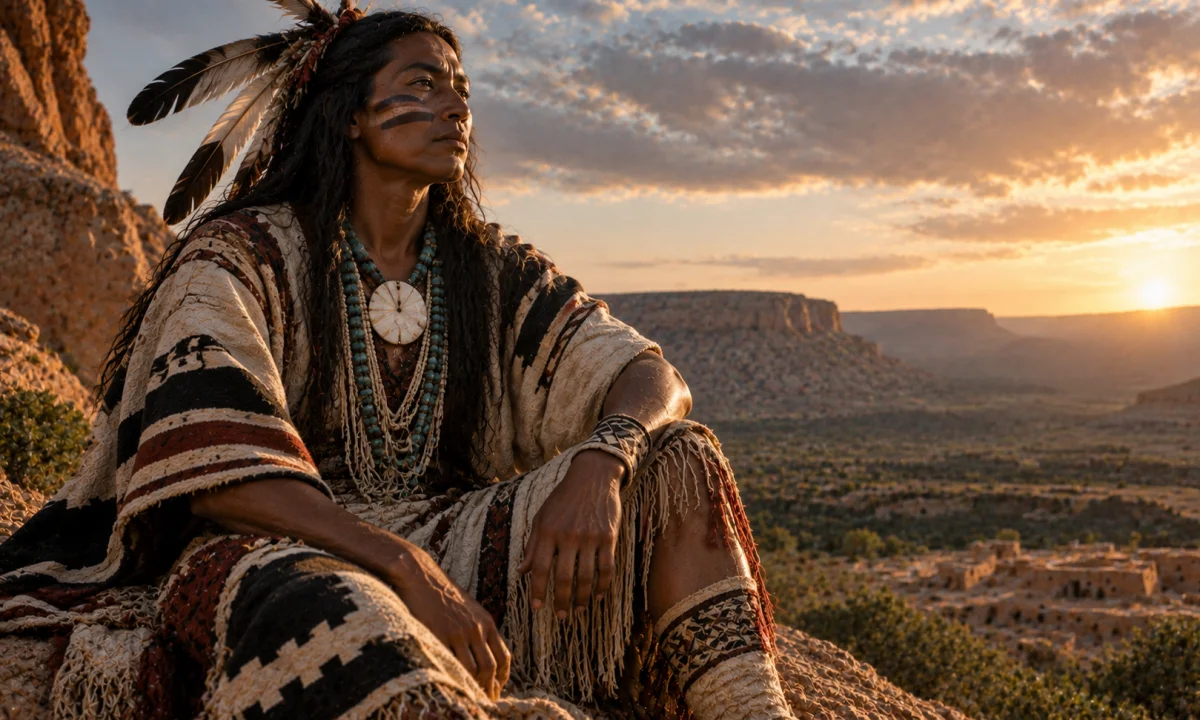
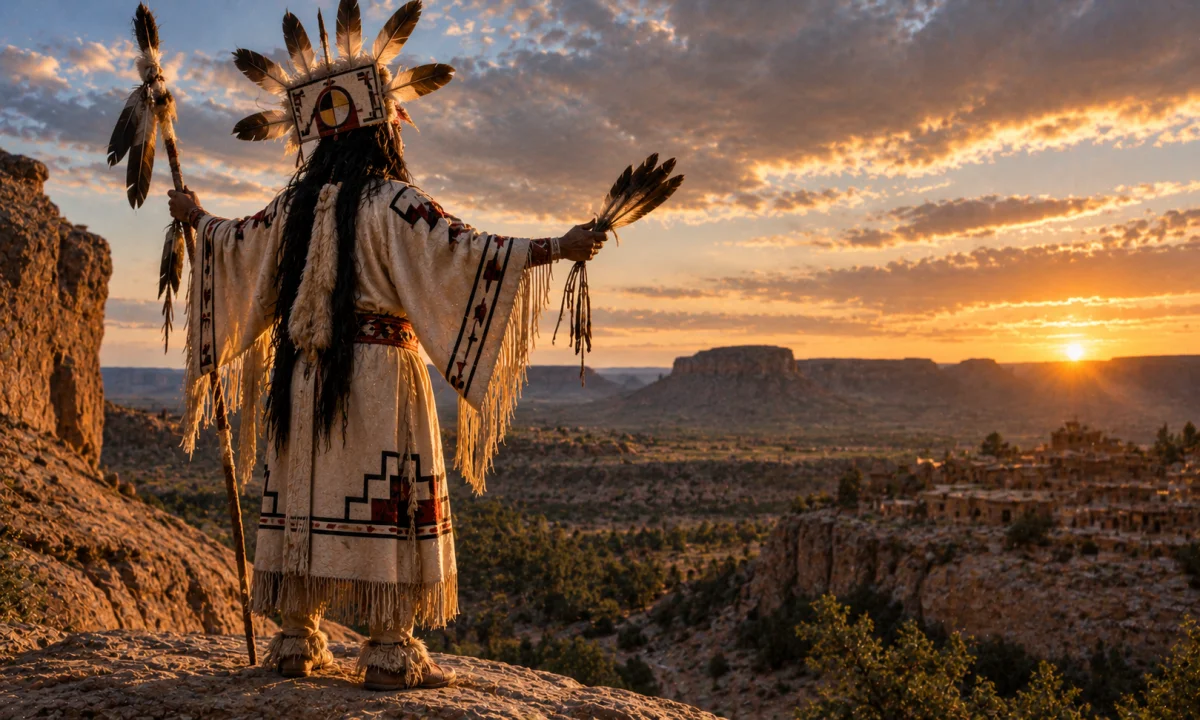
Descriptions of Sotuknang usually emphasize function more than physical appearance. He is not consistently given a detailed body, costume, animal form, or weapon. Images found in modern publications should not automatically be regarded as traditional Hopi representations.
His most important attributes are associated with:
- Cosmic order: Sotuknang arranges the worlds and helps establish the structure in which life can exist.
- Movement and harmony: Some accounts connect him with the coordination of celestial or earthly forces.
- Creation: He works under Taiowa and cooperates with Spider Woman and other beings in preparing the worlds.
- Judgement and renewal: He brings destruction when a world has fallen into serious disorder, allowing a new stage of emergence.
- Communication of sacred purpose: He conveys or carries out the intentions of the higher creative power rather than acting as an isolated, self-created god.
Through these functions, Sotuknang can be interpreted as a figure of ordered creation. His stories express the idea that the universe is not morally neutral. Human actions affect the condition of the world, and survival depends on living in accordance with a wider sacred pattern.
Relationship with Taiowa
Taiowa is generally described in published accounts as the ultimate creator or the power that exists before the ordered universe. Sotuknang is his appointed helper, nephew, or emanation, depending on the source and its translation into English. The relationship is important because it prevents Sotuknang from being understood as the sole origin of everything.
Western labels such as “god,” “angel,” or “demiurge” may offer rough comparisons, but they can also create confusion. Sotuknang is not an angel in Jewish, Christian, or Islamic tradition, and he is not a figure borrowed from those religions. Nor should the term “demiurge” be used as though Hopi cosmology were simply another form of Greek or Gnostic thought. Sotuknang belongs to a specifically Hopi religious framework.
Distinguishing Sotuknang from related figures
Spider Woman
Sotuknang and Spider Woman are sometimes merged in simplified summaries because both are involved in the making of living beings. They are distinct figures in the narratives most commonly published. Sotuknang has a more overtly cosmic and administrative role, while Spider Woman is associated with generative wisdom, life-making, and protection.
Masauwu
Masauwu, also written Masaw or Masau'u in different sources, is another major Hopi religious figure who is frequently confused with Sotuknang. Masauwu is strongly associated with the earth, death, fire, the underworld, and the stewardship of the present world. In some emergence traditions he meets or instructs the people when they arrive in the current world. He is not simply another name for Sotuknang, and the two figures should not be combined.
Taiowa and Tawa
Popular accounts sometimes treat Taiowa and Tawa as identical, while other presentations distinguish them. Tawa is often associated with the sun or with a solar creative power, but the use of these names varies among sources and contexts. Taiowa, Sotuknang, and Tawa should not be rearranged into a fixed family tree without identifying the particular tradition being followed.
Katsinam and “kachinas”
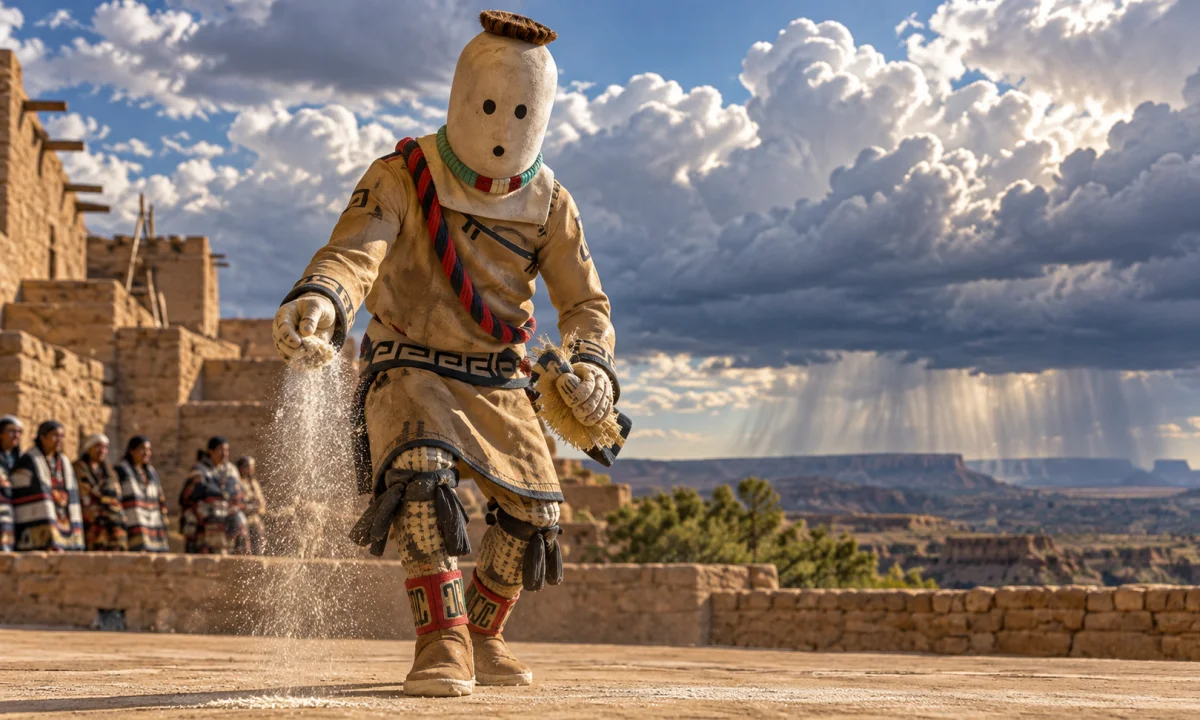
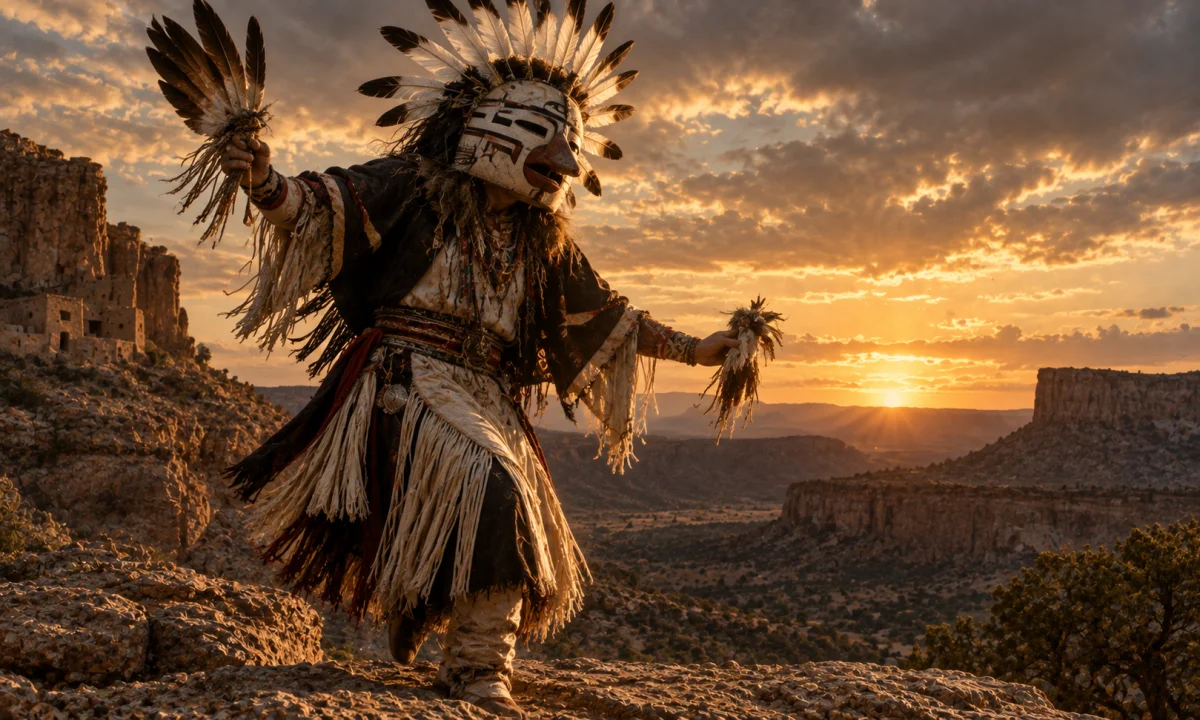
English-language sources sometimes classify every supernatural Hopi being as a “kachina.” The term is imprecise when applied indiscriminately. Katsinam are spirit beings with important ceremonial and social dimensions, and the category includes many different kinds of beings. Sotuknang is more commonly discussed in connection with creation and emergence narratives than as a generic member of the katsina tradition. A broad online label does not establish that he is traditionally understood in exactly the same way as ceremonial katsinam.
Interpretation and cultural significance
The stories associated with Sotuknang are often interpreted as teachings about accountability. The destruction of an earlier world follows a failure of human conduct, not merely a natural accident. People are expected to remember their origins, respect the powers that sustain life, and maintain proper relationships with other people, animals, the land, and the sacred world.
The worlds also express a concept of emergence. Humanity does not simply appear once in a finished universe. It passes through stages, each requiring adaptation and renewed instruction. Movement from one world to another can therefore symbolize maturation as well as survival. The underground refuge of the Ant People, for example, presents the earth as a place of shelter and transformation rather than only a hostile environment.
It is important not to reduce these teachings to a simple environmental slogan or to claim that every detail encodes a literal geological event. Some people may find comparisons with volcanic eruptions, ice ages, floods, or other natural catastrophes suggestive, but such comparisons are modern interpretations. The religious significance of the narratives does not depend on proving that they preserve a scientific record of planetary history.
Modern reception
Sotuknang has had limited presence in mainstream popular culture compared with figures such as Coyote, Raven, or the thunder beings of other Indigenous traditions. His wider recognition largely comes from books, websites, documentaries, and new-age discussions of Hopi cosmology. These presentations often highlight the cycle of worlds, the destruction by fire and flood, or the supposed prediction of a coming global catastrophe.
Such modern treatments frequently detach Sotuknang from Hopi ceremonial life and present him as a universal “space god,” an extraterrestrial being, or an apocalyptic oracle. Those ideas are not established features of the traditional accounts described above. They reflect modern speculation, esoteric interpretation, or popular fiction rather than a neutral rendering of Hopi religion.
A responsible understanding of Sotuknang keeps the figure within the Hopi context: a powerful helper of Taiowa, a participant in the ordering of creation, and an agent in the renewal of worlds. Public accounts remain partial, and differences between sources should be acknowledged rather than smoothed away into a single supposedly canonical biography.